
In June 2025, the FTC ordered Evoke Wellness to pay $1.9 million for misleading ads targeting people in addiction crisis. What they did wasn’t exotic. Evoke ran 68,510 Google search ads using dynamic keyword insertion to impersonate competing treatment centers. Patients clicked, thinking they’d reached their chosen facility. Evoke’s agents were waiting, posing as staff from the clinics the patients believed they’d called.
That’s not a rogue operation. It’s an aggressive version of what many addiction treatment marketing programs do every day: intercept patients at their most vulnerable moment, optimize for call volume, and let the intake team sort out the rest.
The difference? Evoke got caught.
If you’re running addiction treatment marketing with anything resembling that playbook, you need to understand the regulatory framework you’re operating inside, and what it actually demands.
How Most Addiction Treatment Marketing Programs Work
The dominant model is volume-first. Generate as many inbound leads as you can from paid search and paid social. Route them through intake. Verify insurance on the ones that qualify. Admit the fraction that pass.
In practice, that means high-spend Google and Meta campaigns covering every rehab-related keyword. Aggressive retargeting of website visitors through Meta Pixel and Google remarketing. Ad copy that implies superior outcomes. Third-party lead brokers filling gaps in internal campaign volume. Patient data flowing from intake forms into CRM platforms connected to ad audiences.
Drug rehab marketing teams treat this as standard digital marketing. They borrow tactics from healthcare lead generation broadly and drop them into a vertical with a completely different regulatory structure.
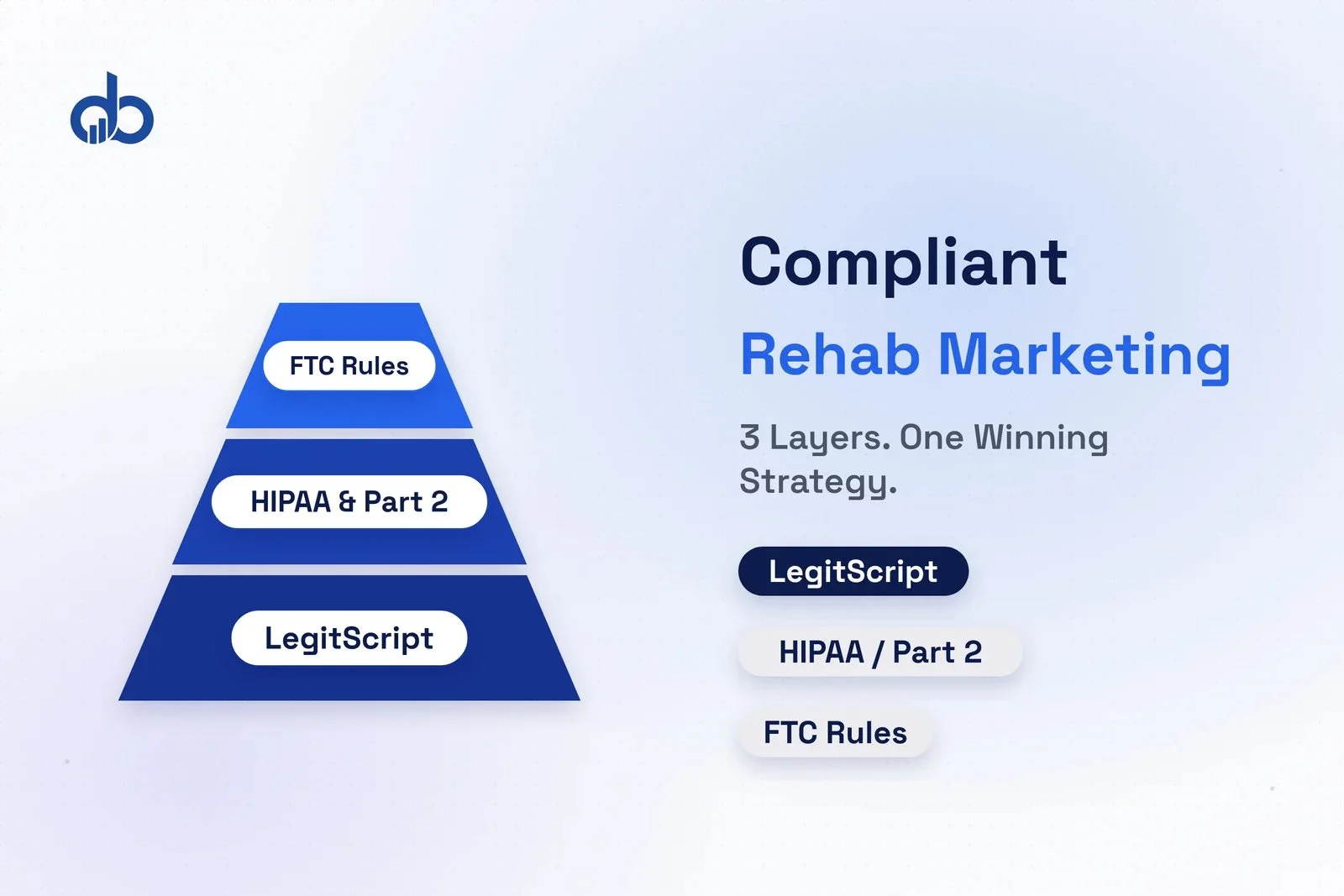
The result is programs carrying compliance exposure across four overlapping frameworks at once: LegitScript certification requirements, HIPAA, 42 CFR Part 2, and FTC advertising rules. Each one governs a different part of the marketing funnel. Together, they make the standard playbook mostly unusable.
Where the Volume-First Model Breaks Down
The cracks show up at every stage of a typical rehab marketing funnel.
Platform access is gated. Since 2018, Google has required LegitScript certification for any addiction treatment advertiser. Meta, Microsoft, and TikTok followed with similar policies. A treatment center without LegitScript certification can’t run paid ads for addiction-related keywords, period. The certification process takes four to sixteen weeks, costs $995 upfront, and runs $1,995 per year to renew. Facilities that try to launch campaigns before completing certification get their accounts suspended. Yet many do exactly this.
Retargeting violates HIPAA. Standard Meta Pixel and Google Analytics implementations capture browsing behavior as visitors move through a website. On a treatment center site, that browsing is likely Protected Health Information under HIPAA. A visitor who reads your detox page, checks your insurance page, and submits a contact form has disclosed health-related intent. Standard pixel implementations send that behavioral data to Meta and Google for audience building. In 2023, HHS Office for Civil Rights settled $4.9 million in HIPAA penalties tied directly to digital marketing pixel practices in healthcare.
42 CFR Part 2 goes further than HIPAA. This regulation covers confidentiality of substance use disorder patient records and is stricter than HIPAA for this patient population. The 2024 Final Rule, with most provisions requiring compliance by February 16, 2026, expanded OCR enforcement authority and tightened marketing disclosure rules. Under Part 2, you can’t use SUD treatment information as an audience signal for retargeting without explicit patient consent. A standard Business Associate Agreement doesn’t satisfy Part 2’s marketing consent requirements. Testimonials, retargeting pixels, alumni outreach, and CRM re-engagement campaigns all need Part 2-compliant consent flows.
FTC enforcement isn’t theoretical. The Opioid Addiction Recovery Fraud Prevention Act gives the FTC civil penalty authority over deceptive addiction treatment advertising. The Evoke Wellness case is what enforcement looks like in practice: 68,510 ads, dynamic keyword insertion to impersonate competitors, agents pretending to be staff from other clinics. The $1.9 million payment came alongside $7 million in suspended fines under both the FTC Act and OARFPA. Any outcome claim without documented substantiation is a potential violation.
And the volume model fails on its own terms. Even without the compliance risk, the economics don’t work. According to Webserv’s 2025 State of Rehab Marketing report, the average cost per lead from paid media is $406. Only 15.9% of those leads complete a verification of benefits. That means 84 out of every 100 paid media leads never become admission candidates. The average cost to convert one paid media lead into an actual admission: $16,608.
Optimizing that funnel for volume is optimizing the wrong thing.
The Three Compliance Layers Every Rehab Marketer Must Know
Compliant addiction treatment marketing is built around three distinct regulatory layers. Each requires a specific operational response.
Layer 1: LegitScript Certification
LegitScript certification is the entry ticket for paid advertising in addiction treatment. Without it, you’re locked out of Google Ads, Meta Ads, Microsoft Advertising, and TikTok for addiction-related keywords. The certification verifies your facility’s licensure, clinical staff credentials, program quality, and marketing ethics standards.
Getting certified means submitting state operating licenses, accreditation documentation, and existing marketing materials for review. The timeline runs four to sixteen weeks. Factor that into your campaign launch plan.
Once certified, you gain access to the full inventory of addiction treatment keywords on major platforms. In a vertical where many facilities delay or skip certification, that’s a genuine competitive edge. Certification gets you through the policy gate, but it doesn’t touch Quality Score, which Google bases on expected CTR, ad relevance, and landing page experience. Certified advertisers who improve those three factors can bring their cost per click down over time.
Layer 2: HIPAA and 42 CFR Part 2
HIPAA compliance for rehab marketing starts with your tracking stack. Standard implementations of Google Analytics 4, Meta Pixel, and third-party chat widgets can capture Protected Health Information when browsing behavior reveals health status. On a treatment center website, that’s almost certain.
Compliant analytics means server-side tracking or HIPAA-certified analytics platforms that don’t send PHI to advertising systems. It means removing retargeting pixels from intake forms, contact pages, and any page where users submit identifying health information. It means signing Business Associate Agreements with every vendor touching patient data: your CRM, your email platform, your analytics tool, your chat provider.
42 CFR Part 2 adds a specific layer for substance use disorder records. Under the 2024 Final Rule, you can’t use SUD patient information as an advertising audience signal without patient-specific consent. Your standard HIPAA BAA structure won’t cover this. Consent flows for testimonials, retargeting, alumni outreach, and CRM remarketing all need to be built to Part 2 standards. Every vendor in your martech stack needs evaluation against Part 2, not just HIPAA.
Layer 3: FTC Advertising Rules
OARFPA gave the FTC civil penalty authority it didn’t have before over substance use disorder treatment marketing. That changes the risk calculus.
In compliant drug rehab marketing, ad copy describes your facility accurately without superlative claims. Outcome claims stay within what you can document. Success rate statistics require a claims substantiation file. Testimonials include disclosure language. Even implied outcome claims, including imagery of happy, recovered patients with no explicit statements, can draw scrutiny.
The practical response: build a claims library before any campaign launches. Every claim in ad copy, on landing pages, or in marketing emails needs a corresponding substantiation document. It’s not just legal protection. It’s the discipline that separates credible addiction treatment marketing from the kind of advertising that ends with an FTC complaint.
Is your current addiction treatment marketing putting you at regulatory risk? Get a free compliance audit from Digiblazon's healthcare marketing team.
Getting Certified Is Not the Same as Being Compliant
This is the part most drug rehab marketing guides miss. They treat compliance as a setup problem. Get LegitScript certified, sign the BAAs, then market normally. The dominant framing: compliance is a barrier to clear at the start, after which you run standard digital marketing.
That framing is wrong.
Compliance in addiction treatment marketing is an ongoing discipline embedded in every campaign cycle, every tracking change, every vendor contract, and every copy review. Certification is table stakes. Operational compliance is the moat.
Think about what ongoing compliance actually requires. Every time you add a new analytics tool or CRM integration, it needs HIPAA and Part 2 review before going live. Every new landing page needs a claims review before traffic runs to it. Every testimonial needs consent documentation. Every email workflow touching patient data needs a consent audit. Every ad creative with an outcome claim needs a substantiation check.
That’s not a checklist you complete once. That’s an operational discipline you build into your team’s workflow.
Here’s the upside: facilities that treat compliance as ongoing discipline tend to run cleaner, more effective campaigns. Documenting claims forces you to make specific, credible assertions instead of vague superlatives. HIPAA-clean tracking forces you to measure what matters: verified leads and admissions, not pixel-based audience proxies. That’s what analytics built for healthcare is designed to surface. LegitScript maintenance keeps your ad accounts running rather than cycling through suspensions and appeals.
The discipline pays for itself.
What the Compliance-First Marketing Stack Looks Like
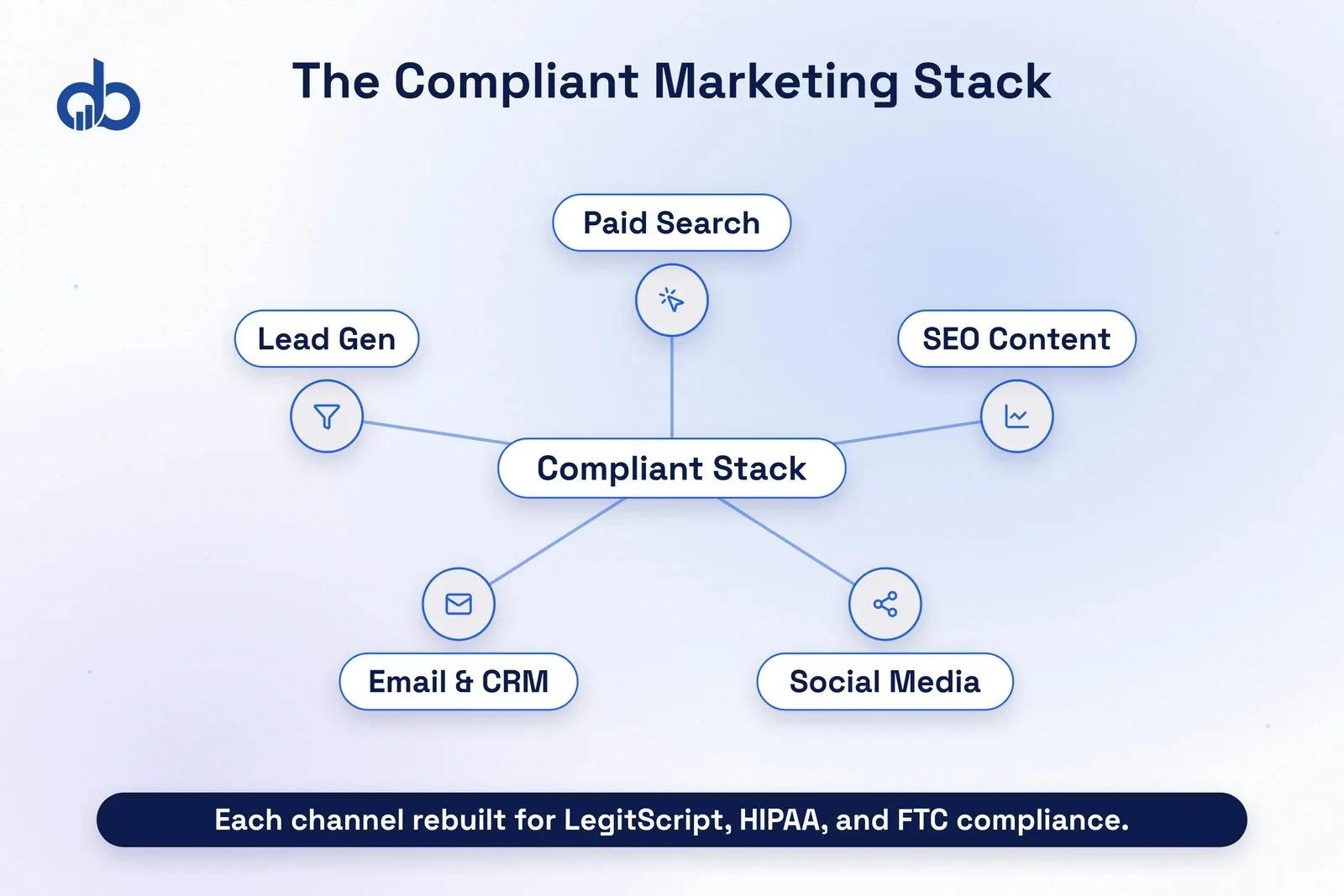
A compliant addiction treatment marketing program isn’t a reduced version of the standard healthcare marketing playbook. It’s a different architecture.
Paid Search. LegitScript-certified campaigns on Google, Meta, and Microsoft targeting high-intent keywords tied to specific treatment types, insurance coverage, and location. Ad copy that describes programs accurately: level of care, accreditations, specific modalities. No implied outcome claims. Landing pages with clear contact paths and no pixel tracking on form submissions. Call tracking through HIPAA-compliant providers.
SEO and Content. Educational content targeting the informational queries that patients and families research during consideration. Condition-specific articles about treatment approaches, detox processes, and how to evaluate a facility. Content built through SEO and organic growth doesn’t require LegitScript and builds durable referral traffic. It also generates higher-intent leads because users who find you through specific informational queries have already done part of the qualification work.
Social Media. Awareness-level campaigns that don’t use health-based audience targeting. Educational content about addiction and recovery rather than direct-response admissions messaging. No retargeting of website visitors unless a Part 2-compliant consent framework is in place. Community building with recovery-adjacent audiences instead of targeting people in active crisis.
Email and CRM. Part 2-compliant consent flows on intake forms and alumni communication workflows. BAAs with your CRM vendor, email service provider, and any platform receiving patient data. No cross-referencing SUD patient information with advertising audiences. Re-engagement campaigns based on patient-consented preferences, not behavioral retargeting.
Rehab Lead Generation. Internal intake funnels over third-party lead brokers. Quality scoring based on verified insurance benefits, not raw contact volume. Measurement frameworks that track cost per verified lead and cost per admission. Effective rehab lead generation isn’t about volume. It’s about building a funnel where the 15.9% verification rate isn’t the ceiling but the starting baseline to improve.
Ready to build a compliant program that actually drives admissions? Digiblazon's performance marketing team works exclusively with regulated healthcare providers. Get Free Marketing Audit
What This Means for Addiction Treatment Centers Right Now
The compliance landscape is tighter now than it was three years ago. The 42 CFR Part 2 Final Rule compliance deadline arrived in 2026. The FTC’s Evoke Wellness settlement in June 2025 was a public signal that OARFPA enforcement is active. The $4.9 million in HIPAA penalties tied to digital marketing practices in 2023 made clear that pixel violations are a real enforcement priority.
Facilities still running volume-first marketing playbooks in this environment are carrying compounding risk. A single HIPAA complaint about pixel tracking can trigger an OCR investigation. A single FTC complaint about a misleading outcome claim can trigger OARFPA scrutiny. An expired LegitScript certification can take weeks to resolve and eliminate paid media during that window.
The opportunity cost of non-compliance is just as real. Every month without LegitScript certification is a month competitors access paid search inventory you can’t touch. Every dollar spent on a non-compliant tracking setup is a dollar not going toward the analytics infrastructure that supports smart marketing decisions.
The facilities winning in addiction treatment marketing right now have treated compliance as a foundation. Not a constraint. Not a one-time setup checklist. A foundation.
Conclusion
Compliant addiction treatment marketing isn’t a restricted version of what you’d otherwise do. It’s a better-performing version. LegitScript certification unlocks inventory competitors can’t access. HIPAA-clean tracking produces data you can trust. FTC-compliant copy converts better than vague superlatives. Effective rehab lead generation starts with the compliance foundation, not volume optimization on a broken funnel. If your current drug rehab marketing program wasn’t built with this compliance stack, Digiblazon’s performance marketing team can help you rebuild it. Get a free marketing audit to see exactly where you stand.
- LegitScript certification is required by Google, Meta, Microsoft, and TikTok before you can run any addiction-related paid ad, and takes four to sixteen weeks to complete.
- Standard Meta Pixel and Google Analytics setups on a treatment center site can send Protected Health Information to ad platforms, exposing facilities to HIPAA penalties.
- 42 CFR Part 2 requires patient-specific consent before using substance use disorder information as a retargeting or advertising audience signal, beyond what a standard HIPAA BAA covers.
- FTC enforcement under OARFPA is active: outcome claims, testimonials, and superlatives all need documented substantiation.
- Only 15.9% of paid media leads in rehab marketing complete a verification of benefits, making lead quality a bigger lever than lead volume.
- Compliance is an ongoing operational discipline embedded in every campaign, tracking change, and vendor contract, not a one-time certification checklist.
Frequently Asked Questions
How do addiction treatment centers advertise legally?
Legal addiction treatment advertising requires LegitScript certification for all paid media on Google, Meta, Microsoft, and TikTok. Ad copy must comply with FTC rules: all outcome claims must be substantiated, testimonials must include disclosures, and superlatives require documented evidence. Website tracking must be configured to avoid sending Protected Health Information to advertising platforms. Substance use disorder patient data can't be used for retargeting without explicit patient consent under 42 CFR Part 2.
What is LegitScript certification for rehab?
LegitScript is an independent certification body that verifies addiction treatment facilities meet standards for licensure, clinical quality, and ethical marketing. Google, Meta, Microsoft, and TikTok require LegitScript certification before approving ads for addiction treatment keywords. The certification costs $995 upfront and $1,995 per year to maintain. Approval takes four to sixteen weeks and requires documentation of state licenses and accreditations, plus a review of your marketing materials.
What is patient brokering in addiction treatment?
Patient brokering is paying kickbacks to refer patients to a treatment facility. It's illegal under federal law and most state statutes. In marketing, it typically shows up as third-party lead brokers who charge per-lead fees for referrals. While not all lead generation is illegal, arrangements where a broker receives a fee tied to patient admissions are generally unlawful. The FTC has flagged patient brokering-adjacent practices in several enforcement actions.
Is HIPAA required for rehab marketing?
Yes. Treatment centers that are HIPAA-covered entities must apply HIPAA protections to all digital marketing systems handling patient data. This includes website analytics, CRM platforms, email marketing tools, and chat widgets. For substance use disorder treatment specifically, 42 CFR Part 2 adds restrictions beyond standard HIPAA. The 2024 Part 2 Final Rule compliance deadline was February 2026. Facilities that bill Medicare, Medicaid, or accept federally regulated insurance and treat SUD patients are almost certainly covered by Part 2.
What are the FTC rules for drug rehab advertising?
The FTC regulates drug rehab advertising under the Opioid Addiction Recovery Fraud Prevention Act (OARFPA). Key rules: all outcome and success rate claims must be substantiated with reliable data; testimonials must represent genuine patient experiences with appropriate disclosures; superlatives like "best" and "most effective" require evidence; impersonating another facility is a specific violation. The FTC settled a $1.9 million case against Evoke Wellness in June 2025 for exactly that. Civil penalties apply under OARFPA.
How do I get more admissions to my treatment center?
The most effective path to more admissions is improving lead quality rather than lead volume. Only 15.9% of paid media leads in rehab marketing complete a verification of benefits. Programs combining LegitScript-certified paid search with organic SEO content targeting patients in the research phase generate fewer but higher-converting leads. Internal intake funnels consistently outperform third-party lead brokers on cost per verified admission. Start by measuring cost per verified lead, not cost per raw lead. That single change will show you where your funnel is actually losing patients.