
The average Google Ads search query now runs 9 to 10 words long. In 2022, it was 2.8 words. That shift is driven by voice search and AI-assisted queries, and it’s quietly broken a core assumption behind most PPC campaign structures.
Google reports that 27% of online users globally now use voice search on mobile. That traffic is entering your campaigns through broad match, phrase match, and Performance Max, whether you designed for it or not. The question isn’t whether voice search is in your data. It’s whether those queries are converting or draining budget.
Most voice search optimization guides focus on one side of the problem: how to capture more voice traffic. They recommend conversational keywords, natural-sounding ad copy, and call extensions. But they don’t cover what happens when you run that traffic without the budget controls to filter out low-intent spoken queries. Voice search optimization for Google Ads campaigns is a two-sided discipline. The 7 steps below cover both sides.
What Your Google Ads Account Needs Before You Optimize for Voice
Before restructuring campaigns for voice search, confirm these are in place. Skip this step and you’re layering voice tactics onto a misconfigured account. That amplifies waste rather than fixing it.
Before You Start: Account Readiness Checklist:
- Search term report access at the campaign and ad group level (not just the account summary view)
- Call conversion tracking configured as a primary conversion event with a forwarding number and 30-second minimum duration
- Smart bidding active on target campaigns: Target CPA, Target ROAS, or Maximize Conversions with a target
- Match type audit complete: no broad match running without smart bidding active
- Performance Max asset group insights enabled if PMax campaigns are running
- Google Business Profile connected and verified for local campaigns
If your call conversions aren’t set as primary, or if any campaign runs broad match with manual CPC, fix those before adding a single conversational keyword. Voice queries on broad match without smart bidding have no guardrails. They’ll match to everything.
Way 1 — Audit Your Search Term Report for Voice Traffic Patterns
Before adding any new keywords, look at what voice search is already sending. Most accounts have weeks or months of voice-originated queries sitting in their search term report, unreviewed. And most teams never look at them. That’s real budget data sitting idle.
Open the STR at the campaign level. Filter by query length: anything with 7 or more words is likely voice-originated or AI-assisted. Look for question starters: “what is,” “how do I,” “where can I find,” “which is the best,” “near me that.” These patterns are distinctive. Typed queries don’t look like that.
Sound familiar? Here’s what to do with it. Sort the filtered results by cost and conversion rate. Three groups will emerge.
The first group is high-spend, low-conversion: long informational queries like “what is search engine optimization and how does it work.” These are voice users in research mode, not buying mode. They’re budget waste and should become negatives.
The second group is conversional: queries like “best Google Ads agency near me for ecommerce brands.” These should be added as phrase match keywords in a dedicated ad group, not left to broad match.
The third group is local intent: “open now,” “near me,” “in [city],” spoken from a phone with GPS active. These deserve their own bidding adjustment and location targeting configuration.
Running Google Ads but never reviewed your STR for voice traffic? Get Free Marketing Audit
Way 2 — Rebuild Your Keyword Strategy Around Conversational Phrases
Voice search optimization starts with accepting that the keyword structure that works for typed queries doesn’t work for spoken ones. Exact match captures very little voice traffic. Voice queries vary too much in phrasing for exact match to be reliable. And broad match captures voice queries, but without smart bidding guidance, it captures the wrong ones.
The practical approach is to build phrase match keywords constructed as full intent statements rather than short fragments.
For a Google Ads management agency, the typed keyword is “Google Ads agency.” The voice-equivalent phrase match keyword is “best Google Ads agency for ecommerce” or “which Google Ads company handles small business accounts.” Same intent. Completely different phrasing.
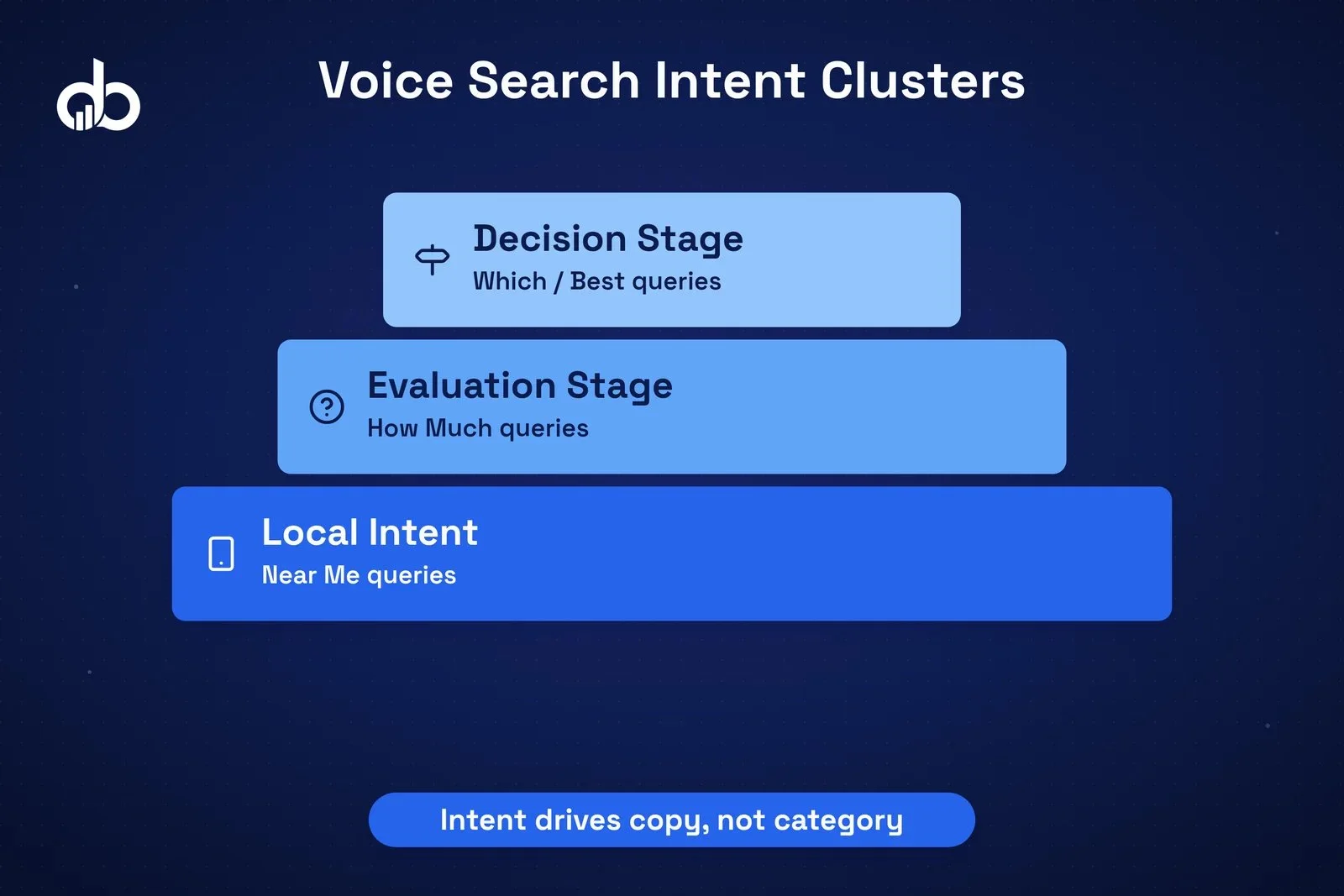
Organize voice keywords into intent clusters rather than topic groups. Decision-stage queries (“which agency should I choose for Google Ads”) need different ad copy and landing pages than evaluation queries (“how much does Google Ads management cost”) or local queries (“Google Ads consultant near me”). Grouping by intent at the ad group level lets you write copy that answers the specific spoken question. That’s what voice-intent copy requires.
The keyword research process also changes. People Also Ask boxes are the best proxy for voice query structure. PAA questions are written the way people speak. Every PAA question relevant to your product category is a potential voice phrase match keyword.
When building voice keywords, resist the urge to organize by topic ("bidding," "campaigns," "targeting"). Voice searchers don't think in topics. They think in situations: "I'm a small business owner who can't figure out why my Google Ads are costing too much." Build ad groups around the situation, not the category. Situation-based grouping lets you write copy that speaks to the exact moment the query happened, and that's what gets the click.
Way 3 — Write Ad Copy That Answers the Question
Voice users ask a question. The ad should answer it. That’s the entire principle of voice-oriented ad copy, and most Responsive Search Ads aren’t built this way.
The standard RSA approach loads headlines with keywords and benefit statements. “Google Ads Management Services — Measurable ROI — Book a Free Audit.” That headline structure answers nothing. A voice user who asked “which marketing agency is best for my small business” reads that headline and can’t tell whether the answer applies to them.
So what does voice-optimized copy actually look like? Voice-optimized Responsive Search Ad (RSA) copy mirrors the question in the headline, then answers it.
Headline 1 (pinned): “Top-Rated Ads Management for SMBs”
Headline 2: “25+ Active Clients. 4.9/5 Rating.”
Headline 3: “Free Marketing Audit — No Lock-In”
The pinned Headline 1 reflects the conversational query. Headline 2 provides proof. Headline 3 provides action. A voice user scanning search results on a mobile device can process that in under two seconds.
Landing page match matters as much as the headline. Voice queries frequently originate from mobile devices. If the landing page takes longer than two seconds to load on mobile, or if the message on the page doesn’t match the spoken intent, the conversion rate drops regardless of how good the ad is. Voice optimization doesn’t end at the ad.
Way 4 — Calibrate Smart Bidding for Voice-Driven Conversions
Smart bidding optimizes toward the conversion signals you give it. If the only signal is web form submissions, it learns to find users who fill out forms. Voice search users convert differently: they call rather than fill forms. If calls aren’t configured as a primary conversion, smart bidding will chronically undervalue voice-driven sessions.
The fix is to give smart bidding complete conversion data. Set call conversions as a primary conversion action alongside form fills. Assign a conversion value to phone calls based on actual lead quality data. If your analysis shows phone leads close at twice the rate of web form leads, set the call conversion value at twice the form conversion value. Smart bidding will allocate budget toward the signal that produces the higher value conversion (which for voice-heavy campaigns is usually the phone).
Here’s where it gets interesting. Smart Bidding Exploration testing by Google showed an 18% increase in unique search query categories with conversions and a 19% lift in overall conversions for accounts using this feature. The mechanism is exactly this: bidding on a richer signal set captures intent patterns that narrow keyword targeting misses.
For Performance Max campaigns, monitor asset group insights for which assets drive call versus form conversions. Voice-originated sessions tend to cluster around mobile call assets and local inventory ads. If PMax is generating calls at high cost but not attributing them to the campaign’s learning, the campaign structure needs a call value adjustment. Proper conversion signal configuration is also where Analytics & Tracking setup becomes directly relevant: granular attribution data is what lets smart bidding distinguish high-value call sessions from low-value click-throughs.
Your smart bidding may be optimizing toward the wrong conversion type. Get Free Marketing Audit
Way 5 — Build a Voice-Specific Negative Keyword List
This is the step most guides skip. It’s also the step with the largest direct impact on ROAS for accounts running broad match or Performance Max. (That’s not a small distinction.)
Voice search creates noise in the search term report. Not all conversational queries reflect buying intent. Many voice queries are research, curiosity, or ambient: the digital equivalent of asking a question without wanting an ad answer. They’re long, they look like intent signals to the matching algorithm, and they drain budget.
A voice-specific negative keyword list filters these out. It’s different from a standard negative keyword list because it targets query patterns that appear only in spoken searches.
Build the list across three categories.
Category 1: Informational queries with no commercial intent:
“what is,” “explain,” “definition of,” “history of,” “how does work,” “what does mean.” These appear constantly in voice STRs for advertising-adjacent topics like search engine optimization, Google Ads bidding, and digital marketing trends.
Category 2: Wrong-stage queries:
“how to do it yourself,” “free alternative to,” “how to learn,” “DIY guide for,” “tutorial on.” A user asking “how to run Google Ads myself” isn’t buying agency services.
Category 3: Wrong-audience queries:
“for students,” “for nonprofits,” “for beginners,” “how to start with no money.” If your offer requires a minimum ad budget, these queries represent zero-conversion traffic regardless of how many sessions they generate.
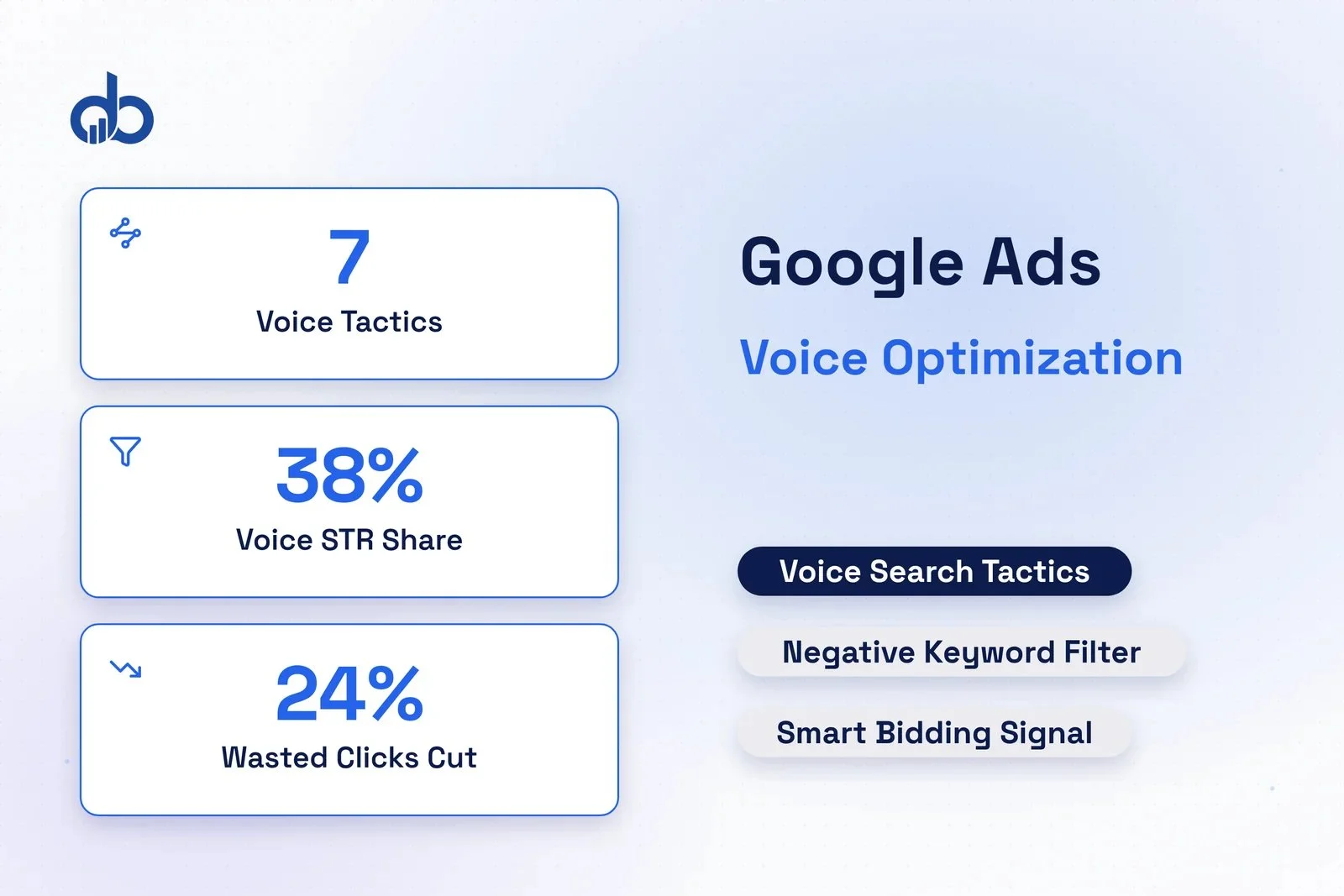
One of our Performance Marketing clients (a B2B SaaS company running broad match) found that 38% of their search term report volume came from 7+ word queries. After implementing a voice-specific negative keyword list as part of their voice search optimization process, irrelevant click volume dropped by 24% within 45 days with no reduction in conversion volume. The negative list is where this discipline pays off directly.
In Performance Max, the March 2025 update raised the negative keyword limit from 100 to 10,000 per campaign. Use the capacity. Build a dedicated voice-specific exclusion list, push it to PMax negative keywords, and review it weekly. Voice query patterns shift as assistant capabilities evolve: a list built in January will be incomplete by July.
Common questions we hear on calls:
“How do we know which queries are actually voice-originated? Google Ads doesn’t label them.”
You can’t tell with certainty, but you don’t need to. Any query with 7 or more words that starts with “what,” “how,” “which,” or “where” is almost certainly voice-originated. Run a filter in your STR by query length and look for the question-starter pattern. If 15-30% of your long query volume is informational and unconverted, you have a voice noise problem regardless of the technical source.
“We’re already running smart bidding on Target CPA. Won’t it figure this out on its own?”
Not fast enough. Smart bidding learns from what you signal as valuable. If you haven’t explicitly set call conversions as primary, the algorithm is learning from incomplete data. A voice-specific negative list gives it faster, cleaner signal by removing queries that would never convert anyway. Target CPA handles optimization within the signal you give it. You still have to give it the right signal.
Way 6 — Activate Call Extensions and Track Phone Calls as Primary Conversions
Voice users call. This is the most consistent behavioral difference between voice-originated and typed sessions. A user who spoke a query into their phone is already holding the device. The barrier to calling is zero.
Call assets (formerly call extensions) should be active on every campaign targeting audiences who are likely to use voice search. For local service businesses, this is non-negotiable. For B2B advertisers targeting decision-makers, it’s equally important: senior buyers are more likely to call than complete a web form.
Configure call assets to show during business hours only. A call extension active at midnight generates a click without a conversion opportunity. Scheduled call assets ensure the extension surfaces when someone’s available to answer.
Google forwarding numbers allow call duration tracking. Set a 30-second minimum for primary conversion counting and a 60-second minimum for high-quality lead conversion counting. Feed both values into smart bidding as separate conversion actions with different values. This gives the algorithm granular signal quality data: not just “a call happened” but “a call that lasted long enough to be substantive.”
When configuring call conversion values, use your actual lead quality data, not an estimate. If your CRM shows phone leads close at twice the rate of web form leads, set the call conversion value at twice the form value. Smart bidding will then allocate budget toward the signal that produces higher-value outcomes, which for voice search optimization campaigns is almost always the inbound call. Revisit and adjust this ratio quarterly as your conversion data accumulates.
For local campaigns, consider call-only ads for mobile ad groups targeting “near me” voice queries. Call-only ads remove the website visit step entirely. For a user who asked “plumber near me open now,” a call-only ad is a direct answer.
Way 7 — Use Location Targeting to Capture Local Voice Intent
76% of voice searches include local intent: phrases like “near me,” “open now,” “closest,” “best [service] in [city].” This is the highest-converting segment of voice traffic for most businesses. It’s also the most commonly misconfigured.
Local voice optimization in Google Ads requires three configurations working together.
Bid adjustments by proximity: Increase bids for users within your service radius. For most local service businesses this is 5 to 15 miles. Users who are close and asking about your service category convert at meaningfully higher rates than users researching from across the city. A 15 to 30% bid uplift for proximity is a reasonable starting point, calibrated against your conversion rate data.
Location assets active: Google Business Profile data feeds directly into location assets in Google Ads. Keep GBP updated: business hours, address, phone number, service categories. When a voice assistant pulls local business data to answer a query, it reads from GBP. If that information is outdated, local voice traffic may not reach your ads at all.
Dayparting for local voice peaks: Local voice searches spike on weekday evenings (5 to 7 PM) and weekends. Run higher bids during these windows for local campaigns. Reduce bids during business hours on weekdays when local intent voice searches drop relative to the research-mode queries that dominate daytime use.
Three Voice Search Mistakes That Drain Google Ads Budgets
Mistake 1: Broad match without smart bidding active. Voice queries on broad match without Target CPA have no optimization signal. The algorithm matches spend to volume, not to intent. Query lengths averaging 9-10 words mean enormous surface area for irrelevant matches. This combination is the fastest way to double cost-per-lead without understanding why.
Mistake 2: Treating call conversions as secondary. If form fills are primary and calls are secondary, smart bidding deprioritizes call-driving ad variations. Voice search campaigns optimize toward what the system measures as success. If calls are invisible to the algorithm, voice traffic won’t generate calls, even when the campaign targets voice-heavy keywords.
Mistake 3: Never refreshing the negative keyword list. Voice assistant capabilities evolve quarterly. New query patterns emerge as assistants improve at interpreting complex spoken queries. Staying current with digital marketing trends (particularly how conversational AI is reshaping search behavior) is part of what keeps voice search optimization effective over time. A negative keyword list built when the campaign launched will miss the patterns appearing in the STR now. Weekly STR review and monthly negative keyword additions aren’t optional for campaigns with significant voice traffic exposure.
Voice Search Is Already in Your Campaign Data — Start Managing It
The gap between accounts built for 2026 query patterns and those still running the 2022 playbook shows up directly in ROAS: real search term data generating real conversions or real waste.
Weekly STR audits, negative keyword refreshes, and call conversion value calibration require consistent attention. That’s what our Performance Marketing service delivers: account-level voice search optimization as standard, not a one-time audit. Start with a Free Marketing Audit to see exactly what your STR says about your voice traffic.
- Voice queries now average 9–10 words — your existing match types are capturing this traffic whether you planned for it or not, making a regular STR audit non-negotiable.
- Build phrase match keywords as full intent statements ("best Google Ads agency for ecommerce"), not short fragments — voice searchers phrase queries as situations, not topics.
- Ad copy that mirrors the spoken question and answers it directly outperforms generic benefit-statement headlines for voice-driven sessions.
- Set call conversions as a primary conversion action with an accurate value — smart bidding undervalues voice traffic if phone calls aren't signaled correctly.
- A voice-specific negative keyword list (targeting informational, wrong-stage, and wrong-audience queries) is the highest-impact ROAS improvement for accounts running broad match or Performance Max.
- 76% of voice searches carry local intent — proximity bid adjustments, accurate Google Business Profile data, and dayparting for evening/weekend peaks are required for local voice campaigns.
- The three most common voice search mistakes — broad match without smart bidding, secondary-only call conversions, and static negative keyword lists — each independently drain budget at scale.
Frequently Asked Questions
Does voice search work differently in Google Ads than in organic SEO?
Yes. Voice search affects Google Ads through match types and the search term report rather than keyword rankings. In organic SEO, you optimize content structure for voice answers. In Google Ads, you manage keyword strategy, negative keyword lists, and bid adjustments to capture high-intent voice queries while filtering out low-intent conversational noise. Both disciplines require conversational keyword targeting, but the execution is entirely different.
Should I create separate campaigns specifically for voice search?
Not necessarily. Voice queries aren't tagged as voice in Google Ads. You identify them by their length and conversational structure in the search term report. A better approach is to layer voice optimization onto your existing campaigns: add question-based phrase match keywords, build a voice-specific negative keyword list, and ensure call extensions are active. Separate campaigns can be useful for local intent targeting, but they're not required for effective voice search optimization.
How do I know if voice search is already affecting my campaign performance?
Open your search term report and filter queries by length. Any query with 7 or more words is likely voice-originated or AI-assisted. If you see a pattern of long conversational queries (especially question-based ones starting with "what," "how," "where," or "which"), voice search is already in your data. Check whether these queries are converting at the same rate as your shorter typed queries. If conversion rates are significantly lower, you have a voice traffic quality problem.
What call bidding strategy works best for voice-driven Google Ads campaigns?
Set up call conversions as a primary conversion action and use Target CPA bidding calibrated specifically for call conversion value. Voice searchers call at significantly higher rates than text searchers. If you're still counting only form submissions as conversions, your smart bidding algorithm is undervaluing voice traffic. Add a call conversion with a value that reflects the average lead quality of a phone inquiry versus a web form, and let Target CPA optimize against both.