
Why Most Negative Reviews Don’t Get Removed
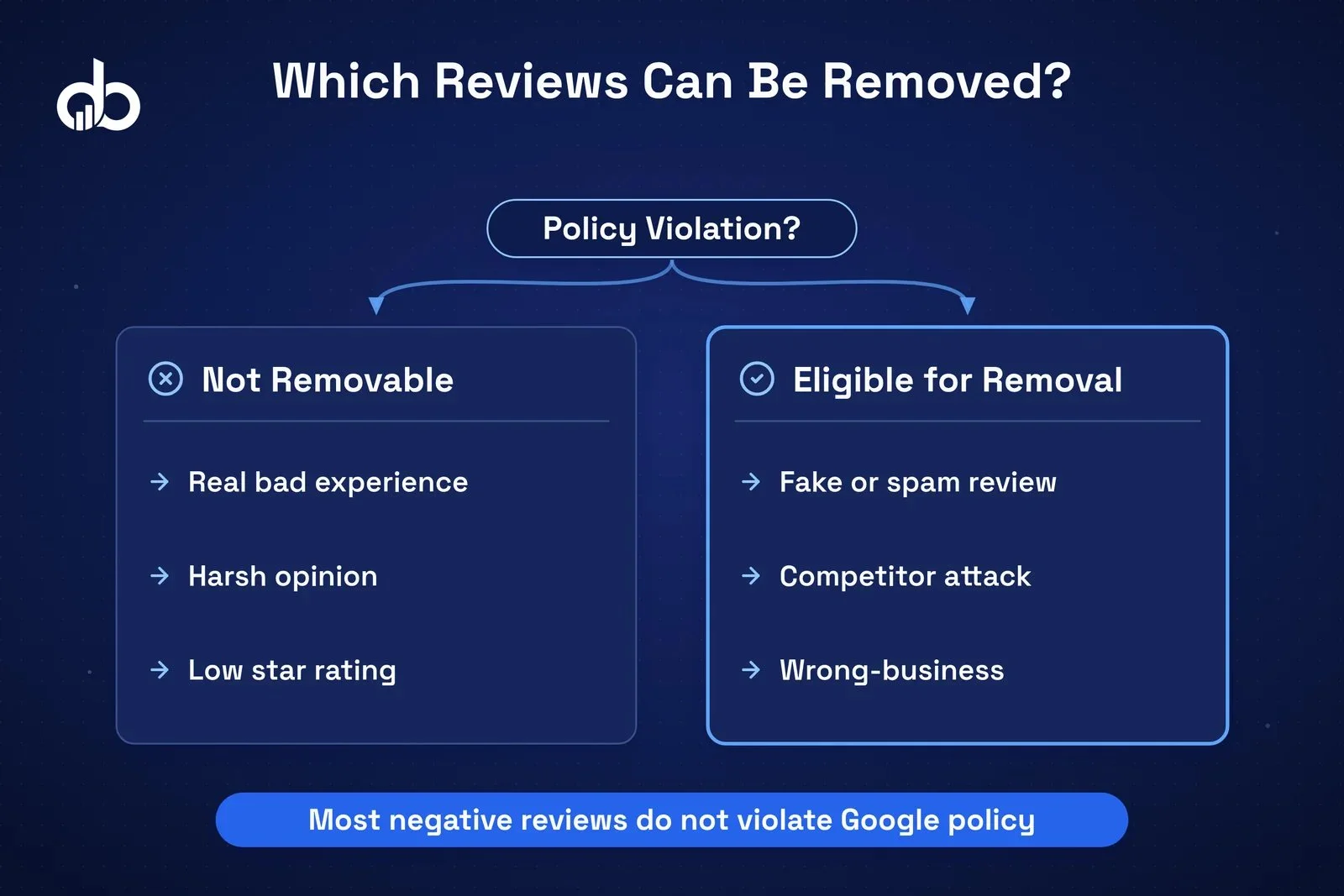
Google’s content policy is not a grievance policy. It doesn’t protect businesses from bad experiences. It protects users from fake or harmful content. That distinction matters more than almost anything else in this topic, because it means most legitimate negative reviews (even unfair ones, even reviews you disagree with) are not removable.
Here’s what Google will remove:
- Spam and fake content: Reviews from accounts that never interacted with your business, multiple reviews from the same IP, or reviews that appear in coordinated bursts tied to a paid campaign
- Conflict of interest: Reviews from current or former employees, competitors, or anyone with a demonstrable personal grudge unrelated to a genuine customer experience
- Prohibited content: Harassment, threats, hate speech, profanity, explicit content, or personal attacks on named staff members
- Off-topic or promotional: A reviewer advertising another business, promoting their own service, or posting content with no connection to your business
- Wrong business or location: A genuine customer who confused your location with another, especially common with franchises or businesses sharing a name
Here’s what Google won’t remove:
- A bad experience that genuinely happened, even if you disagree with the customer’s version of it
- Low star ratings with minimal or no text explanation
- Negative opinions, even harsh ones, as long as they’re not provably false factual claims
- Reviews you consider unfair, exaggerated, or one-sided
- Content that’s unprofessional in tone but still describes a real interaction
The distinction that trips most businesses up: there’s a meaningful difference between opinion and false factual claims. “The food was terrible and the service was slow” is an opinion. Not removable. “This restaurant was cited for a health code violation last month” is a factual claim. If it’s false and you can prove it, you have grounds. If it’s an opinion, you don’t.
Of the 292 million reviews Google removed in 2025{:rel=“nofollow”}, the vast majority were fake positives caught by its Gemini-based spam detection systems, not negative google reviews sitting on legitimate business profiles. For businesses trying to remove a genuine complaint, the success rate for google review removal is considerably lower than those aggregate numbers suggest. Most negative google reviews stay up because they describe something real.
When Google Review Removal Actually Works
There are five scenarios where google review removal has a realistic chance of success. Knowing which one applies before you start flagging is half the process; it’s also the step most business owners skip when removing a bad review from google becomes urgent.
Scenario 1: Spam or Fake Review
The reviewer has no history of interactions with your business. Their account is brand-new or inactive. You’ve received multiple reviews in a short period from similar accounts. The review content is generic, uses templated language, or reads like it was written by someone who’s never visited your city.
What to gather: Screenshots of the review with timestamp, CRM or booking records showing no corresponding customer, screenshots of the reviewer’s account history if publicly visible.
Realistic outcome: Moderate-to-good. Google’s spam detection has improved significantly in 2025 and 2026. Coordinated review attacks are harder to sustain than they were two years ago.
Scenario 2: Competitor or Conflict-of-Interest Attack
The reviewer is a known competitor, a former disgruntled employee, or someone with a verifiable personal connection that isn’t a customer relationship.
Sound familiar? This one comes up constantly with local businesses.
What to gather: Screenshots linking the reviewer’s public profile to the competitor, employment records, any direct communication that demonstrates the personal relationship.
Realistic outcome: Low-to-moderate. “I believe this person is a competitor” isn’t the same as documented proof. Strong evidence significantly improves your chances on appeal.
Scenario 3: Wrong Business or Wrong Location
A real customer had a genuine bad experience. Just not with you. They confused your location with a similarly named business, a franchise across town, or a business that occupied your space before you did.
What to gather: Booking records, receipts, or order history showing the reviewer has no transaction with your location. The reviewer’s own text often contains clues: wrong address mentioned, wrong product or service described.
Realistic outcome: High. If you can document the case clearly, this is one of the stronger grounds for successful removal.
Scenario 4: Prohibited Content
The review contains explicit threats, hate speech, harassment directed at named staff, or sexually explicit language.
What to gather: Screenshot the full review immediately: prohibited content can be edited by the poster before Google acts. Document the specific language and which policy it violates.
Realistic outcome: High for clear-cut cases. Google’s automated systems often catch explicit violations within 24-48 hours{:rel=“nofollow”}. Human review consistently agrees on obvious cases.
Scenario 5: Off-Topic or Promotional
The “review” is actually an advertisement for another business, an unrelated complaint about something outside your control, or content that has nothing to do with a customer experience at your location.
What to gather: The review text itself, showing it doesn’t reference your business, product, or services.
Realistic outcome: Moderate. Automated systems are less reliable here than they are for spam detection, but well-documented off-topic reports get solid results on human review.
How to Flag a Review and What to Do the Moment You Submit It
The flagging process is straightforward. Here’s how to remove bad reviews from Google My Business using the built-in tools:
Step 1. Open Google Business Profile Manager{:rel=“nofollow”} and log in to your account.
Step 2. Navigate to your business location, then select “Reviews” from the left-hand menu.
Step 3. Find the review you want to flag. Click the three-dot menu icon on the right side of the review.
Step 4. Select “Flag as inappropriate” (or “Report review,” depending on which version of the interface you’re on).
Step 5. Choose ONE reason from the list. Pick the most accurate match. Submitting multiple reports with different reasons signals to Google that you’re casting around for any viable violation rather than citing a genuine one. And that works against you.
Simple. But critical.
Step 6. Submit. Note your confirmation number or take a screenshot of the submission confirmation.
Standard removal requests are processed within 3-5 business days. Clear violations caught by automated systems often resolve in 24-48 hours.
Now, the part most people skip:
- Prepare your documentation package. Screenshot the review with date and timestamp. Pull CRM records, booking confirmations, or delivery receipts that are relevant. If the review shows signs of being from a fake account, screenshot the reviewer’s profile activity.
- Draft a professional public response. Don’t wait for Google’s decision. Respond to the review within 24 hours regardless of whether removal succeeds. Your response is visible to every potential customer reading your profile. (Don’t overthink it.)
- Record the outcome. If Google removes the review, note what worked. If denied, you’re ready for the escalation path.
Before you flag, run a quick documentation check. If you can't answer "who is this reviewer and why does this review violate policy X specifically?" you're not ready to flag yet. Flags submitted without documentation are rejected at a much higher rate than those accompanied by screenshots and records.
The 3-Step Escalation Ladder When Google Says No
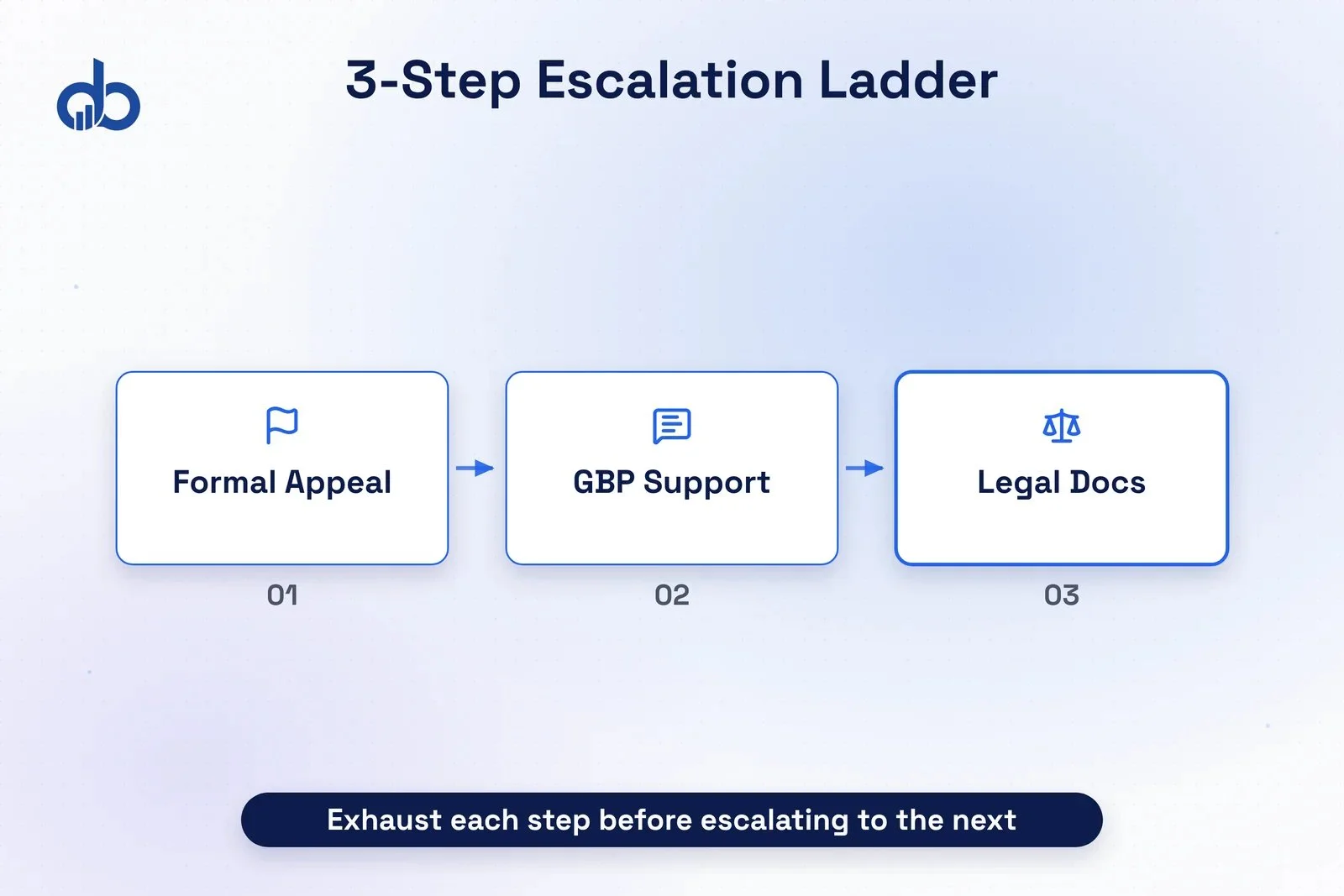
If your flag is denied, you have exactly three escalation moves before you’ve exhausted Google’s internal process. Each has a specific trigger, a different decision-maker, and a realistic outcome range.
Step 1: Formal Appeal (Reviews Management Tool)
This is your most important escalation move. Most business owners skip straight past it.
After a flag is denied, go to Google’s Reviews Management Tool{:rel=“nofollow”}. Scroll to the bottom of the page and select “Appeal eligible reviews.” Find the denied review and walk through the appeal form.
Fill it out with maximum specificity: exact review text, reviewer name, posting date, which specific policy you believe it violates, and every piece of evidence you gathered. Here’s the key difference between the initial flag and the appeal: humans review appeals{:rel=“nofollow”}, not the automated system that rejected your original flag. Automated systems miss context. Humans can read documentation.
Timeline: 3-7 additional business days after submission.
Realistic outcome: Your best chance of overturning a denial, especially if the original rejection was by automation and your evidence is strong.
Step 2: Google Business Profile Support (Human Escalation)
If the appeal is also denied, contact Google Business Profile Support directly.
In GBP Manager, click “Support” at the bottom left. Choose chat (fastest for a human response) or phone support. Have ready: your original flag confirmation number, your appeal case number, and a concise summary of the violation and your evidence. Ask specifically for a “manual review of policy violation.”
Timeline: Same-day for chat support; variable for phone.
Realistic outcome: Lower probability than the formal appeal, but worth the attempt for genuine violations. Support contacts are most effective for clear-cut cases.
Step 3: Legal Documentation (for Provable Defamation Only)
If Steps 1 and 2 are exhausted and the review contains provably false statements of fact (not negative opinions, but specific factual claims you can prove are untrue), consult a defamation attorney.
A court order naming the specific review is the one submission Google consistently acts on{:rel=“nofollow”}. The path to it: consult an attorney, determine if the content meets the defamation standard (false statement of fact, not opinion or hyperbole), file a John Doe lawsuit if the reviewer is anonymous (this compels Google via subpoena to identify the reviewer), and once a court order is obtained, submit it for review removal.
Timeline: Weeks to months, depending on jurisdiction and case complexity.
After Step 3, you’ve exhausted Google’s internal process. If the review remains and isn’t defamatory, it’s time to shift focus entirely.
What to Do When Removal Isn’t Going to Happen
For legitimate negative reviews (a bad experience that genuinely occurred), removal is almost never available. That’s not a failure of the process. It’s the process working exactly as designed.
One of our local restaurant clients received a scathing one-star review after a private event went wrong. The complaint was real. The customer was unhappy. The review didn’t violate any policy. Rather than pursuing a removal that had no chance of succeeding, we focused on building a response strategy and accelerating review volume. Within 90 days, the profile had 47 new reviews and the one-star was no longer visible in the aggregate without specifically scrolling for it.
Three moves that actually advance your reputation when negative google reviews aren’t going anywhere:
Move 1: Professional public response within 24 hours
97% of consumers{:rel=“nofollow”} who read reviews also read business responses. 88% say they’re more likely to use a business that responds to all of its reviews, versus 47% for businesses that don’t respond at all.
Your response isn’t just for the reviewer. It’s for the next 200 people who read that review. (And they will.) A calm, professional response that acknowledges the concern and invites offline resolution shows potential customers more about your character than the original complaint does.
A good response includes: acknowledgment of the customer’s experience, a genuine apology where appropriate, a clear offer to resolve the issue offline, and contact information. It never includes defensiveness, public arguments about who was right, or personal attacks.
Move 2: Offline resolution attempt
If you have the customer’s contact information, reach out privately. Many negative google reviews get softened or deleted not because Google removed them, but because the business resolved the underlying issue and the reviewer chose to update or remove their own post. You can’t ask a reviewer to change their review; that violates Google policy. But resolving the issue changes the dynamic, and reviewers who feel genuinely heard sometimes make that choice on their own.
Move 3: Review volume strategy
Removing a bad review from google is a win, but a fragile one. Your competitor’s next coordinated attack, or your next dissatisfied customer, puts you back to square one. Volume is permanent.
One bad review in 200 is a 0.5% anomaly. One bad review in 12 is an 8.3% problem. A business with 200 reviews and a 4.2-star average is a more resilient profile than one with 12 reviews and a 4.8. Every new authentic review you earn reduces the proportional impact of any negative one. Our Local SEO Checklist covers the full system for building that volume consistently.
Your review response is a public document, not a private conversation. The right length is 75-150 words: long enough to show you take feedback seriously, short enough that it doesn't look defensive. Stick to: acknowledge, apologize briefly, offer to resolve offline, provide contact. Never argue the facts publicly, even if you're right.
Common questions we hear on calls:
“Is it worth pursuing removal if the review is only a few months old?”
It depends on which scenario applies. For spam, fake, or prohibited content, yes: time doesn’t reduce your chances much. For wrong-business complaints, act fast; the reviewer is more likely to engage with a resolution early. For genuine bad experiences, the answer is usually no. Put that same energy into generating 10 new reviews instead.
“My review has a lot of helpful votes from users. Does that affect removal chances?”
No. Google’s review policy doesn’t factor in helpfulness votes when evaluating policy violations. A review with 100 helpful votes can still be removed if it violates policy. The vote count affects how prominently the review appears to other users, not whether it’s removable.
“We’ve been flagging the same review for three months and Google keeps saying no. What do we do?”
Stop flagging it. More flags with the same reasoning won’t change the outcome. At this point, you’re looking at Step 1 or 2 of the escalation ladder: file a formal appeal through the Reviews Management Tool if you haven’t already, or escalate to GBP Support with a case number. If both are exhausted, removal isn’t available for this review. Move your energy to the response and volume strategy above.
When Legal Action Makes Sense (And When It Doesn’t)
Most negative reviews don’t meet the legal standard for defamation, and most businesses shouldn’t pursue legal action. This section is for the narrow category of cases where they should.
Defamation requires a false statement of fact. “This company’s service was a disaster” is an opinion. “This company stole $3,000 from me and refused to provide the service I paid for,” if false and provable, is a factual claim. That distinction matters legally.
Cases where legal action may make sense:
- A review contains specific, provably false factual claims (not just negative sentiment or harsh opinion)
- You’re facing a coordinated fake review attack from an identifiable source: a competitor, a former partner, or someone engaged in review extortion (“pay me or I’ll keep posting”)
- The review constitutes direct extortion, which is a criminal matter in most jurisdictions
What the legal process looks like: A John Doe lawsuit allows your attorney to compel Google via court subpoena to identify an anonymous reviewer. Once identified, you can pursue a defamation claim for reputational and commercial damages. Google typically acts on a valid court order for review removal.
The honest cost picture: Months. Attorney fees ranging from several thousand to tens of thousands of dollars depending on complexity. Appropriate for identifiable false-fact claims or coordinated attacks with real commercial impact, not for one-off unhappy customers.
The Review Volume Strategy That Makes Bad Reviews Less Powerful
The one outcome that makes removing a bad review from google less urgent over time: enough authentic reviews that no single negative one defines your profile.
The math is simple. A business with a 4.2-star average across 200 reviews is a stronger profile than one with a 4.8-star average across 12. One bad review can shift a 12-review profile by half a star. It barely registers on a 200-review profile. The psychological impact follows the same logic: a one-off complaint in a sea of positive reviews reads as an outlier. A negative review among several others reads as a pattern.
Building review volume ethically:
- Ask at the moment of peak satisfaction: right after a positive service interaction, right after delivery, or right after a resolved issue
- Make it frictionless: send a direct link to your Google Business Profile review page via email or SMS. Every extra click you require is a request that doesn’t get completed
- Systematize the ask: don’t rely on staff to remember. Build the review request into your post-service workflow: automated email, follow-up SMS, checkout page prompt
- Avoid anything that violates policy: don’t offer discounts for reviews, don’t ask for only positive reviews, don’t mass-request from friends or family. Google’s systems detect abnormal review patterns, and businesses that trigger those filters risk losing their entire review set
This is the long-game answer that runs in parallel with any removal or response effort. No google review removal strategy is as reliable over time as a consistent volume of authentic reviews from real customers. Full stop.
The most effective reputation strategy isn’t a single removal win. It’s a combination of knowing when to pursue removal, responding professionally to what stays, and systematically building review volume that dilutes any negative outlier. Digiblazon’s SEO & Organic Growth service includes Google Business Profile management and review strategy as part of every local SEO engagement.
- Most negative Google reviews are not removable — Google's policy protects against fake or policy-violating content, not bad customer experiences.
- Five scenarios support legitimate removal: spam or fake reviews, competitor conflicts, wrong business, prohibited content, and off-topic promotional posts.
- When a flag is denied, escalate in order: formal appeal via the Reviews Management Tool, then Google Business Profile Support, then legal documentation for verifiable defamation.
- For reviews that won't come down, respond professionally within 24 hours, attempt offline resolution, and build review volume to dilute the impact.
- Consistent review volume is the most durable reputation strategy — one negative review in 200 is a 0.5% anomaly, not a crisis.
Frequently Asked Questions
Can a business owner remove a Google review themselves?
No. Business owners can't delete Google reviews directly. Only Google can remove a review, and only if it violates content policy. What you can do is flag the review for Google to evaluate, respond publicly to it, or escalate through Google Support if a flag is denied.
How long does it take Google to remove a review after flagging?
Standard removal requests are typically processed in 3 to 5 business days. Clear policy violations (harassment, hate speech, or obvious spam) are often caught by automated systems within 24 to 48 hours. Complex cases involving appeals or legal documentation can take 30 to 60 days.
What happens if Google refuses to remove a review?
If your initial flag is denied, you have three options: file a formal appeal through the Reviews Management Tool (reviewed by humans, not the automated system), contact Google Business Profile Support directly to escalate, or consult legal counsel if the review contains provably false statements of fact. For legitimate negative reviews, the most effective path is a professional public response combined with a review generation strategy.
Can I sue someone for leaving a fake Google review?
Yes, if the review contains false statements of fact (not just negative opinions), you can pursue a defamation claim. This typically starts with a John Doe lawsuit to compel Google to identify the reviewer, followed by the defamation claim itself. Litigation is slow and expensive. It makes sense for businesses facing identifiable false claims or coordinated fake review attacks, not for one-off dissatisfied customers.
Do businesses get penalized for flagging too many reviews?
Google doesn't officially penalize businesses for flagging, but submitting multiple reports with different reasons for the same review can work against you. It signals that you're looking for any viable violation rather than citing a genuine one. Flag once, with the most accurate reason. If denied, use the formal appeal process. Don't re-flag the same review repeatedly.