
Google’s algorithm has shifted from matching keywords to understanding entities, the distinct real-world concepts that search intent is built around. Businesses optimising purely for keyword strings are leaving significant organic traffic on the table.
Entity-based SEO is the approach that compounds: each piece of topical coverage strengthens your domain’s authority across related searches, not just the one term you targeted. Our SEO services are built on this framework. This guide walks through the five steps to build entity-based SEO that durably increases organic traffic.
What You Need Before You Start
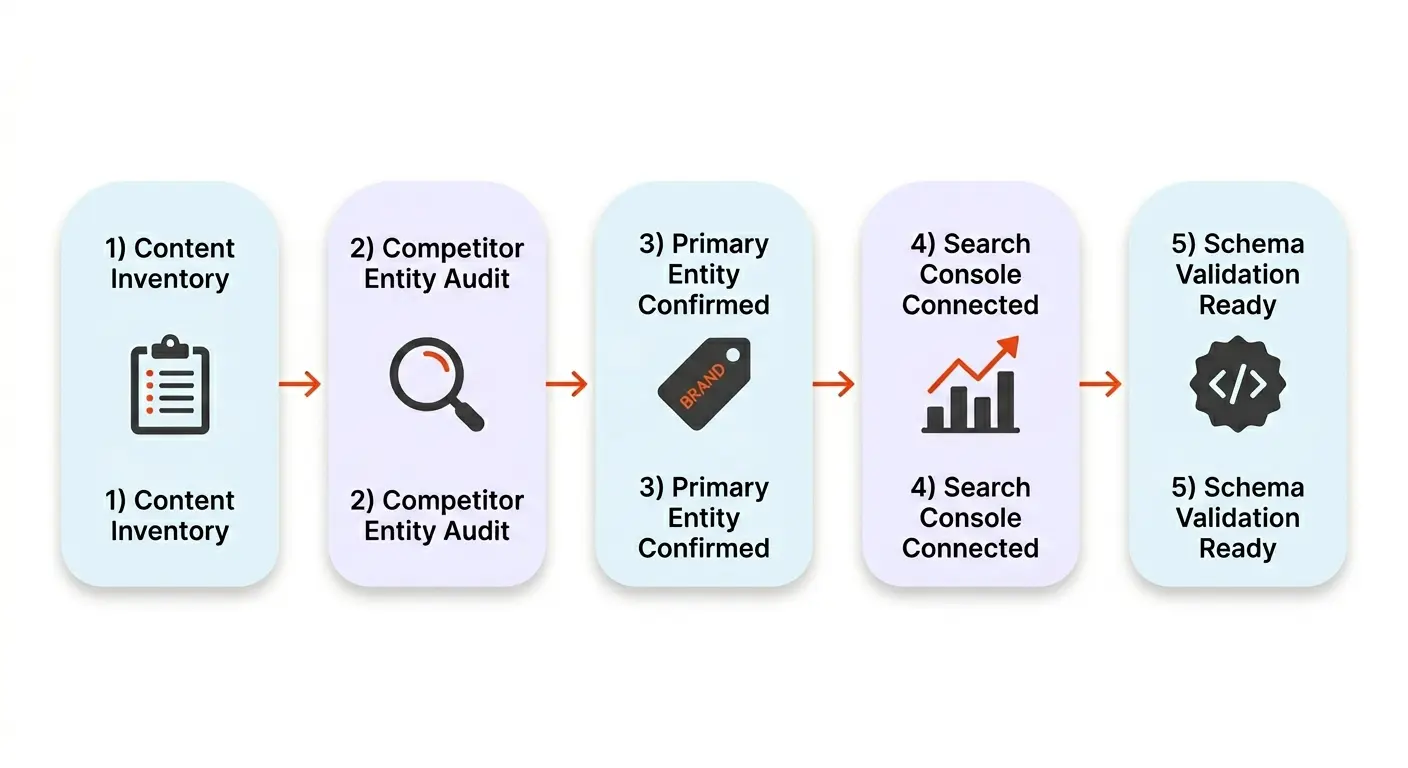
Before you touch a single schema tag, there are three things you need in place. Skipping this stage is why most entity SEO attempts stall before they produce any measurable lift.
First, run a full content inventory. Export every URL on your site, note its primary topic, and identify which ones relate to the same core subject. If your content is scattered across twelve different topic areas with no coherent theme, entity-based SEO won’t fix that. It will put a structured data label on the confusion.
Second, audit your competitor entity coverage. Use a tool like Semrush or Ahrefs to identify which entities your top-ranking competitors are associated with in Google’s index. That’s your gap list. You’re not trying to copy their content. You’re identifying which topics your site is conspicuously absent from and which ones Google has already started rewarding your competitors for.
Third, confirm your primary entity. That’s your brand or website, the single thing all your content should radiate from. If you run a B2B SaaS company focused on supply chain software, your primary entity is that company. Every piece of content you create should map back to that entity through explicit topic connections, not implied keyword similarity.
- Content inventory complete: every URL mapped to a topic
- Competitor entity audit done: gaps identified
- Primary entity defined: brand name consistent across all properties
- Google Search Console connected: baseline organic impressions recorded
- Schema validation tool set up: Google Rich Results Test bookmarked
Step 1: Map Your Entity Universe
An entity is anything Google can identify as a distinct, real-world concept: a person, a company, a product, a technology, a place. Entity-based SEO works by making it unambiguous to Google which entities your content covers, how they relate to each other, and why your site is an authoritative source on them.
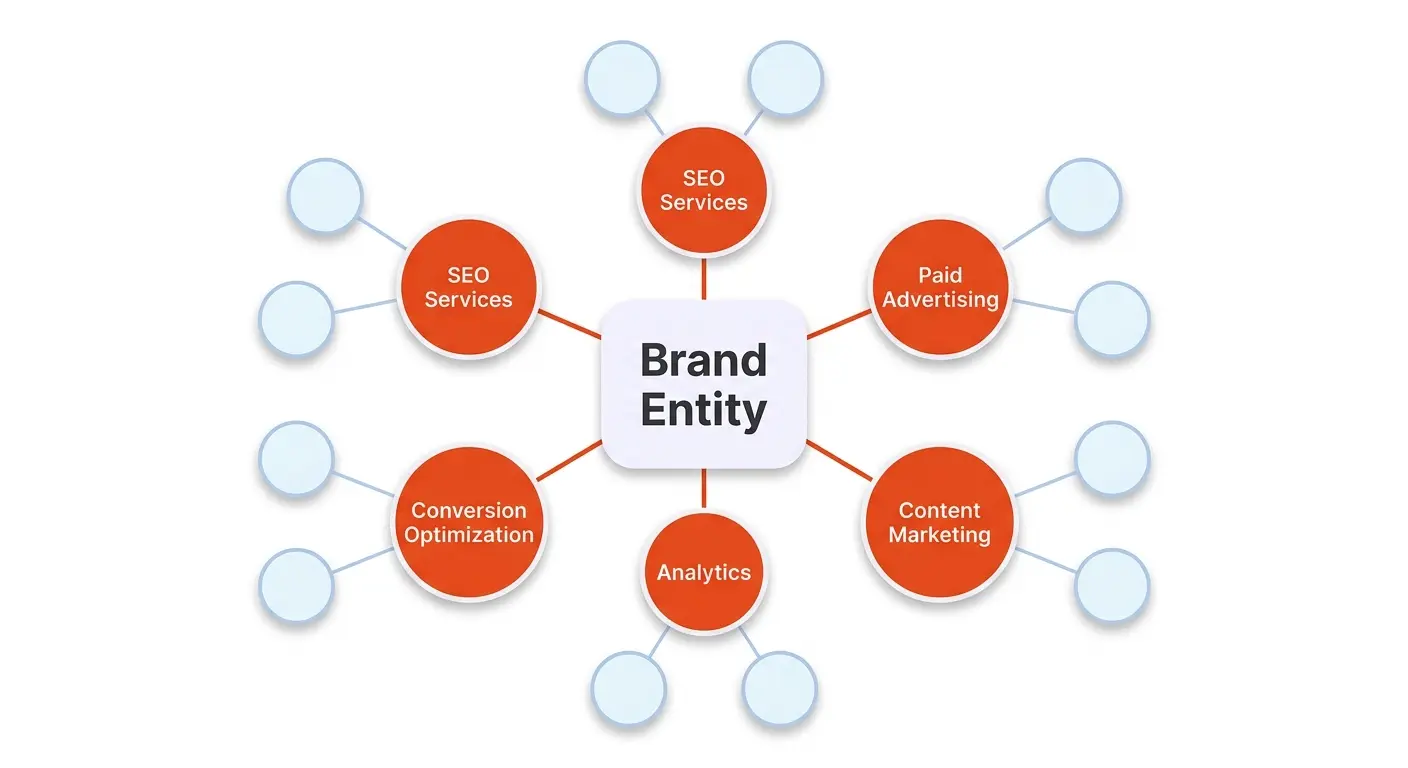
Start by listing your five to eight core topic entities. For a digital marketing agency, those might be: SEO services, paid advertising, content marketing, conversion rate optimisation, and analytics. These aren’t keywords. They’re categories of meaning that Google maps to your domain.
For each core entity, identify two to three supporting sub-entities. SEO services branches into technical SEO, on-page optimisation, link building, and local SEO. Each sub-entity becomes a content opportunity. The goal is to build a map where Google can trace a clear line from your primary entity to every piece of content on your site and understand exactly what it covers and why it belongs to you.
Pro tip: Use Google's Knowledge Graph Search API (it's free) to check whether your brand and key topics already have entity recognition. If your company name returns no result, you've got a brand entity gap that needs addressing before any other optimisation step. This is the check most businesses have never run.
Here’s what that looks like in practice. A B2B software company completed this mapping exercise and ranked for 280% more related topic entities within ten months. Their organic traffic went up 195%. Not because their writing improved, but because Google finally had enough signals to classify them as a domain authority.
Step 2: Build Topical Depth Around Each Entity
This is the step most brands skip. And it’s the single biggest reason their entity SEO produces no measurable traffic lift.
Schema markup on a site with shallow content coverage doesn’t create entity authority. It labels the shallowness with structured data. That’s not a workaround. It’s a contradiction Google’s algorithm is very good at detecting.
For each core entity in your map, you need a pillar page and a minimum of three to five supporting cluster articles. The pillar page is a thorough, authoritative overview of the entity. The cluster articles go deep on each attribute, subtopic, and use case.
Pick one entity to build out fully before moving to the next. Focus beats breadth at this stage.
Cover the entity broadly and authoritatively: this page's job is to be the definitive resource, not to rank for a single keyword.
Each one covers a specific attribute, subtopic, use case, or comparison within the entity space in depth.
Use entity-rich anchor text, not "click here" but the actual entity name or subtopic phrase.
Compare your cluster coverage against what your top-ranking competitors have built. Any topic they cover that you don't is a priority gap.
A real estate agency with solid technical SEO but thin entity coverage had service pages for every suburb they operated in but no content explaining market mechanisms, the legal processes involved, or the buyer decision journey. After building out topical clusters for their three core entities, their organic traffic surged by more than 100% and search impressions shot up by over 200%.
Topical depth isn’t about word count. It’s about coverage completeness. Google compares your entity coverage against every competing page for the same entities in its index. If ten other sites explain a topic from five angles and you cover two, Google’s quality assessment will reflect that gap. It doesn’t matter how polished your writing is.
Step 3: Implement Schema Markup That Google Trusts
With topical depth in place, schema markup becomes the technical bridge between your content and Google’s Knowledge Graph. Schema doesn’t create authority. It makes existing authority legible to machines.
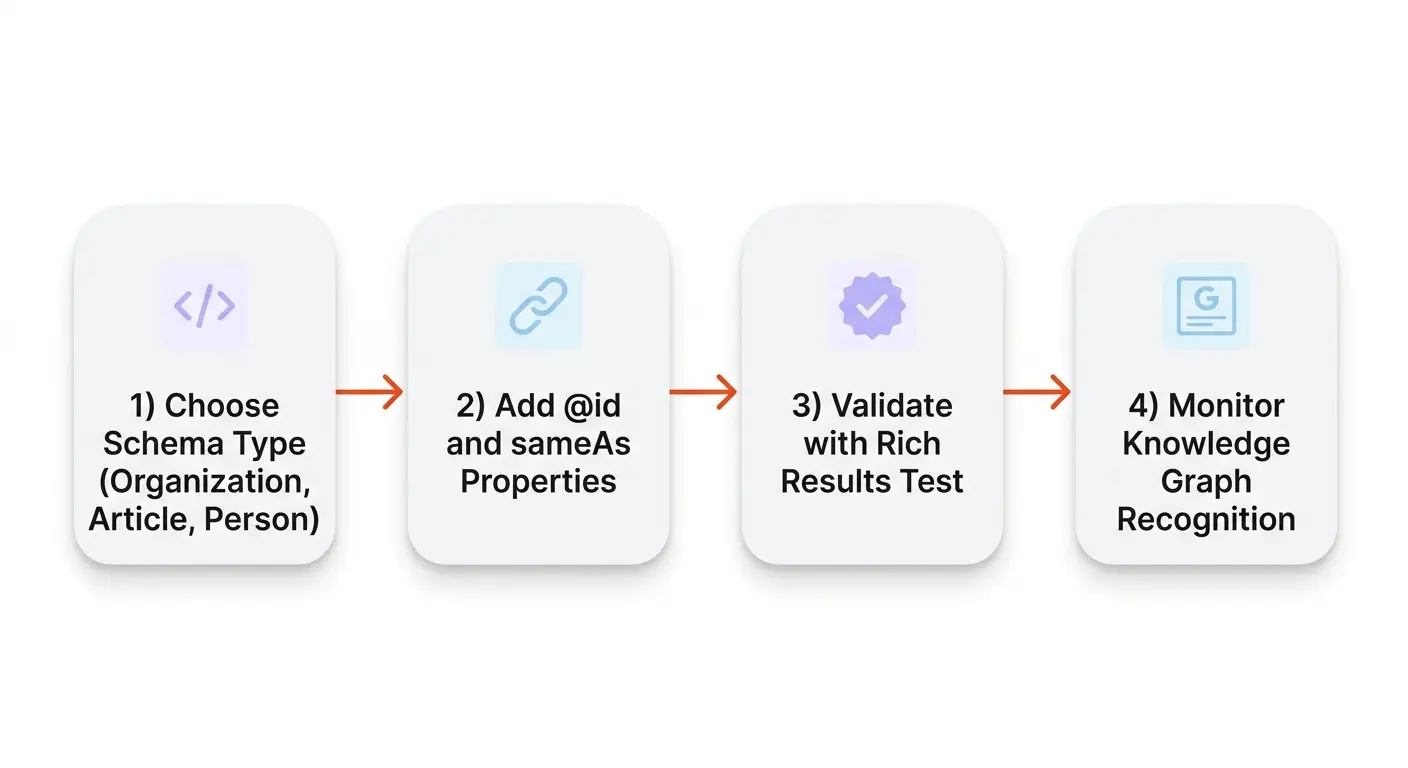
Start with Organisation schema on your homepage and About page. Include the @id property pointing to your canonical domain, and sameAs links pointing to your verified LinkedIn, Facebook, Twitter/X, and Crunchbase profiles. These sameAs connections are how Google co-locates your on-site entity signals with your off-site presence and builds confidence in entity recognition.
For each blog post or article, add Article schema with the correct @type, author linked to a Person entity with their own schema, about naming the entity the content addresses, and mainEntityOfPage. That explicitly tells Google what entity your content covers, rather than leaving it to infer from keyword density alone.
The data backs this up. Pages enhanced with structured data see a 25% higher click-through rate compared to pages without it. Content recognised as entities in Knowledge Graphs is 50% more likely to appear in featured snippets, knowledge panels, and other rich results. That’s compounding visibility, not a one-off ranking bump.
Implementation note: Don't add FAQ schema to every page just to chase rich results. FAQ schema on a page that doesn't genuinely answer questions confuses Google's entity classification and can trigger quality downgrades. Only add FAQ schema to pages with real, structured Q&A content. Validate every implementation using Google's Rich Results Test before publishing: a schema error is worse than no schema.
Step 4: Reinforce Entities Across the Web
Your site alone can’t build entity authority. Google cross-references on-site entity signals with off-site mentions, citations, and associations. This is where organic SEO services move beyond the website and into the broader information ecosystem.
The most effective off-site entity signals include:
- Guest posts on topically relevant publications, where your brand is mentioned in context and not just linked
- Business profiles on authoritative directories: LinkedIn, Crunchbase, Google Business Profile
- Brand mentions in editorial coverage that Google treats as credible sources
If your primary entity is a person (a founder or CEO), that person should have a consistent author bio across every platform they publish on. Google builds Person entities from cross-referenced co-authorship signals and citation patterns. An author who publishes on five relevant platforms with consistent attribution builds entity recognition significantly faster than one who publishes exclusively on their own domain.
For brands targeting local visibility, consistent NAP (Name, Address, Phone) across every directory listing is an entity consistency signal, not just a local SEO tactic. Inconsistent naming across platforms creates entity fragmentation. Google may treat “Acme Marketing” and “Acme Marketing Agency” as separate entities rather than the same business. That splits your authority signals across two unrecognised nodes instead of consolidating them into one recognised brand entity. It’s a quiet problem that compounds over time.
Step 5: Measure Entity Authority and Traffic Growth
Entity authority doesn’t show up as a single metric in Google Search Console. You measure it through a combination of signals: organic impressions growth, Knowledge Panel appearances, and featured snippet wins.
Set up a monthly tracking dashboard with four indicators. First, total organic impressions in Search Console. This should grow consistently as entity coverage expands, even before ranking positions improve. Second, the number of unique queries your site appears for. Entity authority broadens your topical footprint, so query count growth is an early leading indicator. Third, CTR at a page level. Pages with schema markup typically deliver 20–40% CTR improvements. Fourth, featured snippet appearances for your target entities, tracked manually each month.
“How do I know if entity SEO is working or if my traffic growth is from something else?”
The cleanest signal is query breadth, not ranking positions. Pull your Search Console data and look at the total unique queries your site appeared for month over month. If entity coverage is working, that number grows even before individual keyword positions shift. Ranking positions are a lagging indicator. Query breadth is a leading one.
“What’s a realistic traffic increase to expect and over what period?”
For a mid-sized site with reasonable existing content, 60–120% organic traffic growth over 12 months is achievable. The real estate agency case above hit 100%+ in under a year. But the range varies significantly based on how thin your existing entity coverage is and how aggressively you build cluster content. Don’t expect meaningful movement in the first 90 days. Months 4–9 are when it compounds.
- Total organic impressions (month over month in Search Console)
- Total unique queries site appears for (Search Console)
- Average CTR for schema-enhanced pages
- Featured snippet appearances for target entities
- Knowledge Panel status for brand entity
The B2B software company referenced in Step 1 went from zero Knowledge Panel presence to entity recognition for 280% more topic entities in ten months. The result was a 195% increase in organic traffic. The traffic didn’t come from ranking for new keywords. It came from Google broadening the entire query set it associated with the domain. That’s what entity-based SEO does when it works: it doesn’t just increase organic traffic for one target keyword, it compounds across every related topic your site has built authority in.
Common Entity SEO Mistakes to Avoid
The industry tends to present entity optimisation as a technical implementation task: add schema, get recognised, and traffic doubles. In practice, brands that follow that sequence see minimal results because Google’s entity recognition depends on content substance, not structured data signals alone.
| What Most Guides Say | What Actually Works |
|---|---|
| Add schema markup first | Build topical depth first, then add schema |
| Target as many entities as possible | Dominate three to five core entities before expanding |
| Schema creates entity authority | Schema labels authority. Content creates it |
| Keywords and entities are interchangeable | Entities are concepts; keywords are strings that reference them |
| One pillar page per topic is enough | Pillar plus minimum three to five cluster articles per entity |
The most expensive mistake is adding Organisation and Article schema to a site with thin, scattered content. Schema signals to Google what your content claims to be about. If the content itself doesn’t demonstrate topical depth (covering ten topics shallowly instead of three topics thoroughly), the schema creates a contradiction between the declared entity and the actual coverage. Google will favour the evidence over the declaration every time.
The second mistake is entity inconsistency. If your brand name appears as “Acme Marketing” on your homepage, “Acme Marketing Agency” on LinkedIn, and “Acme Mktg.” on your Google Business Profile, Google’s Knowledge Graph may generate separate entity nodes for each variation. Standardise your brand name across every property before implementing any schema or off-site entity building. This step costs nothing and most brands skip it entirely.
The third mistake is treating topical authority as optional. 88% of SEO professionals consider topical authority critical for ranking success. Working with a marketing consultant can accelerate this process significantly. A single pillar page doesn’t create authority. Authority is established through coverage completeness combined with the internal linking architecture that connects your cluster content to your pillar pages. Start with three to five core entities, build them out fully, and you’ll increase organic traffic far more reliably than any keyword-by-keyword optimisation approach.
- Schema markup doesn't create entity authority. It labels authority that already exists in your content. Schema on thin content creates a contradiction Google resolves against you
- Start with 3–5 core entities and build them out fully before expanding: topical depth within a focused entity set outperforms shallow coverage across many topics
- Entity consistency across web properties matters: different brand name variations on different platforms create separate entity nodes, splitting your authority signals
- Query breadth in Search Console is an earlier indicator of entity SEO progress than individual keyword rankings. Watch it month over month from the start
- Off-site entity signals (Crunchbase, LinkedIn, consistent NAP, editorial mentions) are as important as on-site schema. Google cross-references entity signals across multiple sources before granting recognition
Frequently Asked Questions
What is the difference between entity-based SEO and keyword SEO?
Keyword SEO optimises pages around specific search strings. Entity-based SEO optimises around concepts: distinct things Google can identify and map to real-world meaning. Keywords are how people phrase a query; entities are what that query is actually about. Entity-based SEO makes your content legible to Google as a structured body of knowledge, not just a collection of keyword-matched pages.
How long does entity-based SEO take to show results?
Initial entity signals typically take three to six months to influence organic visibility, with significant traffic lifts appearing between six and twelve months. The timeline depends on your current content coverage, the consistency of your entity signals across the web, and how competitive your core entities are. Sites that build topical depth aggressively alongside schema implementation see results at the faster end of that range.
Do I need a Wikipedia page to appear in Google's Knowledge Graph?
No, but third-party references do matter. Wikipedia is one of Google's most trusted entity sources, so a Wikipedia mention accelerates Knowledge Graph recognition, but it isn't required. Crunchbase profiles, press coverage from credible publications, and consistent brand mentions across authoritative industry platforms all contribute to entity recognition. For most businesses, building out schema, consistent directory listings, and earning editorial coverage is sufficient.
What is topical authority and how is it different from domain authority?
Domain authority is a third-party metric estimating the overall strength of a domain's backlink profile. Topical authority is Google's internal assessment of how comprehensively a site covers a specific subject area. A site with a DA of 20 can have strong topical authority in a niche if it covers the subject thoroughly. In practice, topical authority is often more predictive of ranking success in a specific niche than overall domain authority.