
Three studies published in 2025 show AI-powered PPC campaigns delivering conversion lifts between 14% and 27%. The State of PPC 2026 survey of 1,306 PPC practitioners, fielded late that same year, found that 53% of respondents say their work is harder now than two years ago.
Both findings are accurate.
The question worth sitting with is this: how does the same technology improve conversion rates and make the job harder at the same time?
That question isn’t rhetorical. The answer determines which type of advertiser ends up with a 27% conversion lift, and which one ends up paying 13% more per click with less visibility into why. This article works through the research on both sides. Covering what the data actually shows about AI in PPC, where the gains are real, where the costs are hidden, and what the evidence says about building a position that benefits from the technology rather than subsidizing it. For teams working with an experienced PPC management partner, these distinctions translate directly into how campaigns are structured.
The Measurable Case for AI in PPC: What Current Research Shows
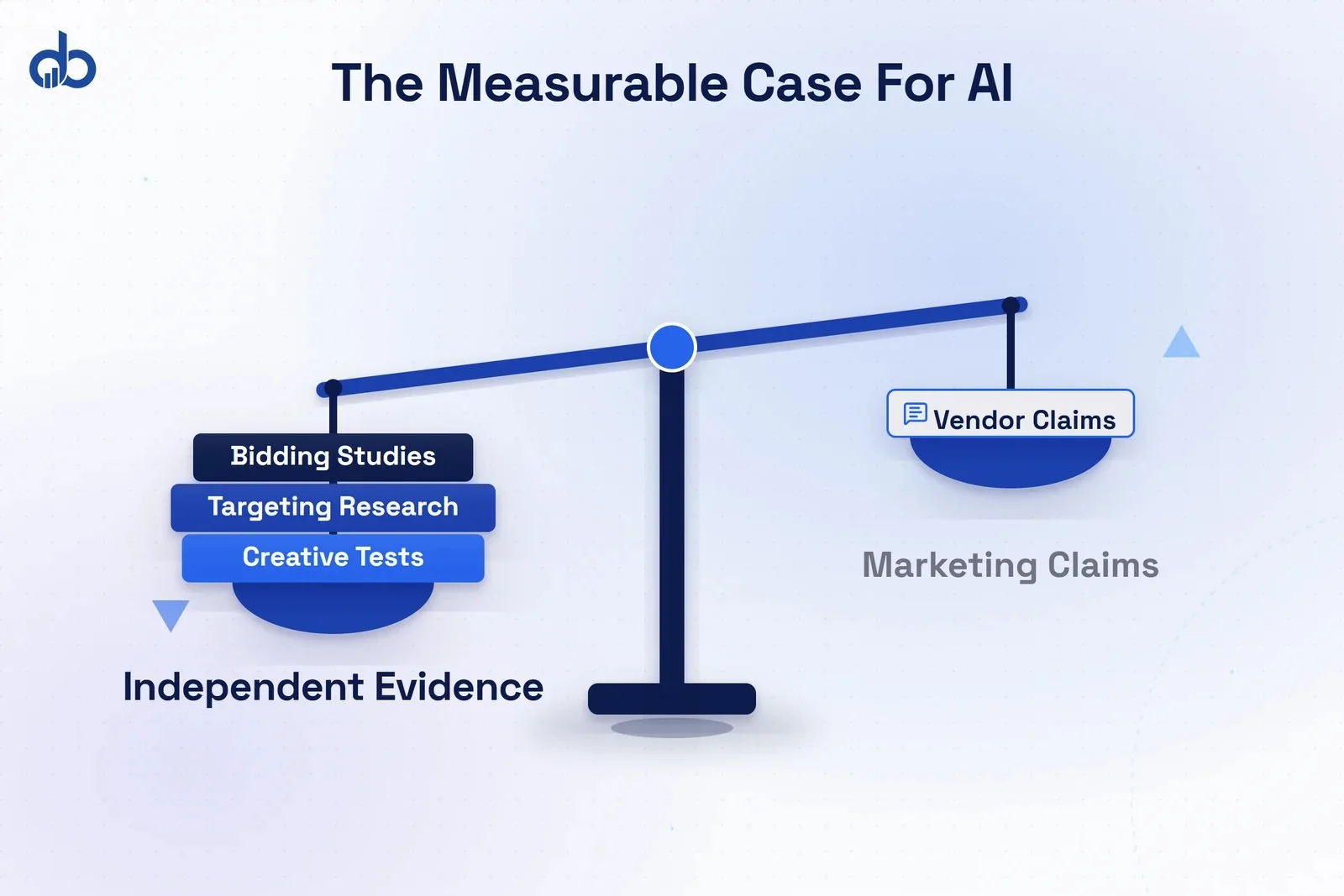
The performance data supporting AI in PPC isn’t platform marketing. It comes from two distinct evidence streams, and both are worth reading carefully.
Platform-reported outcomes
In May 2025, Google published data from AI Max for Search campaigns. Advertisers who switched to AI Max saw an average 14% increase in conversions or conversion value at similar cost per acquisition (CPA) or return on ad spend (ROAS). For accounts running on exact-match-heavy keyword structures, the gain was larger: 27% more conversions. These aren’t projected figures. They reflect actual PPC campaign performance measured against control groups running standard Search campaigns.
That same month, Google released data on Smart Bidding Exploration, a feature that lets the algorithm test new search query categories for conversion signals. The result: a 19% increase in conversions and an 18% increase in unique search categories that generated conversions. Accounts reached new customers they wouldn’t have found through manual keyword planning.
Third-party and cross-industry research
McKinsey’s research on AI in marketing and sales, published in May 2023 and still cited as a benchmark in current industry reports, found that AI-driven marketing programs produce 3-15% revenue uplift and 10-20% sales return on investment versus non-AI approaches. The range is wide because outcomes scale with implementation quality, not with the tools themselves.
HubSpot’s State of AI Report 2025 found that 75% of marketing leaders who invested in AI report positive ROI, and 91% now use AI in some part of their day-to-day work. These figures represent broad marketing activity, not PPC specifically. But they establish the directional reality: AI investment is producing measurable returns across the marketing function.
The case for AI in PPC is genuine. What the case studies and platform reports tend to understate are the conditions under which these results materialize.
Getting these numbers from your campaigns? Digiblazon's Performance Marketing team builds evidence-first PPC strategies that apply AI where research supports the investment.
The Optimization Paradox: Why AI Improves Platform Metrics and Reduces Advertiser Control at the Same Time
Here’s the research finding that doesn’t appear in most AI-in-PPC content.
WordStream’s 2025 Google Ads Benchmarks report analyzed 16,446 US advertising accounts over twelve months. Average cost per click across industries rose 13%, reaching $5.26. Average conversion rates improved during the same period (from 6.96% to 7.52%). That 0.56 percentage point conversion rate gain is real. So is the 13% CPC increase.
The net effect, depending on your margin structure, may not be the efficiency gain the platforms describe. Advertisers are paying substantially more per click while experiencing only modest conversion rate improvement.
This pattern reflects what might be called the optimization paradox in AI-driven PPC. The algorithm optimizes effectively for the metric it is given, and that metric isn’t advertiser profit. It’s auction performance: the highest-converting traffic that can be sourced at the lowest internal cost to the algorithm’s objectives. When AI raises the efficiency of the auction system overall, CPCs rise because every participant’s algorithm has become better at identifying valuable signals. You’re bidding against other AI systems, all of which have access to similar machine learning infrastructure.
What the practitioner data shows
The State of PPC 2026 global survey asked 1,306 PPC professionals about their experience with AI-driven campaign management. The findings are specific.
53% of respondents said managing paid search PPC campaigns is harder now than it was two years ago. Of those who said it was harder, 62% identified black-box platform automation as the primary cause. They cited the inability to see why the AI makes the decisions it makes, and the resulting difficulty in diagnosing performance problems or improving the account systematically.
AI also saves these same practitioners an average of 5.2 hours per week on tactical tasks like bid adjustments and search term reviews. Time savings are real. So is the complexity increase. The two findings aren’t contradictory. They describe the same shift in what paid search management requires: less time on execution, more demand for interpretive and diagnostic skill.
The industry trends point toward a profession that has changed structurally. Not one that has simply gotten easier or harder overall.
Why this happens architecturally
AI bidding systems are trained to optimize for the signal they receive. When that signal accurately represents business value (clean conversion data tied to revenue, first-party audience data reflecting actual customers, offline conversions closing the loop from click to sale), the system performs well. When it doesn’t, the system optimizes efficiently for the wrong outcome.
Platform incentive structures matter here. Google and Microsoft earn revenue when advertisers spend. AI systems that identify more auction opportunities, expand match types more aggressively, and serve ads to broader audiences generate more spend. Those incentives aren’t hidden. They’re structurally built into how the platforms generate revenue. This doesn’t mean the tools don’t work. It means understanding what they optimize for is a precondition for getting them to work in your favor.
Signal Quality as the New Competitive Moat in AI-Driven PPC
If every advertiser has access to the same AI bidding infrastructure, the competitive differentiator can’t be the AI itself. The research points consistently toward one factor that separates advertisers seeing outsized gains from those seeing the industry-average results.
Signal quality.
AI bidding systems are prediction engines. They predict which users are most likely to convert given the bid amount and current auction conditions. The quality of that prediction depends entirely on the quality of the data the algorithm is trained on. Two advertisers running identical AI Max campaigns on the same keywords will get different results if one is feeding the algorithm rich, accurate conversion data and the other is feeding it partial, noisy, or misaligned signals.
McKinsey’s research on AI in marketing found that companies investing in data infrastructure alongside AI tools see materially larger gains than those deploying AI without addressing underlying data quality. The same pattern appears in PPC specifically: machine learning bidding underperforms in accounts with poor conversion tracking, incomplete audience data, or conversion events that don’t reflect actual business outcomes.
The signal stack
Building a strong signal stack for AI in PPC requires four components. Each one independently improves the algorithm’s prediction quality.
Conversion events tied to business outcomes: If the primary conversion event the AI optimizes toward is a page view, a session duration threshold, or a low-intent form submit, the algorithm will efficiently deliver traffic that produces those events. Revenue doesn’t follow automatically. The conversion event must represent a meaningful step in the purchase process.
First-party audience data via Customer Match: Uploading CRM lists, email subscriber data, and customer segments lets the AI find patterns in who actually converts for your specific business, not just who converts across all advertisers in the category. This is the highest-impact input for improving Smart Bidding prediction accuracy.
Offline conversion import: For B2B advertisers and any business with a meaningful gap between lead and sale, offline conversion import closes the loop. The AI learns which ad interactions produced actual revenue, not just form fills. Without this, Smart Bidding optimizes for the last measurable event before the sale, which is almost never the event that determines account profitability.
Conversion value rules: Telling the algorithm that certain customer segments, geographic regions, or product categories are worth more per conversion allows it to skew bidding toward higher-value outcomes. Accounts that configure value rules consistently see stronger ROAS than those relying on uniform conversion goals, because the algorithm learns which traffic actually correlates with revenue.
The signal stack isn’t a one-time setup. It requires ongoing maintenance as audiences change, conversion patterns shift, and new customer segments emerge. The advertising technology demands the same rigor as a first-party data program, because in effect, that’s what it is.
Not sure your campaigns are feeding AI the right signals? Digiblazon's team audits your PPC signal stack and builds the data infrastructure AI needs to work in your favor.
Machine Learning in Practice: Bidding, Targeting, and Creative
Understanding how machine learning functions across the three primary PPC layers helps practitioners decide where human oversight is most critical.
Bidding
Smart Bidding evaluates dozens of auction-time signals simultaneously: device type, location, time of day, query context, audience membership, and prior site behavior. No human analyst can process that combination in real time across hundreds of thousands of daily auctions. The machine learning advantage in bidding is unambiguous and well-documented.
The limit is this: the algorithm trains on whatever conversion signal it receives. A PPC campaign running Smart Bidding with accurate offline conversion data and first-party audience lists behaves very differently from the same campaign running on view-through conversions and broad audience signals. Both use machine learning. The outcomes diverge because the inputs diverge.
Targeting
Predictive audience targeting uses machine learning to identify users exhibiting behavioral patterns similar to existing converters. Customer Match extends this by using your own CRM data to anchor the model. Performance Max and Demand Gen campaigns take this further, expanding reach across YouTube, Gmail, and Display inventory based on AI-identified affinity signals.
75% of PPC practitioners now use AI to assist in writing ad copy. The shift toward AI-assisted creative generation has changed how targeting and messaging interact. The same AI that identifies high-propensity audiences also assembles the ad combinations most likely to perform for those audiences, running tests at a speed and volume that manual A/B testing can’t replicate.
Creative
Responsive Search Ads use machine learning to test headline and description combinations against real user data. The AI learns which combinations perform for which search contexts and adjusts asset mix accordingly. Performance Max extends this across video, display, and discovery formats.
The research note on creative AI: human review remains necessary. Machine-assembled ad copy lacks brand context by default. Without creative input guardrails, AI-generated combinations can produce headlines that are technically optimized but off-brand, inconsistent in tone, or misaligned with specific landing page messaging. Signal quality applies to creative inputs as much as it applies to bidding inputs.
Risks and Accountability: What the Research Flags
AI in PPC generates measurable gains and measurable risks. The risks receive less attention in the current body of published content, which is itself a gap worth flagging for practitioners making resource and governance decisions.
Algorithmic bias
Machine learning models trained on historical data can perpetuate biases present in that data. In advertising contexts, this manifests as systematic over-serving or under-serving of ads to particular demographic segments. Not because of intentional targeting decisions, but because the model has learned patterns from historical performance data that reflect pre-existing inequalities.
The FTC and DOJ have both issued guidance on algorithmic advertising practices. The EU AI Act, effective 2026, classifies certain AI advertising applications as high-risk. For advertisers, the practical implication is that AI-generated targeting decisions require periodic auditing: not just for performance, but for demographic distribution of ad delivery.
Transparency deficits
Of the PPC professionals in the State of PPC 2026 survey who found the work harder, 62% cited black-box automation as the primary driver of increased campaign management difficulty. When AI controls bidding, audience expansion, creative assembly, and placement simultaneously, diagnosing performance changes becomes structurally harder. The algorithm doesn’t explain its decisions. Practitioners must infer them from outcome data, which requires more sophisticated measurement frameworks than traditional campaign management demanded.
Brand safety and governance
AI-assembled creative combinations and AI-driven placement decisions can produce off-brand content or ads appearing in contextually inappropriate environments without explicit exclusion settings. The research flags this as an active governance problem, not a theoretical one.
The accountability question (who is responsible when AI-driven advertising produces discriminatory outcomes or brand safety failures) remains unresolved in most organizations. Building an internal governance layer before AI problems materialize is less costly than responding after the fact.
What This Means for PPC Practitioners
The research on AI in PPC points toward a coherent set of practical conclusions for practitioners and decision-makers.
First, the performance gains are real but conditional. Google’s conversion lift data shows 14% to 27% improvements for accounts that meet the signal quality threshold. McKinsey’s revenue uplift figures (3-15% range) reflect programs that invested in data infrastructure alongside AI deployment. The conditions matter as much as the tools.
Second, the optimization paradox is structural, not accidental. CPC inflation alongside conversion rate improvement isn’t a temporary market condition. It reflects the architecture of AI-driven auction systems in which every participant improves simultaneously, raising costs for all while distributing gains unevenly based on signal quality.
Third, signal quality is where the investment in AI in PPC actually compounds. The advertising technology is available to every advertiser. The first-party data architecture, conversion tracking integrity, and offline conversion import discipline that make AI work effectively are not. Building those capabilities is the sustainable competitive advantage in an AI-driven PPC environment.
For teams evaluating how to allocate PPC management resources, the research suggests rebalancing. Fewer hours on manual bid adjustments (AI handles those more effectively). More investment in conversion tracking audits, first-party data programs, and incremental measurement frameworks that can distinguish what AI is actually contributing from what would have happened anyway. The industry trends in paid search are moving in this direction regardless. Teams that build data infrastructure now aren’t ahead of their peers by much. But they’re ahead.
The difference between the advertiser seeing a 27% conversion lift and the one paying 13% more per click for modest gains isn’t the AI tools in use. It’s what those tools have to work with.
If you’re evaluating PPC management options for your business, the signal quality question is the right place to start.
Conclusion
AI in PPC is neither hype nor a solved problem. The research shows real, documented performance gains from specific AI applications. Those gains are conditional on the quality of data the algorithm receives and the rigor with which human oversight governs what it optimizes for.
The optimization paradox is the finding most current AI-in-PPC content avoids: the same technology that lifts conversion rates is also compressing transparency, inflating CPCs, and increasing the professional difficulty of managing paid search campaigns well. Both facts coexist because they reflect the same underlying architecture.
The practitioners and teams who get the better side of that equation aren’t using different AI tools. They’re feeding better signals to the same tools every competitor has access to, and maintaining the diagnostic capability to know whether those tools are working.
That’s the central argument the current research supports, and the question worth asking before any AI-in-PPC budget decision. You can request a free proposal to see how Digiblazon approaches this for active clients.
- AI-powered PPC campaigns deliver real, documented gains — Google data shows 14% more conversions from AI Max and 19% from Smart Bidding Exploration at similar CPA/ROAS.
- The optimization paradox: average CPCs rose 13% in 2025 while conversion rates improved only modestly — the same AI technology that lifts performance also inflates auction costs for all participants.
- Signal quality is the decisive variable. Accounts feeding clean, business-tied conversion data to AI bidding systems consistently outperform those feeding noisy signals like low-intent form fills.
- 53% of PPC professionals say managing paid search is harder now, with 62% of them citing black-box platform opacity — AI saves time on execution but raises diagnostic complexity.
- Getting the better side of AI in PPC requires better data infrastructure and rigorous human oversight, not different tools — every competitor has access to the same machine learning systems.
Frequently Asked Questions
How does AI work in PPC advertising?
AI in PPC advertising operates primarily through machine learning models that process auction-level signals in real time. Device type, location, time, search context, audience membership, and prior conversion behavior all feed the model. It sets bids, assembles creative combinations, expands audience targeting, and allocates budget faster and at greater scale than manual management. Smart Bidding, Responsive Search Ads, and Performance Max are the three primary delivery mechanisms.
What are the risks of using AI in Google Ads?
Research identifies three primary risk categories. Transparency deficits: 62% of PPC professionals who say the job is harder cite less insight from the ad platforms into why their campaigns perform the way they do. CPC inflation: average CPCs rose 13% in 2025 even as conversion rates improved modestly. Algorithmic bias: AI trained on historical data can perpetuate targeting patterns that exclude or over-serve demographic segments. All three risks are manageable with proper signal quality, human audit layers, and governance policies.
What is Smart Bidding and does it actually work?
Smart Bidding is Google's suite of automated bid strategies that uses machine learning to set bids at auction time. Google's May 2025 data shows Smart Bidding Exploration produces a 19% increase in conversions and opens 18% more unique search categories for converting traffic. It works best when accounts have clean conversion tracking, at least 30 conversions in the past 30 days per campaign (50 for Target ROAS), and first-party audience signals fed through Customer Match. Below those thresholds, the algorithm doesn't have enough data to outperform manual management.
What is the difference between AI PPC and traditional PPC?
Traditional PPC relies on human-set bids, manually defined keyword lists, and manually selected audiences. AI in PPC replaces or augments each with machine learning models that adapt in real time to auction-level signals. The core tradeoff is scale versus transparency: AI processes far more signals than a human could, but reduces visibility into why specific decisions are made. Managing AI-driven PPC campaigns requires different skills: less manual optimization, more data infrastructure and oversight.
Is managing PPC getting harder because of AI?
Yes, according to current research. The State of PPC 2026 survey found 53% of professionals say managing paid search is harder now. The leading cause cited by 62% of those respondents is increased platform opacity: AI-driven automation making it harder to diagnose what is driving performance. Keyword match types have expanded, campaign types have consolidated, and attribution has grown more complex. Managing AI-era PPC campaigns well requires better data infrastructure and more rigorous measurement discipline, not less.
What data do I need to feed AI bidding systems?
AI bidding systems perform best with four types of input: accurate conversion events tied to actual business outcomes, first-party audience data uploaded through Customer Match, offline conversion imports that close the loop between ad clicks and actual sales, and conversion value signals that tell the AI which conversions are worth more. Accounts that feed the algorithm noisy signals (page views, low-intent form fills, incomplete audience data) will get AI that efficiently optimizes for the wrong outcomes.