
Ranking in Google’s Local Pack in 2026 requires more than just filling out a Google Business Profile. The businesses that consistently appear for competitive local searches have invested in a systematic approach — verified GBP, consistent citations, steady reviews, and location-optimised website content all working together.
This 12-step checklist covers every element of a local SEO programme that actually moves the needle. Before you run through it, understand one thing: sequence matters. Doing these steps in the wrong order compounds errors rather than building authority.
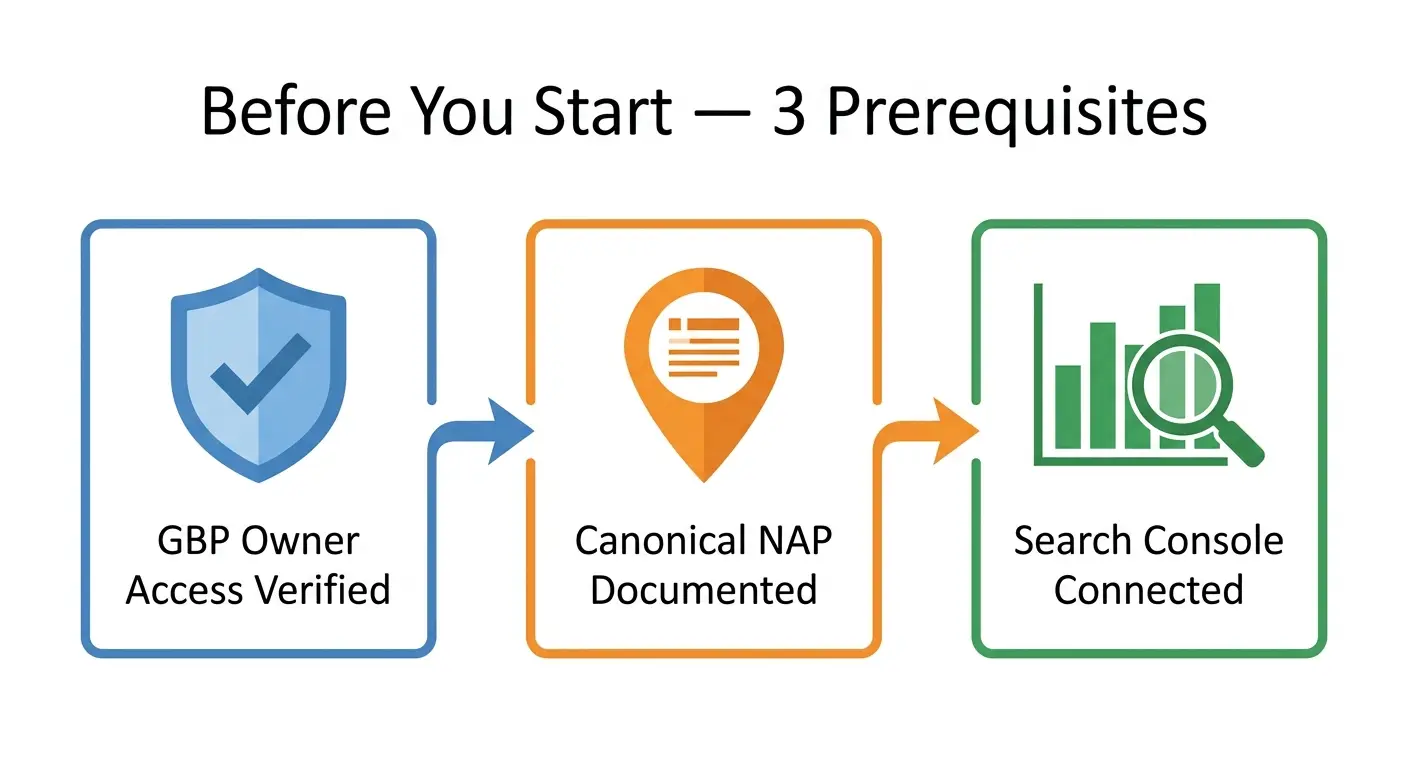
Before You Start: What You Need in Place
First, confirm you have owner-level access to your Google Business Profile. Not manager access. Not claimed-but-unverified. Owner-level, verified access. If you don’t have it, that’s step one.
Second, establish a single, authoritative NAP — Name, Address, Phone. Pick one exact version and write it down. Everything from here forward references that version. Variations fragment your entity signals and confuse Google’s local matching algorithm.
Third, connect Google Search Console to your domain and confirm it’s pulling data. You’re about to change things across your local presence. You need a baseline to measure against.
- GBP owner access confirmed and verification complete
- Canonical NAP written down (exact name, address, phone format)
- Google Search Console connected and showing data
- Website crawlable with no robots.txt blocking Googlebot
- At least one real customer contact you can request a review from
1. Claim and Verify Your Google Business Profile
If your GBP isn’t claimed and verified, nothing else on this list will help. Google’s Local Pack only serves businesses with verified GBPs. That’s not a best practice — it’s a hard requirement.
Go to business.google.com and search for your business. If it exists but isn’t claimed, request ownership. If it doesn’t exist, create it. Verification is typically a postcard to your business address, arriving within five business days. Some businesses qualify for phone or video verification, which is faster.
One common trap: multiple GBP listings for the same business. This happens when a previous owner created a listing, a franchise auto-generated one, or Google created it from third-party data. Find and merge any duplicates before proceeding.
A complete, verified GBP gets 7x more clicks than an incomplete one — and that’s before you optimise a single field.
2. Complete Every Section of Your GBP
Google uses every piece of information in your GBP to evaluate relevance for local search queries. Empty fields don’t just miss opportunities — they signal incompleteness to Google’s quality systems.
Fill in every section: business name, address, phone, website, hours, categories, description, attributes, and photos. Add service areas if you serve customers at their location rather than a fixed address.
Upload at minimum ten photos. Businesses with photos receive 42% more requests for directions and 35% more website clicks than those without. Add an exterior shot so customers recognise your location, an interior shot, a team photo, and product or service images.
Enable messaging if your business can respond within 24 hours. GBPs with messaging active show meaningfully higher engagement rates in the Local Pack — it’s a low-effort completeness signal that most competitors skip.
3. Nail Your Business Name, Address, and Phone (NAP) Consistency
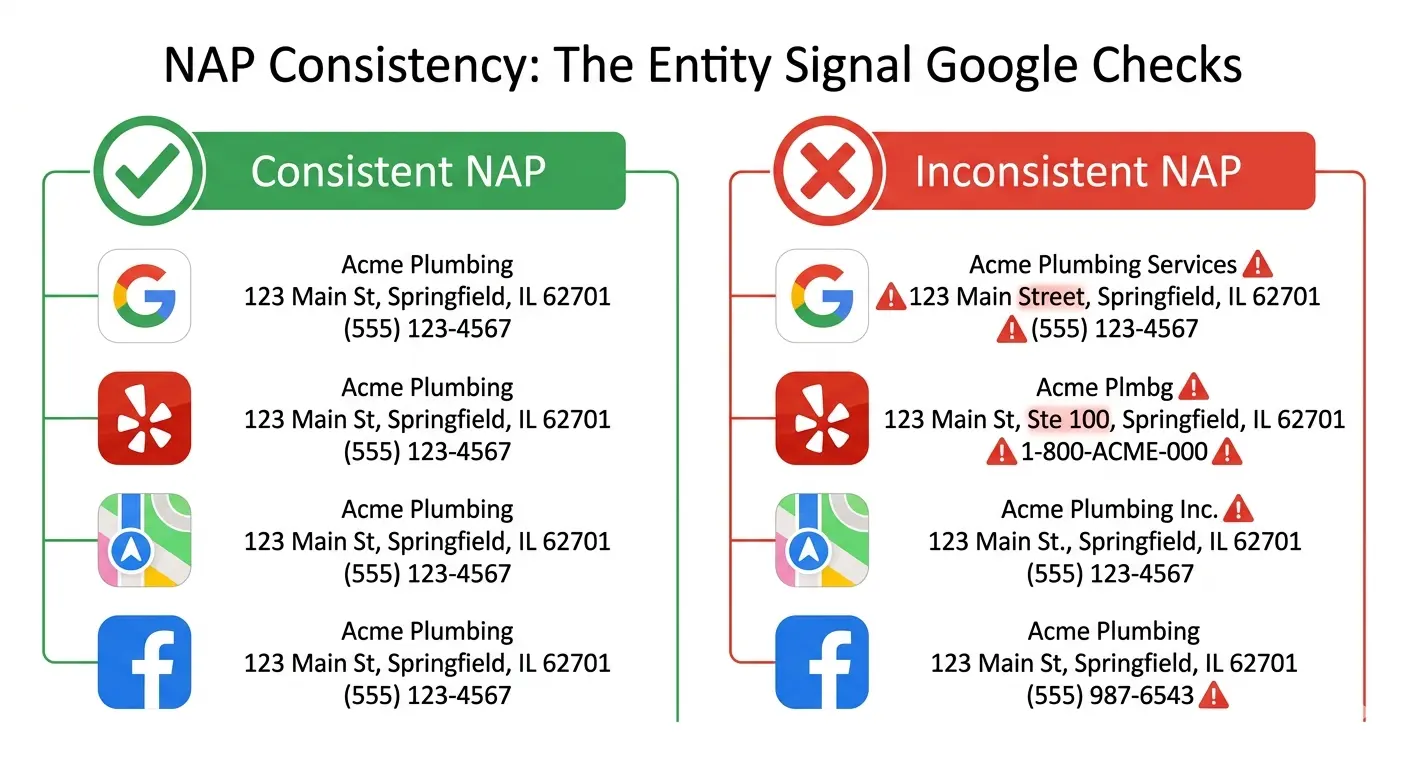
Use the exact business name you registered legally. Not a keyword-stuffed version, not a nickname, not an abbreviation. If your business is “Acme Plumbing Services LLC,” that’s your GBP name, your directory name, and your website name. Apply the same precision to your address — “Suite” vs “Ste.” and “Street” vs “St.” are each a potential entity fragmentation point.
Your phone number should use a local area code, not a toll-free number. Google uses local phone numbers as a geographic relevance signal.
Note every listing that appears — GBP, directories, review sites, and social profiles.
Use Moz Local or BrightLocal to surface inconsistencies across hundreds of directories automatically.
Document every name, address, or phone format that differs from your canonical NAP.
Correct every inconsistent listing to match your canonical NAP, starting with highest-authority directories.
Keep a record so you can re-audit in 90 days and catch any that reverted or new inconsistencies.
4. Choose the Right Primary and Secondary Categories
Your primary GBP category is the single most important ranking signal you control. It tells Google which search queries your business should appear for. Getting it wrong is expensive.
Choose the most specific category that accurately describes your core service. “Plumber” is more powerful than “Home Services Contractor” if you’re a plumbing business. “Italian Restaurant” outperforms “Restaurant” for Italian cuisine searches. Specificity is precision.
Then add secondary categories for every legitimate service you offer. A law firm handling both personal injury and estate planning should have both — each secondary category expands the query range your business can appear for.
One rule that matters: never add categories for services you don’t actually provide. Google’s quality raters review GBP data regularly, and category stuffing is one of the fastest paths to a listing suspension.
5. Write a Keyword-Rich Business Description
Your GBP description doesn’t directly rank your business — it communicates relevance to Google’s systems and to the humans reading your profile before they click.
Write up to the 750-character limit. The first 250 characters appear in search results without requiring a tap to expand. Make those count.
Include your primary service keywords, your location, and what differentiates you. Avoid keyword stuffing. “We are the best plumber plumbing services plumber in Chicago” tells Google you’re gaming the system. Write for humans first, with the keywords that matter placed naturally in sentences that communicate real value.
Effective structure: what you do, where you do it, who you serve, what makes you different, and a light call to action. Five pieces of information Google can match against five types of search intent.
6. Build Local Citations on High-Authority Directories
Local citations are mentions of your NAP on third-party websites. They’re a core ranking factor because they’re how Google corroborates your GBP information against independent sources.
Start with the essential directories: Yelp, Apple Maps, Bing Places, Facebook Business, Yellow Pages, Better Business Bureau, and your industry’s major vertical directories. For a restaurant, that includes TripAdvisor. For a contractor, it’s Angi and HomeAdvisor. For healthcare, it’s Healthgrades and Zocdoc.
Prioritise quality over quantity. A citation on Yelp with 100 million monthly visitors carries more weight than a citation on a directory with 200 users. Whitespark’s research consistently shows that citation authority matters more than raw citation volume.
Build 20 to 30 high-quality citations before worrying about the long tail of minor directories. Consistency within your citation set is what creates the entity corroboration signal — inconsistent citations are actively worse than fewer citations.
7. Earn and Respond to Google Reviews
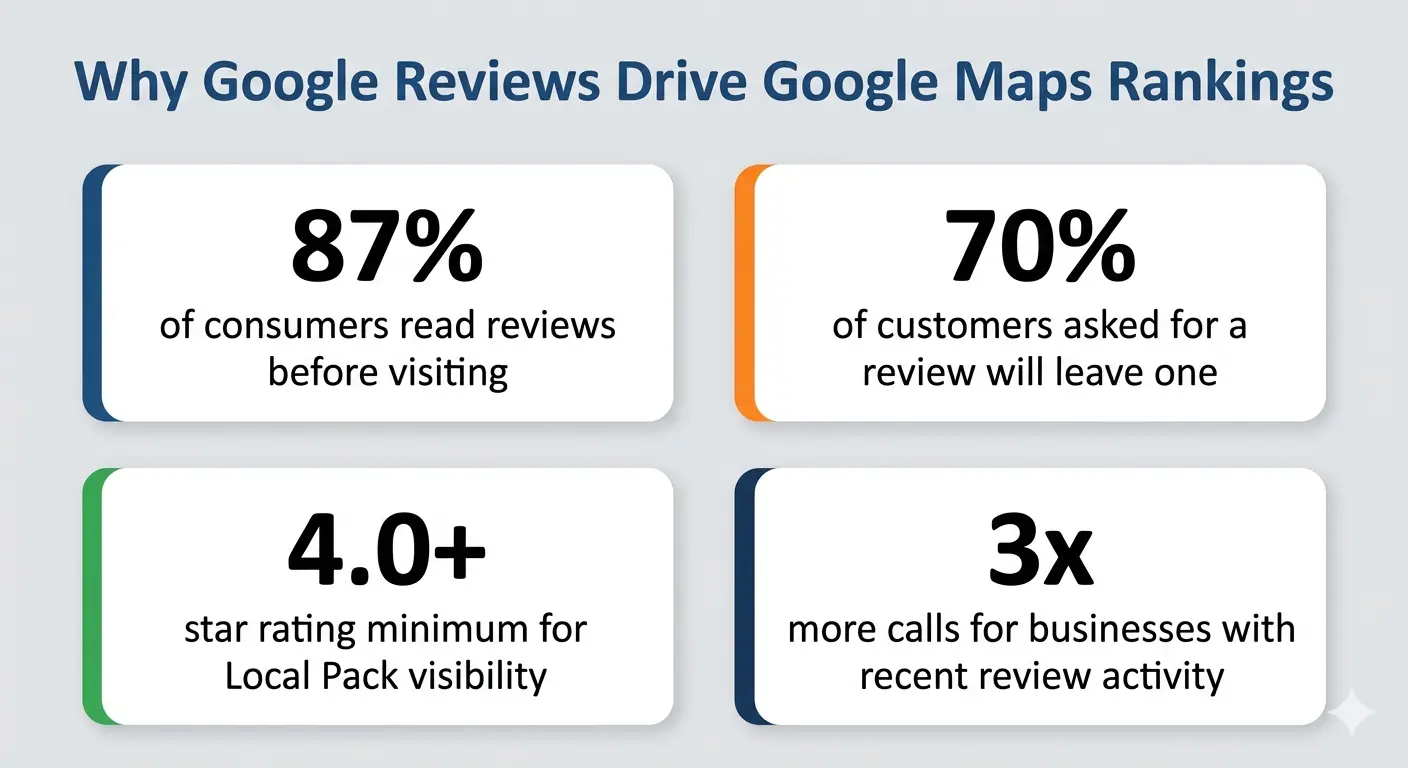
87% of consumers read reviews before visiting a local business. A business with 50 reviews and a 4.8-star average outranks a business with 500 reviews and a 3.9-star average in most markets. Quality and recency beat volume.
Build a simple review request process. After every completed service or positive interaction, send a follow-up with your GBP review link. BrightLocal data shows 70% of customers who are asked for a review will leave one — most businesses simply never ask.
Respond to every review, positive and negative. Responses show prospective customers how you operate and add keyword-relevant text to your listing. Keep responses short: acknowledge the review, add a relevant specific detail, and close professionally. Respond to negatives within 24 hours; positives within 72 hours.
Review Generation Checklist
- GBP short review URL saved and ready to send
- SMS and email review request messages drafted
- Negative review response template prepared
- Weekly routine set to check and respond to new reviews
- Monthly review count target set (minimum 4 per month for active momentum)
8. Optimize Your Website for Local Keywords
Your GBP and your website are interdependent. Google matches your GBP entity against your website to corroborate your local relevance. A strong GBP tied to a weak website doesn’t rank as high as both signals working together.
Add your city, neighbourhood, or region to your page titles, H1 tags, and meta descriptions. “Plumbing Services in Chicago” ranks for local intent queries where “Plumbing Services” alone does not.
Embed a Google Map on your contact page. Include your full NAP in the website footer on every page. Add a clear service area description to your About or Services pages. These signals reinforce the geographic entity associations your GBP is building.
Page speed matters too. 53% of mobile visits are abandoned if a page takes more than three seconds to load. Google Maps users are predominantly on mobile. A slow website that your GBP links to signals poor user experience and can suppress local rankings regardless of how well your profile is optimised.
9. Build Location-Specific Landing Pages
If you serve multiple locations, a single homepage with a general service area description isn’t enough. Build a dedicated landing page for each city or neighbourhood you actively serve.
Each location page needs: the city name in the H1, a unique description of your service in that location, local reviews or testimonials from customers in that area, a location-specific phone number if possible, and an embedded map showing the service area.
Duplicate pages with just the city name swapped will not work. Google’s quality systems detect thin, templated location pages and they suppress rather than rank them. Write genuinely useful content for each location — 300 to 500 words minimum with something location-specific in at least one section.
For businesses with more than ten locations, the content requirements at scale exceed what most internal teams can maintain consistently. Each location needs truly unique content — not a template with a city name substituted.
10. Earn Local Backlinks
Local backlinks — links from other businesses, publications, and organisations in your geographic area — are a strong signal for local search authority. They connect your domain to the local information ecosystem Google uses to rank local results.
Start with the easiest local link sources: your local Chamber of Commerce membership, local business associations, sponsorships of local events, and partnerships with complementary non-competing businesses. A plumber who links to a local hardware store and earns a link back has built a locally verifiable authority connection.
Get listed in local news sites. A feature in a local newspaper or regional business publication — even a brief mention — creates an editorial backlink with high local authority weight.
Avoid buying links. Google’s spam detection systems identify unnatural link patterns at scale. A manual penalty on a local business website wipes out years of ranking progress. The recovery timeline is measured in months, not weeks.
11. Add Local Business Schema Markup
Schema markup for local businesses is the technical layer that makes everything else more legible to Google. It doesn’t create local authority — it removes ambiguity about what type of business you are, where you are, and what you do.
Add LocalBusiness schema (or the appropriate subtype, like Restaurant, Dentist, or LegalService) to your homepage. Include: business name, address, phone number, geographic coordinates, opening hours, and URL. These should match your GBP exactly.
Add Review schema if you display on-site testimonials. Add FAQ schema to pages with genuine question-and-answer content. Each schema type gives Google a structured signal it can use for rich results.
Validate every schema implementation using Google's Rich Results Test before publishing. Schema errors don't just fail to help — they create signal contradictions that can suppress the rich results you're trying to earn.
12. Track Your Local Rankings and Fix What’s Broken
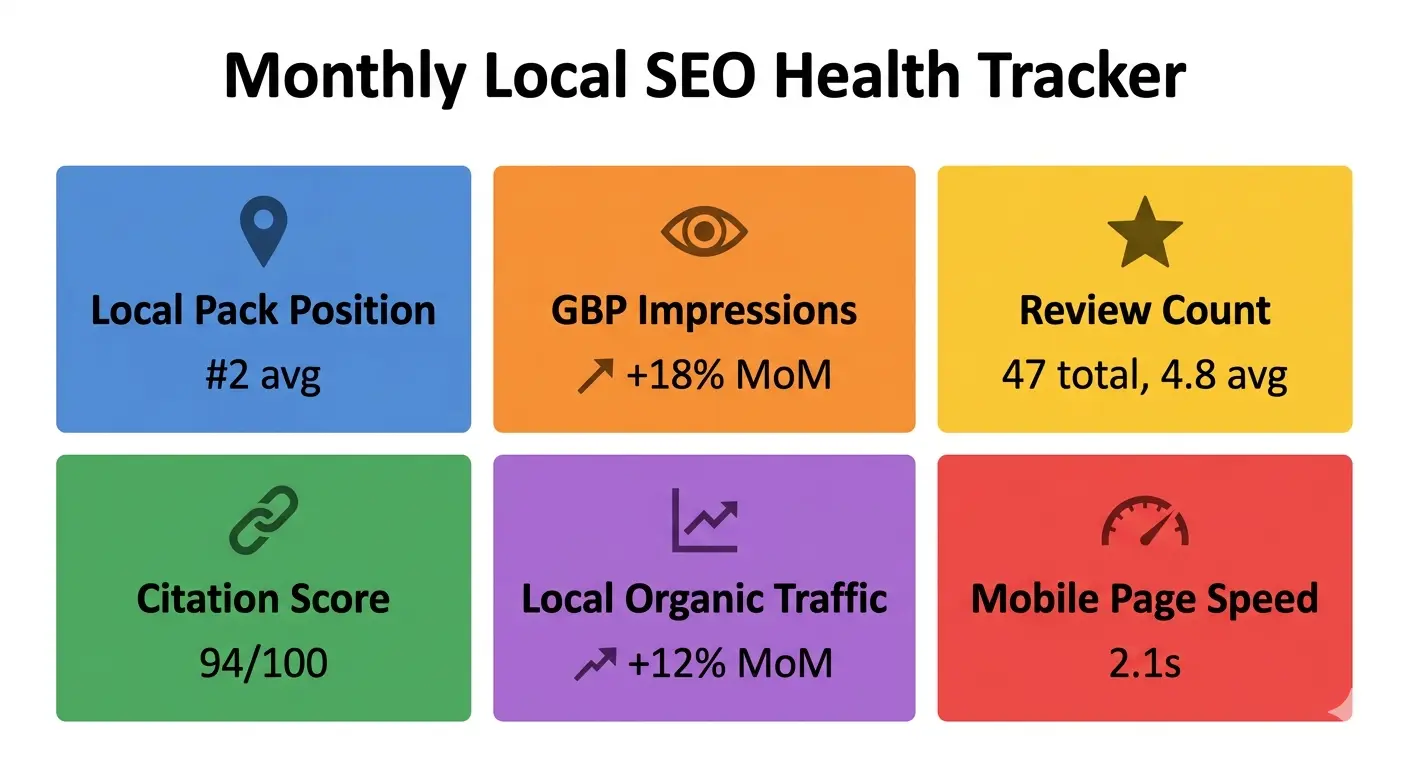
Set up monthly tracking for: your Local Pack position for your three to five target keywords, GBP impressions and clicks from the Performance tab, review count and average rating trend, citation consistency score using Moz Local or BrightLocal, and website organic traffic from local-intent queries in Google Search Console.
Look for drops before you look for wins. A sudden decline in GBP impressions often means a category was changed, a listing got flagged, or a competitor built citations you don’t have. A drop in local rankings without a GBP impression decline often points to an on-site issue or a new competitor content investment.
Fix one variable at a time. Local SEO has enough ranking factors that changing multiple things simultaneously makes it impossible to know what worked.
Monthly Local SEO Tracking Dashboard
| Metric | Tool | Frequency |
|---|---|---|
| Local Pack position (top 5 keywords) | BrightLocal or Whitespark | Weekly |
| GBP impressions and clicks | GBP Performance tab | Weekly |
| Review count and average rating | GBP Dashboard | Weekly |
| Citation consistency score | Moz Local or BrightLocal | Monthly |
| Local keyword organic traffic | Google Search Console | Monthly |
| Website page speed (mobile) | Google PageSpeed Insights | Monthly |
Common Local SEO Mistakes That Kill Your Google Maps Rankings
Most guides present local SEO as a task list where order doesn’t matter. Complete enough of them and you’ll rank. In practice, sequence is one of the most expensive variables in local SEO that almost nobody addresses directly.
Building citations before your NAP is consistent is the most common example. You can earn 20 local citations in a month, and if each directory records a slightly different address format, you’ve created 20 entity fragmentation points. The citations add presence. The inconsistency subtracts entity confidence. Net result: flat rankings despite significant effort.
Running review campaigns before your GBP has photos and a complete description is another. Potential customers click through from your review request to a profile with one photo and a blank description. They don’t convert. Google notices low engagement and your impressions start dropping.
The third mistake is treating the Local Pack and organic search as separate optimisation tracks. They’re not. Your website’s organic authority amplifies your GBP authority. A website ranking in organic results for the same queries your GBP is targeting sends corroborating relevance signals. Businesses that optimise both in parallel consistently outperform those focusing on one track at a time.
What Most Local SEO Checklists Miss
| Common Advice | What Actually Works |
|---|---|
| Complete the checklist in any order | Sequence matters: GBP first, NAP second, citations third |
| More citations always mean better rankings | Consistent citations beat citation volume every time |
| Respond to negative reviews only | Responding to all reviews boosts engagement signals |
| Location pages need 100+ words | Location pages need location-specific content, not just length |
| Schema is optional | Schema removes the ambiguity Google uses to rank local results |
Local SEO is a compounding discipline. The businesses that rank consistently in 2026 built their citations, reviews, and on-page content 12–18 months ago. The best time to start was last year; the second best time is now.
- Your GBP verification status is a hard requirement, not a ranking signal — an unverified listing cannot appear in the Local Pack regardless of any other optimisation
- NAP inconsistency is more damaging than no citation — 20 directories with slightly different address formats create 20 entity fragmentation points that offset each other
- Sequence matters: fix GBP first, establish canonical NAP second, build citations third — doing it out of order compounds errors rather than building authority
- Review recency outweighs review volume — 5 new reviews per month consistently beats 50 reviews from one week two years ago
- Location pages need location-specific content, not just the city name swapped into a template — Google detects thin, templated location pages and suppresses them
- Local and organic SEO amplify each other — a website ranking organically for the same queries your GBP targets sends corroborating relevance signals that improve Local Pack positions
Frequently Asked Questions
How long does local SEO take to show results?
Initial Local Pack improvements typically appear within 30 to 60 days in low-competition markets. Competitive markets or businesses starting from scratch take three to six months for consistent Local Pack visibility. NAP corrections and GBP completeness changes are among the fastest signals to register.
What is the most important ranking factor for Google Maps?
Google's own guidance points to three official factors: relevance, distance, and prominence. Relevance (correct categories and GBP completeness) and prominence (citations, reviews, and links) are the levers you control. Distance is fixed by the searcher's location. In competitive markets, prominence separates businesses at equal relevance.
Do I need a physical address to rank in Google Maps?
You need a verified business address to have a GBP. Service-area businesses like contractors and cleaners can hide their physical address from the public while remaining verified and ranking locally. The address still needs to be real and verifiable by Google's postcard process.
How many Google reviews do I need to rank?
There's no fixed number. In most markets, businesses in the top three Local Pack positions have between 20 and 200 reviews with an average rating above 4.0. Review recency matters significantly. Five new reviews per month is more valuable than 50 reviews that all arrived in one week two years ago.
Can I rank in multiple cities without separate offices?
Service-area businesses can set their service area in GBP to cover multiple cities. But dedicated location pages on your website for each city substantially improve your ability to rank for city-specific queries. Without those pages, GBP service area settings alone produce minimal local ranking lift for secondary cities.