
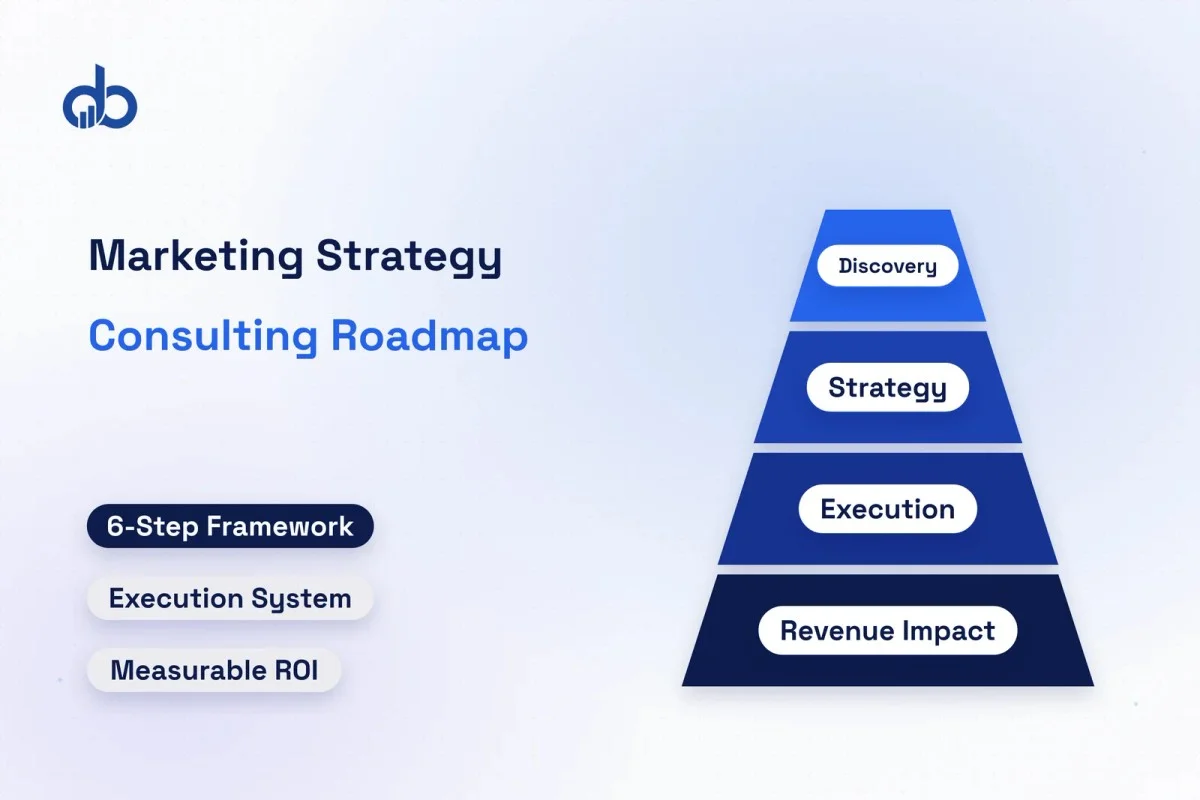
Only 37% of B2B companies have a documented marketing strategy. Yet organizations that document their strategy are 397% more likely to report marketing success. That gap is exactly where a marketing strategy consultant earns their fee.
But knowing you need strategic help isn’t the same as knowing what the engagement should look like. Most consultants present a polished strategy document and call the work done. The client gets a plan they can’t execute. No one owns it. Marketing spend continues without direction while the strategy ages in a shared drive.
The step most engagements skip (co-designing the execution system) is what separates a strategy that ships from one that ages in a presentation deck. This guide covers every step: from goal alignment to the accountability framework that keeps the strategy alive after the consultant exits.
Prerequisites: What You Need Before the Engagement Begins
Before a marketing strategy consultant can build anything useful, the right inputs need to be in place.
Consultants who skip structured discovery build strategy on assumptions. The output looks credible but fails on contact with the client’s real customers, team capacity, and market dynamics. It’s expensive to correct.
Have these ready before the first session:
- Last 12 months of marketing performance data: channel spend, leads generated, and conversion rates by source
- A specific revenue goal for the next 12 months (a target number, not directional language)
- Customer data: CRM segments, top customers by revenue, and churn reasons if available
- Your current positioning statement: how you describe what you do and for whom
- A list of competitors you’re actively losing deals to, not just names you recognize
- Budget parameters: what you can spend on execution after the strategy engagement closes
Arriving without these inputs shifts the first two weeks from productive work to rediscovering information the client already had. That’s a week of consulting time (and budget) spent on prep that should have been done before kickoff.
Step 1: Define Business Goals and Set Measurable Marketing Objectives
Every marketing strategy consulting engagement starts with one question: what does winning look like in 12 months?
The answer must be specific. “We want to grow” isn’t a goal. “We want to add $1.2M in new ARR from mid-market B2B clients” is.
The consultant’s first job is to translate that business target into a measurable marketing objective. The math looks like this: $1.2M in ARR requires roughly 240 qualified demos. At a 50% sales-qualified lead (SQL) conversion rate, that means 480 marketing qualified leads. That number sets the cost per lead (CPL) the marketing budget must support. Without that calculation, there are no success criteria. Every channel, campaign, and content decision becomes a preference rather than a number.
This is where how to develop a marketing strategy actually begins: not with channels or content, but with the revenue math. Most consultants discuss goals in the first discovery call but never formalize them as KPIs traceable to revenue. The strategy becomes detached from the business outcome. And when results don’t appear, neither party has a clear standard to measure against.
Not sure what your marketing objectives should actually be? Our Marketing Consulting team maps measurable KPIs to your revenue targets before any strategy work begins.
With the revenue math documented, the engagement has a success standard. That standard is what makes every subsequent step defensible. Step 2 builds on it by mapping exactly who the strategy must reach.
Step 2: Map Your Target Audience and Market Position
Most businesses have a working hypothesis about their ideal customer profile (ICP). A winning marketing strategy requires evidence, not a hypothesis.
The consultant’s job here is to replace assumptions with what the data actually shows. That means structured interviews with existing customers: not asking what they liked, but mapping how they first recognized the problem, how they searched for a solution, what alternatives they considered, and what made them choose this company over others.
In the buyer interviews we run, the most consistent discovery is that buyers found the company differently than the company believed. The CEO assumes buyers come from LinkedIn. The actual first touch was a Google search six weeks before they contacted anyone. That gap rewrites the channel strategy before a single dollar is allocated.
Once the real ICP is documented, market positioning becomes a calculation. Map the client against competitors on a 2x2 grid by value delivered and price point. Where’s the white space? Where is the client currently positioned, and where does the strategy need to take them? What claims can they make that competitors can’t credibly match?
Run at least five customer interviews before building any audience profile. Three conversations surface patterns. Five confirm them. Anything fewer and you're still working from assumptions dressed as data.
This step produces the positioning foundation the rest of the strategy is built on. Skip it, and the messaging framework in Step 4 will speak to the wrong person. Step 3 audits what current marketing is actually producing before anything new is built.
Step 3: Audit Current Marketing Performance
[IMAGE] article-29-marketing-audit — Marketing Audit Framework: Four Areas Every Consulting Engagement Must Assess
Before building anything new, a marketing audit surfaces what is working, what is wasting budget, and what structural gaps are limiting growth.
The audit covers four areas.
Channel performance: What does each channel cost per lead, and what’s the lead quality? A channel generating 200 leads per month at $15 CPL looks strong until you track close rates. If those leads close at 3% while a channel generating 30 leads at $80 CPL closes at 28%, the expensive channel is cheaper per customer. The audit reveals real cost-per-customer, not just cost-per-lead.
Content audit: What content currently drives traffic, rankings, or conversions? What’s outdated, underperforming, or cannibalizing other pages? Most businesses have more content than they realize. They just don’t know which pieces are working.
Data audit: Is conversion tracking configured correctly? Are the right events firing in Google Analytics 4 (GA4)? Can the client attribute revenue to specific channels, campaigns, or content? Most SMBs find significant tracking gaps here. Without clean data, every optimization decision rests on incomplete information.
Budget audit: How is spend currently allocated, and does that allocation match where results are coming from? The audit frequently reveals budget concentrated in weak-performing channels while high-performing ones are underfunded.
The output is a priority matrix: Quick wins (high impact, low effort), Strategic shifts (high impact, higher effort), Maintenance items, and Cut (low return regardless of effort). This matrix sets the execution sequence for Step 4.
Want to know exactly where your marketing budget is going to waste? Get Free Marketing Audit: we identify channel waste and surface the highest-ROI opportunities before you reallocate a dollar.
Step 4: Build the Core Strategy Framework
The goals are defined. The audience is mapped. Current performance is audited. Now the consultant builds the strategic architecture. This framework is what every campaign, content decision, and budget allocation gets measured against.
A winning marketing strategy includes five components.
Positioning statement: Who you serve, what you do, and what makes you credibly different. This is an internal compass, not a tagline. It determines which claims you make in market and which you leave to competitors.
Channel selection: Based on where your ICP spends time and which funnel stage the business most needs to support. Not “we should be on LinkedIn because competitors are” but “our buyers research on Google first, then validate on LinkedIn, which is why we prioritize organic search for acquisition and LinkedIn for nurture.”
Messaging framework: The value proposition leads to three to five key messages. Each message has a supporting proof point. Every piece of marketing content produced from this point maps back to one of those messages.
Content architecture: A pillar and cluster structure mapped to the buyer journey. Awareness content builds traffic and familiarity. Consideration content handles comparison and evaluation. Decision content handles objections and drives conversion.
Campaign prioritization: Every initiative ranked by estimated revenue impact and time-to-first-result. The first 90 days focus on quick wins that generate data and build internal confidence. Longer-term initiatives run in parallel.
The framework isn’t a plan. It’s the rationale that makes plans defensible. When a team member, board member, or budget reviewer asks why the business is doing what it’s doing, the framework has the answer. That clarity is what makes Step 5 executable rather than theoretical.
Step 5: Turn Strategy Into an Execution System, Not Just a Document
[IMAGE] article-29-execution-gap — The Strategy-to-Execution Gap: Why Most Marketing Plans Fail to Ship
This is where most marketing strategy consulting engagements break down.
The standard model delivers a strategy document, presents it, and closes the engagement. The client receives a polished framework without the internal bandwidth, defined ownership, or execution infrastructure to ship it. The consultant exits. The strategy ages.
This failure isn’t rare. 64% of CMOs say they lack the internal resources to fully execute their marketing strategies. That figure points to more than a resource problem. It’s a design problem. Most strategies are built to impress in a presentation, not execute within a real team managing competing priorities.
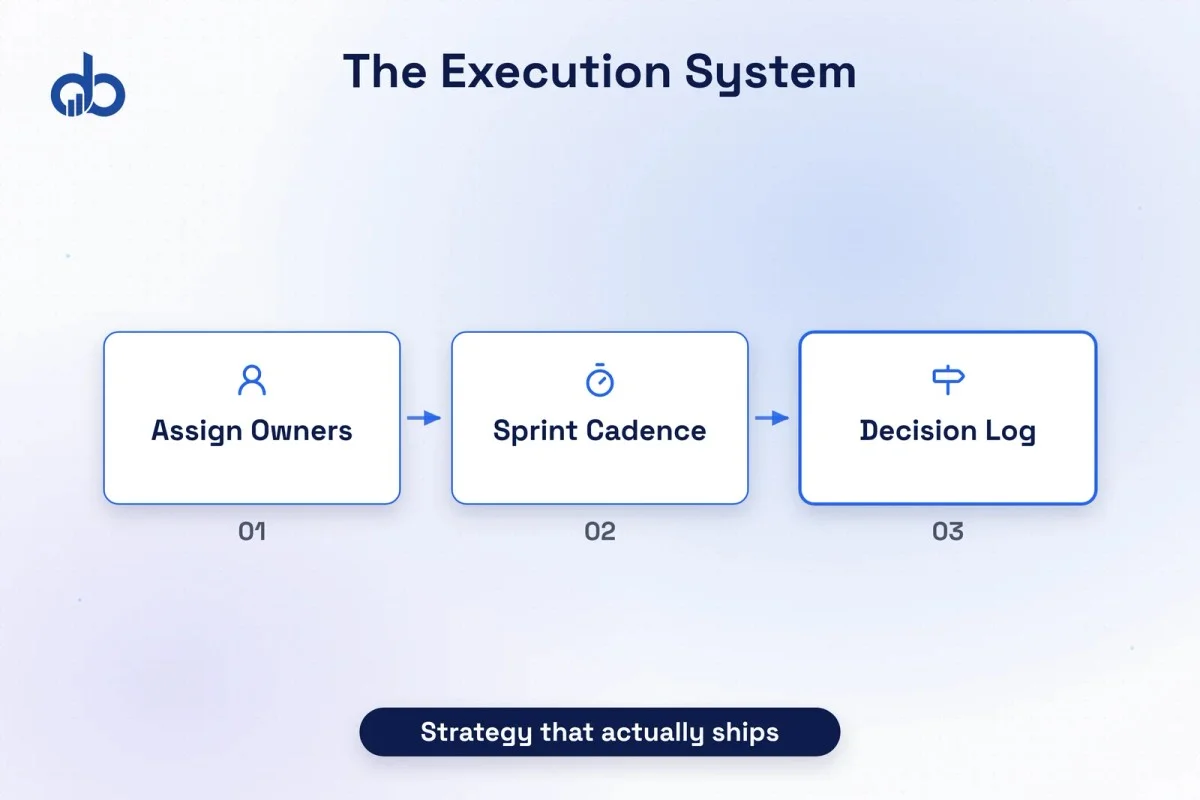
A winning marketing strategy consulting engagement co-designs the execution layer before the consultant exits. That means three things.
Owner assignment: Every initiative has a named person responsible for the output, the timeline, and the escalation if something blocks progress. Not “the marketing team.” A name.
Sprint sequencing: A 30-day sprint launches execution and establishes baselines. The 60-day milestone delivers first performance data and initial channel optimization. The 90-day review is a structured strategy assessment: what’s working, what needs adjustment, what to cut.
Decision log: Pre-agreed triggers that distinguish a tactical adjustment from a strategy revision. When a channel underperforms in week three, is that a signal to adjust the ad copy or a signal to reconsider the channel? Without a decision log, every underperformance triggers an unnecessary strategy debate.
Build the decision log in the first week of execution, not after the first underperforming result. Pre-agreed triggers are dispassionate. After-the-fact triggers get political.
A documented strategy without an implementation owner is a paid hypothesis. The execution system is what turns the hypothesis into a result.
Has your marketing strategy been sitting unexecuted? Digiblazon’s Marketing Consulting team builds the execution infrastructure alongside the strategy, so the plan doesn’t stop at the presentation.
Step 6: Set Up Accountability Checkpoints and Measurement
[IMAGE] article-29-accountability-loop — Marketing Strategy Accountability Loop: 30-60-90 Day Checkpoint Framework
The final element of a winning marketing strategy consulting engagement is the governance layer. Who reviews what, on what cadence, and what decisions get triggered by what data.
The 30-60-90 checkpoint structure gives the client and consultant a shared calendar for evaluation.
At 30 days, execution has launched, baselines are established, and early leading indicators are tracked. Pipeline touches, content published, ad impressions, email list growth. No one expects revenue results at 30 days. The question is whether the right activities are running at the right scale.
At 60 days, first performance data arrives. Channel-level optimization starts here, based on real data rather than strategy assumptions. Audience validation happens in this window too. Are the people engaging with content and ads matching the ICP the framework predicted? If not, messaging or targeting needs adjustment before budget scales.
At 90 days comes the strategy review. This isn’t a check-in. It’s a structured assessment against the success criteria defined in Step 1. What’s working and warrants more investment? What’s underperforming and needs adjustment or a cut? What assumptions from the original strategy have been confirmed or disproven by real data?
Leading indicators (pipeline activity, content output, traffic growth) tell you if the strategy is executing correctly. Lagging indicators (revenue, CPL, ROAS, customer acquisition cost) tell you if it’s working. Measuring only lagging indicators leaves you blind for the first 60 days. Measuring only leading indicators lets busy execution mask poor results.
The cadence must be agreed with named reviewers before the consultant exits. A governance structure left undefined defaults to no governance at all.
Questions we hear on calls:
“How do I know if I’m hiring the right marketing strategy consultant?”
Ask five questions before you sign anything: Do they start with your revenue goal before discussing tactics? Have they worked with companies in your revenue range? Can they show you an execution system (with owner names and a decision log) from a prior engagement? Do they define success in revenue terms or marketing-activity terms? If they can’t answer all five specifically, keep looking.
“What’s the most common mistake in the first 90 days?”
Skipping the decision log. The strategy launches, something underperforms in week three, and because no one pre-agreed on what triggers an adjustment versus a pivot, it turns into a leadership debate. Two weeks lost. Build the decision log in week one, not after the first bad result.
How to Evaluate Whether Your Marketing Strategy Is Actually Good
Most founders and CMOs receive a marketing strategy with no reliable framework for evaluating it before they try to execute it.
A strategy that looks credible in a presentation can fail all five of the following tests.
Goals are tied to revenue. Not traffic targets or impression benchmarks. Revenue-traced KPIs with a clear mathematical path from marketing activity to business outcome.
ICP has behavioral and firmographic specifics. Not “B2B companies with 50 to 200 employees.” The ICP should describe how buyers recognize the problem before they know a solution exists, what triggers a search, what alternatives they compare, and what makes them choose.
Channel selection has a rationale. Not a list of channels to activate. A stated reason for each one: why this channel fits this ICP at this funnel stage with this budget.
Messaging has proof points. Every key message is supported by evidence: a client outcome, a data point, a differentiating capability. Positioning without proof is just language.
90-day plan has named owners and success metrics. Not “next steps.” A list of who does what, by when, and what the measurable output looks like.
A strategy missing any of these is incomplete. Knowing how to develop a marketing strategy well enough to evaluate one after delivery protects against receiving a presentation disguised as a strategy.
Common Marketing Strategy Consulting Mistakes That Kill Results
Starting with tactics before strategy. Building campaigns before the ICP is defined, the positioning is confirmed, and the channel rationale is documented. Tactics without strategy are expensive experiments with no learning framework.
No structured discovery. Consultants who skip the prerequisites discovery phase build strategy on what the client believes to be true. The first month of execution corrects those beliefs at the client’s expense.
The document-exit failure. Strategy delivered without an execution system. The consultant exits. The client has a plan but no owner assignments, no sprint structure, and no decision log. Sixty days later the strategy is forgotten.
Measuring activity instead of outcomes. Counting blog posts published, ads running, and emails sent. These are outputs, not results. The right framework tracks what those activities produce in terms of pipeline, CPL, and revenue.
No revision trigger. Treating the strategy as permanent. Markets shift. Competitive dynamics change. Team capacity fluctuates. A strategy without a pre-agreed revision trigger gets either abandoned or defended past its useful life.
The Strategy That Actually Ships
Most marketing strategy consulting engagements produce a deliverable. The best ones produce a system. The deliverable sits in a shared drive. The system runs in the background of every campaign, every budget call, and every hire the business makes in the next 12 months.
Digiblazon’s Marketing Consulting service is built around that gap: from the diagnostic audit that surfaces where your current strategy is breaking down, to the execution infrastructure that ensures the next one actually ships. If you want to see where your marketing strategy is falling short and what it would take to close that gap, start with a Free Marketing Audit.
- Define measurable goals before building strategy — vague objectives produce vague plans that no one can execute.
- A marketing audit takes 2–4 weeks but prevents months of misdirected spend; skip it and the strategy addresses the wrong problems.
- Document who owns every tactic and what "done" looks like — unnamed ownership is the fastest path to execution failure.
- Your strategy is only as good as the execution system built alongside it — a document no one follows wastes budget.
- Accountability checkpoints every 30–90 days let you course-correct before a tactical mistake becomes a strategic one.
Frequently Asked Questions
What is the difference between a marketing strategy consultant and a marketing agency?
A marketing strategy consultant diagnoses problems and builds the strategic framework: positioning, channel prioritization, messaging, and measurement architecture. An agency executes against a brief. Consultants work upstream of agencies. Without a clear strategy, agencies optimize tactics with no strategic direction. Some firms offer both, but strategy and execution are typically separate engagements with different success metrics.
How much does marketing strategy consulting cost?
A project-based strategy engagement typically runs $8,000 to $25,000 for SMBs, covering discovery, audit, framework development, and a 90-day execution roadmap. Retainer-based consultants charge $3,000 to $8,000 per month for ongoing advisory. Fractional CMO arrangements run $150 to $500 per hour depending on experience. Cost scales with scope, business complexity, and the seniority of the consultant.
How long does a marketing strategy consulting engagement take?
A complete engagement, from kick-off to final strategy delivery, typically takes 8 to 12 weeks. Discovery and audit take the first 3 to 4 weeks. Strategy development runs weeks 5 to 8. Alignment sessions, revisions, and execution planning fill weeks 9 to 12. Engagements compress for businesses with clean data and clear goals. They expand for organizations with fragmented marketing history or contested internal priorities.
When should I hire a marketing strategy consultant instead of a fractional CMO?
Hire a marketing strategy consultant when you need a defined diagnostic and framework with a clear end date. Hire a fractional CMO when you need ongoing strategic leadership embedded in your operations: someone who attends leadership meetings, manages vendors, and owns the marketing P&L week to week. The decision comes down to whether your need is a one-time strategy build or sustained leadership capacity.
How do I know if the marketing strategy I received is actually good?
A good marketing strategy includes revenue-tied goals, a behaviorally specific ICP, a channel selection rationale, messaging with proof points, and a 90-day execution plan with named owners and success metrics. If any of these are missing or vague, the strategy is incomplete regardless of how polished the presentation looks.