
The average editor or journalist responds to 3.43% of the pitches they receive. That means 96 out of every 100 emails get deleted, including ones built from templates marketed as “foolproof” and “battle-tested.”
Key Stat: 3.43% average editor response rate to pitch emails (AMW Group, 2025). Pitches that address an editorial gap achieve 24% higher reply rates.
If your pitches aren’t landing replies, the template is rarely the problem. What fails first is the step before the template: understanding what the editor actually needs right now. Most pitching advice skips this step entirely. That’s why response rates stay at 3.43% even when the formatting looks right.
This guide gives you five sample email pitch to editor templates, each paired with the specific editorial context it’s built for. The research step before each template is what makes the difference between the average 3.43% response rate and the 24% higher rates that come from pitching editorial gaps.
What Separates Pitches That Get Replies from Ones That Get Deleted
Eighty-three percent of journalists say they want personalized pitches. Most PR and content teams know this. So why does the average response rate stay at 3.43%?
Key Stat: 83% of journalists want personalized pitches. Most teams personalize the name, not the angle. That's why response rates stay at 3.43%.
Because most teams personalize the greeting, not the angle. “Hi Sarah” isn’t personalization. “I read your piece on B2B content measurement from last Thursday, and there’s an angle your readers asked about in the comments that your piece didn’t address.” That’s personalization.
Seventy-three percent of journalists reject pitches because they’re not relevant to their coverage area. Relevance isn’t about matching the publication’s general topic. It’s about matching what the specific editor is covering this month, what their readers have been asking about, and what the publication hasn’t yet covered recently.
Here’s the thing most pitch guides miss. The distinction between a pitch that lands and one that doesn’t comes down to one concept: the editorial gap. An editorial gap is a topic, angle, or data point the publication’s audience is actively interested in but the outlet hasn’t addressed yet. Editors are always looking to fill these. A pitch that names and fills one gets read. Everything else goes in the bulk folder.
The data backs this up. Most pitch template articles treat pitching as a volume game: use a good template, personalize it lightly, send to many editors, iterate on response rates. But the numbers tell a different story. The 3.43% average response rate doesn’t improve from better templates alone. Pitches that address an editorial gap achieve 24% higher response rates than personalized-but-generic outreach. The gap between 3% and 24% isn’t the template. It’s the research step before the template. The limitation: editorial gap research takes 20-30 minutes per pitch, which makes volume approaches unworkable for most marketing teams without a dedicated content outreach role.
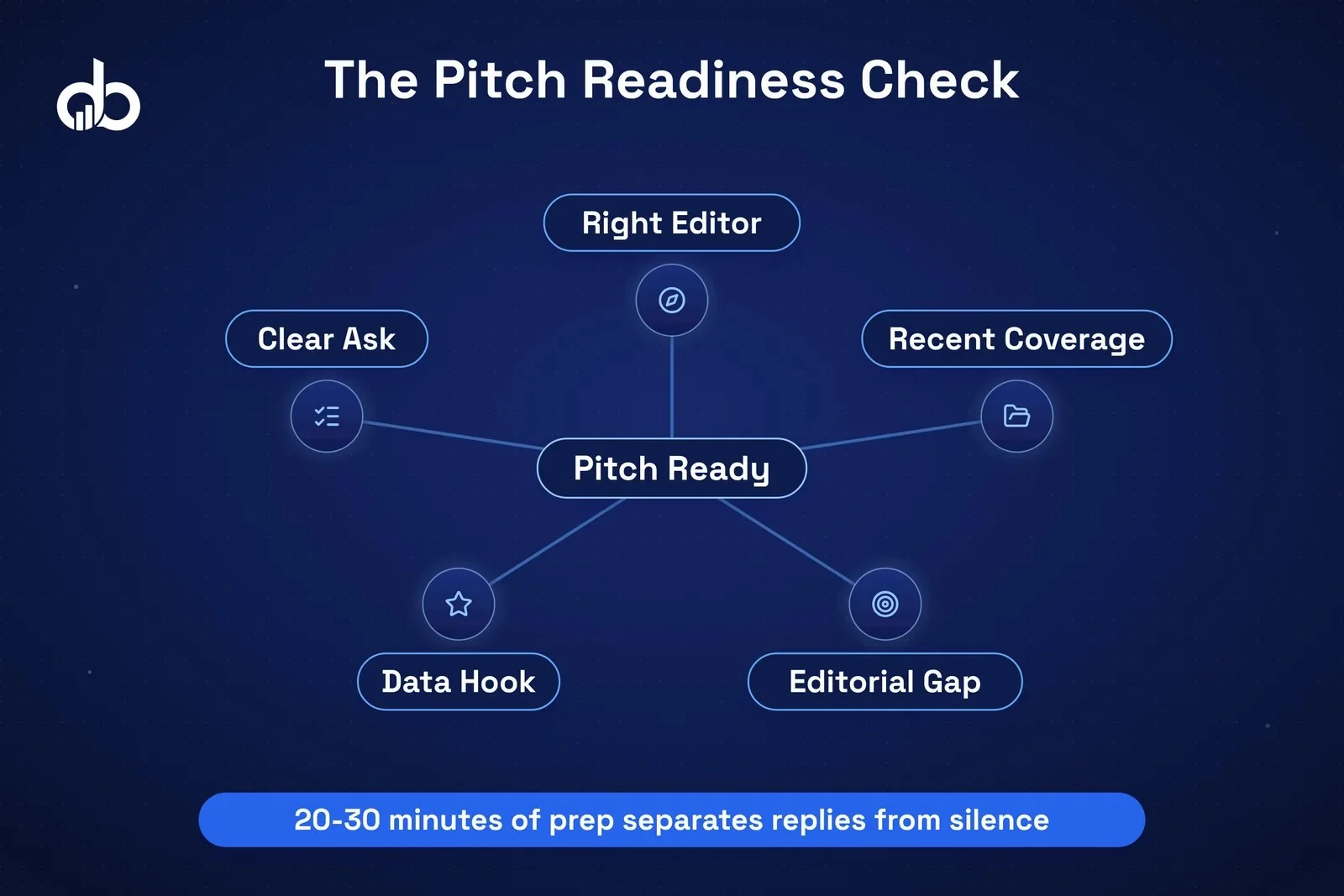
Before writing any version of a sample email pitch to editor, run this readiness check:
Pitch Readiness Check:
- Right editor: confirmed they write about this topic, not just that the publication does
- Recent coverage checked: read their last 5-10 bylines; not pitching what they covered last month
- Editorial gap identified: named the specific angle or reader question their recent content left unanswered
- Data or credibility hook ready: original data, a fresh case study, or specific subject matter expertise
- One clear ask: a single next step in plain language (not “let me know your thoughts”)
This five-point check takes 20-30 minutes per pitch. That’s the actual cost of a pitch that gets a reply. Teams that skip it are paying for the 3.43% result.
In editorial outreach for content marketing clients, pitches built around an identified editorial gap consistently generate 3-5x higher response rates than volume-based approaches. The research step isn’t optional; it’s the work.
Subject line length matters before the editor reads a word of your pitch. Two to four words consistently outperform longer subject lines in open rate testing. The goal is to identify the specific angle, not describe the entire pitch: "Attribution gap for your marketers" beats "Pitch: A New Article Idea About GA4 Attribution for Your B2B Marketing Audience."
Ready to build an editorial outreach strategy that actually gets placements? Get Free Marketing Audit
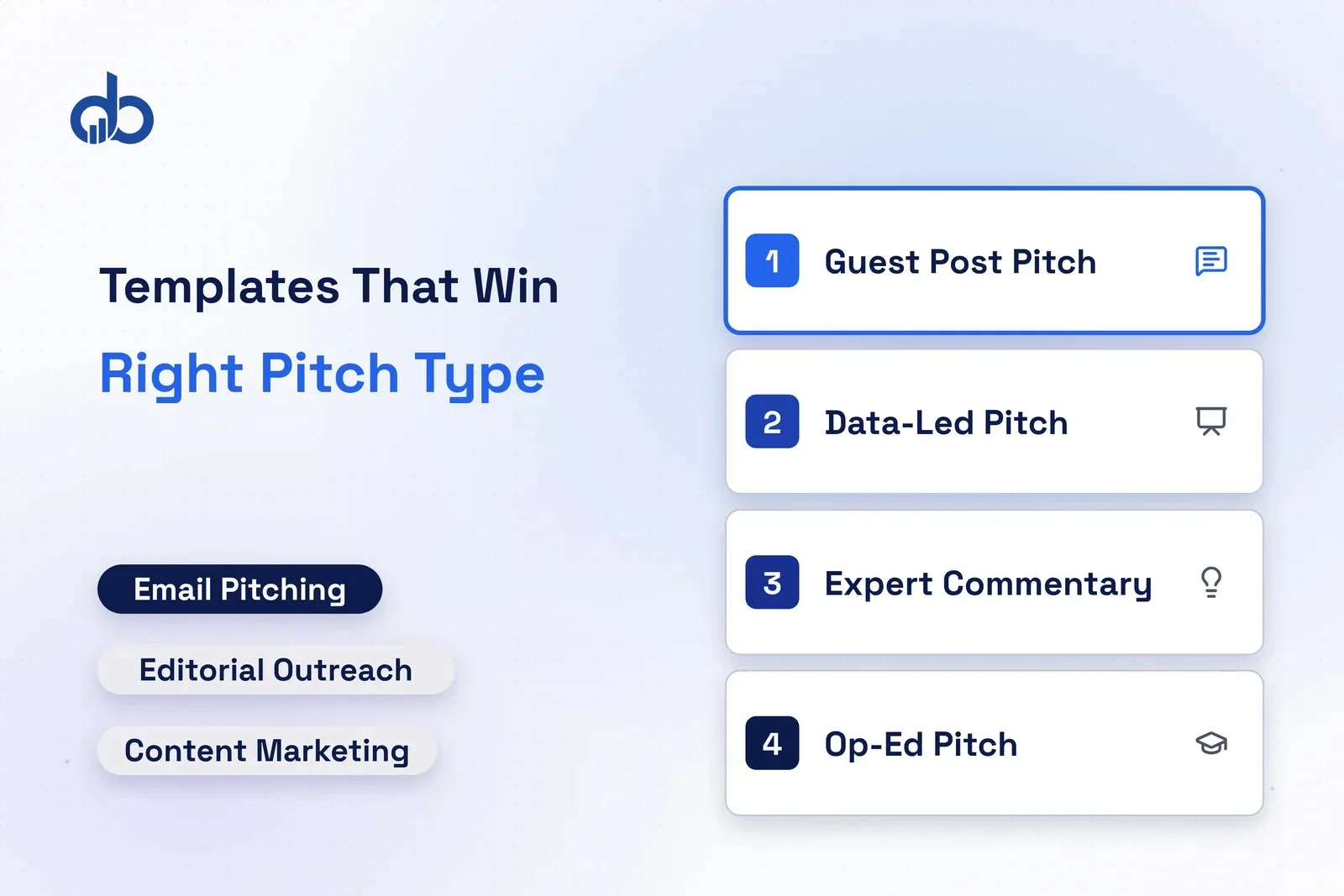
Template 1: Guest Post Pitch Email
The guest post pitch is the most common sample email pitch to editor format in digital marketing. You’re asking an editor to publish content you’ll write for their audience, often with one link back to your site or a client’s site.
The failure mode is pitching a topic the publication has already covered five times. The win condition is pitching an angle they haven’t covered but their readers are asking about.
Subject line formula: [Specific angle or data hook] for [Publication name]‘s [audience type] readers
Example: One attribution model their GA4 setup misses, written for your marketers
Avoid: “Guest Post Request,” “Article Idea,” “Collaboration Opportunity.” These are the subject lines editors recognize as generic pitches before they even open them.
Template 1A: Guest Post Pitch:
Subject: [Specific angle]: guest piece for [Publication]
Hi [First name],

I read your piece on [specific article title] from [week/month]. The comments section had several readers asking about [specific follow-on question], a gap your piece didn't have room to cover.

I'd like to write that piece for you. Working title: [Proposed title]. It covers:

- [Point 1: one sentence]
- [Point 2: one sentence]
- [Point 3: one sentence]

Word count: ~[X] words. I write regularly for [one relevant byline with link].

If this fits your editorial calendar, I can have a draft to you by [specific date].

[Your name]
Why this works: The opening line proves you read their work, not just their masthead. The comments reference shows you identified an actual reader gap, not an invented one. Three bullet points respect the editor’s time: they’re not reading a full pitch deck. One byline link is enough; a portfolio dump signals you’re outsourcing the credibility check to your list.
The guest post pitch also differs from the media pitch examples covered in Template 2. An editor reviewing a guest pitch evaluates it as a content contribution. An editor reviewing a media pitch evaluates it as a PR opportunity. These are different filters, and using the wrong template for the context is the single most common pitch mistake.
Template 2: Data-Led Media Pitch for Brand Coverage
This is the template for getting a brand, product, or company mentioned in editorial coverage, not for placing your own content. It’s the article pitch email example most likely to land in industry publications, trade media, or vertical news outlets.
Editors at these outlets get pitched companies constantly. What they rarely get pitched is original data. A survey of 500 marketing directors. A six-month analysis of campaign performance across clients. A benchmark report no one else has run yet. When you lead with that, the pitch becomes a content opportunity for the editor, not a promotion request from your brand.
Subject line formula: New data: [finding] among [audience group]
Example: New data: 61% of ecommerce brands misattribute their top revenue channel
Template 2A: Data-Led Media Pitch:
Subject: New data: [Key finding] for [short audience descriptor]
Hi [First name],

We surveyed [N] [audience type] and found [specific data point]. One result was particularly relevant to what your readers are navigating right now: [secondary finding in one sentence].

I thought this might be useful for a piece you're working on, or as standalone data for a short. Happy to share the full dataset and arrange an interview with [spokesperson name and title] if that would help.

The data is available exclusively for [Publication] for the next [X] days.

[Your name]
[Title, Company]
Why this works: The pitch is framed as a service to the editor’s audience, not a promotion. The “exclusively for X days” line is genuine urgency: it works because editors know it means they have a window before competitors get the same data. Attaching nothing to this first email keeps it out of spam filters and keeps the ask small. The spokesperson detail shows you’re ready to deliver; you’re not pitching vaporware.
This is one of the most effective media pitch examples for getting brands mentioned in outlets like Search Engine Journal, Marketing Week, and trade publications. Most other media pitch examples fail here because they lead with the company announcement, not the editorial value.
When you move from Template 2 to reactive pitching, the dynamic shifts entirely. Template 3 covers that scenario.
Template 3: Expert Commentary Pitch
This is reactive pitching: responding to a trend, a news story, or a topic an editor is actively covering. It’s often called “newsjacking” in PR circles, but the more accurate frame is that you have a source the editor needs right now.
The response rates on reactive pitches are higher than on cold proactive pitches because you’re arriving at a moment of genuine editorial demand. The editor is already working on a piece. They need a credible voice. Your job is to show up at the right moment and make their job easier.
Where to find opportunities: Set up Google Alerts for your key topics. Monitor editors’ recent bylines. Follow relevant hashtags. Subscribe to Connectively (formerly HARO) alerts. When a story breaks in your space, this is the moment.
Subject line formula: Source for your [topic] piece: [expert name], [brief credential]
Example: Source for your GA4 deprecation piece: Dhaval Patel, digital analytics lead
Template 3A: Expert Commentary Pitch:
Subject: Source for your [topic] piece: [Name], [brief credential]
Hi [First name],

I saw your recent coverage of [specific topic or article]. [One-sentence observation about their angle or coverage direction.]

[Expert name] is [one-sentence credential relevant to this topic specifically]. They can speak to [specific angle or data point] with firsthand experience in [relevant context].

Available for a [15-minute call / email Q&A / quoted statement], whichever is easiest for your deadline. If it's helpful, I can send a two-paragraph background brief on their perspective on [topic] right now.

[Your name]
[Title, Company]
Why this works: This article pitch email example leads with what the editor needs, not who you’re representing. The “available for” line removes friction: the editor doesn’t have to guess whether you’ll deliver. Offering to send a background brief immediately addresses the editor’s biggest pain, which is finding a credible angle fast under deadline pressure.
This sample media pitch for expert commentary works because it positions your contact as a resource the editor needs right now, not a brand seeking exposure.
On reactive pitches, speed is a ranking factor. Editors working on breaking topics need sources within hours, not days. If you have a relevant expert in your network, set up a system to flag relevant news in under 30 minutes and get the pitch out the same day. A pitch sent four hours after a story breaks has a higher open rate than the same pitch sent two days later.
From reactive pitching, the next distinct format is thought leadership, where you’re not offering a source but putting forward a specific opinion worth publishing.
Common questions we hear on calls:
“How many pitches should we be sending per week?”
Depends on whether you’ve done the editorial gap research first. Without it, volume doesn’t move the needle; you’re just generating more noise at the average 3.43% response rate. With genuine editorial gap research, 5-10 well-targeted pitches per week will outperform 50 generic ones. Start with a target list of 10-15 publications, study their editorial calendar and recent bylines, then pitch only when you have an angle that fills a real gap. Most teams can sustain that at 3-5 pitches per week realistically.
“What happens if the editor never replies to any of our pitches?”
Two possibilities. First: the editorial gap research isn’t happening; pitches are generic even if personalized. Second: the target publication list is wrong; you’re pitching publications where your content isn’t a genuine editorial fit. Before sending more pitches, pull your last 10 and ask whether each one addressed a specific gap the publication had left open. If the answer is no for most of them, the research step needs to happen before the next send.
Template 4: Thought Leadership Op-Ed Pitch
An op-ed pitch isn’t a guest post pitch. A guest post says “I’ll write something useful for your readers.” An op-ed pitch says “I have a perspective that challenges the conventional wisdom your readers hold.” The distinction matters because editors evaluate them differently.
The test: if your pitch could be written by anyone with decent knowledge of the topic, it’s not an op-ed; it’s a how-to article. An op-ed requires an opinion the author can defend, preferably one that a meaningful portion of the industry would initially disagree with.
Where this works: Publications like Forbes, Entrepreneur, Search Engine Journal opinion sections, Marketing Week, and vertical trade publications that run bylined perspective pieces.
Subject line formula: [Contrarian claim]: an op-ed for [Publication]
Example: Why content calendars produce worse content: an op-ed for Marketing Week
Template 4A: Thought Leadership Op-Ed Pitch:
Subject: [Contrarian claim]: op-ed for [Publication]
Hi [First name],

[Accepted belief] is widely held in [industry]. I think it has a flaw that's costing [audience type] [specific consequence].

Working title: [Op-ed title]

Central argument: [One to two sentences stating the specific claim and the evidence behind it.]

[Your name] is [one-sentence credential that makes you specifically credible to hold this view, not to teach this topic, but to have this opinion based on direct experience.]

Happy to send a 200-word outline or draft opening if that would help you assess the fit.

[Your name]
[Title, Company]
Why this works: The second sentence names the specific consequence: editors of opinion sections aren’t looking for observations; they’re looking for stakes. The “central argument” line in two sentences is the hardest part of this pitch to write, but it’s what the editor reads first to decide if this piece has a reason to exist. The credential framing is different from a how-to byline credential; it matters here because op-ed editors want voice, not expertise.
This sample media pitch format consistently generates brand mentions in industry publications. It doesn’t generate a link; it generates a byline, which compounds over time into editorial relationships.
Once your proactive pitches are in motion, the follow-up is the sequence most teams mishandle. Template 5 covers the rules.
Template 5: The Follow-Up Email
Forty-eight percent of journalists say they’ll block a PR contact for repeated follow-up. The follow-up email is the most dangerous pitch in the sequence because the margin between “polite and welcome” and “blocked” is one email.
The rule is simple: one follow-up maximum, sent three to six business days after the original (Muck Rack, 2025). But the format of that follow-up matters as much as the timing.
The only acceptable follow-up adds new information. Options include:
- A new stat that strengthens the angle
- A related industry development that makes the story more timely
- A story angle update triggered by something that happened since you sent the original
“Just checking in” isn’t a follow-up; it’s a reminder that you expect a response. Editors don’t owe you one, and sending that message signals that you don’t understand how their work operates.
Template 5A: Follow-Up Email:
Subject: Re: [original subject line]
Hi [First name],

Following up on my pitch from [date]. One development since I sent it: [new data point, industry update, or angle shift in one sentence that adds genuine value to the original pitch].

Still happy to discuss if the timing works. If this isn't a fit for your coverage right now, no worries. I appreciate your time.

[Your name]
Why this works: The “one development” line is the entire justification for sending this email. If you don’t have a genuine new development, don’t send the follow-up; send a different pitch for a different story. The final sentence gives the editor an out without demanding a rejection. Editors remember that. It makes it easier for them to respond next time with a yes.
Which Sample Email Pitch to Editor Template Should You Use?
The five templates above cover the most common editorial outreach goals, but using the wrong one for the context produces lower response rates regardless of template quality.
Decision guide:
Checklist:
- Guest post template: you’re pitching original content for their audience, educational angle, you can write the piece
- Data-led media pitch: you have proprietary data, a survey result, or original research; you want brand mention, not byline
- Expert commentary: a story is breaking in your space right now and you have a credible SME ready to speak to it
- Op-ed pitch: you have a specific contrarian opinion backed by firsthand experience; you want a bylined perspective piece
- Follow-up: you sent a pitch 3-6 business days ago with no reply and you have a genuine update to add
Common mistake: Using a sample email pitch to editor built for PR (the data-led media pitch) when the goal is a guest post placement. These are different editorial relationships. A media pitch from a brand gets evaluated as a PR opportunity. A guest post pitch from an individual author gets evaluated as a content contribution. The editor reads them with different filters.
Among the best media pitch examples that misfire, the most common pattern is a data-led pitch sent through a personal byline request, which confuses the editor about what they’re being asked to do. Keep the format matched to the ask.
Another common mistake: Sending the same article pitch email example to multiple editors at the same publication simultaneously. Publications track this. And it ends the relationship before it starts.
When you’ve identified the right template and confirmed the editorial gap, the actual pitch takes about 15 minutes to write. The research before it takes 20-30 minutes. That asymmetry is the job. Teams that invest in the research step consistently generate editorial placements. Teams that start with the template rarely get past the subject line.
Your Pitches Are Ready. Your Editorial Strategy Might Not Be.
You now have a complete sample email pitch to editor toolkit matched to the specific editorial goal each format is designed for. Using the right template for the right context is the decision that separates a 3.43% response rate from a 24% higher rate.
The harder challenge isn’t knowing which template to use once. It’s building an editorial outreach strategy that generates consistent placements across multiple publications, maintains relationships with editors over time, and aligns each placement with your broader content marketing goals. That’s where most in-house teams run into capacity limits (and that’s not a small thing to admit).
Our Content Marketing service handles pitch strategy, editorial research, and outreach execution so brands can build editorial authority systematically, not one cold email at a time. If you want to see what that could look like for your business, start with a Free Marketing Audit.
Learn more about how Performance Marketing and editorial coverage work together to build qualified pipeline at every stage of the funnel.
- The average editor responds to 3.43% of pitches; addressing a specific editorial gap consistently drives 3–5× higher response rates.
- Match the template to the editorial goal: guest post for original content, data-led for brand mentions, expert commentary for reactive news.
- Every effective pitch identifies a gap in the publication's recent coverage — personalization goes deeper than a first-name greeting.
- One follow-up maximum, sent 3–6 business days after the original, and only if you have genuinely new information to add.
- Subject lines of 2–4 words consistently outperform longer lines — the angle belongs in the subject, not the generic topic.
Frequently Asked Questions
How long should an email pitch to an editor be?
Keep the first pitch under 200 words. Editors open dozens of pitches daily and most read on mobile. Your pitch competes with every other email in their inbox. A pitch that can be read in 30 seconds and evaluated in two more has a structural advantage. If the editor needs more detail to decide, they'll ask for it. That reply is a win.
What should I include in an article pitch email?
Five things: a subject line that names the specific angle (not the topic), a personalized opening that shows you read their work, the editorial gap you're filling in one sentence, a three-bullet outline or central argument, and a single clear ask. Leave out your bio, your company description, your previous media list, and your attachment. You can send those when they reply.
How do you personalize a media pitch?
Read the editor's last five bylines. Identify one topic or angle their recent coverage hasn't addressed. Reference a specific piece by title and date in your opening line. Build the pitch hook around the reader question that piece left unanswered. That's the level of personalization that increases reply rates by 133% in Muck Rack's data compared to batch-sending with only name substitution.
What is the difference between a media pitch and a press release?
A media pitch is a one-to-one email to a specific editor proposing a story angle or offering a source. A press release is a formal announcement distributed broadly to a media list. A pitch is conversational and targeted. A press release is structured and public. Most editors today prefer the pitch first; you attach the press release only if they express interest. Leading with a press release attachment signals you're broadcasting, not pitching.
When should I follow up on an email pitch?
Wait three to six business days after the original send. Send one follow-up only, and only if you have a genuine new piece of information to add: a related development, a new data point, or a story angle update. "Just checking in" messages get ignored or trigger a block. Two unreplied pitches to the same editor without a new development means this pitch isn't a fit. Move on and come back with a different story.