
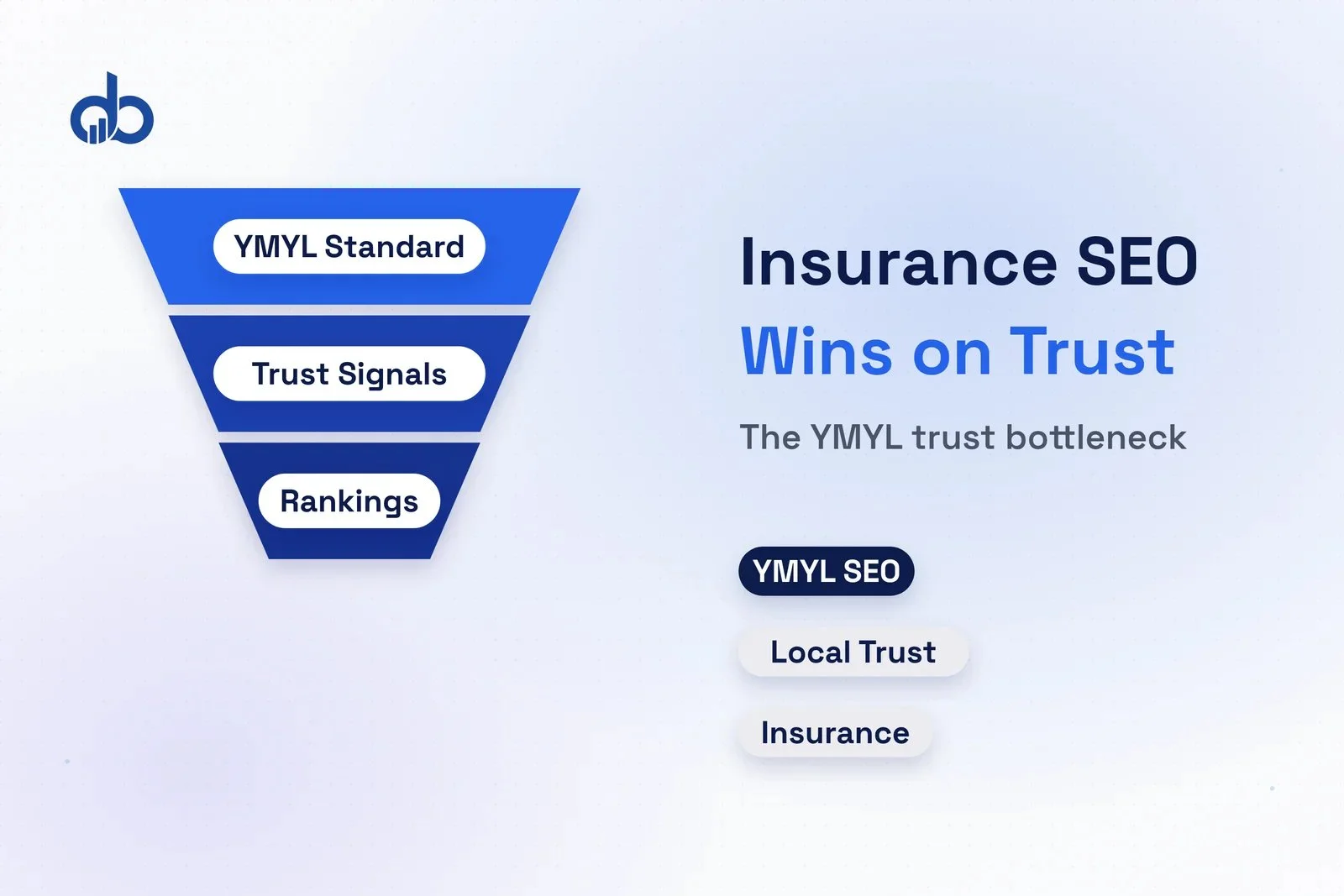
The insurance broker two miles from a prospect ranks above the national carrier with ten times the domain authority. Not because of more backlinks or a faster website. Because of trust signals Google can verify at the local level.
That gap shows up in how searchers behave, too. 68% of people trust local 3-pack listings when they find them in search results. Only 10% say the same about paid ads. The broker who earns that top local position gets the inquiry before anyone else does, including the broker who spent more on Google Ads.
47% of insurance customers buy through digital channels, ahead of agents at 35% and call centers at 17%. A broker who isn’t visible in local search isn’t competing at a disadvantage. They’ve already lost half their potential market before the phone rings.
Most brokers know the standard advice: claim your Google Business Profile, collect some reviews, build citations, do keyword research. Plenty of them follow it correctly. They still plateau. Not because the tactics are wrong, but because they’re solving the wrong problem. There are three specific trust signals that carry disproportionate weight for insurance in Google’s algorithm, and almost no broker is building them on purpose.
The Real Reason Insurance SEO Behaves Differently
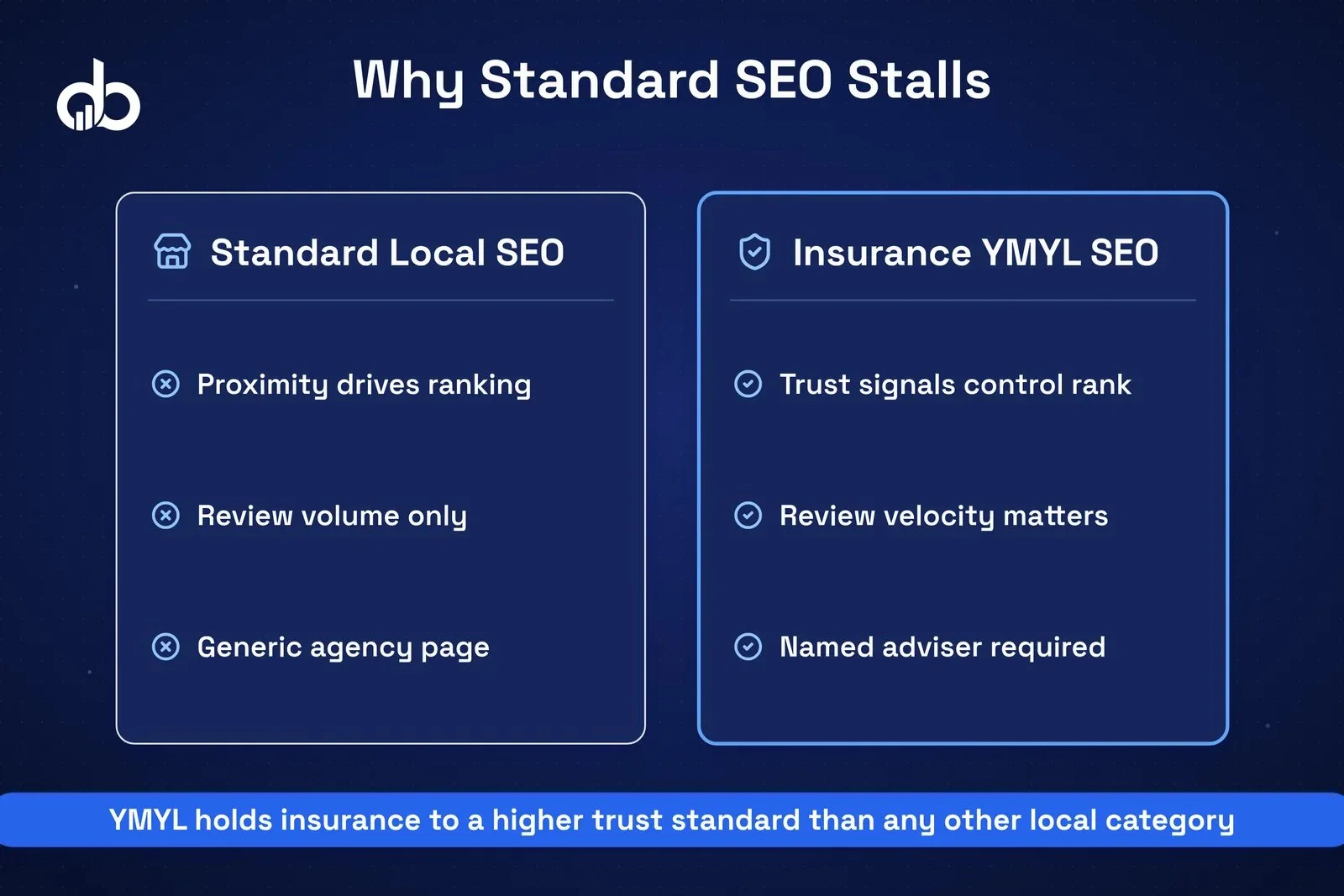
Not all local businesses face the same ranking conditions. Google’s search quality guidelines classify certain categories under YMYL (Your Money or Your Life). Insurance is explicitly in this group.
YMYL classification changes how Google’s quality systems evaluate a business. Standard local businesses (restaurants, contractors, hair salons) get ranked primarily on proximity signals, review volume, and page relevance. A wrong answer means a bad meal or a leaky faucet, and the algorithm treats the stakes accordingly.
Insurance is different. A wrong answer can cost someone their home, their savings, or their business. So Google’s quality raters, the human evaluators who train the algorithm, apply a specific test to YMYL content: does this source demonstrate enough expertise, authoritativeness, and trustworthiness to be trusted with a financial decision? The technical label for this test is E-E-A-T: Experience, Expertise, Authoritativeness, and Trustworthiness.
That changes everything for a local broker.
Two brokers in the same city, same coverage lines, identical technical SEO setups, can rank significantly differently based on how well their local trust signals satisfy this test. The 68% of searchers who trust local 3-pack listings are right to do so. The algorithm is selecting for brokers who can be trusted, not just brokers who are nearby.
Most insurance SEO guides miss this entirely, listing E-E-A-T as one of ten bullet points rather than recognizing it as the primary ranking variable for this category. For seo for insurance companies in competitive markets, that miss is the difference between a page-one local position and a plateau at position 7.
Why Standard Local SEO Stalls for Insurance Brokers
Every insurance SEO guide covers the same checklist. Claim your Google Business Profile. Get your NAP consistent across directories. Collect some reviews. Do keyword research. Publish occasional blog content.
That advice isn’t wrong. It’s incomplete. And for seo for insurance brokers specifically, incomplete advice plateaus fast.
Here’s the structural problem. Citation consistency is table stakes in insurance SEO, not a differentiator. If a broker’s NAP is consistent across 50 directories, they haven’t gained an edge. They’ve met the minimum floor every competitor already meets. The algorithm’s already accounted for it.
Reviews are a ranking factor, but not the way most brokers manage them. A broker with 45 reviews, all collected in a campaign two years ago, is algorithmically weaker than a competitor with 20 reviews spread consistently over the past eight months. Google’s local ranking systems weight recency heavily. Stale review profiles suggest a business that was once active but is no longer engaged.
The bigger gap is in how brokers present their advisory capacity. A generic “our agency has been serving [city] since 2005” page signals presence. A page with a named broker, specific credentials, coverage expertise, and a state license verification link signals trust. Google quality raters evaluate the latter very differently from the former for YMYL content.
Review ratings make this worse. Businesses with a 5-star rating in the local 3-pack receive 69% of searcher attention. At 4 stars, it drops to 59%. At 3 stars, it falls to 44%. A one-star improvement in Google rating correlates with 5-9% higher revenue for independent businesses. Brokers who collect reviews passively, accepting whatever comes in, are letting their primary trust signal degrade without realizing it.
The result? A broker who follows the standard local SEO checklist correctly still plateaus within 3-6 months. Not because they did anything wrong. They never attacked the variable that actually governs their ranking position.
The Three Local Trust Signals That Actually Move Rankings for Insurance Brokers
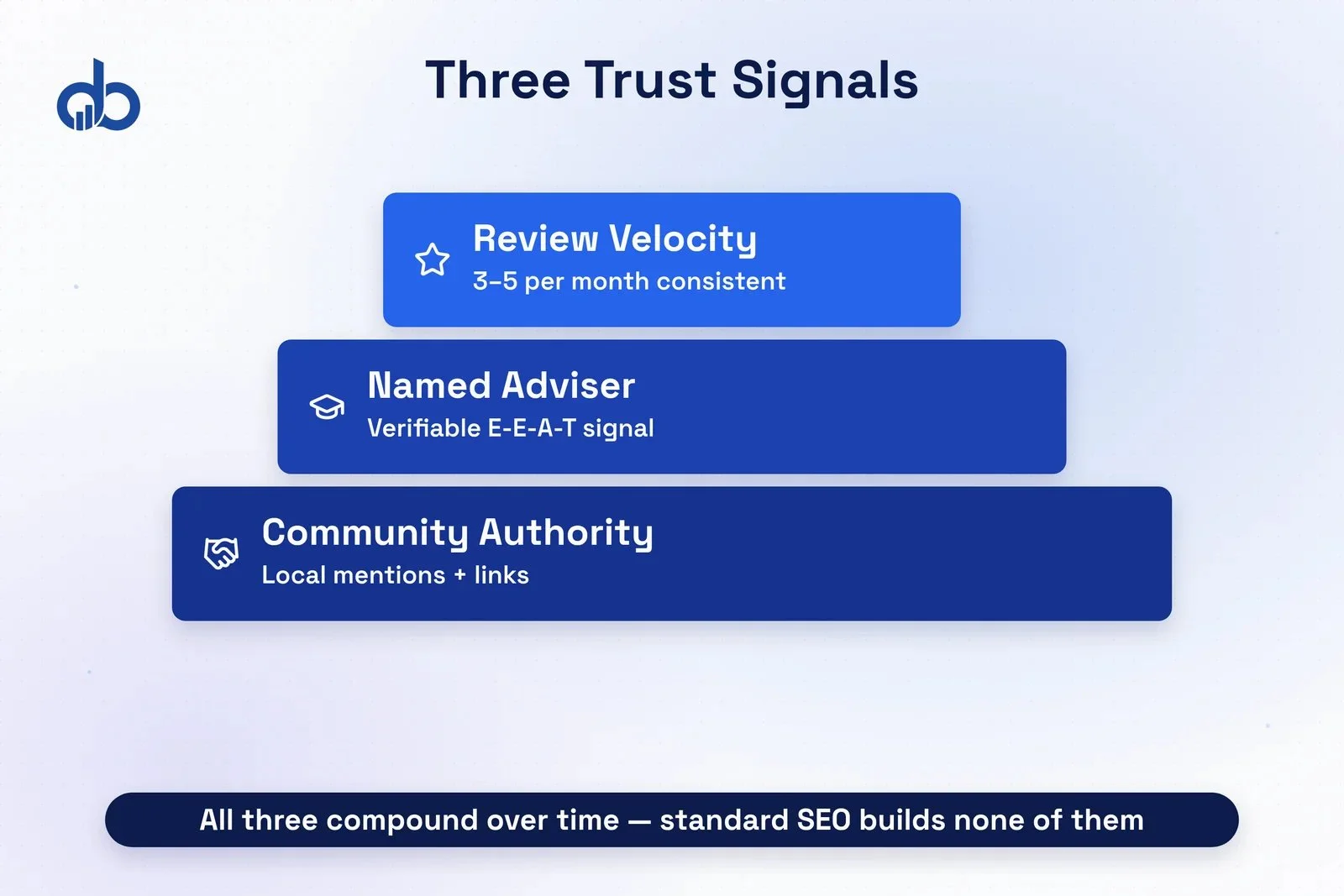
For seo for insurance companies, the trust signals that carry real algorithmic weight in a YMYL category are specific. They’re not complicated, but they’re different from what most SEO checklists prioritize.
Review velocity and recency: not just total count
The question Google’s local algorithm asks isn’t “how many reviews does this broker have?” It asks “how recently has this broker earned trust from new clients?”
A steady flow of three to five genuine reviews per month signals an active, trusted, engaged business. An old review volume, even a high one, signals a business that stopped earning new trust.
For insurance brokers, the highest-ROI moment to request a review isn’t random. Policyholders who have just had a claim handled well, renewed their policy without surprises, or completed a coverage review with a good outcome are the most motivated to leave one. Building a systematic review request at those three moments, not a one-time campaign, is what separates a growing review profile from a stagnant one.
93% of consumers read reviews for local businesses before making contact. The review profile a broker builds isn’t just a ranking signal. It’s the first substantive trust decision a prospect makes.
Named-adviser credential signals
Google quality raters evaluate YMYL pages against a specific question: is there a real expert behind this content? For an insurance broker, this translates directly to whether a specific, named adviser appears on the page with verifiable professional context.
It’s not about adding a photo and a bio. It’s about demonstrating verifiable expertise. A page that includes a named broker, their professional designations (CIC, CLU, ChFC, or equivalent state credentials), a brief description of their specific expertise area, and a link to their state insurance license lookup creates a trust signal a generic agency page can’t replicate.
Quality raters check those links. The algorithm learns from rater patterns. Brokers whose individual adviser pages satisfy the E-E-A-T check rank above generic agency pages on competitive local queries.
Community authority signals
Beyond citations, which confirm a broker exists, community authority signals confirm a broker belongs. These are the mentions and links that come from local news coverage, chamber of commerce directories, local non-profit sponsorships, sports club partnerships, and community organization memberships.
These links work differently from standard link-building. A mention from the local chamber confirms to Google that a real business with community standing is behind this website. A sponsorship mention from a local charity isn’t a high-DA link, but it is a geographically verifiable trust signal that a lead-gen landing page can’t manufacture.
Brokers who invest in genuine local community presence (not for SEO, but because it’s how they build their book of business) accumulate these signals naturally. Brokers who treat SEO purely as a digital activity miss the local trust layer YMYL classification specifically rewards.
What Insurance Brokers With Top Local Pack Positions Do Differently
The brokers consistently ranking in the top three local positions for competitive insurance queries share one characteristic. They treat trust-building as a business process, not an SEO activity.
Local pack visibility for a properly managed Google Business Profile can move within 4-8 weeks. But the brokers who hold those positions over time aren’t doing SEO maintenance. They’ve built systems.
Their review management is systematic. They have a templated request (text or email) sent within 24 hours of the three moments that generate the highest response rates: claim resolution, renewal completion, and new coverage explanation. They respond to every review within 48 hours, positive and critical. Google’s local algorithm tracks response rate as an engagement signal.
Their content structure is granular. One page per coverage line, not a single services page competing for every search. One location page per city or neighborhood, not a homepage trying to rank for a 40-mile radius. Each page is written with specific detail: what coverage scenarios look like in that market, what local risks apply, what questions their clients in that area actually ask.
Their Google Business Profile is treated as an active marketing channel. Posts go up weekly: a coverage tip, a claim story (anonymized), a community event the broker attended. The Q&A section is populated with the questions new prospects ask. Attributes are complete. Photos show real people at real locations, not stock images.
This is insurance seo at the operational level: not a technical setup, but a trust-signal maintenance system that runs week after week. The result compounds. Every month the trust signals accumulate while a competitor who stopped managing theirs after the initial setup slowly falls behind. That’s why seo for insurance companies that invest in this approach consistently outpace agencies with better technical setups but weaker trust-building habits.
The seo for insurance brokers Foundation: A Practical Trust-Building Sequence
For seo for insurance agents starting from a plateau, the fastest path isn’t doing more of the same checklist. It’s auditing which trust signals are weakest and fixing the highest-impact one first.
Step 1: Audit your current trust signals (Week 1)
Pull your review count and dates. Fewer than three reviews in the past 90 days? Review velocity is your first priority. Check your named-adviser pages. Is there a specific person with credentials and a verifiable professional link, or a generic “our team” page with headshots and titles? Then check NAP consistency across the top ten directories: Google, Yelp, BBB, Angi, Yellow Pages, Bing Places, Apple Maps, Facebook, InsuranceQuotes, and your state’s insurance department directory.
Step 2: Fix the highest-impact trust gaps first (Weeks 2-4)
If review velocity is low: build the ask workflow. Write a 50-word text template and a 100-word email template. Identify the three moments in your client journey (claim resolution, renewal, new policy explanation) and set up a process to send the request within 24 hours of each. Test it on your last 10 interactions before you scale it.
If named-adviser pages are generic: rewrite one page first. Add specific credentials, professional designations with hyperlinks to the issuing body, a two-paragraph bio that describes the adviser’s expertise for a specific coverage type, and a direct link to the state license lookup result page. This is the page Google quality raters will land on.
If community signals are absent: identify two or three organizations where the broker has genuine involvement: a chamber membership, a local non-profit, a community sponsorship already in place. Contact them about a link from their directory or sponsor page. These aren’t link-building pitches. They’re documentation of existing relationships.
Step 3: Sustain consistently (Months 2-6)
Publish two educational articles per month. Target local plus line-specific queries: “how much is home insurance in [city],” “business insurance for [industry] in [city],” “what does renters insurance cover in [state].” Not generic definitions. Specific coverage scenarios for your market.
Keep the GBP active every week. Post every Thursday. Answer every new question within 48 hours. Respond to every review by name.
This is where seo for insurance brokers delivers compounding returns. The trust signals built during months 2-6 don’t need to be rebuilt. They accumulate and compound while paid search costs inflate each quarter.
Organic insurance leads average $14 per lead. Paid search averages $44, with CPCs increasing 15% year-over-year. A broker who builds the trust foundation correctly is paying less for better-qualified leads 18 months from now while their competitor’s paid search budget keeps rising.
Local Trust Is the Ranking Variable That Scales
You now know why two brokers with identical technical setups can rank very differently, and which specific signals govern that gap. Knowing the mechanism and building the system to exploit it are two different things. Most brokers understand the theory after reading one article and still don’t implement the review-velocity workflow or rewrite the named-adviser page. That gap between knowing and doing is exactly where the ranking difference lives. Digiblazon’s SEO service is built around that implementation layer, not just the strategy. If you want to know where your trust signal profile actually stands, a free audit shows you the gaps before you guess at them.
Most insurance brokers plateau in local rankings not because their SEO is wrong, but because they're optimising for the wrong variable. A Digiblazon SEO audit shows exactly where your local trust signals stand and what needs to happen to move into the 3-pack for your highest-value searches. Get Free Marketing Audit
- Google classifies insurance as YMYL, so trust signals carry disproportionate ranking weight compared to standard local business categories.
- Review velocity (3–5 genuine reviews per month) matters more than total review count—stale profiles signal a disengaged business to the algorithm.
- Named-adviser pages with verifiable professional designations and state license links directly satisfy the E-E-A-T test Google quality raters apply to YMYL content.
- Community authority signals—chamber directory listings, local sponsorship mentions, non-profit links—confirm local belonging in ways citations alone cannot.
- A trust-signal audit covering reviews, adviser pages, and community mentions is the fastest starting point for brokers stuck at a rankings plateau.
- Organic insurance leads cost roughly $14 versus $44 for paid search, with compounding returns as trust signals accumulate over time.
Frequently Asked Questions
How long does SEO take for insurance brokers?
Local pack movement for insurance brokers typically takes 4-8 weeks with a properly managed Google Business Profile and consistent review flow. Competitive organic content rankings, the kind that pull high-intent informational searches, generally need 3-6 months of active work. The YMYL classification means Google moves more cautiously with new trust signals, so the timeline tends to run on the longer end compared to lower-stakes categories.
Is SEO worth it for insurance brokers compared to buying leads?
Organic search delivers insurance leads at roughly $14 per lead versus $44 for paid search, with nearly double the conversion rate. The bigger advantage is compounding: a bought lead disappears the moment you stop paying. An organic ranking built on strong local trust signals keeps generating inquiries without incremental spend. For brokers with a 2-year horizon, SEO consistently outperforms lead buying on cost per acquired client.
What does Google look for in insurance broker websites?
Because insurance falls under YMYL (Your Money or Your Life), Google applies a higher trust standard to insurance websites than to most local business categories. That means named advisers with verifiable credentials, fresh and genuine reviews, consistent NAP across directories, and content that demonstrates specific expertise rather than generic definitions. A page that says "we offer home and auto insurance in [city]" ranks below a page written by a named broker that explains specific coverage scenarios for that market.
What keywords should insurance brokers target for local SEO?
High-intent local queries drive the most conversions: "insurance broker near me," "insurance agent [city]," and line-specific searches like "home insurance [city]" or "business insurance [city]." Long-tail queries with purchase intent ("how much is home insurance in [city]", "best insurance broker for small business [city]") convert well and face less competition than broad terms. Build dedicated pages for each coverage line rather than competing for all terms on one page.