
Every plumbing owner we talk to describes the same situation. They run ads, leads come in, the phone stays busy. Then they pause the campaign for a month (maybe for a vacation, maybe because the budget got tight) and leads stop. Completely. Meanwhile, a competitor across town answers calls every morning without running a single ad. Their Google Business Profile shows up in the Map Pack for every emergency search in the area. They did not get there by accident.
76% of people who search on their smartphones for something nearby visit a business within a day. For plumbing, that window is even shorter: a homeowner with a burst pipe calls whoever appears in the Map Pack first. Paid ads rarely win that moment.
The standard marketing advice for plumbing companies is to run paid ads now and worry about SEO later. That advice misses the actual structure of the problem. It treats paid and organic as a timing decision when they are actually a job-type decision. The plumbing jobs that generate the most revenue (emergency calls, burst pipes, flooding at midnight) are won almost entirely through organic rankings. Paid ads, even well-managed ones, are structurally outperformed for that specific intent. Understanding why changes where you put your next marketing dollar.
Why Every Plumber Starts With Paid Ads (And the Honest Case For It)
Paid search is the rational first move for a plumbing company. Turn on Google Local Services Ads and your business appears at the top of results for “plumber near me” within 48 hours. You pay per verified lead, not per click. The LSA badge signals Google’s vetting. For a new plumbing business or a company entering a new service area, that immediate visibility has real value.
The honest case for paid ads is this: when you need leads next week, not next year, ads deliver. Seasonal ramp-ups in spring and summer can be handled with a short campaign burst. New service lines (commercial drain cleaning, water heater installation) can be tested with a limited budget before committing to content strategy. Ads give you data about which jobs convert and at what cost. That data is genuinely useful.
Ads work. The issue is the economics behind how they work, and what happens as your market gets more competitive around you.
Not getting the lead volume your ad spend should support? Get Free Marketing Audit
Where the “Ads Are Faster” Logic Falls Apart
The average cost per lead for plumbing Google Ads is $129.02, according to LocaliQ’s 2025 home services search advertising benchmarks. In competitive urban markets it climbs higher. And that number does not drop over time. As more plumbing companies bid on the same keywords, the cost of each click goes up with them.
The structural issue with paid advertising for plumbing comes down to one thing. You pay $129 on average for every lead, every month, indefinitely. There is no compounding. The 500th lead costs the same as the first. Nothing you have spent in prior months reduces what you will pay next month.
Organic search does not follow that logic. The ranking authority you build in month three of an SEO campaign still influences your Map Pack position in month thirty. The Google Business Profile reviews you accumulate over twelve months cost nothing to maintain. Each local citation you claim remains active without a renewal fee.
The dependency trap is the real problem. A plumbing company spending $4,000 per month on Google Ads cannot reduce that budget without losing proportional lead volume. The business becomes structurally dependent on the ad spend to function. Every competitor who enters the market pushes the required spend higher just to maintain the same position.
That is not a strategy. It is a treadmill.
The Jobs Where Organic Search Leaves Paid Ads Behind
The standard SEO vs. PPC framing breaks down for plumbing in a specific way.
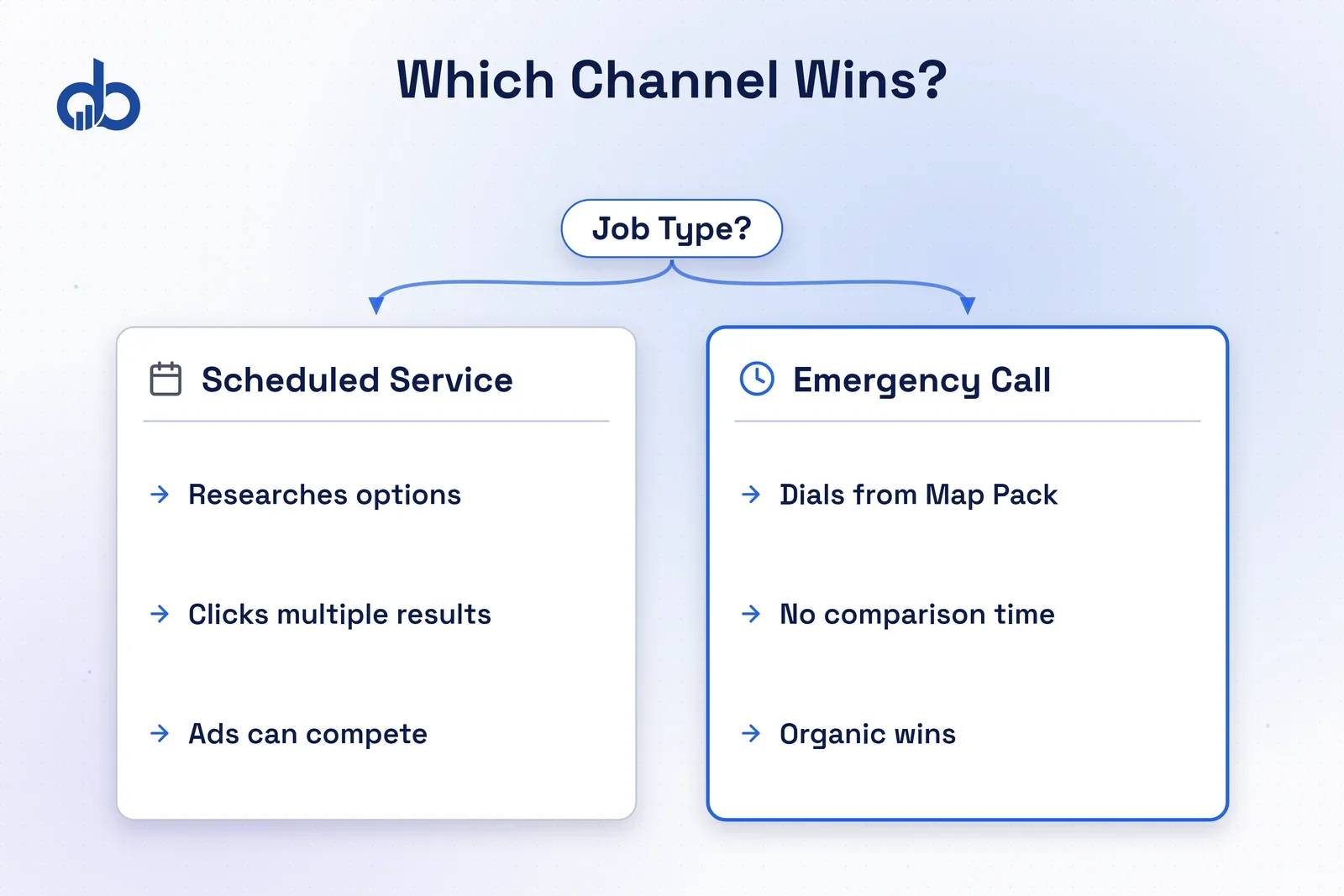
Not all plumbing leads behave the same way in search. Emergency calls (“burst pipe repair,” “water heater not working,” “plumber near me open now”) produce completely different search behavior than research-mode calls. A homeowner with water coming through the ceiling at 10pm is not comparing three plumbing companies by clicking on their websites. They look at the Map Pack and call the first number with a good review count. They are not clicking on ads.
42% of local searchers click on Map Pack results, with the top three positions capturing the vast majority of that share. A plumbing company in the top-three Map Pack for emergency searches in its city captures those calls at effectively zero cost per lead. That position advantage is unavailable to any ad campaign.
| Job Type | Buyer Behavior | Channel That Wins |
|---|---|---|
| Burst pipe, flooding, no hot water | Dials immediately from Map Pack | Organic / Map Pack |
| Water heater replacement (planned) | Compares 2-3 options, reads reviews | Mixed (ads + organic) |
| Repiping, large project | Gets multiple quotes | Ads + referral |
| Preventive maintenance | Does research, reads content | Organic / content |
Paid ads win more of the scheduled service calls because those buyers have time to click through to a website and compare options. Ads can reach people in research mode. But for emergency volume (the calls that book same-day and generate the highest ticket size) organic rankings are structurally superior to ad spend.
SEO for plumbers is not a “someday” investment. Emergency jobs are the highest-value work in plumbing. Every month without strong organic rankings is a month those calls go to a competitor.
The Local Authority Loop: How Plumber SEO Compounds
Paid search is linear. Spend $4,000, get leads proportional to $4,000 of ad spend. Spend nothing, get nothing.
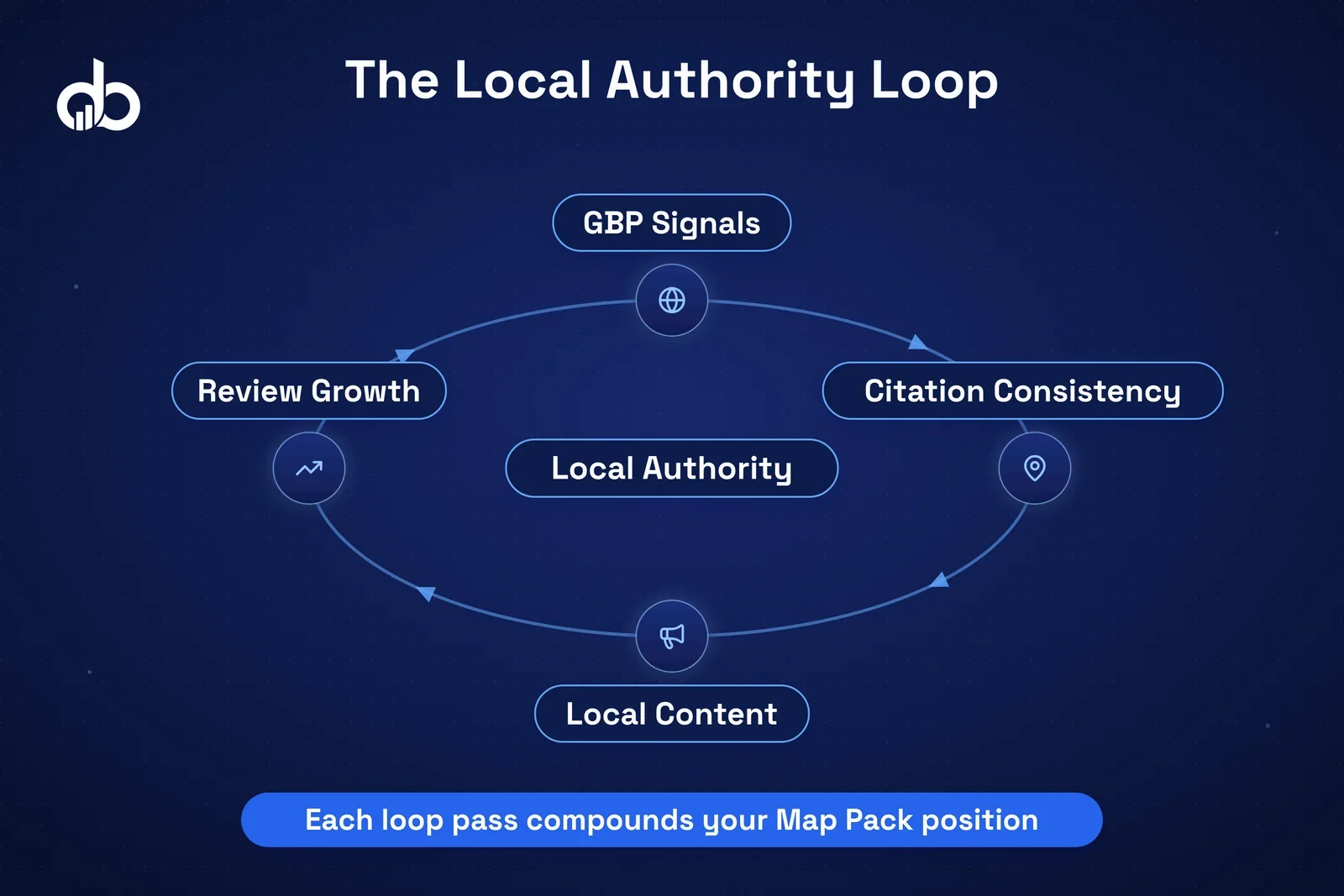
Organic search does not follow that model. The mechanism we use is the Local Authority Loop. It has three inputs that compound on each other:
Google Business Profile signals: Reviews, photos, and category accuracy all feed Google’s local ranking algorithm. Your review count and recency carry significant weight. Profiles with active photo uploads, consistent business hours, and recent reviews outperform static ones in the Map Pack over time.
Citation consistency: Your business name, address, and phone number appearing consistently across local directories tells Google your business is credible in your area. The first 40 to 50 citations require active effort. After that, many appear organically as data aggregators pick up your listing.
Local content authority: Service pages targeting city-specific searches. Blog content answering emergency questions homeowners search for at 2am. This content builds topical authority that supports both your website rankings and your GBP position.
Walk through the timeline for a typical plumbing company:
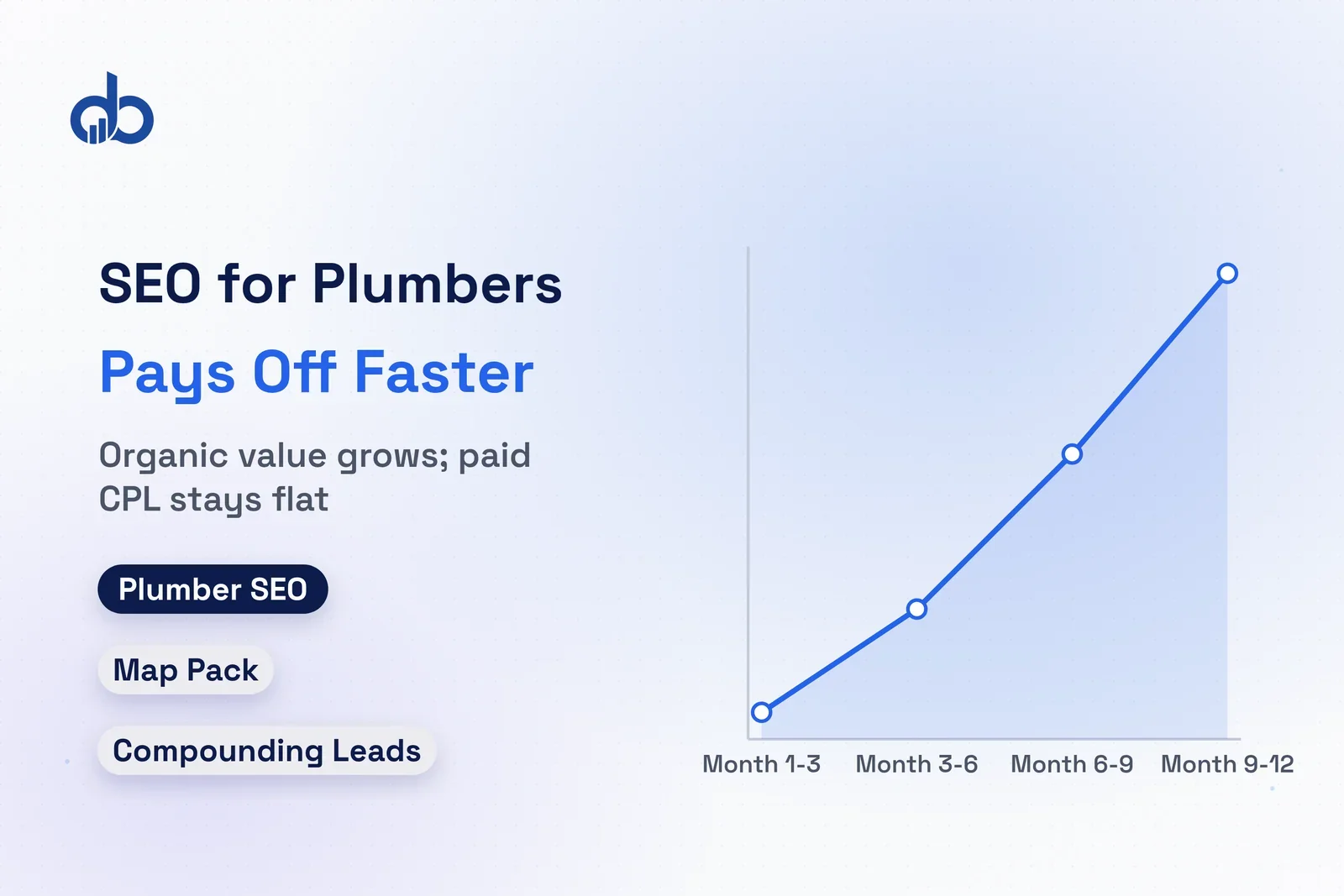
Months 1 to 3: GBP optimization complete, citation cleanup done, local service pages published. Impressions in local search start rising. No significant lead volume yet.
Months 3 to 6: Map Pack appearances begin for secondary keywords. Phone calls from organic start arriving: typically 5 to 15 per month. The organic cost per lead at this stage is already lower than paid for those specific calls.
Months 6 to 12: Primary emergency keywords (“plumber near me,” your city plus “plumber”) start producing consistent Map Pack positions. Organic lead volume reaches 20 to 40 calls per month. HubSpot’s CPL benchmarks put average organic lead cost at $31 compared to $61 for paid search. At that ratio, the savings on 30 organic leads per month cover a typical plumber SEO services retainer within the first year.
Month 12 onward: Each new review, each new citation, each content piece strengthens the existing authority. Rankings are easier to defend than to build. The cost of maintaining position is a fraction of the cost of building it. Paid advertising cannot replicate that trajectory.
Want to see exactly where your organic ranking stands today? Request a Proposal
The crossover point arrives when monthly organic lead value exceeds the monthly SEO investment. For most plumbing companies in mid-sized markets, that crossover arrives between months nine and fourteen. After that, every month of continued SEO investment pushes the return higher while the cost stays flat.
What This Means for Plumbing Business Owners
The practical implication is not to cancel your ads and hope SEO saves you in six months. That is the wrong move. The right move is to run both, set a clear crossover milestone, and transfer budget from paid to organic as rankings prove themselves.
Three specific shifts make the difference this quarter:
Allocate SEO investment to emergency keyword authority first. SEO for plumbers compounds fastest on Map Pack rankings. Target “plumber near me” and your top city-plus-service terms before investing in blog content. A plumbing seo company that leads with GBP optimization and emergency keyword authority delivers a faster return than one that starts with content.
Track your blended cost per lead, not just your paid CPL. Most plumbing owners only look at ad platform CPL because that number is easy to find. But as organic leads arrive, your actual cost per booked job drops below what the ad dashboard shows. Build a simple tracking sheet: paid leads plus cost, organic leads plus attribution, total leads plus blended CPL. When blended CPL drops below paid CPL, you are compounding.
Evaluate plumber seo services on local signals, not vanity rankings. The wrong question is “what position do you guarantee?” The right questions are: how many Map Pack appearances do your current clients have for emergency searches in their city? What is the average GBP review count for plumbers you work with after 12 months? What citation coverage do they achieve in the first 90 days? A plumbing seo company that can answer those questions with real numbers is running a system that compounds. One that talks about “domain authority” and monthly reports is selling a report, not a result.
Checklist: Signs Your Plumbing Company Is Ready to Shift Budget From Ads to Organic
- Your Google Business Profile has fewer than 40 reviews
- Your “plumber near me” searches don’t show your Map Pack listing in the top three
- Your ad spend has increased year-over-year without a proportional increase in booked jobs
- You have no city-specific service pages on your website
- Your business name, address, or phone number is inconsistent across online directories
If three or more apply, you are paying full price for leads that a stronger organic presence would deliver at a fraction of the cost.
SEO for Plumbers Is a Capital Allocation Decision
SEO for plumbers is not a patience play. It is a compounding asset that pays more in year two than year one, and more in year three than year two. Paid search never works that way.
The plumbing companies that misread this keep increasing ad budgets every spring. They treat SEO as a future project and find themselves in an auction where every competitor does the same. It is a race with no finish line. The companies that get it right run ads to cover immediate lead gaps while building organic authority that eventually makes those ads optional.
Your emergency call volume (the most valuable work you do) is being won or lost right now based on your Map Pack position. Ads do not reach that buyer at the moment they decide to call.
Digiblazon’s SEO & Organic Growth service focuses specifically on the local authority signals that determine plumbing Map Pack rankings. The same compounding model that works in carpet cleaner SEO and other home services applies here at a higher average ticket value. The audit shows exactly where your organic presence stands in your market.
- Emergency plumbing calls are won almost entirely through organic Map Pack rankings, and 42% of local searchers click on Map Pack results.
- Paid ads cost an average of $129 per lead, indefinitely; SEO builds compounding authority that reduces cost per lead over time without proportional ongoing spend.
- The Local Authority Loop (GBP optimization, citation consistency, local content) produces measurable organic leads by months 3-6 and primary keyword rankings by months 6-12.
- Track blended cost per lead across both channels, not just paid CPL, to see the true crossover point when SEO outperforms ads.
- Prioritize Map Pack and emergency keyword authority before investing in blog content, as plumber SEO compounds fastest on local rankings.
Frequently Asked Questions
How long does SEO take to produce leads for a plumbing company?
Most plumbing companies see measurable ranking improvements within 60 to 90 days, with lead flow increasing significantly between months three and six. Emergency keyword rankings ("plumber near me," "burst pipe repair") tend to move faster. Local Map Pack results are driven by proximity and Google Business Profile signals, not just domain authority. Full compounding, where organic CPL consistently beats your paid CPL, typically arrives between months 9 and 14.
Should a plumbing company use SEO or paid ads?
Both serve different intent. Emergency plumbing calls (the highest-value, highest-ticket jobs) are won primarily by the top three Map Pack results because the searcher is already dialing, not comparing. Paid ads compete harder for scheduled service calls where buyers have time to click multiple results. The strongest plumbing marketing strategies use organic SEO to capture emergency volume and PPC selectively for planned work during slow seasons.
What does plumber SEO actually involve?
Plumber SEO covers three core areas. Your Google Business Profile is the source of most emergency call leads. Your local service pages target city-specific and service-specific searches. Your backlink and citation profile tells Google your business is credible in your area. A good plumber seo services provider handles all three as an integrated system. Optimizing one without the others produces limited results.
How much should a plumbing company spend on SEO?
Monthly investment for plumbing companies typically ranges from $1,000 to $3,000 depending on market competition. LocaliQ's 2025 benchmark puts plumbing paid CPL at $129. An organic strategy delivering 20 qualified leads per month saves roughly $2,580 in ad spend monthly. That makes most SEO retainer investments net-positive within the first year for mid-competitive markets.