
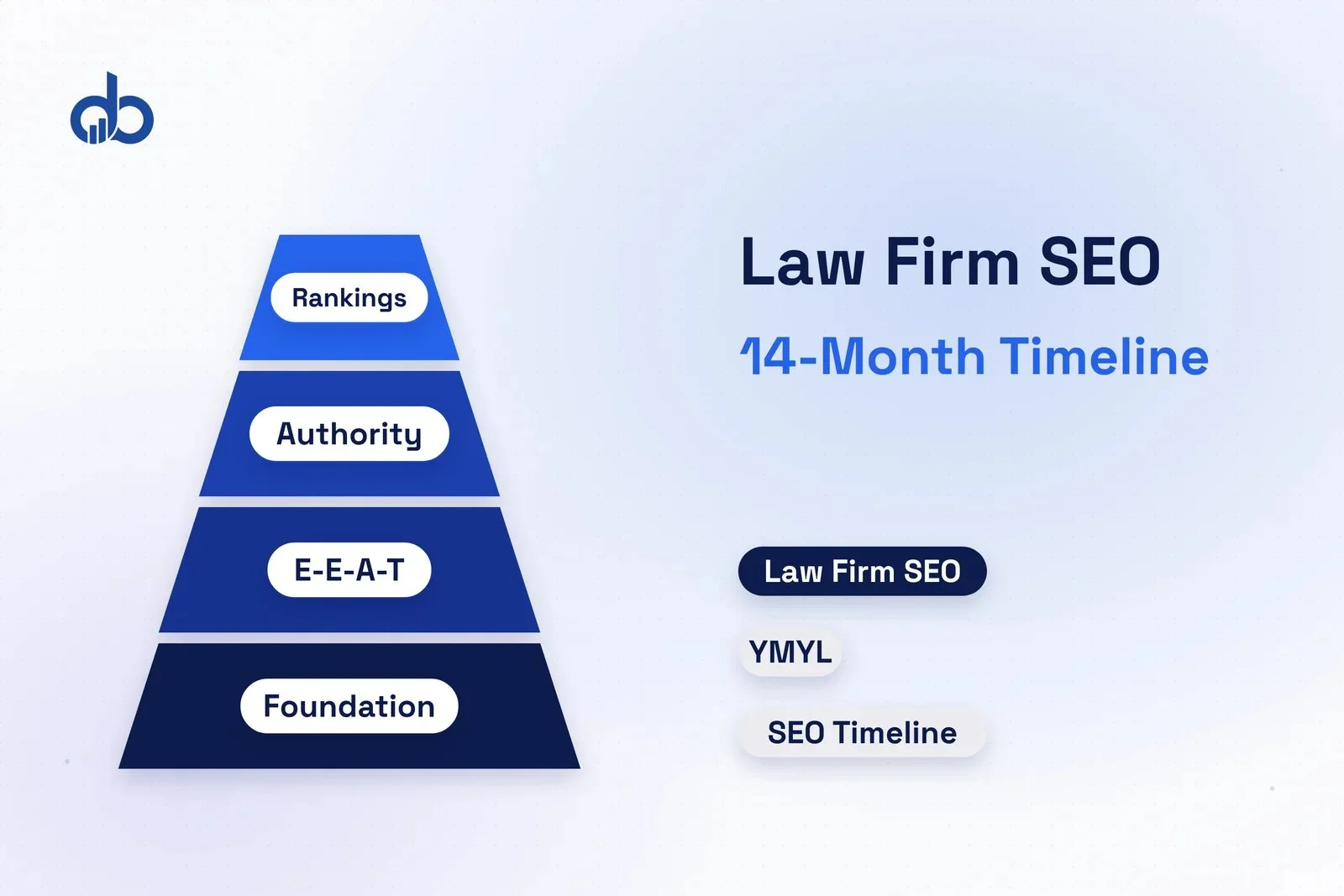
Ninety-six percent of legal clients search for an attorney online before making contact. Law firms on the first page of Google capture the majority of that traffic. But most law firm SEO programs get canceled before they reach the return on investment stage. The reason is almost always the same. The managing partner running the budget review has no clear answer for why rankings haven’t moved after six or seven months. The agency says to trust the process. That’s not an answer anyone who bills by the hour is going to accept. The frustration is legitimate. What’s missing isn’t patience. It’s a structural explanation for why legal search works differently at the algorithm level, and a different financial framework for evaluating the return. If you’re already seven months into a law firm SEO engagement and questioning the invoice, here’s what you’re actually measuring against.
The Question Every Managing Partner Asks at Month Six
At month six, the invoice is real. The intake call volume is not. That gap is where most law firm SEO engagements fail. Not because the strategy is underperforming. Because the expectation was never calibrated to how legal search actually works. Sound familiar? The belief most managing partners bring to SEO is shaped by Google Ads. In paid search, you spend money on Monday and you get calls by Wednesday. The attribution is immediate. The feedback loop is visible. The relationship between investment and return is direct and measurable within a billing cycle. SEO doesn’t work that way. And this isn’t a limitation of the agency or the effort. It’s a feature of how search engines evaluate and rank content. In legal, that evaluation process is structurally longer than in almost any other industry. The managing partner at month six who sees no ranking movement is not wrong to question the investment. They’re wrong about what the absence of rankings means. Rankings are the last thing to move in a law firm SEO program. Everything that matters happens first. That sequence isn’t a problem to solve. It’s a function of how Google handles legal content specifically.
Legal Is Not a Normal Google Category, and That Changes Everything
Not sure why your firm's SEO is moving slower than your agency projected? Get Free Marketing Audit
The fastest way to accelerate a law firm's SEO timeline is to separate the technical authority-building work (schema markup, E-E-A-T author pages, citation cleanup) from content production. Most agencies bundle them and sequence them linearly. Running them in parallel cuts 6-8 weeks off the initial foundation phase without changing what Google requires.
The Real Law Firm SEO Timeline: What the Data Shows
The Capital Investment Framework: How Winning Firms Think About Legal SEO
The managing partners who reach month fourteen don’t do so because they’re more patient. They do so because they apply a different financial framework to the investment. They stopped treating their law firm SEO program as a quarterly marketing expense. They started treating it as a capital deployment with a defined break-even horizon. This reframe is what the best law firm seo agency relationships have in common. The firm and the agency aren’t managing a monthly retainer. They’re managing a 14-month investment with a documented return horizon and a set of leading indicators that confirm progress before the phone starts ringing. The Capital Investment Framework has three components:
- Break-Even Horizon Accounting Define the total investment through month fourteen before the program starts. Compare that figure against the lifetime value of the organic leads the program will generate. The question isn’t “did we get leads this quarter?” It’s “what’s the expected return on this capital over three years?” Law firm SEO consistently answers that question with a 526% ROI. Quarterly lead counts aren’t the right metric for a 14-month break-even investment.
- The Moat Argument Most firms that start an SEO program cancel before month twelve. Those firms hand their market position to the firms that stay. In competitive legal markets, firms with established domain authority and content depth hold rankings for years. The cost for a competitor to displace them is enormous. They’d need to restart the 14-month process from zero. Long-timeline SEO isn’t a patience test. It’s a barrier to entry. The firms that stay build a moat the firms that quit can’t afford to cross.
- Leading Indicator Reporting Rankings and intake call volume are lagging indicators. They reflect work done 6-9 months ago. Managing partners who evaluate the investment at month six on lagging indicators will always be disappointed. The leading indicators that predict future performance are domain authority trajectory, local pack impression volume, branded search volume, indexed page count, crawl health scores, and referring domain acquisition rate. These move first, often by months.
Ask your law firm SEO agency for a monthly report that shows domain authority score trajectory, local pack impression count, and referring domain count alongside rankings. If you're only receiving a rankings report, you're being shown the last metric to move. The three indicators above confirm progress 6-8 months before rankings shift.
What to Tell Your Partners and What to Actually Measure
The partner alignment problem at month six isn’t a communication failure. It’s a metrics failure. The agency is reporting rankings. Partners are measuring phone calls. Both are looking at the wrong thing for the current stage of the investment. The conversation most managing partners need at month six isn’t a progress update. It’s a reframing of the investment thesis. Here’s the language that holds up in a boardroom context: “Law firm SEO is a 14-month capital investment, not a monthly marketing expense. We’re at month six. We haven’t reached the return stage yet. What we’ve built is the authority foundation that generates returns in months 9-14. Here’s what our five leading indicators show, and here’s why they confirm the strategy is working.” Then show the five indicators: domain authority score trajectory, local pack impression growth, branded search volume, indexed page count, and referring domain count. All five are measurable from Google Search Console and standard SEO tools. All five move before rankings do. Questions we hear at this stage: “We’re six months in and nothing’s moved. Should we switch agencies?” Not necessarily. First, check whether your five leading indicators are trending up: domain authority, local pack impressions, referring domain count, indexed page count, crawl health. If all five are flat or declining, that’s worth a direct conversation with your agency. If three or more are trending in the right direction, you’re in the normal 6-9 month lag window. Switching at that point resets your timeline to zero and hands the accumulated foundation to whoever picks up the domain next. “How do we explain this to partners who came from a paid media background?” Frame it as two different financial models. Paid media is an operating expense: spend $10K, get leads that month, stop spending and leads stop. Law firm SEO is a capital deployment: invest over 14 months, then the program generates organic leads at a fraction of paid costs for years after. The 526% 3-year ROI figure tends to shift the conversation for partners who think in capital-return terms. Firms evaluating seo for lawyers that don’t frame the investment this way before month one consistently face the same review meeting at month six. The data doesn’t support cancellation at that stage. But without a framework for interpreting the data correctly, the data will always look like underperformance. What separates firms that benefit from lawyer seo from firms that cancel isn’t strategy quality. It’s expectation architecture built at the start of the engagement. A managing partner who understands the 14-month break-even horizon from day one doesn’t ask the wrong question at month six. They ask the right one: “Are our leading indicators on track?” The SEO & Organic Growth reporting framework structures every client engagement around these leading indicators so that managing partners always have a defensible answer at their quarterly reviews.
Conclusion
You now have the structural explanation for why law firm SEO takes longer: YMYL classification, the E-E-A-T authority gap, and the 14-month break-even horizon. That converts “trust the process” into a capital investment thesis your equity partners can evaluate. The gap between understanding this and using it to hold firm through month fourteen is a reporting problem, not a strategy problem. Digiblazon’s SEO & Organic Growth service structures every engagement around milestone-based authority metrics that give managing partners the right language at every review. If your firm is past month six and still waiting for clarity on what you’re building toward, start with a Free Marketing Audit.
- Law firm SEO takes 14 months to break even because Google's YMYL classification requires demonstrable domain authority, E-E-A-T signals, and topical depth before ranking legal content.
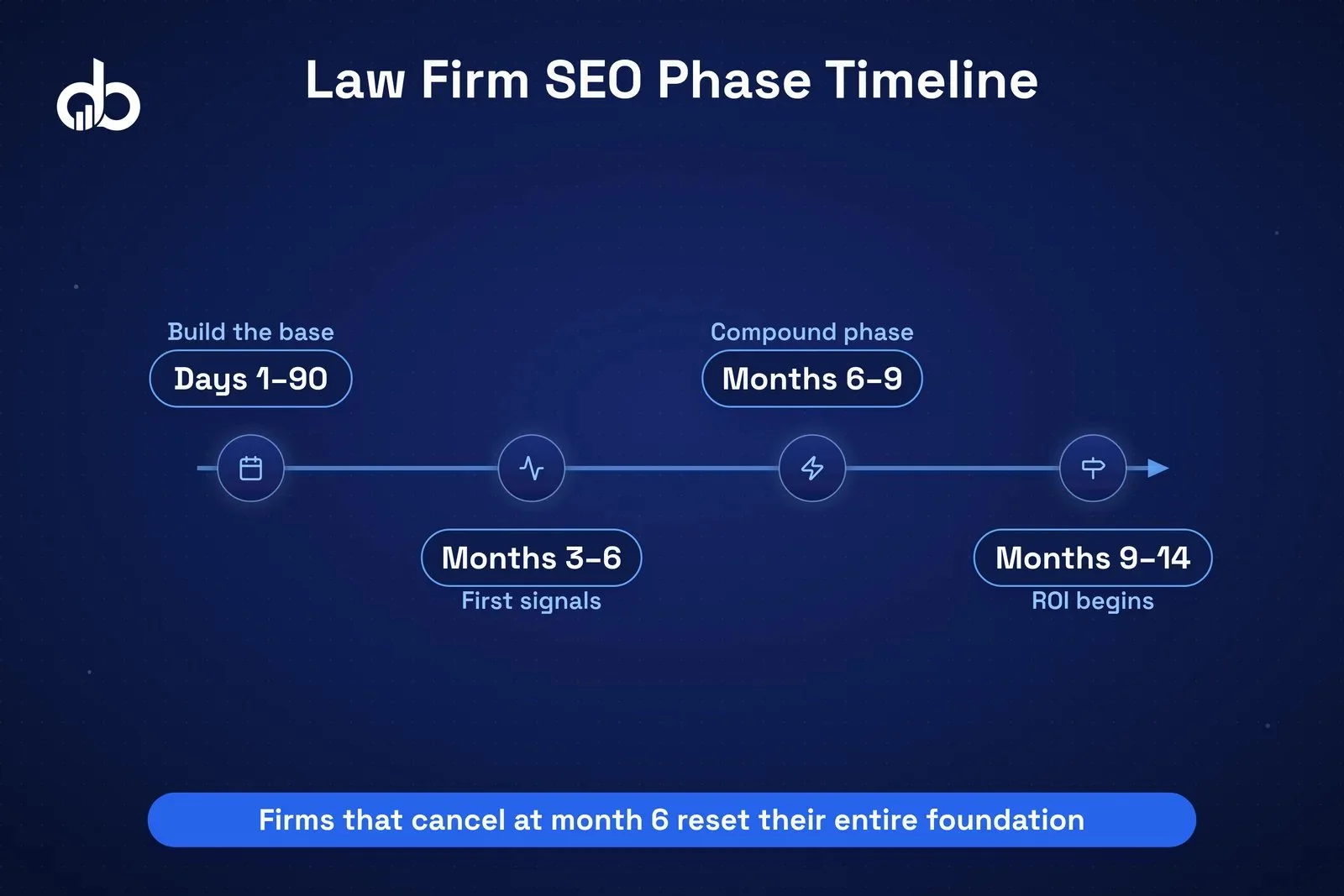
- The first 90 days are infrastructure — no ranking movement is expected or meaningful at this stage.
- Track five leading indicators before rankings move: domain authority trajectory, local pack impressions, branded search volume, indexed page count, and referring domain acquisition rate.
- SEO leads convert at 14.6% versus 3.75% for paid search, and cost per lead drops 40–70% after month 12 of consistent investment.
- The 3-year ROI for law firm SEO programs that complete the engagement averages 526%.
Frequently Asked Questions
How long does law firm SEO take to produce results?
The first measurable signals, including local map pack impressions, long-tail keyword rankings, and crawl health improvements, appear within 90 days. Meaningful traffic and first leads arrive between months 5 and 8. The break-even point, where the cost of the program is recovered by lead value generated, averages 14 months for properly executed law firm SEO engagements. Firms in less competitive markets targeting niche practice areas can reach meaningful lead flow in 4-5 months.
Why does SEO take longer for law firms than for other types of businesses?
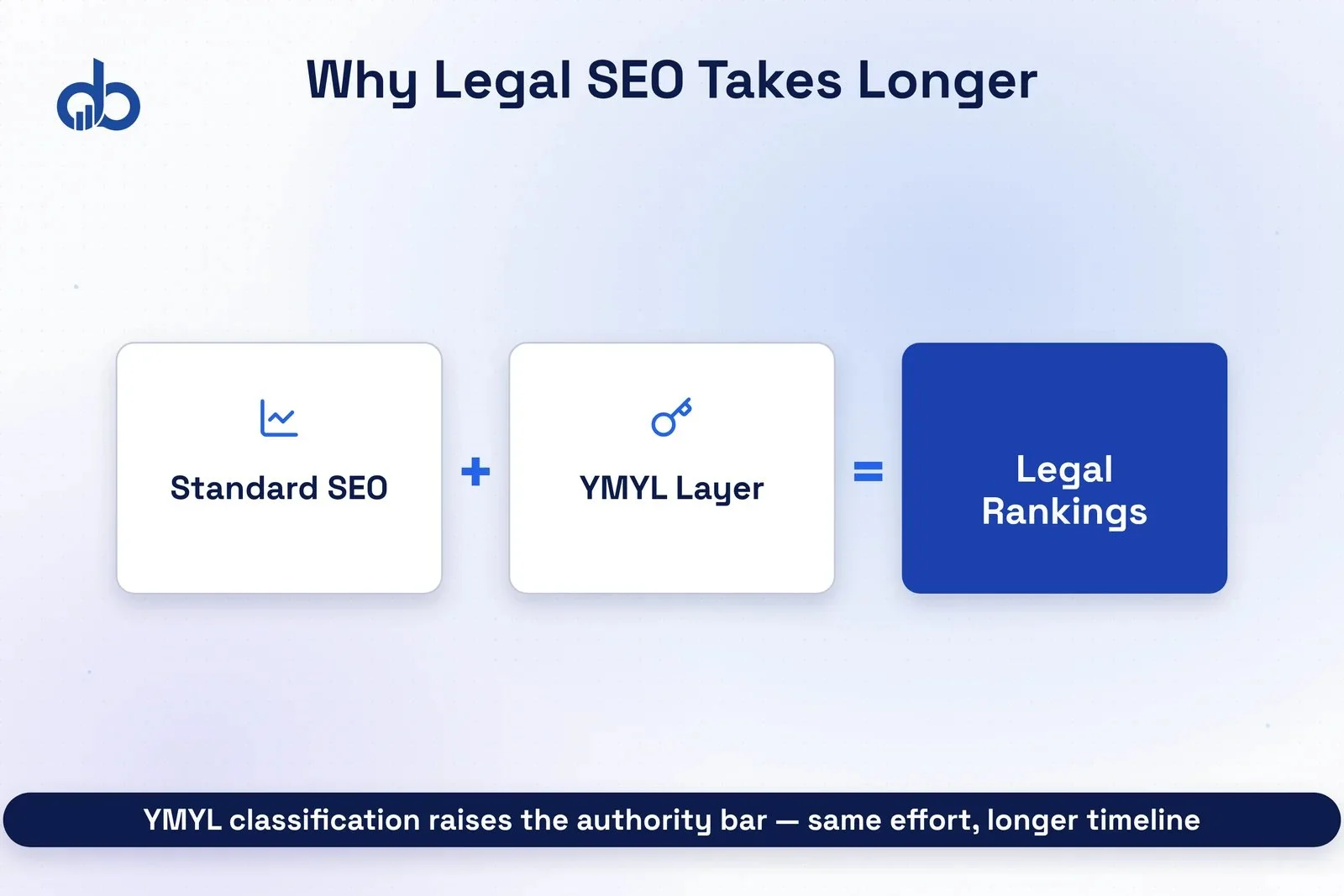
Google classifies law firm websites as YMYL content, the same category as medical and financial advice. This triggers stricter algorithmic review of domain authority, author credentials, and topical depth before any ranking appears. The same backlink and content effort that ranks a technology company in 4 months takes 12 months for a law firm. The trust threshold Google applies to legal content is structurally higher. It's a category-level standard, not a vendor execution problem.
Is law firm SEO worth it if we are already running Google Ads?
Yes, and the comparison favors SEO at scale. Google Ads in legal can cost over $150 per click on average for personal injury keywords, with some competitive markets exceeding $800 per click. SEO leads convert at 14.6% compared to 3.75% for paid search leads. The cost per lead via organic search drops 40-70% versus paid after month 12 of consistent investment. The two channels aren't substitutes. Paid search provides short-term lead flow while seo for lawyers builds the long-term organic foundation.
What should a law firm track in the first 6 months of SEO before rankings move?
Track five indicators: domain authority trajectory, local pack impression volume (even without clicks), branded search volume growth, indexed page count, and referring domain acquisition rate from legal directories and regional publications. These leading indicators confirm the strategy is working 6-8 months before intake call volume reflects it. Any law firm seo agency that can't provide this data monthly isn't structured for transparent accountability.