
Most carpet cleaning businesses get their first dozen jobs the same way. A neighbor mentions them. A property manager passes along the number. Word spreads inside a few apartment complexes. It works until it doesn’t.
Then the referral pipeline slows. The owner starts noticing a competitor in the same zip code showing up at the top of Google results, again and again, for every search that should lead to a call.
The difference is not the quality of the work. It’s carpet cleaner SEO, specifically the way it converts local search intent into phone calls. There are four specific levers behind that conversion, and most carpet cleaning businesses are missing at least two of them.
What Carpet Cleaner SEO Actually Is (and What It Isn’t)
Carpet cleaner SEO has nothing to do with keyword-stuffed web pages or buying backlinks from shady link farms. Carpet cleaning SEO is a system. It controls how your business appears across every surface where a local customer might search. There are more of those surfaces than most business owners realize.
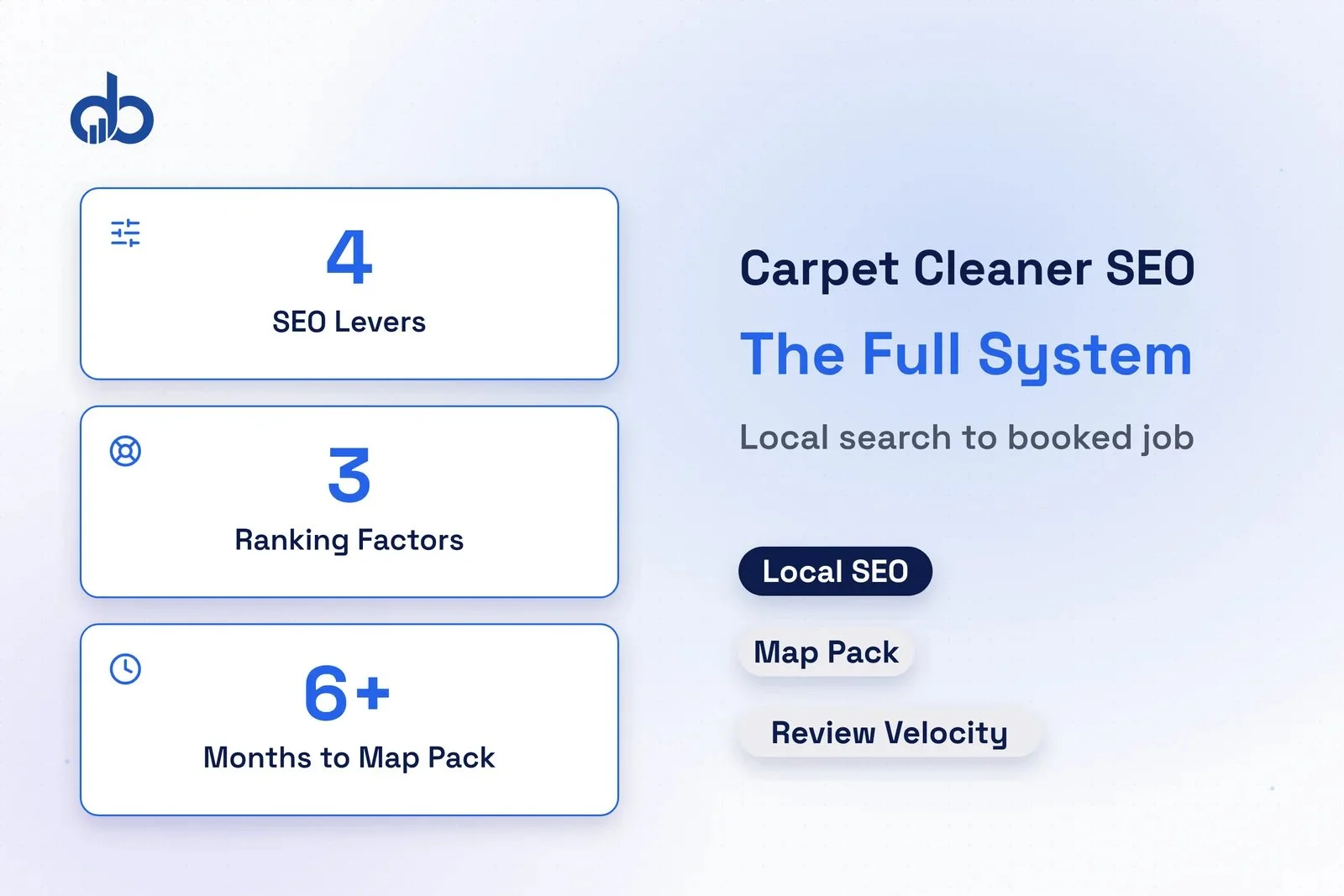
That system runs on four parts: your Google Business Profile, your website, your reviews, and your local citations. Each one sends signals to Google’s local algorithm. The algorithm weighs those signals to decide who gets into the Map Pack — the three-listing panel that captures most of the clicks for local service searches.
Here is what most business owners miss. Google’s local search algorithm is completely different from the one it uses for national or informational queries. According to Whitespark’s 2026 Local Search Ranking Factors survey of 47 expert local SEOs, Google Business Profile signals account for 32% of the local ranking algorithm on their own. Review signals add another 20%. Your website’s on-page SEO, the part most business owners picture when they hear the word “SEO,” accounts for 19%.
The system that gets carpet cleaners in front of local buyers leans heavily on your Google Business Profile and your reviews. A beautifully built website with zero GBP optimization will not move the Map Pack needle at all.
Not sure where your local SEO is underperforming? Get Free Marketing Audit
Why Local Search Intent Makes Carpet Cleaning SEO Different
Not every business gets the same return from local SEO. Carpet cleaning pulls unusually high value from it, and the reason comes down to purchase intent.
When someone searches “carpet cleaning near me,” they are not doing research. They have a stained carpet, a pet odor problem, or a move-in date on the calendar. The decision to hire someone has already happened. They are choosing who to call, not whether to call anyone.
Google research compiled by Backlinko shows 76% of people who search on their smartphones for something nearby visit a business within a day. 28% of those local searches result in a completed purchase. For carpet cleaners, that data has a direct implication. SEO for carpet cleaners is not a brand-building exercise. It is demand capture. The customer has already decided to spend money on carpet cleaning. Your SEO decides whether they spend it with you or your competitor.
Google Ads creates a similar capture moment, but with a cost attached to every click. Carpet cleaning SEO, specifically local SEO, captures the same intent for a fraction of the ongoing cost. The visibility also compounds over time instead of disappearing the moment ad spend stops.
How the Local Search Ranking System Works for Carpet Cleaners
Google judges every local business listing on three things: relevance, proximity, and prominence. Knowing how each one works explains why two carpet cleaners operating in the same city can pull completely different results from the same search.
Relevance measures how closely your business profile and website match what the searcher typed. If someone searches “upholstery cleaning [city]” and your GBP only lists carpet cleaning, you will rank lower for that query. Every service you offer needs to show up explicitly in your profile, your website, and your content.
Proximity reflects how close your business address or service area is to the searcher’s location. This one you cannot change. What you can do is define a service area in your GBP that covers the full geography where you actually take jobs, instead of leaving it at your physical address.
Prominence measures how well-known and trusted Google thinks your business is. Reviews are the biggest driver of prominence for local service businesses. Local citations, local news sites, and chamber of commerce listings also count. The more credible sources that reference your business by name, the more prominent Google considers you.
These three factors work together. A highly relevant profile with weak reviews will underperform a moderately relevant profile with strong review signals. Proximity advantages can be partially canceled out by low prominence. Google rewards businesses that stay consistently strong across all three, not businesses that dominate one and ignore the others.
Why Ranking in the Map Pack Is Not Enough: The Booking Conversion Gap
Here is what the standard carpet cleaner SEO guides skip over entirely.
Getting into the Map Pack does not mean you get the call. It means you get a shot at the call. The booking decision happens before the customer clicks anything. They are scanning the three listings, comparing review counts, star ratings, and profile photos. That comparison takes seconds.
A carpet cleaner ranked #1 with 14 reviews and 4.3 stars loses the call regularly. The competitor ranked #3 with 97 reviews and 4.8 stars gets it. Not because the algorithm favored them more, but because the customer chose them based on visible trust signals.
That gap is the booking conversion gap. Most businesses put all their energy into getting into the Map Pack and then stop. The businesses that consistently win jobs from the same ranking positions treat trust signal building as an ongoing operation, not a one-time task.
Review volume and recency are not just ranking signals. They are conversion signals visible to the customer before they click anything. Any strategy that ignores them is only solving half the problem.
| Map Pack Position | Profile Signals | Relative Call Volume |
|---|---|---|
| #1 | 14 reviews, 4.3 stars, few photos | Lower (weak trust signals) |
| #2 | 43 reviews, 4.7 stars, moderate photos | Moderate |
| #3 | 97 reviews, 4.8 stars, full photo set | Higher (stronger trust signals) |
The pattern holds across local service categories: stronger trust signals outperform higher ranking positions whenever there is a visible trust gap in the results panel.
Not sure how your Google Business Profile compares to competitors in your Map Pack? Get Free Marketing Audit
The Four SEO Levers Carpet Cleaners Control Directly
Once the ranking system and the conversion gap make sense, the question gets practical. What actually moves the needle fastest? There are four levers, all of them fully in a carpet cleaner’s control.
1. Google Business Profile completeness and category accuracy
Your primary GBP category is the single most influential individual ranking signal in the entire local algorithm. Set it to Carpet Cleaning Service, not a generic option like Cleaning Service. If you offer upholstery, rug, or commercial cleaning, add those as secondary categories.
Beyond category selection: fill every section of your profile. Business hours. Service area. A services list with individual prices where you can add them. A short business description that names your city and primary services. Add photos weekly — equipment, before/after work, your team. Profiles with 10+ photos receive significantly more direction requests than those with fewer than five.
2. Review velocity, not just review count
The word “velocity” matters here. Google’s local algorithm weights recent reviews more heavily than older ones. A profile with 80 reviews from 2022 performs worse than a competitor with 40 reviews spread across the last 12 months. Building a system to request reviews from every customer is the highest-return activity most carpet cleaners skip.
Carpet Cleaner Local SEO Audit: Review Checklist
- Minimum 30 reviews to compete in most local markets
- At least 4 new reviews per month to maintain velocity
- Every review gets a response within 24 hours
- Review request texts sent to customers within 24 hours of job completion
3. Service-specific location pages on your website
Implementing carpet cleaning SEO on your website means going well beyond a single homepage. A location page, an upholstery cleaning page, and a commercial cleaning page each capture searchers that your homepage never will. Google matches specific queries to specific pages — a general homepage competes poorly against a dedicated “upholstery cleaning [city]” page.
Each page needs your city or service area in the H1 and opening paragraph. Add a specific description of what that service includes, plus a clear call to action. These pages compound in value over time: each one you build is another door into your business from local search.
4. Citation consistency, NAP everywhere
NAP stands for name, address, and phone number. Every directory listing needs to use exactly the same format. “Carpet Cleaners Inc.” and “Carpet Cleaners Incorporated” look different to Google’s crawlers. Inconsistent NAP data confuses the algorithm and can suppress your local rankings.
High-priority directories for carpet cleaners include Yelp, Angi, Houzz, HomeAdvisor, and Better Business Bureau. Also add your local Chamber of Commerce and any city-specific business directories. Run a citation audit to find existing listings and correct any that use outdated addresses or phone numbers.
What to Realistically Expect from Carpet Cleaning SEO
Carpet cleaner SEO is not a quick fix. The timeline is faster than most business owners expect, though, if the work starts with GBP and reviews rather than website content alone.
Month 1-2: GBP optimization, citation audit and cleanup, review request system set up. No visible ranking change yet. This is foundation work.
Month 3-4: Map Pack movement for lower-competition queries, service area neighborhoods, specific service types like “upholstery cleaning [city].” First trickle of inbound calls from search.
Month 6+: Consistent Map Pack presence for primary keywords. Review velocity compounds, where each new review improves both ranking position and conversion rate simultaneously. Businesses that reach this stage rarely fall out of local search.
The carpet cleaners who plateau in local SEO almost always made the same move. They hit the Map Pack, stopped adding photos, and let reviews go cold for a few months. The algorithm noticed. Maintaining strong Map Pack positions in competitive markets means treating local SEO as a running system, not a setup task.
Ready to build a local SEO system that compounds month over month? Request a Proposal
Carpet Cleaner SEO vs. Google Ads: Which One and When
Both channels capture local search intent. Where they differ is timing, cost structure, and what happens when you stop spending.
Google Ads delivers immediate visibility. Your business appears at the top of results the day your campaign goes live. The trade-off is cost per click and the fact that visibility stops the moment your budget runs out. For carpet cleaners in a new market, or businesses needing to fill the schedule immediately, Ads make sense as a short-term bridge.
SEO for carpet cleaners builds more slowly but compounds. Each review, each optimized page, each directory listing adds to a permanent foundation. When the algorithm ranks you, that visibility doesn’t require ongoing spend to maintain — only ongoing maintenance.
The approach most established carpet cleaning businesses land on: run Google Ads for immediate call volume while building local SEO in parallel. Reduce Ads spend as SEO positions firm up. By month six, the organic system typically covers baseline call volume and paid spend can shift to expansion or seasonal peaks.
Local SEO Is the Revenue System Most Carpet Cleaners Already Need
You now know the full chain: local search intent, Map Pack visibility, trust signal comparison, call, booking. Each link in that chain either converts or leaks. A business that ranks well but has thin reviews leaks at the trust signal comparison step. A business with strong reviews but poor GBP completeness never reaches the comparison.
Knowing the chain is the easier part. Running it consistently — updating the profile, maintaining review velocity, adding service pages, fixing citations — is where most carpet cleaning businesses need support. Not because the work is complicated, but because it requires sustained attention while you are focused on actually cleaning carpets.
Digiblazon’s SEO & Organic Growth service covers exactly this: Map Pack positioning, review strategy, and the booking conversion layer that most SEO providers miss. If you want to see where your current setup breaks the chain, a Free Marketing Audit is the right starting point.
- Carpet cleaner SEO targets local search intent — buyers who have already decided to hire, not researchers still weighing options.
- Google Business Profile signals drive 32% of the local ranking algorithm; reviews add another 20%. Website SEO alone won't move the Map Pack.
- Ranking in the Map Pack is only half the battle. Trust signals — review count, recency, and photos — determine which listing gets the call.
- Four levers move the needle: GBP completeness, review velocity, service-specific location pages, and citation consistency across directories.
- Results typically appear within 90 days and compound over time; businesses that maintain review velocity and profile activity sustain their positions.
Frequently Asked Questions
How do I do SEO for my carpet cleaning business?
Start with your Google Business Profile. Select Carpet Cleaning Service as your primary category, add photos of your work and equipment, and fill in your service area. Then build a system to request reviews from every customer. Once those foundations are in place, add location and service-specific pages to your website.
How long does SEO take to work for carpet cleaners?
Most businesses see initial Map Pack movement for lower-competition queries within 90 days of GBP optimization and active review building. Primary keyword rankings typically stabilize between months four and six. The system compounds — each new review, each new page, each citation adds to a permanent foundation.
Is local SEO worth it for carpet cleaning companies?
Yes, for one specific reason. Carpet cleaning has unusually high purchase intent. When someone searches for a carpet cleaner, they have already decided to hire someone — they are choosing who to call. That intent makes local SEO unusually efficient compared to businesses where the customer is still in research mode.
What keywords should carpet cleaners target?
Start with your primary service and city: carpet cleaning in [city] and carpet cleaner in [city]. Add service-specific terms next: upholstery cleaning, area rug cleaning, commercial carpet cleaning. Then expand to nearby neighborhoods and service area cities. Long-tail terms like same-day carpet cleaning [city] and move-out carpet cleaning [city] often convert faster than broader terms.