
Most Construction Companies Already Have a Marketing Problem, Just Not the One They Think
Ask most construction company owners about their marketing and you’ll hear a version of the same story.
They have a website, built a few years ago, looks decent enough. They’re on Google Business Profile. They have some reviews, maybe 8 or 12. Someone on the team handles the Facebook page. They ran Google Ads for a couple of months, spent a few thousand dollars, got a handful of calls, and nothing closed. Now they’re skeptical that digital marketing works for their kind of business.
Here’s what actually happened: they ran demand capture before the foundation was ready to convert.
Google Ads in construction averages around $165 per lead. That cost is fixed regardless of what happens when the prospect lands on your site or calls your number. If your website has 8 reviews, no project case studies, and no clear indication of what you build or where you build it, that $165 lead converts at roughly 1-2%. Spend $3,000 and you might close one job, if you’re lucky.
Generic construction company marketing guides don’t tell you this. They hand you a list of 15 tactics (SEO, Google Ads, social media, reviews, email, referrals, video) and imply that each one is equally valuable and can be started in any order. That framing is the source of most wasted construction marketing budgets.
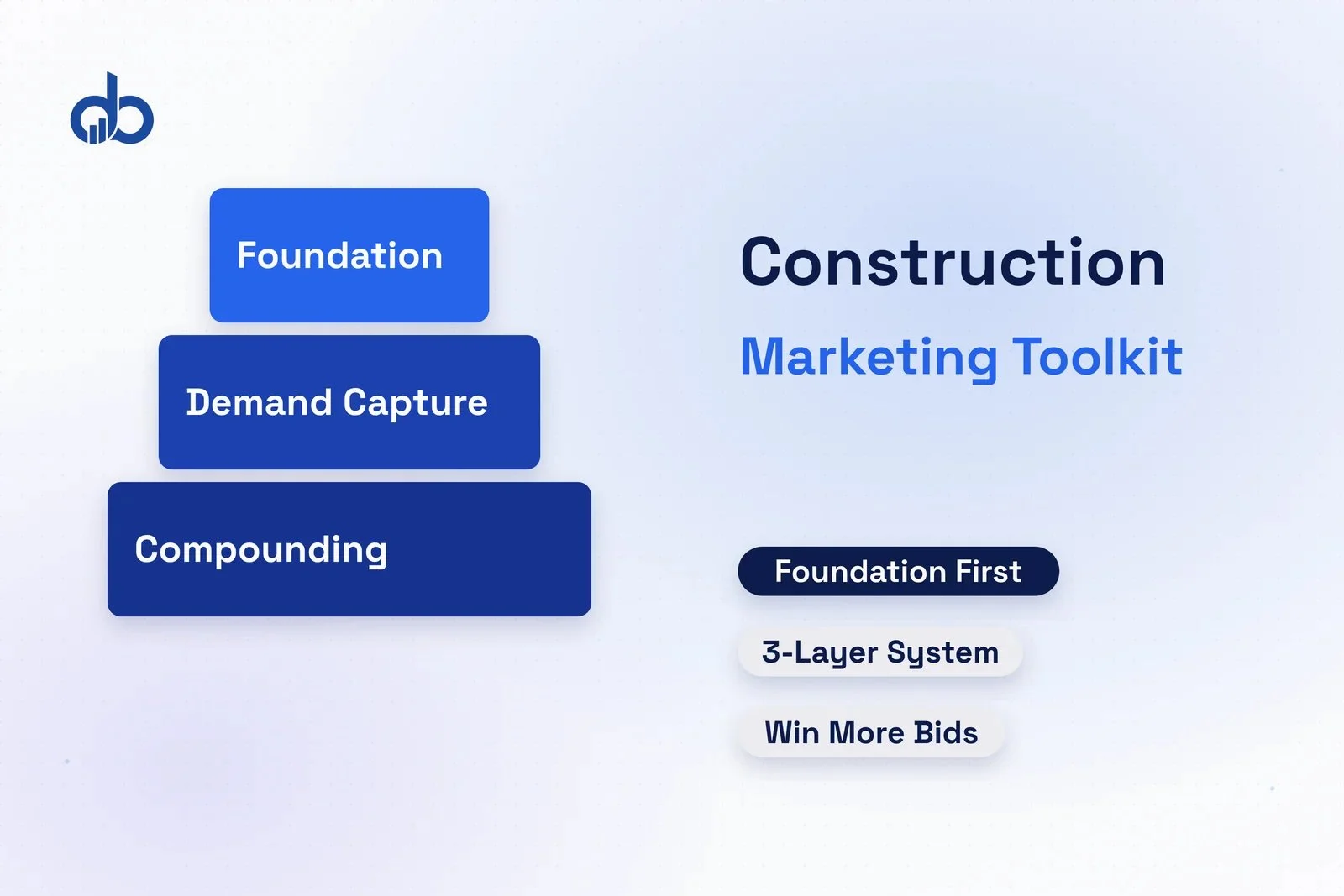
The construction company marketing toolkit what builders need to win bids is a build sequence, not a checklist. What you add first determines whether everything else works.
Why the Sequence Matters More Than the Tools
Take the same Google Ads campaign and point it at two different sites.
Site A: a construction company with 8 Google reviews, a homepage with a stock photo of a hardhat, no project portfolio, and a contact form that goes to an email nobody checks until Thursday.
Site B: a construction company with 47 Google reviews, a portfolio of 12 completed projects with before-and-after photos and project scopes, a service area page that names the specific cities they serve, and a phone number that gets answered during business hours.
Same keywords. Same ad spend. Same impressions. The conversion rate difference between those two sites is significant: sites like A convert paid traffic at 1-2%, while sites like B convert at 8-12%. That’s six to twelve times the return on the same ad budget. At Digiblazon, we’ve tracked this consistently across construction clients who came to us after running Google Ads to unconverted sites, and the pattern repeats without exception.
The tools aren’t different. The sequence in which they were built is.
One thing worth acknowledging: building the foundation properly (getting reviews to 40+, building out the portfolio, creating service area pages) takes 60-90 days before it starts influencing ROI from paid channels. Builders who need revenue this month are facing a genuine tension. You can run ads now to an unconverted site and pay the conversion penalty, or you can build the foundation for 90 days before turning on spend. That’s not a comfortable answer, but it’s the honest one.
What’s clear is that 78% of customers choose the first company that responds to their inquiry. Being first doesn’t help if they didn’t call. And they won’t call unless the foundation gave them enough trust to reach out.
Layer 1: Foundation (What Must Be in Place Before You Spend on Ads)
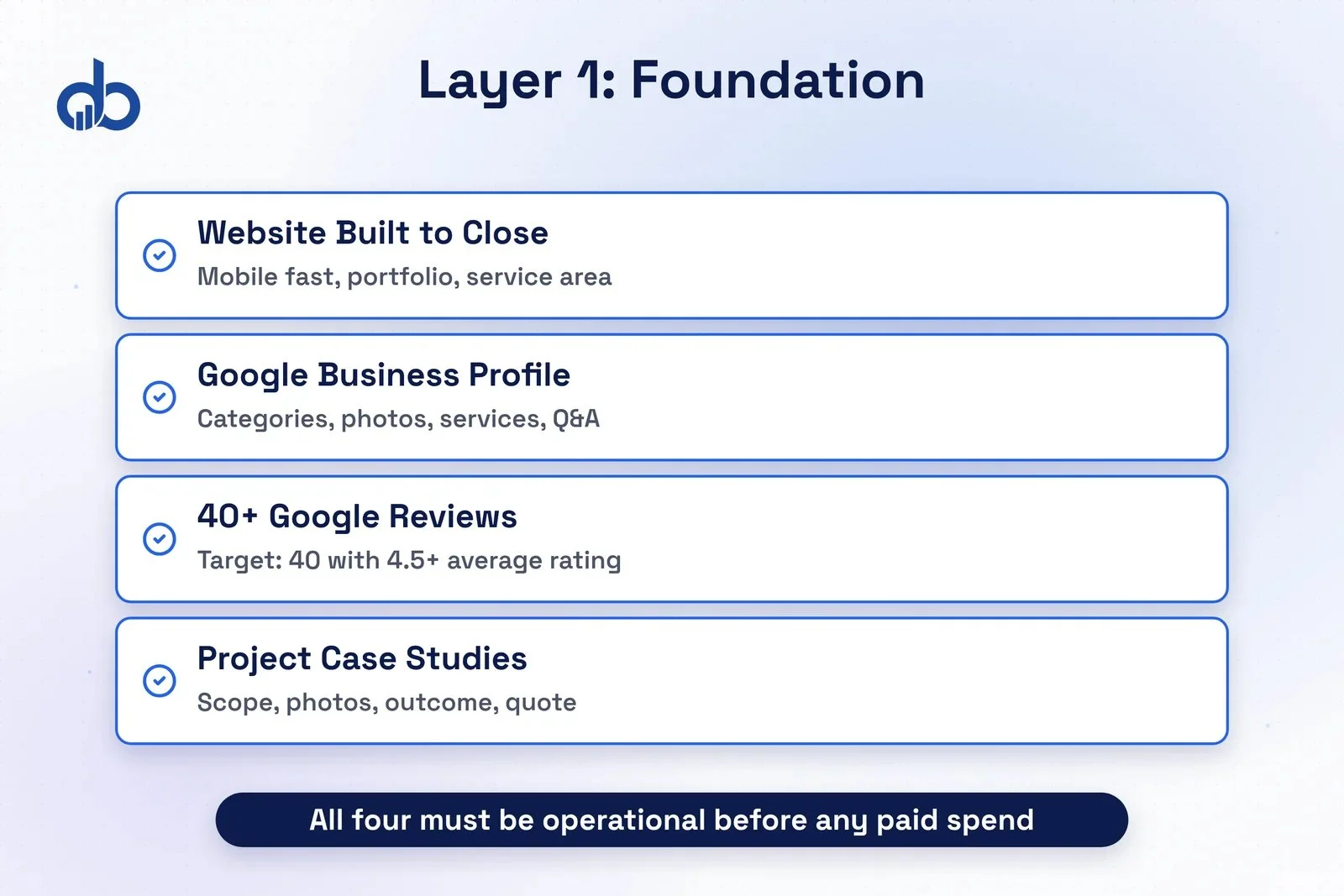
The foundation layer of your construction company marketing toolkit has four non-negotiable components. None of them require ongoing ad budget. All of them directly affect the conversion rate of everything else you run.
A website built to close, not just exist
Your website is not a brochure. It is the closing environment for every lead you generate, whether from paid search, organic, referral, or social. A construction website that converts has fast load times (under 3 seconds on mobile), clear service descriptions by project type, photos organized by project category rather than chronologically, a defined service area, and a contact path that takes fewer than two clicks.
Most construction company websites are designed for aesthetics and get rebuilt every five years. The ones that generate consistent leads are designed for conversion and updated quarterly with new project completions.
A Google Business Profile that earns trust before the first call
Your Google Business Profile is the most-viewed marketing asset most construction companies own, and the most neglected. A profile with the right business categories, a populated services list, updated photos of recent projects, and answered Q&As functions as a pre-sales tool for every local search query your potential clients run. Incomplete profiles lower your local ranking and tell prospects who find you anyway that you don’t pay attention to detail.
A minimum of 40 Google reviews
The number 40 is not arbitrary. Consumer trust thresholds increase sharply around the 35-50 review range. Below 20 reviews, your cost per lead from paid search runs significantly higher because you’re paying to overcome the doubt your review count creates. Cross 40 reviews with an average rating above 4.5 and that doubt mostly disappears.
The system for getting to 40 is simple and most builders ignore it: ask within 48 hours of project handoff, not six months later. One direct text with a link to your Google review page, sent the day the project wraps up, converts far better than a generic email sent weeks later.
Project case studies (not just photos)
Three detailed case studies outperform a 50-image gallery in every metric that matters: time on page, contact rate, and referral validation. A case study includes the project type, the challenge or scope, what was built, the timeline, and an outcome the client was happy with. Client quotes make it work harder. Before-and-after photos contextualized by the scope give a prospect the information they need to decide if you’re the right fit before they call.
Case studies also give your referral partners (realtors, architects, designers) something specific to share when they recommend you.
Not Sure Which Marketing Tools Your Construction Business Is Missing? Our team audits your current marketing stack and maps exactly which tools belong at each layer of your growth plan, so you stop wasting budget on demand capture before your foundation converts Get Free Marketing Audit
Layer 2: Demand Capture (The Tools That Bring Buyers to Your Foundation)
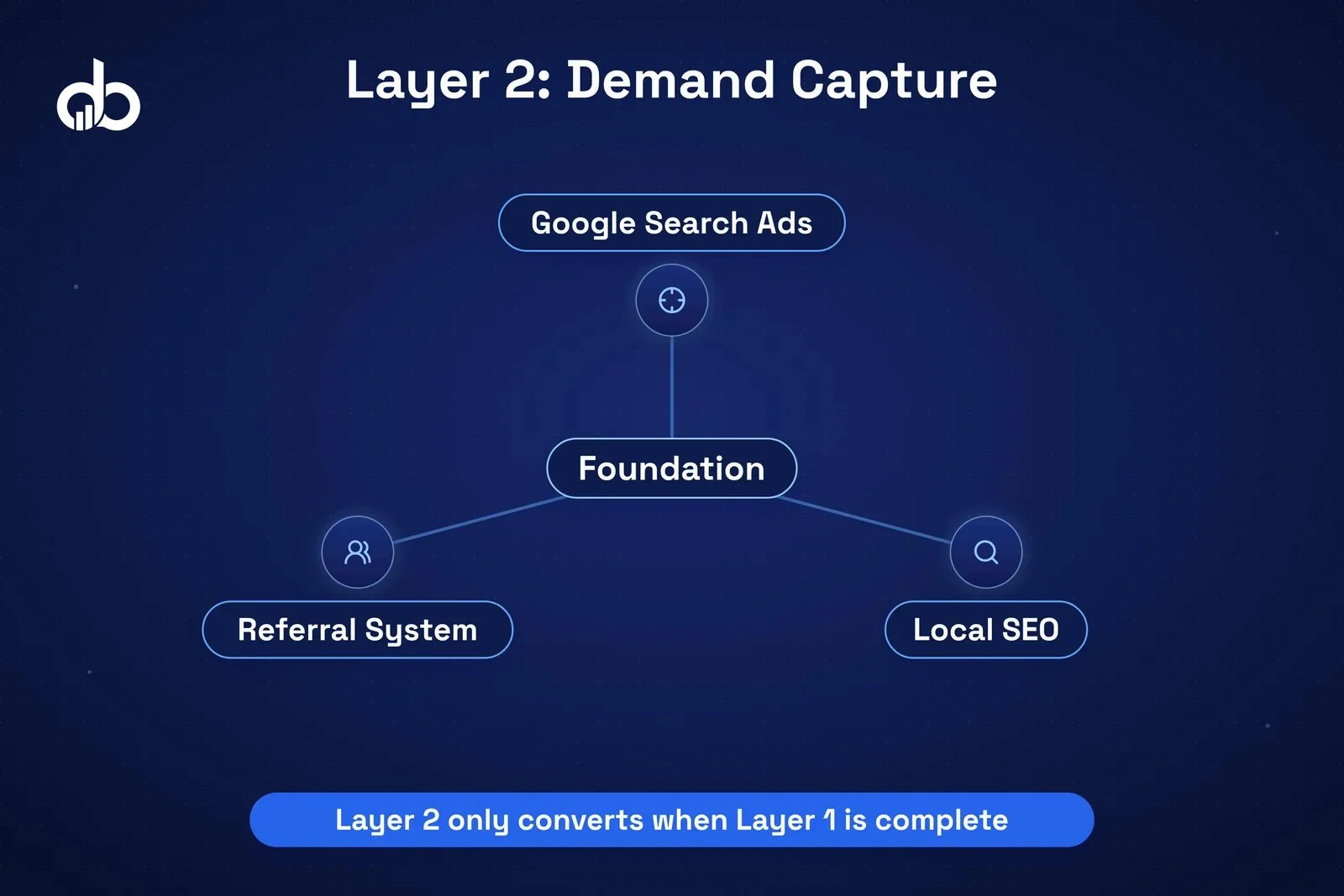
Once Layer 1 is operational, demand capture works. Before Layer 1 is operational, demand capture bleeds budget.
Google Search Ads
Google Ads is the fastest path to new construction leads when the foundation is in place. High-intent queries (“general contractor [city]”, “home addition contractor near me”, “commercial renovation company”) come from buyers who are actively looking and have already narrowed their search to specific work. You don’t have to convince them they need construction services. You just need to be the most credible option when they search.
The construction marketing plan for Google Ads requires three things beyond the ads themselves: a converting landing page (not your homepage), call tracking to attribute which ads produce booked jobs not just calls, and a defined service area that matches your actual operational geography. Campaigns without these three elements spend $165 per lead generating calls that close at 2%. Campaigns with them close at 8-12%.
Local SEO
Local SEO is the demand capture tool with the longest runway and the highest long-term ROI. SEO delivers 681% ROI in construction, nearly seven times the return of paid social. It takes 4-6 months before ranking movement is visible and 6-12 months before lead volume becomes meaningful.
The construction marketing plan for local SEO is built on location-based service pages, not blog posts. A page optimized for “kitchen remodel contractor Chicago” will generate more leads than ten blog posts about kitchen renovation trends. Build dedicated pages for each service you offer in each geographic area you serve. Structured schema markup on each page helps search engines confirm what you do and where you do it.
Referral system (structured, not passive)
Most construction revenue comes from a small number of referral relationships maintained consistently. Realtors, architects, interior designers, cabinet showrooms, and specialty suppliers all talk to homeowners before construction starts. They’re not sending referrals because they forgot you exist. They send them to whoever stayed in contact.
A structured referral program is not complicated. It’s a monthly touchpoint: a project update email to your five most active referral partners, an occasional coffee or site visit, and a reciprocal referral when a client asks for a recommendation. Builders who formalize this into a calendar-based habit generate a meaningful share of new business from referral partners who actively keep them top-of-mind.
Layer 3: Compounding (The Tools That Reduce Your Cost Per Lead Over Time)
Layer 3 tools are not immediately visible in lead volume. They work by lowering cost per acquisition as they mature. All of it makes the tools in Layers 1 and 2 more efficient over time. The compounding is slow to start and hard to see until it isn’t.
Content marketing for construction
Content marketing for construction works when it answers specific questions buyers have during the decision-making process. Not generic renovation trends, but “how much does a home addition cost in [city],” “what permits do I need for a commercial remodel,” “what’s the difference between a general contractor and a construction manager.”
Those questions get typed into Google thousands of times per month in local markets. A construction company that publishes thorough, credible answers to them builds organic traffic that requires no ongoing ad spend. Content marketing for construction generates three times more leads than outbound tactics but takes six to twelve months to reach meaningful traffic volume, which is why it belongs in Layer 3, not Layer 1.
Email marketing
Email has the highest ROI of any channel in the construction company marketing toolkit, at 3,800% in construction. It also requires the smallest ongoing investment once the list exists. The list builds from Layer 1 (review requests, quote form submissions, job completions) and Layer 2 (Google Ads lead capture).
Email in construction is not promotional. It’s a project documentation channel that keeps past clients and referral partners current on what you’re building. Monthly or quarterly emails with new project photos, case study links, and simple updates maintain relationships with past clients who refer repeatedly and referral partners who need a reason to remember you.
Social media (one platform, done well)
Social media belongs in Layer 3 because it compounds trust over time but rarely generates direct construction leads at scale, particularly in the first year. The construction companies getting consistent value from social are posting project documentation: progress photos, completion reveals, time-lapse videos of the build. Not promotional content.
Platform choice matters. LinkedIn is the right channel for commercial construction companies targeting project managers, developers, and procurement teams. Instagram and Facebook work for residential builders who want referral validation from past clients and their networks. One platform maintained consistently outperforms three platforms managed sporadically.
By the time Layer 3 is producing meaningful returns, 38% of contractors report measurable impact from AI tools in 2026, up from 17% just a year ago. The Layer 3 content your company builds today is what gets cited when someone asks an AI assistant for a contractor recommendation in your area.
What a Full Construction Company Marketing Toolkit Looks Like at Each Stage
The timeline for building the toolkit looks like this:
Months 0-3: Foundation only
Website conversion audit and fixes. Google Business Profile completed. Review request system launched. First three project case studies published. No paid ad spend until reviews reach 20+.
Months 3-12: Add Demand Capture
Google Ads launched with call tracking and a dedicated landing page. Local SEO build begins with service and location pages. Referral partner list identified and monthly touchpoint calendar built.
Months 12+: Add Compounding
Content marketing for construction begins, two to four articles per month. Email list activated with quarterly project updates. Social media content calendar built around project documentation.
A construction marketing plan that reverses this sequence (launching social media and Google Ads before the foundation converts) produces exactly the experience most builders describe: “we tried digital marketing and it didn’t work.” The construction company marketing toolkit what builders need looks identical across every revenue bracket. The sequencing is always the differentiator between companies that grow and companies that plateau.
The builders who tell us construction marketing doesn’t work are almost always in the same position: they started with Layer 2 or Layer 3 tools while Layer 1 was still incomplete. Fixing the sequence is what changes the result.
The One Mistake That Kills Every Construction Marketing Budget
The single most common sequencing error in construction company marketing: running demand capture before the foundation is ready to convert the demand it produces.
Builders spend $2,000-5,000 per month on Google Ads with eight Google reviews and a contact form that goes to a generic inbox. They get calls. Some of those calls don’t get answered when the prospect follows up. Some go to voicemail and aren’t returned the same day. Some do get answered, and the prospect hears nothing that differentiates the builder from the three other contractors they’ve also called.
78% of customers choose the first company that responds. Demand capture generates the call. The foundation (the reviews, the case studies, the response system) determines whether that call turns into a bid, and whether that bid turns into a job.
The diagnostic is simple. Map every tool you’re currently running against the three layers. Every Layer 2 or Layer 3 tool running before Layer 1 is complete is a budget leak. Fix the foundation first, then spend on the demand.
A complete construction company marketing toolkit is not about having every tool. It’s about having the right tools operational at the right time. Your Performance Marketing and Digital Marketing strategy works when each layer is in place before the next one is funded. Build the foundation. Add demand capture once it converts. Let compounding reduce your cost per lead over time.
When you’re ready to audit your current stack and identify exactly which layer to focus on next, our team can map it out in a single session.
- 62% of construction leads now come from online — your marketing toolkit must be built where buyers search.
- Build in sequence: Foundation first (website, GBP, reviews, case studies), then Demand Capture (Google Ads, Local SEO, referrals), then Compounding (content, email, social).
- Skipping Layer 1 and running Google Ads converts at 1–2%; completing Layer 1 first pushes conversion to 8–12%.
- Local SEO delivers 681% ROI in construction — highest of any channel — but takes 4–6 months to rank.
- The most expensive marketing mistake is adding tools out of sequence, not picking the wrong tools.
Frequently Asked Questions
How much should a construction company spend on marketing?
U.S. builders currently spend 2.8-3.2% of revenue on marketing.Construction firms that allocate 5% or more of revenue to digital marketing see 28% higher lead conversion rates compared to those spending less.The amount matters less than the sequence. Spending 3% on the right construction marketing plan in the right order outperforms spending 8% in the wrong one.
Do construction companies need social media?
Social media belongs in Layer 3, valuable for compounding trust and authority over time, but a poor starting point. Before investing consistent effort in social, confirm that Layer 1 (website, reviews, GBP) and Layer 2 (Google Ads, local SEO) are operational and converting. For residential builders, Instagram validates referrals. For commercial, LinkedIn is the B2B bid relationship channel.
How long does it take for construction marketing to produce leads?
It depends on the layer. Google Ads produces leads within days of launch if Layer 1 is converting. Local SEO takes 4-6 months before ranking movement and 6-12 months before consistent lead volume. Content marketing for construction takes 6-12 months to reach meaningful organic traffic. The toolkit works fastest when layers are built in sequence.
What's the most important marketing tool for a construction company right now?
Google Business Profile, specifically one with 40+ reviews and updated project photos. It's free, it directly influences local search rankings, and it functions as a trust signal for both organic and paid traffic. No other component of the construction company marketing toolkit produces more return per hour invested at the foundation layer.