
The pipeline was moving. Then it wasn’t. No announcement, no obvious cause. Just fewer calls, fewer form fills, and longer gaps between booked estimates.
62% of contractor calls go unanswered during regular business hours. That figure comes from a ServiceTitan study of more than 50,000 contractor phone lines. It means the average home remodeling business isn’t reaching homeowners who actively tried to hire them. Not because the homeowner gave up on the project. Because someone else answered first.
This is the pattern every home remodeling business eventually hits. And the usual diagnosis is wrong.
Most remodelers respond to a quiet pipeline by adding volume. More budget, more platforms, more content. But home remodeler lead generation doesn’t fail because there are fewer homeowners searching. It fails because leads that were already generated are being lost before they convert. There’s one failure mode in particular that accounts for most of this loss, and it has nothing to do with ad spend. The rest of this article identifies all four and shows which one is most likely draining your pipeline right now.
The 4 Reasons Home Remodeler Lead Generation Goes Cold
Most advice frames a quiet pipeline as a sourcing problem. It’s usually a loss problem. Before adding any new channel or increasing spend, identify which of these four failure modes is active in your business.
- Your leads are tied to a single platform
- You’re generating leads but losing them before the first call
- Your messaging doesn’t match what homeowners are searching for right now
- Your content attracts traffic, not buyers
The first two are the most urgent. They represent lead loss in real time. The second two are structural. They produce the right volume on paper while quietly starving the conversion pipeline.
Sign 1: Your Lead Flow Lives or Dies on One Platform
Home service leads that come from a single source have no redundancy. When that source changes, the pipeline goes quiet. Not gradually. Immediately.
Here’s what it looks like in practice. Consistent lead flow for three to six months. Then a platform update, an increase in local competition, or a budget adjustment cuts volume by 40 to 60 percent. The remodeler’s first response is to increase spend on that same platform. That makes the dependency worse, not better.
The most common single-platform traps for home remodeling businesses:
Single-source risk patterns:
- Google Local Services Ads (LSAs) with no backup channel. When LSA lead quality drops or a competitor earns more reviews, the pipeline stalls.
- Angi or HomeAdvisor with no owned traffic. These platforms retain the homeowner relationship. You’re renting access to their audience.
- Referral networks with no inbound marketing. Word-of-mouth is inconsistent by nature. Relying on it as a primary channel isn’t a home remodeler lead generation strategy. It’s a dependency with no switch.
Lead generation for home services requires at least two independent sources. When one slows, the other holds volume. Without that redundancy, any platform shift becomes an immediate crisis rather than a manageable dip.
Don’t abandon what works. Build a second source before the first one fails. A remodeling business generating 80 percent of its home service leads from LSAs with no secondary channel is one algorithm update away from a very quiet month.
Sign 2: You’re Generating Leads But Losing Them Before the First Call
This is where most home remodeler lead generation systems fail. Not in the sourcing. In the response.
85% of homeowners who can’t reach a contractor on the first call immediately contact the next one on the list. They don’t leave a voicemail. They don’t wait. They move on within minutes.
The industry benchmark is clear. Responding to an inbound lead within five minutes produces significantly higher conversion rates than responding within an hour. By the time most remodeling businesses return a call, the homeowner has already booked an estimate elsewhere.
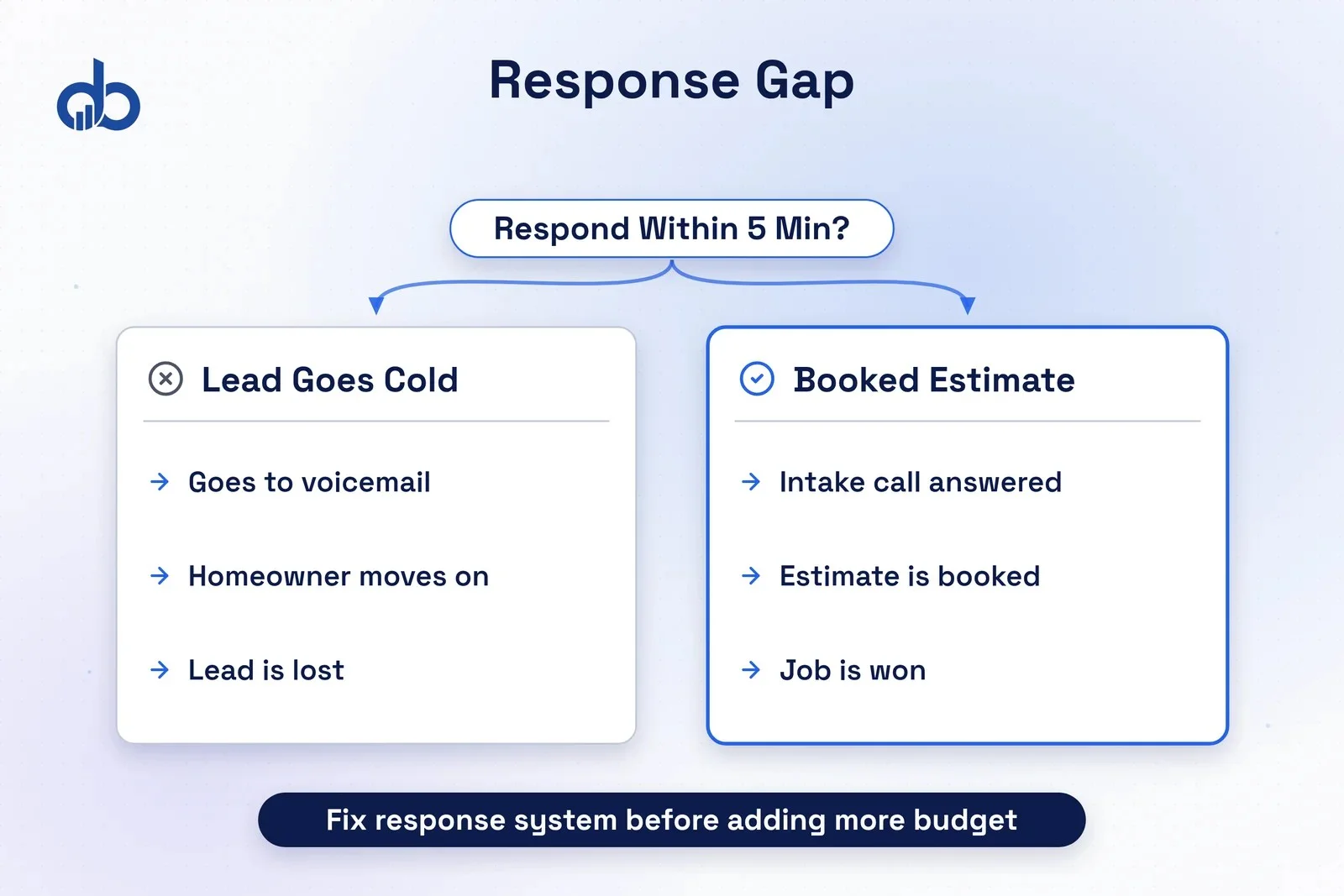
Here’s the misdiagnosis most remodelers make. The problem isn’t that the leads disappeared. The problem is that they existed, came in, and then left because no one responded in time. That’s a lead management failure, not a lead generation failure.
The observable symptom: form fills and inbound calls are arriving, but the booked estimate rate is declining. Calls are going to voicemail during business hours. Leads from evenings and weekends sit unanswered until Monday morning.
78% of homeowners go with the first company that responds to their inquiry. Not the lowest price. Not the most five-star reviews. The first response.
Is slow response time costing you leads you're already generating? Get Free Marketing Audit
This failure mode doesn’t require additional marketing spend to fix. It requires a faster response system. A dedicated intake person, an answering service, or an automated acknowledgment that fires within two minutes. Any of these will recover leads that are currently walking out the door.
Sign 3: Your Messaging Is Out of Season with What Homeowners Want
Pipeline silence is sometimes a messaging mismatch, not a reach problem. The ads are running. The site is indexed. But the inquiries coming in are for smaller jobs, different project types, or homeowners who are months away from committing.
Seasonal intent in home remodeling is consistent from year to year. Spring and early summer bring kitchen and bathroom remodel inquiries. Late summer shifts to exterior updates, roofing preparation, and smaller improvement work. Fall surfaces home office additions and indoor renovations timed to winter projects.
When messaging doesn’t track with those shifts, two things happen. Volume on paper stays consistent. But home service leads slow to convert because the campaign is targeting a different project type than what homeowners are searching for right now.
What this looks like from the inside: inquiries keep arriving, but booked estimates are down. Intake calls are from homeowners who say they’re just gathering quotes or want work started in a timeline that doesn’t match current booking capacity. Quality drops before volume does.
It’s not a sourcing problem. The homeowners are searching. The messaging just doesn’t meet them at the right stage of their decision.
A quarterly review of ad copy, landing page messaging, and content offers prevents this. It doesn’t need to be exhaustive. It needs to answer one question: does the messaging reflect what homeowners in this service area are actively looking for in the next 60 to 90 days?
Not sure if your messaging matches what homeowners are searching for right now? Get Free Marketing Audit
Sign 4: High Traffic, No Home Service Leads
Organic search rankings create a specific failure mode for remodeling businesses. Traffic grows. Keyword positions improve. But lead generation for home services from the site stays flat.
The gap is intent. Content written to rank for informational queries attracts homeowners in research mode. These visitors aren’t ready to hire. Many are six months away from a decision. Some are gathering ideas without a project in mind.
That’s not a content problem. It’s an alignment problem. Research-stage content serves a real purpose in building authority and awareness. But it can’t be the primary driver of home service leads if the business goal is near-term booking.
The observable symptom: organic traffic from blog content is increasing month over month. But form fills from the site aren’t tracking with that growth. Bounce rate on blog pages is high. Service pages have rankings but low conversion rates.
The fix is a content audit by intent stage. Separate pages into three categories: awareness, consideration, and decision. Decision-stage pages (service area pages, project-type pages, and before-and-after project pages) convert. Awareness content doesn’t. Most remodeling sites have too much of the former and not enough of the latter.
Home service lead generation companies that produce content without intent mapping create this problem for their clients. An intent audit surfaces the issue within a handful of pages and redirects content investment toward the pages that actually drive inquiries.
How to Stop Losing Leads in Your Home Remodeler Lead Generation System
Diagnosing which failure mode is active in your home remodeler lead generation system tells you where to act first. Here’s the priority order, ranked by immediate impact on lead flow.
- Fix the response gap first. This is the single highest-impact change for any home remodeler generating leads but not closing them. A dedicated intake person or answering service closes the response gap faster than any campaign adjustment. If a Google Local Services Ad generates a lead at $233 per booked job and a slow response loses that lead before a call ever happens, the waste compounds daily. Fix the response system before adding more ad budget.
- Audit your platform mix second. List every source that produced home service leads over the last 90 days. Calculate what percentage of total volume each source represents. If one channel represents more than 60 percent of leads, you’ve got a concentration risk. Add a second channel over the next 90 days. For most remodeling businesses, LSAs and a well-maintained Google Business Profile work as a natural pairing.
- Review seasonal messaging every 90 days. Set a quarterly reminder to audit ad copy, landing page headlines, and content offers. Identify what homeowners in your service area are actively searching for in the next quarter. Update the messaging before intent shifts, not after lead quality drops.
- Run an intent audit on your site. Categorize each page by decision stage: awareness, consideration, or decision. If most of your content targets awareness-stage visitors, shift investment toward service area pages and project-type pages. These convert. Research articles don’t.
Home service lead generation companies that skip the diagnostic step often recommend more volume. That’s the wrong starting point when the problem is loss, not scarcity.
Ready to identify exactly where your lead pipeline is leaking? Request a Proposal
Is Your Lead Pipeline Leaking? Score These 4 Signs
Run through these checks. If more than two apply, the pipeline is losing leads it has already generated. More spend won’t solve it.
Checklist: Lead Pipeline Health Check
- More than 60% of your home service leads come from a single platform or source
- Inbound calls or form fills are arriving but you’re not responding within 15 minutes during business hours
- Your booked estimate rate has declined even though total lead volume has stayed flat or grown
- Your organic traffic is increasing but form submissions from the site haven’t followed
If three or four of these apply, the issue isn’t generating more leads. It’s fixing the system that handles the ones you already have. Adding budget to a pipeline with these problems increases cost without increasing results.
Stop Adding Volume to a Leaking Pipeline
You can now identify which of the four failure modes is active in your pipeline. That shifts the conversation from “we need more leads” to “we need to fix what we’re already generating.” The gap between knowing the failure mode and fixing the system behind it is where most remodeling businesses stall. Digiblazon’s performance marketing team audits home remodeler lead generation systems. The audit identifies exactly where qualified leads are being lost before any additional spend is added. Start with a Free Marketing Audit.
- A quiet pipeline is usually a loss problem, not a sourcing problem. Fix the leak before adding budget.
- 62% of contractor calls go unanswered during business hours, and 85% of homeowners who can't reach you move on to the next contractor immediately.
- Response speed is the single highest-impact fix: responding within five minutes converts far more leads than responding within an hour.
- Single-platform dependency turns a normal algorithm update into a pipeline crisis. Build a second lead source before the first one slips.
- Messaging that doesn't track seasonal intent shifts keeps lead volume flat on paper while booked estimates quietly decline.
- Rising organic traffic with flat form fills signals an intent mismatch. Decision-stage pages convert; awareness content doesn't.
Frequently Asked Questions
Why do home remodeling leads go cold in certain months?
Seasonal intent shifts are the most common cause. Homeowners search for different project types at different points in the year. When ad messaging and landing pages target project types that are out of season, inquiries drop in quality before they drop in volume. A quarterly messaging review aligned to local seasonal search patterns prevents this. The homeowners are there. The messaging just needs to meet them at the right time.
How fast should a home remodeler respond to a new lead?
Within five minutes during business hours. Industry data consistently shows response time is the single largest predictor of whether an inbound lead converts to a booked estimate. Eighty-five percent of homeowners who can't reach a contractor on the first call move on immediately. A dedicated intake process or answering service is the most direct fix for most remodeling businesses.
What is a reasonable cost per lead for home remodeling?
The more useful metric is cost per booked job, not cost per lead. Google Local Services Ads typically produce a cost per booked job around $233. Traditional Google Ads campaigns can reach $804 per booked job on the same project types. Tracking at the booked-job level shows which channel is actually working, not just which one generates form fills.
What do home service lead generation companies do that most remodelers don't?
Home service lead generation companies that work at scale measure response time as a primary performance metric. They know what slow response costs in concrete revenue terms. They also separate the sourcing problem (where leads come from) from the management problem (what happens after they arrive). Most remodeling businesses focus almost entirely on sourcing and very little on management. That's where the loss happens.