
The Per-Lead Treadmill Most Pest Control Companies Can’t See They’re On
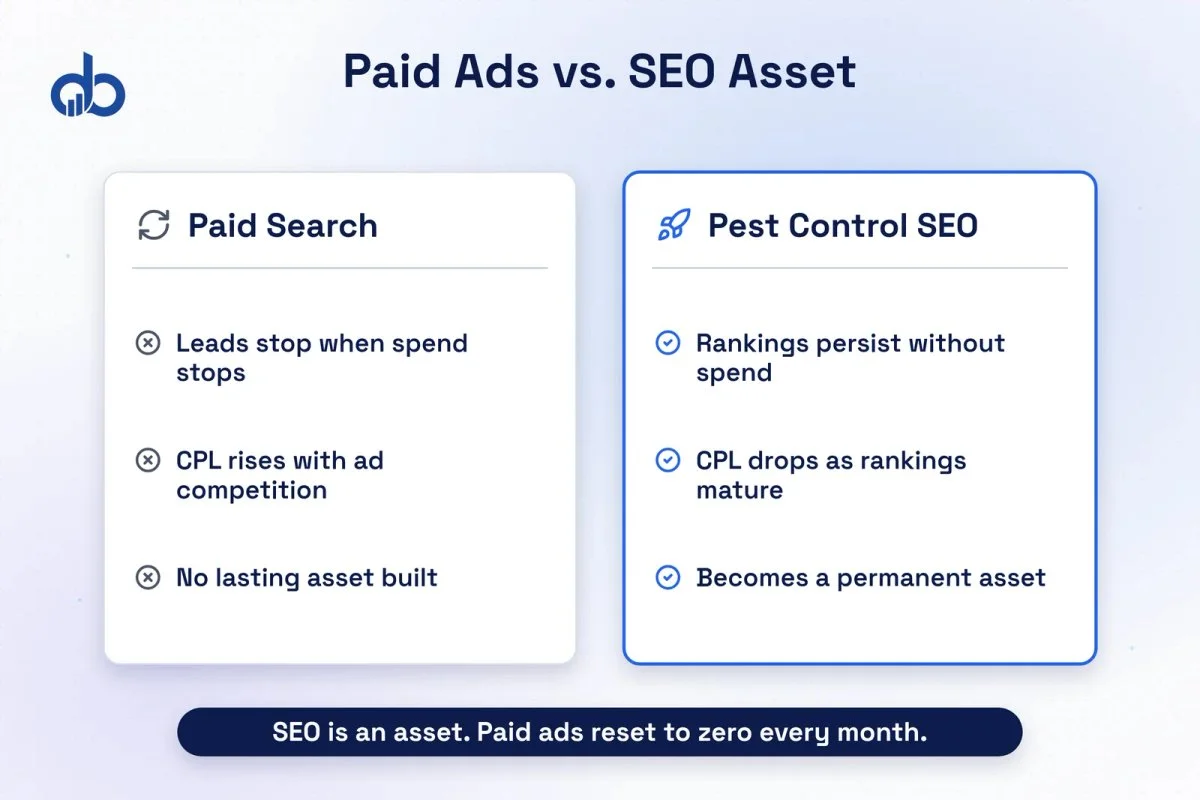
Most operators running Google Ads don’t think of themselves as being on a treadmill. They think they’re running a marketing channel. The distinction matters more than it sounds. A treadmill keeps you moving but doesn’t get you anywhere. Paid search for pest control works exactly that way. Run $5,000 in Google Ads this month and get leads. Run $5,000 next month and get leads. Stop running it and the leads stop within days. You haven’t built anything. You’ve rented attention for thirty days at a time. At $90.92 per lead, a pest control company generating 100 leads per month is spending $9,092 on Google Ads. Not on labor, chemicals, or equipment. On advertising. Every month. Year after year.
$90.92 — average cost per lead via Google Ads for pest control companies
The cost per click (CPC) for “exterminator near me” now averages $34 per click, up from $28-30 in 2024. Competitive markets, Miami, Houston, Phoenix, Los Angeles, push that to $45-60 per click. And here’s what drives it: every year, more pest control operators discover Google Ads and enter the auction, pushing everyone’s bids higher. The pest control keywords that were affordable three years ago now have a waiting list of bidders behind them. There’s another problem: 61% of Google Ads spend is wasted on non-converting clicks on average, and poorly managed accounts see that figure climb above 75%. Broad match keywords, competitor brand terms, irrelevant geographic clicks: these show up in every account that isn’t actively managed. You’re not just paying $90 per lead. You’re paying $90 per lead after already spending money on clicks that never called. This isn’t an argument against Google Ads entirely. It’s an argument for understanding what they are: a channel where you rent traffic. Rented traffic returns to zero the moment you stop paying.
Not sure if your current ad spend is building anything? Get a free marketing audit to see what organic could deliver for your market.
Why Your Ad Budget Keeps Growing Even When Business Is Good
Here’s a pattern business owners describe after five or six years in the industry: revenue grows, route density improves, operations get more efficient, but profit margins stay flat. Sometimes they shrink. The answer usually lives in the marketing budget. Lead costs that started at $40-50 five years ago now run $80-100. Your business needs more customers to keep growing, so the ad spend goes up to match. More ad spend means more competition in the auction, which drives cost per click (CPC) industry-wide. It’s a pressure cycle that rewards scale. Large national brands and well-funded regional operators can absorb it. Growing businesses feel it the most. Seasonality makes it worse. Summer brings peak pest pressure and peak ad competition at the same time. Bed bug season, mosquito season, termite swarm season: every surge in demand sends pest control keywords up in cost. You pay more for leads precisely when you need volume most.
Before pausing any ad spend to test SEO, make sure you have at least 3 months of organic baseline data from Google Search Console showing impression trends for your key service areas. That data will tell you whether organic is already moving before you reduce paid volume.
The deeper issue is dependency. Companies that pause Google Ads to test what happens typically see call volume drop to near-zero within 48-72 hours. For an operator running 40-50 calls per week through paid search, that’s not a test worth running for long. The channel works, so you keep feeding it. But the feeding never stops. There’s no point where you’ve “paid enough” and leads arrive for free. Pest control SEO doesn’t work that way. Rankings built over six months of consistent optimization don’t pause when you stop writing checks. A page ranking first locally for “termite treatment [city]” generates calls in month 18 the same way it did in month 8. The cost of acquisition drops over time rather than rising with competition.
What Pest Control SEO Actually Builds Over Time
Organic search is already the largest single lead channel in pest control: 48% of all pest control leads come from organic search, not paid clicks. Most operators are surprised by that number, because paid leads feel more controllable. But the majority of your potential customers are finding competitors through Google Maps and organic results, not through ads.
48% of pest control leads come from organic search — the single largest lead source in the industry
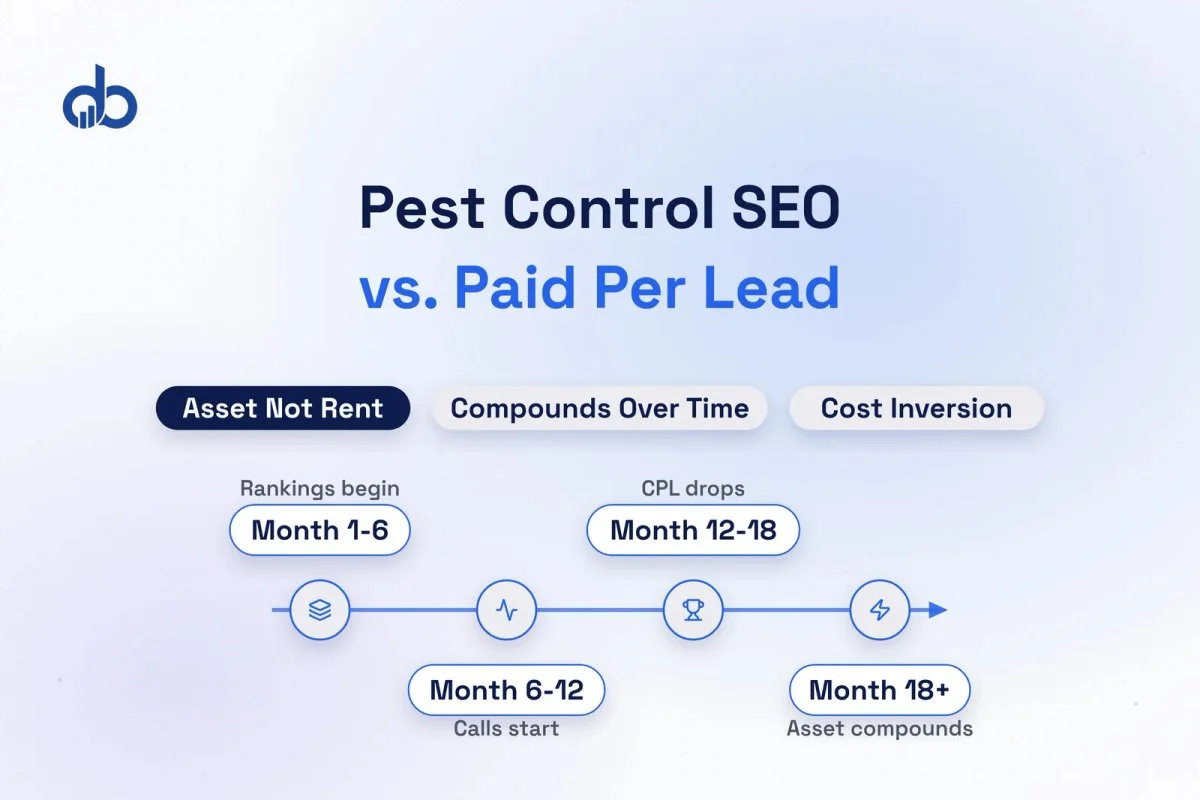
Organic leads also convert differently. They close at 14-22% compared to 8-15% for paid clicks. The reason is intent. Someone clicking a paid ad in an emergency is making a fast decision and may call three companies. Someone who found your site through organic search for “bed bug exterminator [city]” has already done their research. They’re warmer, more ready, and less price-sensitive. The compounding math is where the real argument lives. Months one through six are investment. You’re building content, optimizing your Google Business Profile (GBP), building local citations, accumulating reviews. Rankings start to move, but the phone isn’t ringing from seo for pest control yet. Months six through twelve are the ramp-up zone: organic calls start coming in, and the cost per lead (CPL) from SEO starts closing the gap with what you’re paying Google Ads. After month twelve, the math inverts. We worked with one pest control operator in a mid-size regional market who was spending $6,200/month on Google Ads before starting an SEO program. At month 14, organic calls exceeded their paid volume at roughly one-third the monthly cost. A case study from ironchess-seo.com documented a similar result: a company that restructured its website around pest-specific and location-specific landing pages achieved a 280% increase in inbound quote requests while eliminating a $4,800/month Google Ads spend entirely. By month 18-24, a well-run program typically generates 20-30 organic calls per month at near-zero marginal cost per call. That’s not rent. That’s an asset.
The Pest Control Keywords That Drive Real Booked Jobs
Not all pest control keywords generate the same kind of lead. Emergency-intent keywords (“exterminator near me,” “pest control open now,” “bed bugs emergency”) drive calls from homeowners who need someone today. Those convert quickly but also live in paid search, where you compete in the auction every time. Schedule-intent keywords (“termite inspection [city],” “pest control service [city],” “quarterly pest treatment”) are lower in urgency but higher in customer lifetime value. The person searching “quarterly pest control service [city]” is looking for a recurring contract, not a one-time emergency call. These pest control keywords are also less expensive to rank for organically because fewer advertisers bid on them. Pest-specific content is where seo for pest control builds durable rankings. A page dedicated to “termite treatment in [city],” covering signs, treatment options, cost ranges, and prevention, can rank for dozens of related searches. A page on “bed bug exterminator [city]” does the same. These aren’t generic service pages. They’re answers to the exact questions homeowners type into Google at 11pm when they find evidence of an infestation.
Pest-specific pages that include your city name in the H1, URL, and title tag consistently outrank generic service pages, even with less content depth. One page per pest type, per primary service area, is the target architecture for strong seo for pest control.
Long-tail pest control keywords carry lower search volume but much higher conversion intent. “How to get rid of carpenter ants in walls” is someone who has a carpenter ant problem, not someone casually browsing. An article answering this question accurately can rank in the top three for that search and generate multiple leads per month without spending a dollar on ads. FAQ content targets People Also Ask boxes, which appear in the majority of pest-related searches. When your content answers “How much does pest control cost?” in a featured snippet or PAA box, you capture attention without a click and build brand recognition with every impression. The content structure that works: a pillar page covering your core pest control services in the city, with cluster pages for each pest type and each service area. This is how pest control SEO builds topical authority that search engines favor. You’re not one thin service page. You’re the go-to local resource.
What Pest Control SEO Services Include vs. What You Could Do Yourself
What Full-Service Programs Cover
Pest control SEO services typically cover six components: Google Business Profile (GBP) optimization and management, local citation building and name, address, and phone (NAP) consistency, pest-specific and location-specific content creation, review generation and reputation management, technical site audits and Core Web Vitals, and link acquisition from local sources. You could handle any one of these yourself. The challenge is doing all six consistently while also running a pest control operation. GBP management means checking and responding to reviews regularly. It means updating service listings after seasonal changes. Photos from each job strengthen your profile over time. Content creation requires understanding both pest biology and how people search for it. Technical SEO requires reading a crawl report and fixing structured data errors.
The In-House Trap
If you try to handle seo for pest control in-house, you’ll hit a consistent pattern: intensive work for a month, then operations take over, then you’re back to relying on paid ads because the SEO work stopped. The channel doesn’t compound if you stop tending it.
Timeline and ROI
Timeline expectations for pest control SEO services: GBP improvements typically show within 60-90 days, better map pack position, more calls from Google Maps. Organic rankings for competitive city-level terms take 4-6 months. Stable first-page positions typically require 9-12 months of consistent work. The ROI inversion point is when monthly organic calls multiplied by close rate multiplied by average job value exceeds the monthly SEO investment. Most pest control operators hit this in month 10-14, then continue generating leads from that point with no marginal increase in spend. That said, pest control SEO isn’t the right primary channel for every market situation.
When SEO for Pest Control Isn’t the Right Primary Channel
This is the part most pest control marketing guides skip. Pest control SEO is a long-term asset play, and not every business situation calls for that right now. Rural markets with low search volume. If total monthly search volume for pest control terms in your area is under 500, the ceiling on organic leads is simply too low to justify a 6-12 month investment in building rankings. Google Local Services Ads (LSAs) at $20-30 per lead and strong referral programs deliver better return in low-volume markets. Brand-new businesses. If you need cash flow in your first six months, SEO isn’t your primary channel yet. Google LSAs give you verified leads quickly. Google Ads gives you volume on demand. Build the foundation (website, GBP, a handful of reviews) and start the SEO investment in parallel, but don’t expect organic to carry the load before it’s ready. Urgent seasonal volume. If you’re approaching a peak season and need immediate call volume in the next 30 days, paid search is the right tool. SEO doesn’t respond to urgency. The practical framework for most established operators: keep LSAs and a modest Google Ads budget running for fast leads while building the SEO asset in parallel. As organic rankings build and organic calls increase, shift budget toward retention (email, recurring service contracts) and reduce paid dependency. The goal is having organic as your primary lead source and paid as your volume surge lever, not your baseline.
- Paid search generates leads only while you’re paying — stop the spend, stop the calls.
- The average pest control company spends $90+ per Google Ads lead, a cost that rises as more operators enter the auction.
- SEO builds a lead asset that compounds: each ranked page continues generating calls without a recurring per-lead fee.
- The highest-converting pest control keywords combine service type with city for commercial-intent local searches.
- Most operators see organic cost-per-lead drop below paid CPL by month 12–18 of a well-executed SEO program.
- Pest control SEO is the wrong primary channel if you're a brand-new business that needs cash flow in its first six months, if you need peak-season calls within 30 days, or if you serve too narrow a geography.
Frequently Asked Questions
How long does pest control SEO take to show results?
Initial movement, improved local pack rankings and more GBP calls, typically happens within 60-90 days. Organic search rankings for competitive city-level pest control keywords take 4-6 months. Stable first-page positions and consistent organic call volume usually come at 9-12 months. The compounding value, where each month generates more leads than the one before without increased spend, typically starts at month 12-18 for well-executed programs.
What are the most valuable pest control keywords to target?
The highest-value pest control keywords combine service type with city: "termite treatment [city]," "bed bug exterminator [city]," "pest control service [city]." These have commercial intent and a local qualifier, exactly the searches that convert to booked jobs. For long-tail traffic, pest-specific questions ("how to get rid of termites in walls") generate high-intent visitors at much lower keyword difficulty. "Pest control near me" and "exterminator near me" drive calls but live in paid search territory because of high competition.
How much do pest control SEO services typically cost?
Most pest control SEO services run $1,500-4,000/month for an established market, depending on competition level, number of service areas, and content scope. On a per-lead basis, by month 12-18, most operators see a blended organic cost per lead (CPL) of $30-60, well below the $90+ they're paying Google Ads. The key difference: that cost per lead (CPL) keeps dropping over time as the asset compounds, rather than rising with ad competition.
Can I do SEO for pest control myself?
Yes. Google Business Profile (GBP) optimization, review responses, and basic content creation are all manageable in-house with some learning curve. The challenge is consistency. Technical SEO (site speed, structured data, crawl issues) and local citation management are harder to handle part-time. Most operators who try full in-house seo for pest control find that operations take priority during busy season and the program stalls. A hybrid approach, in-house review management and content ideas with outsourced technical and link building, can work well for cost-conscious operators.