
Every major search consultancy is telling clients to pivot to Generative Engine Optimization. The advice sounds urgent: AI-referred sessions grew 527% year-over-year in the first five months of 2025. AI Overviews now appear on nearly a quarter of all Google searches. The brands cited inside AI-generated answers are reaching audiences who never click on organic results at all.
The pressure to act is real. But the playbook most agencies are selling contains a premise that does not survive contact with the actual citation data.
Here is that premise: Generative Engine Optimization is a replacement for traditional search strategy. Restructure your content for AI synthesis. Optimize for entity recognition instead of keywords. The SEO work your team has spent years building is becoming obsolete.
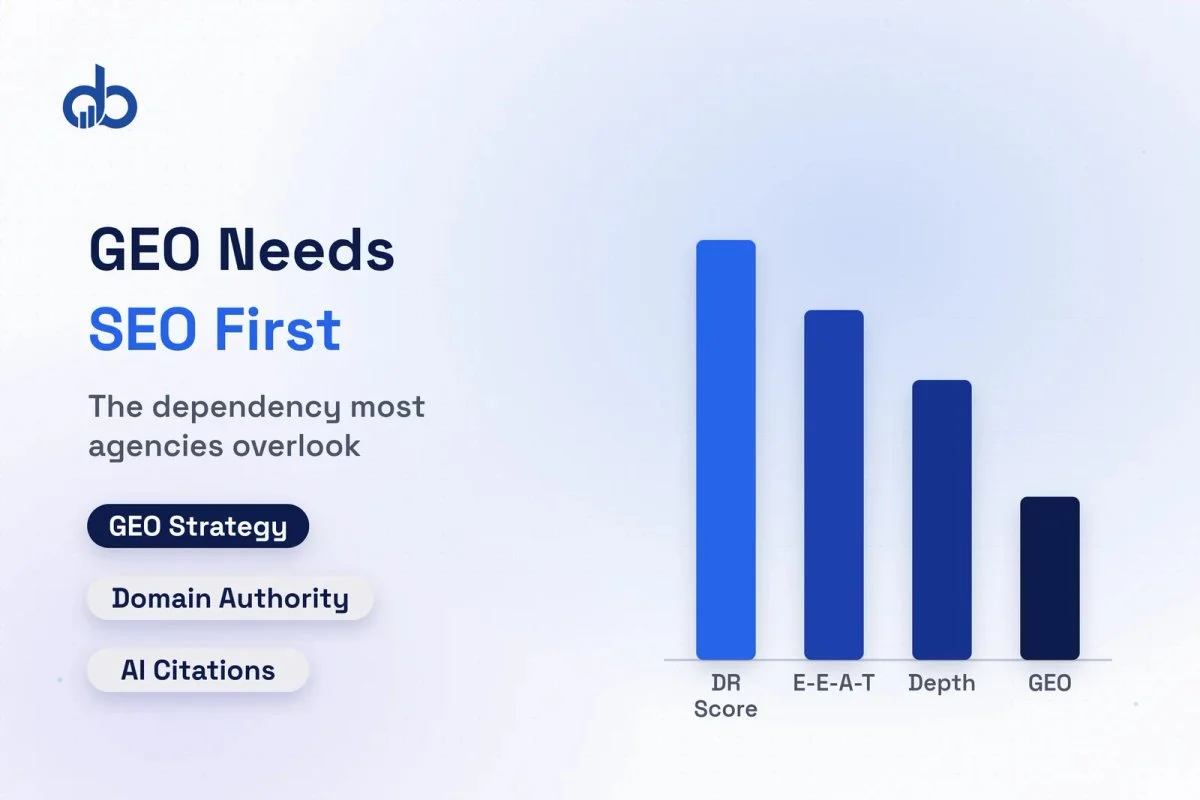
Here is what the citation data shows instead. The brands winning the most AI mentions are not the ones that pivoted away from SEO. They are the ones that built strong domain rating (DR) first, then layered GEO techniques on top of an existing credibility foundation. The dependency relationship is the opposite of what most agencies are selling.
Why the Industry Treats Generative Engine Optimization as SEO’s Successor
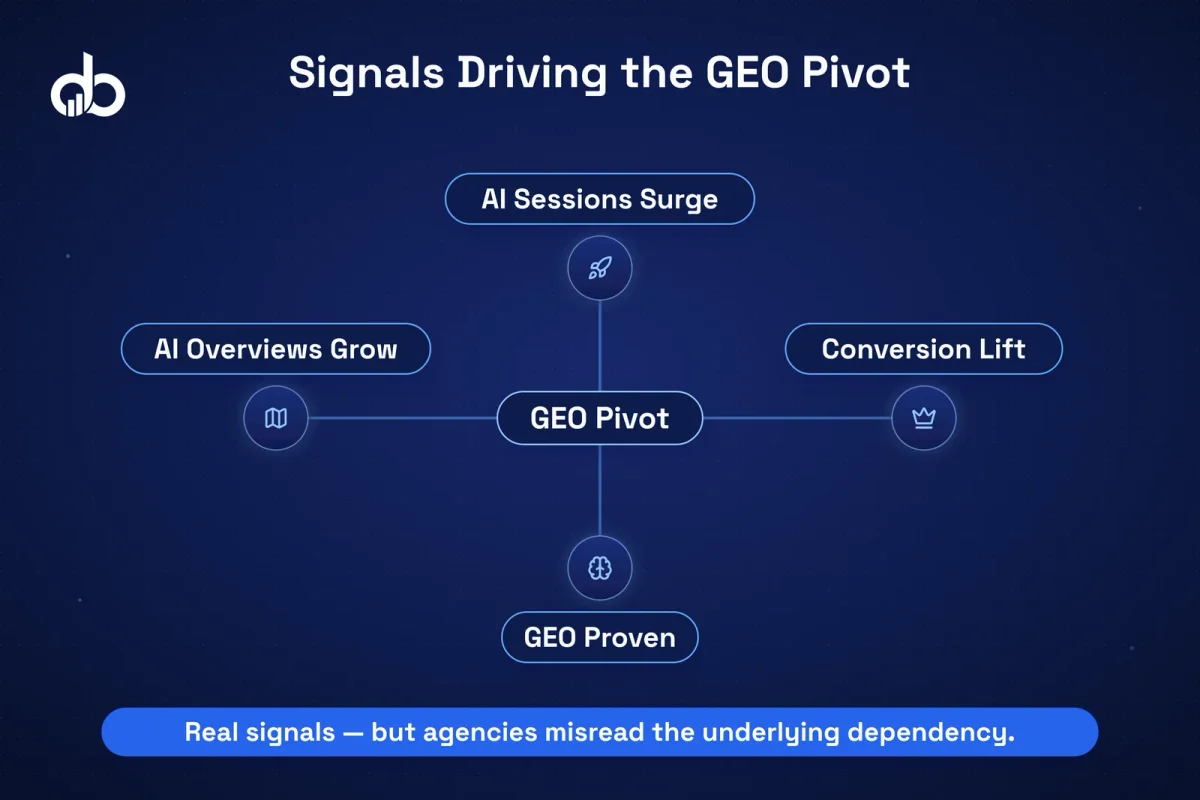
The case for pivoting sounds compelling, because the numbers are real.
When AI Overviews appear for a query, organic CTR drops 61%. AI-referred visitors to Ahrefs convert at 23 times the rate of its standard organic clicks. Session volume from AI referrals grew 527% year-over-year in early 2025. Numbers like these put Generative Engine Optimization on every CMO’s agenda by the end of last year.
The Princeton University GEO study gave agencies a concrete playbook to sell. The researchers found that citing authoritative sources, adding verified statistics, writing with a clear expert voice, and using structured answers that match how AI systems synthesize responses collectively increased AI citation rates by 40% in controlled testing.
Agencies heard “40% citation boost” and built their entire service revisions around it.
What they missed is what the study actually tested. The 40% improvement was measured on content that already demonstrated subject-matter expertise. The researchers controlled for the GEO signal layer. They did not test GEO techniques on thin content or on sites with low domain rating. The baseline was assumed. Most agencies stopped reading at the headline figure.
Where the Pivot Away from SEO Logic Breaks Down
The failure cases are now visible in enough accounts to identify a pattern.
Brands that reduced traditional SEO investment to fund GEO content restructuring have seen three consistent outcomes: organic rankings dropped as technical maintenance and link building stalled, AI citation rates did not improve despite GEO-optimized content, and recovery timelines for both organic traffic and AI search visibility became longer, not shorter.
Three scenarios show exactly where the argument fails.
A B2B SaaS client came to us after reallocating half its search engine optimization budget to GEO content in Q1 2026, a move that illustrates the most common pattern. Their new articles used structured answers, cited primary research, and included entity-rich language. Six months later, AI citation tracking showed no meaningful increase. Organic traffic had fallen measurably as existing pages lost ground without ongoing link building.
An ecommerce brand with domain rating 22 published twelve GEO-optimized product guides. None appeared in AI Overviews. Competitor guides from domains with DR 60+ were cited consistently for the same queries.
A consultancy cut its SEO retainer to fund GEO workshops. AI search visibility did not improve. The content authority gap between them and cited competitors widened every quarter.
The pattern is consistent across account types and verticals. GEO without an SEO foundation produces neither organic traffic nor AI citations. The reason is structural, not incidental. AI systems do not evaluate pages in isolation. They assess domain credibility, authorship signals, and content quality against the full information environment for a topic. GEO amplifies what is already there. It cannot create credibility from scratch.
Why GEO Requires Strong Traditional SEO to Work
The Ahrefs citation study from July 2025 is frequently used to support the GEO pivot. It found that 76% of AI Overview citations come from pages ranking in the organic top 10, but Ahrefs’ March 2026 update put that figure at 38%. Many agencies read that as evidence that traditional SEO ranking is no longer necessary for AI citation.
The interpretation misses the second half of the data.
The 62% of citations coming from pages outside the organic top 10 do not mean rankings stopped mattering. Ahrefs ties the shift to fan-out queries: pages cited outside the top 10 for the main query often rank for related sub-queries instead. They are not ranking in the top 10 for that specific query, but they are not weak pages either. Ranking for those sub-queries still takes the same SEO work that earns top 10 positions.
That is where the dependency becomes structural.
The Princeton GEO study’s recommended techniques work by amplifying credibility signals that already exist. When an AI system reads a page that cites peer-reviewed research, uses specific data, and maintains a clear expert perspective, that signal reads as credible only when the domain context supports it. The same signals on a low-DR domain read very differently.
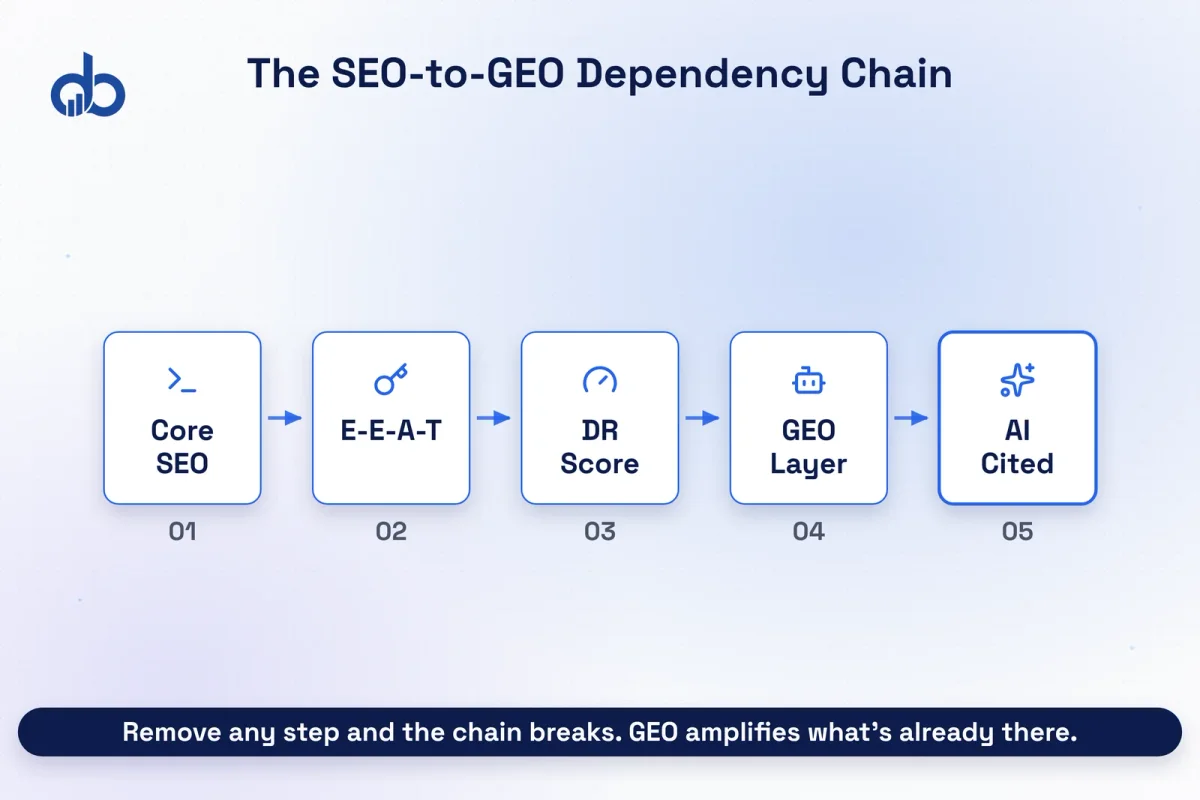
Traditional SEO builds that context. Technical health, link building, Experience-Expertise-Authoritativeness-Trust (E-E-A-T) content signals, and consistent topical publishing create the credibility infrastructure that AI systems rely on. Generative Engine Optimization techniques then give that infrastructure a format AI can extract efficiently.
Remove the infrastructure and the format has nothing to amplify.
The GEO-SEO Authority Stack
Brands building AI citation performance without sacrificing organic growth use an integrated model, not a replacement model. The structure follows three layers, each dependent on the one below it.
Layer 1: Domain Authority Foundation
This is the non-negotiable base: technical search engine optimization, link building, E-E-A-T signals, and site architecture. None of this becomes less important in a GEO environment. It becomes more important, because AI systems rely on domain-level credibility to evaluate content quality at scale.
The practical requirements (Core Web Vitals maintained, backlink acquisition ongoing, author credentials visible on the page, internal link structure supporting topical authority) are the same requirements that have always defined serious SEO. Without this layer, GEO techniques have no foundation to amplify.
Layer 2: Content Depth Layer
This is where traditional SEO content requirements and GEO requirements overlap most directly. Long-form, expert-authored content covering topics with verifiable depth. Primary data cited. Multiple source perspectives synthesized. The kind of content that demonstrates E-E-A-T at the page level.
This layer serves both traditional rankings and AI citations simultaneously. A page that performs well in search engine optimization because it is thorough and credible is also the type of page AI systems prefer to cite. The investment works for both goals at once.
Layer 3: GEO Signal Layer
This is the layer agencies are selling as the complete strategy: structured answers formatted for AI extraction, entity mentions connecting content to established knowledge graphs, cited statistics from authoritative sources, sections written to match how AI systems synthesize responses.
These techniques work. The Princeton study confirmed the citation lift. But they function as an amplification layer on top of Layers 1 and 2. Deployed without those foundations, the lift is minimal. Deployed on content with strong domain rating and genuine depth, the lift is significant. In one B2B SaaS GEO engagement, a client already ranking on page one for dozens of category keywords went from zero AI citations to being cited in 31 of 40 tracked buying-stage queries within four months.
The stack rule: Skipping layers does not accelerate results. It collapses the structure. A brand operating at Layer 3 without Layers 1 and 2 is optimizing a signal the AI system will discount, because the credibility infrastructure supporting that signal is absent.
What This Means for Marketing Teams Facing GEO Pressure in 2026
The pressure to act on GEO is real. Board-level conversations now include AI search. Clients are asking. Competitors appear to be moving.
The right response is integration, not replacement. Before restructuring your content strategy around GEO signals, three questions need honest answers.
What is your current domain rating baseline?
Pull your DR score, your top 20 pages by backlink count, and your E-E-A-T signal audit. If your domain rating sits below 30, GEO techniques will produce minimal AI citation lift regardless of how well-structured your content is. The first investment priority is Layer 1, not Layer 3.
Is your existing search engine optimization producing compounding results?
If organic traffic is growing quarter over quarter and keyword rankings are stable, your SEO foundation is working. You can add GEO techniques at Layer 3 without disrupting Layers 1 and 2. If organic traffic is flat or declining, diagnose the foundation problem first. GEO will not compensate for an SEO base that is underperforming.
Where specifically are you losing to AI citations?
Identify the queries where AI Overviews are cutting into organic clicks. Audit the pages cited for those queries: what domain rating do they carry, what backlink profiles? If the gap is DR-based, the fix is in Layer 1. If the gap is content-format-based, the fix is in Layer 3. Conflating the two leads to investing in the wrong layer.
Digiblazon’s SEO & Organic Growth service runs exactly this audit: domain rating baseline, citation gap analysis, and an integration plan that builds AI search visibility without sacrificing the organic foundation it depends on. Our content marketing team handles the Layer 2 depth work that bridges your authority baseline to your GEO signal layer.
GEO and SEO Are the Same Investment, Structured Differently
You can now audit your authority baseline before restructuring your content strategy, and avoid the most common failure mode: investing in GEO signals that have no SEO foundation to amplify. The real question is not “should we adopt GEO?” It is “do we have the domain rating and content depth for GEO techniques to return results?”
Knowing the framework and diagnosing your specific authority gaps are two different things. Start with the baseline audit before committing to a content restructure.
Digiblazon’s SEO & Organic Growth team runs this audit as the first step. If you want to see where your current domain rating stands and where GEO integration will actually move the needle, start with a Free Marketing Audit.
See where your domain rating stands and where GEO will actually move the needle. Get Free Marketing Audit
- AI-referred sessions grew 527% year-over-year, but the brands winning AI citations built strong SEO foundations first, not brands that abandoned traditional SEO.
- GEO techniques amplify existing domain authority and E-E-A-T signals. Without that foundation, GEO produces neither organic traffic nor AI citations.
- The GEO-SEO Authority Stack has three dependent layers: Domain Authority Foundation, Content Depth, and GEO Signal Layer. Each requires the one below it.
- Brands that reallocated SEO budgets to GEO content restructuring saw organic rankings drop and AI citation rates unchanged after six months.
- Check your domain rating baseline before investing in GEO tactics. Below DR 30, GEO techniques deliver minimal citation lift regardless of content structure.
Frequently Asked Questions
What is the difference between GEO and traditional SEO?
Traditional SEO optimizes content and site structure to rank in organic search results. Generative Engine Optimization optimizes content to be cited and synthesized by AI-powered answer engines. The techniques differ, but the underlying credibility signals (domain rating, E-E-A-T content quality, and backlink equity) are required by both.
Does GEO replace traditional SEO?
No. GEO techniques amplify existing SEO authority. They cannot create it. Brands with strong domain rating and established backlink equity see the citation lift the Princeton study documented. Brands without that foundation see minimal improvement regardless of how well their content is structured for AI extraction.
How do I know if my site is ready for GEO tactics?
Check three signals: a domain rating above 30, at least one topical area where your site ranks consistently in positions 1 through 15, and content that already cites primary sources and demonstrates subject-matter expertise. If those conditions are met, GEO techniques at Layer 3 will amplify what is already working. If not, invest in Layers 1 and 2 first.