AI search visits grew 42.8% year-over-year, from 15.6 billion queries in Q1 2025 to 27.4 billion in Q1 2026. At the same time, AI Overviews cut click-through rates on top-ranked content by 58%. Those two numbers belong together. Your content may be ranking and losing visibility at the exact same time.
That’s not a hypothetical. It’s what the data shows across hundreds of thousands of keyword SERPs in 2026.
Most agencies will tell you the reassuring version: your existing SEO investment carries over, and layering on schema markup, E-E-A-T signals, and topical clusters is enough. Many brands have followed that path and are still missing from AI-generated answers. The advice isn’t wrong. It’s incomplete.
The gap between what SEO programs optimize for and what actually drives SEO citations in AI search is measurable. Brands with strong domain authority, top-10 rankings, and healthy backlink profiles are getting bypassed in AI-generated answers. Brands with weaker traditional metrics are showing up in their place.
Every marketing manager with an active SEO program is now being asked the same question by leadership: are we positioned for AI search? The honest answer requires understanding what actually drives citation selection, not what should in theory.
The dominant predictor isn’t rankings. It isn’t backlinks. It isn’t domain authority. It’s a signal category that most SEO programs have never actively invested in. And the correlation distance between that signal and the metrics most teams report against is wider than any competitor article has made explicit.
The 2026 data quantifies that gap precisely.
AI SEO Is a Natural Upgrade: The Case Most Agencies Are Making
The argument most agencies make isn’t unfounded. Search rank still matters for AI citation selection. Position #1 carries a 33.07% citation probability in AI Overview results. By position #10, that figure drops to 13.04%. That’s a 60% decline across the ranking curve. Brands in the top three positions start with a measurably stronger foundation for earning AI Overview citations than brands outside the first page.
Schema markup adds real lift on top of that ranking base. Pages with proper structured data carry a 2.5x higher chance of appearing in AI-generated answers. FAQ schema blocks specifically increase AI citation rates by 44%. These aren’t marginal gains. They justify the schema work that most technical SEO programs already treat as a standard priority.
The industry picture is particularly reassuring for certain sectors. In healthcare, insurance, and education, organic-to-AI citation overlap remains between 68 and 75%. For teams in those sectors, SEO citations in AI search follow a relatively direct path from traditional ranking investment. The AI Overviews system in high-trust categories draws heavily from established organic results. The continuity message holds for those verticals.
Experience, Expertise, Authoritativeness, and Trustworthiness (E-E-A-T) signals carry forward because AI systems are trained on the web they inherit. Content with first-person expertise, credentialed authorship, and verifiable brand authority carries those trust signals into training data and citation logic. Agencies directing clients toward original research and editorial quality standards are pointing in a genuine direction.
Topical authority fits into the same case. A brand publishing extensively on a subject demonstrates topical depth to both ranking algorithms and AI systems drawing from indexed content. A content cluster covering related subtopics reinforces that depth signal across both channels. Build for SEO and the AI citation benefit follows. That’s the logic, and it’s not without foundation.
Rank matters. Schema matters. Trust signals matter. The case for maintaining and building traditional SEO is genuine.
If you're in healthcare, insurance, or education, the traditional SEO case is stronger than in most verticals. Before reallocating budget toward brand mentions, run a baseline citation overlap audit for your sector. You may find your current investment already covers 68–75% of AI Overview slots. Prioritize schema and E-E-A-T first, then layer in brand presence signals on top.
That’s the case as most agencies present it. The 2026 data tells a more conditional story.
The Citation Gap: Why 62% of AI Overview Citations Now Bypass the Top 10
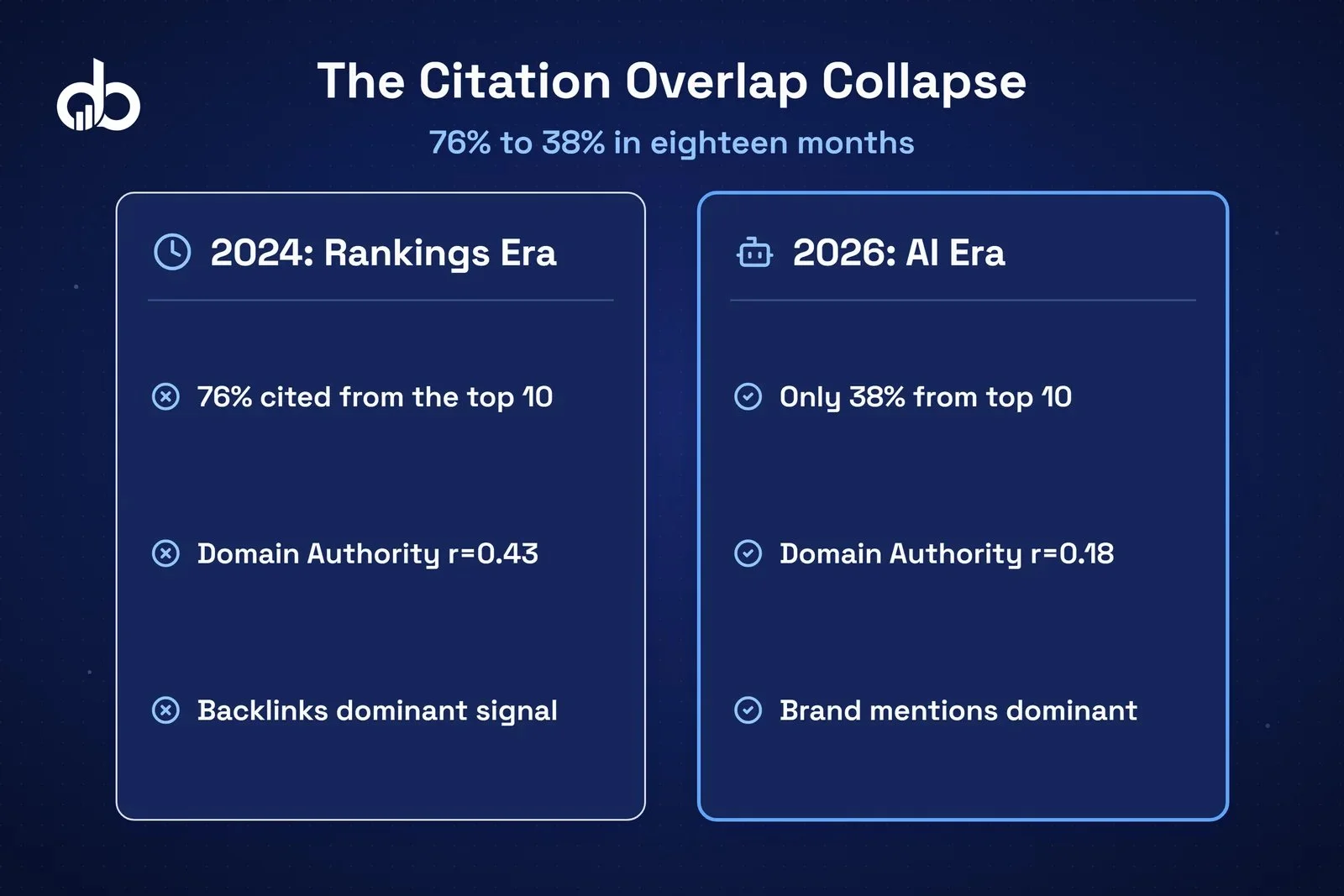
The most significant finding in the 2026 AI citation research is the overlap collapse. In mid-2025, 76% of AI Overview citations came from pages in the organic top 10. By early 2026, that figure dropped to 38%. The decline happened in under a year, measured across 863,000 keyword SERPs. This isn’t a data artifact or a sector-specific anomaly. It’s a structural shift in how AI citation selection relates to organic ranking.
Here’s what that means for your program. 62% of AI Overview citations now come from pages outside the organic top 10. If you’re investing heavily in ranking optimization, you’re competing for a shrinking share of citation slots, even as AI search volume grows at 42.8% per year. The share of AI citations reachable through traditional ranking work has nearly halved in 18 months.
The authority metrics that predicted citation in the pre-AI era have also weakened. Domain Authority correlated with AI citation at r=0.43 before AI Overviews became the default response format. By 2026, that correlation had fallen to r=0.18. That’s a 58% collapse in predictive power. Domain Authority hasn’t become irrelevant, but the metric most SEO programs report on each month now explains less than one-fifth of AI citation variance.
The third mechanism is what researchers call the fan-out problem. When a user asks an AI system a question, the system decomposes it into multiple sub-queries to build its answer. A brand ranking first for “email marketing software” may still lose AI citation slots to competitors who rank well on sub-queries like “email automation for small business” or “drip campaign best practices.” AI citation is won or lost at the sub-query level, not the primary keyword level. A single high-ranking page isn’t enough when the AI is sourcing its answer from many points across a topic.
So if your leadership is asking whether strong rankings guarantee SEO citations in AI search, the 2026 data gives a precise answer: they don’t. Ranking is necessary but no longer sufficient. Optimizing crawl configurations and adding FAQ schema doesn’t close this gap. The input set that determines AI citation has changed, and the data now quantifies what’s on that list.
| Signal | Traditional SEO Correlation | AI Citation Correlation (2026) |
|---|---|---|
| Domain Authority | r=0.43 (pre-AI era) | r=0.18 |
| Search rank (top 10) | 76% citation overlap (mid-2025) | 38% citation overlap (early 2026) |
| Organic top-10 pages | Primary citation source | Source of only 38% of citations |
The authority signals driving traditional rankings have lost over half their predictive power for AI citation in under two years.
The gap is structural, not a technical configuration issue. The signals that drive ranking are genuinely different from the signals that drive AI citation selection. The next section shows what the 2026 data actually points to.
What 75,000 Brands Reveal About SEO Citations in AI Search: The Signal Inversion
The 76% to 38% collapse in citation overlap raises an obvious question: if traditional ranking metrics don’t predict AI citation, what does?
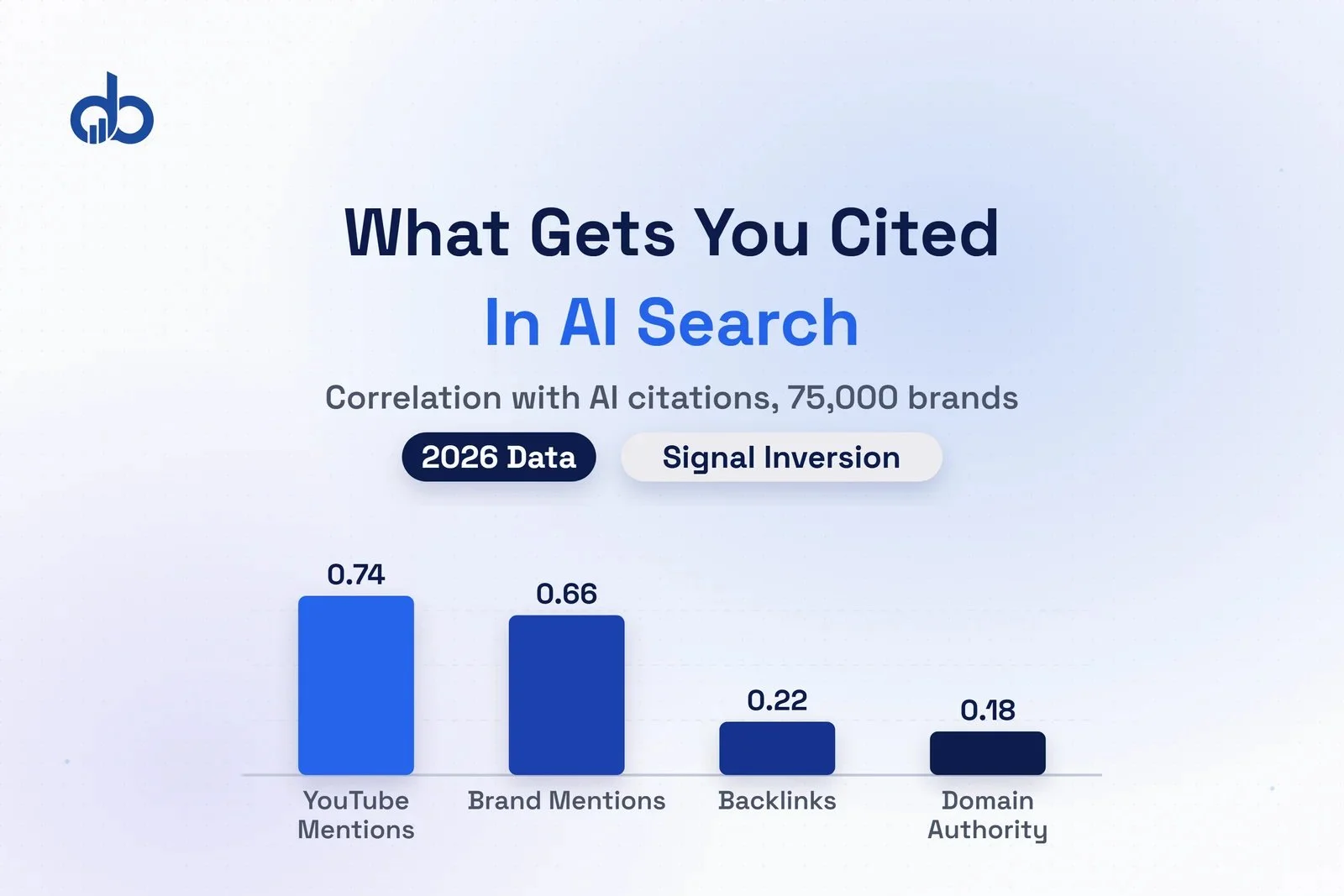
Ahrefs analyzed 75,000 brands to answer that question directly. The results invert the priority stack that has defined off-page SEO for over a decade. Branded web mentions correlate with AI Overview appearance at r=0.664. Backlinks correlate at r=0.218. That’s a 3x gap in predictive power between the two most common off-page SEO investments. The leading off-page investment for most SEO programs is now the secondary predictor for the fastest-growing search channel.
Here’s where it gets more striking. YouTube brand presence sits even higher in the correlation data. YouTube mentions carry a correlation of r=0.737 with AI citation, making it the single highest off-page predictor in the 2026 data set. A brand with consistent YouTube presence is generating the strongest measurable AI citation signal available. But most SEO programs don’t treat YouTube as a citation asset. They treat it as a social media channel.
The off-page picture is reinforced by how citation influence has shifted overall. Brand mentions now represent 55% of off-page influence versus 45% for backlinks. In 2012, backlinks accounted for approximately 80% of off-page ranking signals. That relationship has fully reversed. The implications for brand mentions AI search visibility are direct: investing in link acquisition for domain authority is now the less efficient path for AI citation. Investing in brand presence across the web is the more efficient one.
The correlation holds in practice. A B2B SaaS client with editorial placements across three trade publications in their vertical began appearing in ChatGPT answers for their primary target queries within 60 days of those mentions going live. No new content was published during that period and no additional links were built. Brand presence alone was sufficient to generate initial AI citation visibility.
Content architecture carries its own signal weight in the AI search citations data. Content scoring 8.5 or above out of 10 on semantic completeness is 4.2 times more likely to be cited in AI results. The completeness of topic coverage, not just keyword alignment, determines whether a page adequately addresses the query it’s being evaluated for.
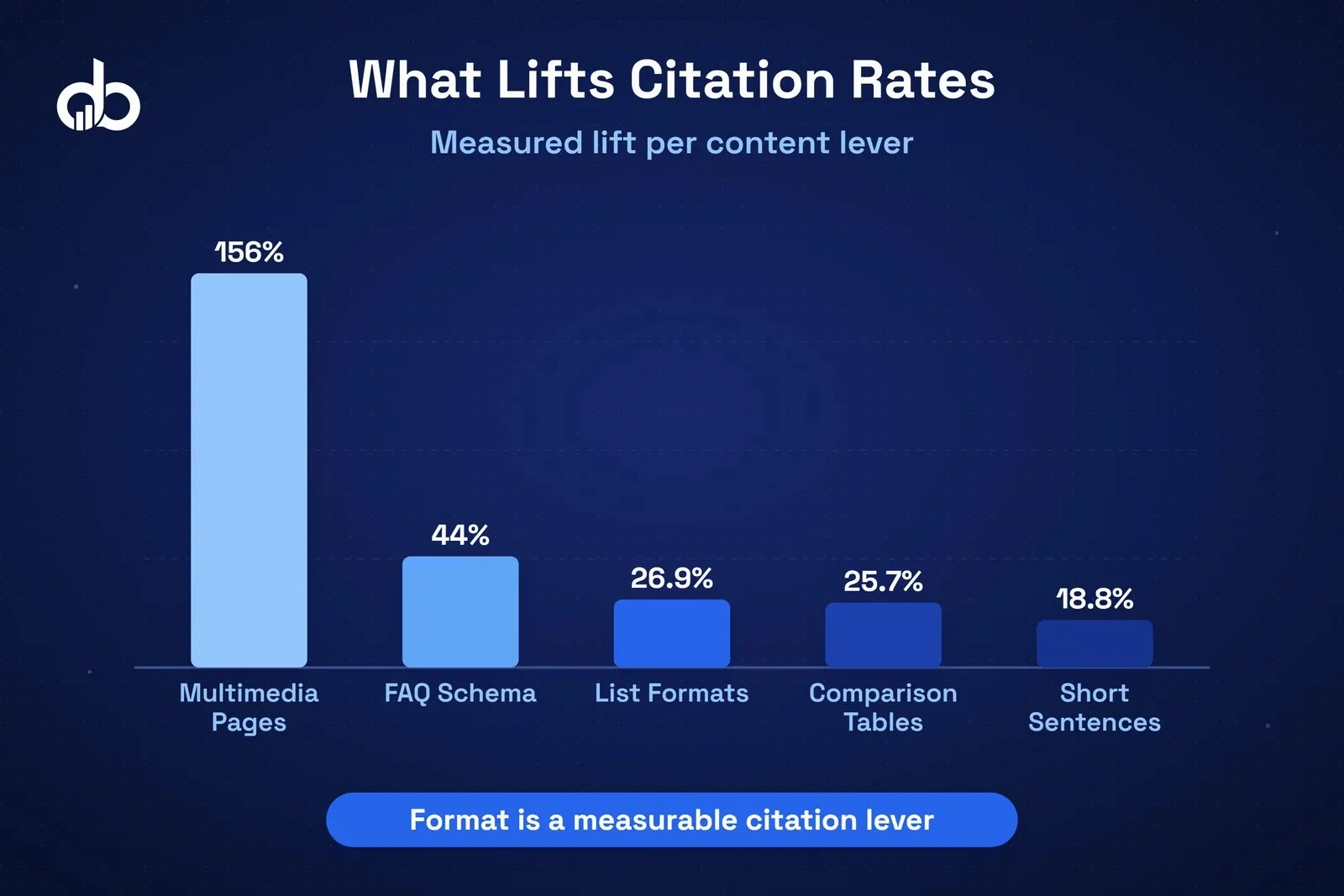
Content format matters beyond completeness. Comparison pages with three structured tables earn 25.7% more AI search citations than comparable pages without them. List-heavy validation pages earn 26.9% more. Pages with short sentences under 10 words earn 18.8% more. Cited content is also 25.7% fresher than organic top-10 results across the same 17 million citations analyzed. Recency is a distinct signal, separate from quality.
Structured data amplifies everything above it. Schema markup correlates with a 2.5x citation probability. FAQ schema blocks add 44% lift. Pages combining text with images, video, and structured data see 156% higher AI selection rates than text-only pages. Schema isn’t a minor configuration checkbox. It’s a multiplier applied on top of the content architecture signals underneath it.
The industry-conditional caveat matters here. In healthcare, insurance, and education, organic-to-AI citation overlap remains between 68 and 75%. For teams in those verticals, the signal inversion is real but less pronounced. The traditional SEO foundation still strongly predicts AI citation there. The data doesn’t argue for abandoning traditional SEO. It argues for selectively adding brand presence signals on top of your existing program.
For teams in commercial, consumer, and general informational verticals, the inversion is more pronounced. The 38% citation overlap means nearly two-thirds of AI citations come from outside the top-10 organic results. The reallocation case is considerably stronger.
The fastest way to test the brand mention hypothesis for your own domain: audit your branded mention volume across Reddit, Quora, and niche publications against your current ChatGPT citation share. Most teams doing this for the first time discover that their YouTube presence generates stronger AI citation signals than their entire backlink portfolio. Start there before adjusting any budget.
The 2026 signal map inverts the traditional SEO priority stack. Brand presence outperforms backlinks by a factor of three.
The Citation Signal Stack: Three Layers That Predict AI Visibility in 2026
The correlation data in the previous section reveals a priority order. Most SEO programs invest heavily in one category of signals and underinvest in the other two. The Citation Signal Stack names those three layers in order of the gap between current program investment and AI citation predictive value.
Layer 1: Brand Presence (Highest Predictive Weight)
Brand mentions are now the dominant off-page predictor for AI search citations, with branded web mentions at r=0.664 and YouTube presence at r=0.737. Most SEO programs treat brand awareness as a marketing function, not an SEO investment. That separation has a measurable cost in AI citation eligibility.
Building brand presence for AI citation requires distributed investment across platform types. The reason is platform fragmentation: different AI engines source content differently, and only 11% of cited domains appear across multiple AI platforms.
Perplexity pulls 46.7% of its top-cited sources from community platforms, including Reddit, Quora, and niche industry forums. A brand visible in those communities is generating direct citation currency for Perplexity queries. ChatGPT favors major publications and Wikipedia. Editorial mentions and coverage in authoritative trade press carry more weight there. Google AI Overviews weight organic rank more heavily than the other platforms, making the Organic Foundation layer below relatively more important for Google-specific citation.
A single content strategy doesn’t cover all three platforms. Platform-specific brand presence investment isn’t a bonus layer. It’s the structural requirement for multi-platform AI citation.
Generative engine optimization (GEO) is the emerging framework for this type of brand presence building. Unlike traditional SEO, which optimizes content for keyword ranking, GEO focuses on the mention signals AI systems use to determine brand credibility across platforms. Most current SEO roadmaps don’t include a GEO track. That’s the primary budget gap the 2026 data identifies.
Layer 2: Content Architecture (Medium-High Predictive Weight)
Content architecture is where most SEO programs have partial investment but real gaps. Semantic completeness, content format, schema implementation, freshness, and fan-out depth are all measurable signals with documented citation impact.
Semantic completeness above 8.5 out of 10 drives a 4.2x citation probability increase. Comparison pages with three or more structured tables earn 25.7% more citations. Schema markup adds a 2.5x multiplier on top of base citation eligibility. Cited pages are 25.7% fresher on average than organic top-10 results. Each of these is a distinct variable. Meeting one doesn’t substitute for the others.
The fan-out content requirement follows directly from the fan-out problem. Because AI decomposes queries into sub-questions, your content cluster must cover those sub-questions at the level of detail the AI needs to build its answer. A single well-optimized page isn’t enough. Coverage depth across a topic is the requirement.
Layer 3: Organic Foundation (Baseline Requirement)
The organic foundation is where most SEO programs are already fully invested. Rank still matters: position #1 carries 33.07% citation probability versus 13.04% at position #10. Technical crawlability is non-negotiable. Pages that can’t be crawled can’t be cited. Evidence strength for URL accessibility scores 9.5 out of 10 in the 2026 citation factor research.
Preview control also matters at this layer. Robots meta configuration and llms.txt files determine whether AI systems can access and process content. Misconfigured preview settings block citation eligibility regardless of content quality or brand presence investment.
The organic foundation is necessary but no longer differentiating in most commercial verticals. It’s the entry cost for AI citation eligibility. It’s not the winning condition.
Where the Investment Gap Is
The three layers are ordered by the size of the gap between typical SEO program investment and AI citation predictive value. Most programs are fully invested in Layer 3. Most programs are partially invested in Layer 2 through content quality processes and some schema. Most programs have minimal investment in Layer 1.
That’s where the data points for brands that want to get cited in AI search results at scale. The highest return on incremental spend is in Layer 1, the layer most SEO programs don’t currently fund.
One adjustment applies for regulated and high-trust verticals. In healthcare, insurance, and education, Layer 3 carries more weight relative to Layers 1 and 2 than in commercial verticals. Adjust layer weighting by vertical before making reallocation decisions.
Common questions we hear on calls:
“How quickly will brand mention investment affect our AI citation rates?”
The client case in Section 3 saw initial ChatGPT citations appear within 60 days of editorial placements going live. That’s the fastest end we’ve seen. For most brands, expect three to six months before AI citation frequency tracks with brand mention volume. The lag exists because AI training data updates on a different cycle from standard crawls. Start tracking AI citation share now so you have a baseline when the results arrive.
“Should we stop link building entirely and redirect that budget?”
No. Backlinks still correlate with AI citation at r=0.218, and organic rank still matters for the 38% of citations that come from the top 10. The reallocation argument is about marginal budget, not total budget. The question is: what does your next dollar of incremental spend do? If you’re already fully invested in Layer 3 and partially in Layer 2, additional link-building spend returns less than the same dollar invested in brand presence. That’s the reallocation case, not a full pivot.
What This Means for Marketing Teams Defending Their SEO Investment
The correlation data has a commercial dimension that most discussions of AI search leave out. AI-referred visitors convert at 14.2%, compared to 2.8% for traditional organic traffic. That’s a 5x difference in conversion rate. AI citation isn’t just a visibility metric. It’s a revenue optimization question.
The scale of the shift adds urgency. 37% of consumers now start product and service searches with AI tools rather than Google. If you’re not appearing in AI citations, you’re missing the first touchpoint for more than a third of your potential buyers.
For marketing teams being asked by leadership whether their SEO program is positioned for AI search, those two figures define the stakes. The question isn’t whether to invest in AI citation eligibility. It’s which parts of your current program to maintain, which to add, and what to deprioritize based on the correlation data.
| Maintain | Add | Shift Away From |
|---|---|---|
| Technical SEO foundation: crawlability, URL structure, site health | Brand mention campaigns: trade publications, industry newsletters, niche community forums | Standalone link acquisition targeting domain authority metrics (DA correlation with AI citation: r=0.18) |
| On-page keyword optimization and content quality processes | YouTube presence and video content: r=0.737 is the highest single AI citation signal in the 2026 data | Broad keyword-volume content without semantic depth or structural clarity |
| Schema markup implementation across all pages | Topic cluster depth: content covering the sub-questions AI decomposes your target keywords into | Single-platform citation strategy: only 11% of cited domains appear across multiple AI platforms |
| Platform-specific community presence: Reddit, Quora, niche forums for Perplexity citation eligibility |
The Industry-Conditional Decision Rule
Not every vertical calls for the same reallocation. In healthcare, insurance, and education, organic-to-AI citation overlap remains between 68 and 75%. For teams in those sectors, earning SEO citations in AI search is still primarily a function of organic ranking strength. The Maintain column is longer. The Shift Away column is shorter. Add Layer 1 brand presence signals selectively, without reducing the SEO foundation below its current level.
In commercial, consumer, and non-regulated B2B verticals, the overlap has collapsed to 38%. The Add and Shift Away columns carry more weight. Brand presence building isn’t optional in these categories. If your team is trying to figure out how to get cited in AI search results outside regulated verticals, brand mention campaigns need to be a primary investment line, not a secondary experiment.
The SEO citations in AI search question that leadership is asking is ultimately a budget allocation question. Every tactic added without a corresponding deprioritization is just more spend. The correlation data makes the tradeoff measurable: standalone link building generates domain authority (r=0.18 for AI citation). Brand mention campaigns generate AI citation presence (r=0.664). That’s the resource allocation argument in two numbers.
For brand mentions AI search visibility to improve in a measurable way, the investment shift needs a tracking layer. Citation frequency in AI platforms, share of model for target queries, and AI-referred traffic conversion rate are the KPIs that correspond to this new allocation.
The fastest internal sell for this reallocation isn't the correlation data. It's the conversion rate comparison. When you can show leadership that AI-referred traffic converts at 14.2% versus 2.8% for organic, the budget conversation changes. Position the brand mention investment as conversion rate optimization, not just citation visibility, and the ROI argument becomes considerably easier to make.
Is Your SEO Program Positioned for AI Citation? Three Questions
- Is your brand mentioned (not just linked to) on at least five trade publications or communities in your vertical?
- Do your top-10 content pages combine text, images, structured tables, and schema markup?
- Does your content cover the sub-questions AI tools ask when decomposing your target keywords?
If the answer to any of these three questions is no, the Citation Signal Stack points to exactly where to focus first.
Your AI Citation Gap: Measurable and Closable
The Citation Signal Stack gives you a precise audit baseline. You can now map your current program against 2026 correlation data. That map shows exactly which layer is generating AI search citations and which is costing you visibility. Reallocating budget based on correlation data is a different internal conversation than the one most SEO programs are currently having, and it requires a clear audit before it can happen. Our SEO & Organic Growth service runs that audit, mapping your program against the Citation Signal Stack and identifying the highest-return gaps in brand presence, content architecture, and organic foundation. Start with a Free Marketing Audit.
- AI Overview citations from top-10 organic pages dropped from 76% in mid-2025 to 38% in early 2026, meaning most SEO programs are now misaligned with AI citation requirements.
- YouTube brand mentions (r=0.737) and branded web mentions (r=0.664) are the strongest predictors of AI citation—far outperforming backlinks (r=0.218) and domain authority (r=0.18).
- Only 11% of cited domains appear across multiple AI platforms; different content strategies are needed for Google AI Overviews, ChatGPT, and Perplexity.
- Semantic completeness above 8.5/10 drives a 4.2x citation probability increase; schema markup correlates with a 2.5x lift in AI-generated answer appearances.
- AI-referred visitors convert at 14.2% vs. 2.8% for traditional organic traffic—making AI citation eligibility a direct revenue optimization lever.
- In regulated verticals (healthcare, insurance, education), organic-to-AI citation overlap remains 68–75%; reallocation toward brand mentions is less urgent than in commercial B2B/B2C.
Frequently Asked Questions
Does ranking on page 1 of Google still help with AI search citations?
Yes, but the predictive value has weakened sharply. In mid-2025, 76% of AI Overview citations came from top-10 organic pages. By early 2026, that figure dropped to 38%. Position #1 still carries a 33.07% citation probability versus 13.04% at position #10. Ranking is now a necessary but insufficient condition, not a guarantee. 62% of AI Overview citations now come from pages outside the top 10. Ranking helps. Ranking alone doesn't determine AI visibility.
Why do brand mentions matter more than backlinks for AI citations?
Ahrefs analysis of 75,000 brands found branded web mentions correlate with AI Overview appearance at r=0.664 versus r=0.218 for backlinks. AI models are trained on brand presence across the entire web, including publications, forums, social platforms, and YouTube, not just link graphs. Building a presence in places where your audience already discusses your category is now the primary off-page lever for AI visibility. Link acquisition builds domain authority. Brand mention building builds citation eligibility.
Do I need different content for Google AI Overviews vs. ChatGPT vs. Perplexity?
Yes. Only 11% of cited domains appear across multiple AI platforms. Perplexity pulls 46.7% of its top-cited sources from community platforms such as Reddit, Quora, and niche forums. ChatGPT favors major publications and Wikipedia. Google AI Overviews weight organic rank more heavily. Content optimized for one platform creates near-zero carryover in the others. Platform-specific brand presence and distribution is the baseline structural requirement for multi-platform AI citation.
Does schema markup actually help with AI search citations?
Yes. Pages with proper schema markup have a 2.5x higher chance of appearing in AI-generated answers. FAQ schema blocks specifically correlate with a 44% increase in AI search citations. The effect typically takes four to eight weeks to appear, as knowledge graphs update on a different cycle from standard crawls. Schema is a Layer 2 signal in the Citation Signal Stack. It provides real lift, but lower absolute impact than the brand presence signals in Layer 1.
Is traditional SEO still worth investing in when AI search is growing?
Yes, for two reasons. AI-referred visitors convert at 14.2% versus 2.8% for traditional organic traffic. But you still need organic presence to earn citation eligibility in the first place. Second, in healthcare, insurance, and education, organic-to-AI-citation overlap remains between 68 and 75%. Strong traditional SEO still directly drives AI citation in those verticals. The answer isn't to stop doing SEO. It's to stop allocating disproportionately to domain authority metrics and start investing in brand presence, where the citation correlation is three times stronger.