
Most businesses optimizing for SEO are building sites that AI systems can’t cite. That’s not a content problem. It’s a structure problem.
Pages with clean heading hierarchy and schema markup earn 2.8 times higher AI citation rates than poorly structured pages. That gap doesn’t come from better writing. It comes from the way the page is built: the syntax of the H1, where the FAQ lives on the page, whether schema vocabulary matches visible heading text exactly, and whether the pillar architecture treats each question as its own narrow-scope document or buries it inside a 4,000-word mega-guide.
Answer engine optimization isn’t a content tactic you layer onto an existing site. It’s a site architecture decision. As AI-powered search surfaces, including Google AI Overviews, ChatGPT Search, and Perplexity, now resolve queries without sending traffic to websites, the structure of your pages determines whether AI systems cite you or move on. Heading hierarchy, FAQ placement, and schema markup are no longer best practices. They’re the primary signals AI engines use to decide what gets cited.
And here’s the problem: most sites were built for traditional keyword ranking. The structure that earns ranking positions — broad H1s, long-form pillar pages, and bottom-of-page FAQs — is the exact structure that makes AI extraction unreliable.
What Answer Engine Optimization Actually Optimizes For
Traditional SEO optimizes for ranking signals: backlinks, keyword density, page authority, click-through rate. These determine where a page appears in a list of results.
Answer engine optimization website structure optimizes for something different: extraction signals. These are structural cues that tell an AI system it has found the right answer, formatted correctly for extraction.
The three extraction signals AI systems weight most heavily:
Heading hierarchy that mirrors query syntax. When a user asks ChatGPT or Perplexity a question, the AI scans candidate pages for headings that semantically match the query. A heading formatted as a question, using words that appear in the query, signals the page is answering rather than discussing.
FAQ blocks in the upper half of the page. AI systems parse pages sequentially. FAQ content encountered early in the document, before 1,500 words of prose, is extracted more reliably than FAQ content buried at the page bottom.
Schema vocabulary that matches visible heading text exactly. AI systems don’t treat schema as a standalone signal. They cross-reference it against visible page content. When the name property in your FAQPage schema says “Frequently Asked Questions” but your H3 says “Common Questions About AEO,” the mismatch reduces citation confidence. Consistency between what the schema says and what the user sees is a prerequisite for reliable extraction.
AEO covers more than featured snippets. The same extraction signals determine citation in Google AI Overviews, AI answers in Bing Copilot, voice search responses, and Perplexity citations. The structural requirements are consistent across all these surfaces. 68% of pages cited in AI Overviews use structured data versus 31% of uncited pages. That gap reflects the difference between sites with extraction signals and sites without them.
Businesses that optimize for featured snippets by restructuring headings and adding FAQ schema are already doing the foundational work of AEO. The difference is in how deep the restructuring goes: at the content level or at the template and architecture level.
Why Your Existing Structure Works Against AEO
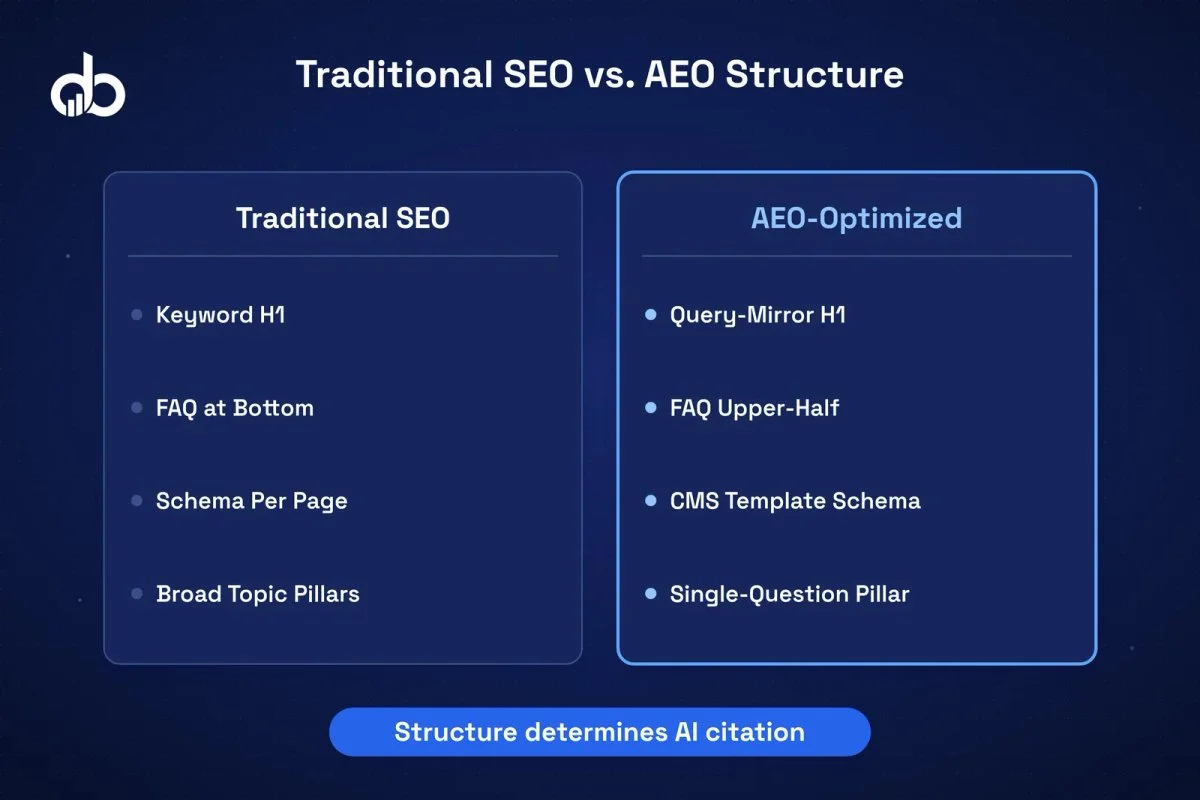
A site built for traditional SEO ranking doesn’t fail at AEO because of bad content. It fails because the structural choices that drive keyword ranking are architecturally incompatible with AI extraction requirements.
There are four specific conflicts.
Conflict 1: H1 strategy. Traditional SEO H1s are keyword-first noun phrases: “SEO Services for Small Business,” “Email Marketing Software,” “Content Strategy Agency.” These signal topical relevance to ranking algorithms. AI systems look for query-matching syntax instead: questions or statements that mirror how a user phrases their actual search.
Conflict 2: FAQ placement. Most sites add FAQs at the bottom of long-form pages. They’re added to capture People Also Ask traffic, rarely updated, and consistently buried. AI systems extract content with lower reliability when FAQs appear after 1,500 or more words of prose.
Conflict 3: Schema as an afterthought. Schema added page-by-page by content teams, not built into CMS templates, is inconsistent. The name property in FAQPage schema mismatches the visible H3 text. Article schema is missing entirely from the majority of blog posts. Organization schema is on the homepage but not inherited across post templates.
Conflict 4: Pillar pages built for breadth. Traditional pillar pages try to cover everything related to a broad topic in one long document. AI systems favor pages with narrow scope: one primary question, answered completely, with clear supporting sub-questions. A 4,000-word guide that covers seven distinct subtopics is a weaker extraction target than a 600-word page that covers one.
These four conflicts explain why piecemeal AEO optimization — adding a summary box here or restructuring one page’s FAQs there — produces marginal results on a traditionally structured site. The gains are capped by the underlying structural conflicts. The 2.8x citation rate advantage that clean-structured sites hold comes from fixing these four conflicts at the template level, not patching them one page at a time.
Before running any AEO optimization, audit one of your highest-traffic pages against these four conflicts. If it fails three or more of them, content-level edits won't move the needle. The structural rebuild needs to come first.
The H1 Rethink: From Keyword to Query
The H1 on a traditional SEO page is a keyword signal. On an AEO-optimized page, it’s a query mirror.
The difference is syntactic. A keyword-first H1 like “Answer Engine Optimization Website Structure” is a noun phrase. A query-first H1 like “How Does Answer Engine Optimization Change Your Website Structure?” reflects how a user actually phrases a question to an AI assistant.
AI systems receive queries in natural language. When they scan candidate pages for citable sources, they run a semantic match between the query string and the page’s heading structure. Pages where the H1 reflects question syntax — using question words like “how,” “what,” “why,” “which,” and “does” — match more reliably against natural language queries than keyword-first noun phrases.
The formula for rewriting H1s for AEO:
[Question word] + [target keyword phrase] + [scope qualifier]
Examples of the transformation:
- “Email Marketing for Ecommerce” becomes “What Email Marketing Strategy Works for Ecommerce Brands?”
- “Local SEO Services” becomes “How Do Local SEO Services Improve Rankings for Small Businesses?”
- “Answer Engine Optimization Website Structure” becomes “How Does Answer Engine Optimization Change Your Site Structure?”
The SEO preservation rule: include the target keyword in the query-form H1. You don’t sacrifice keyword presence by converting to question format. The keyword appears naturally inside the question. Ranking signals from H1 keyword presence are preserved. The syntax change is what adds the AEO citation signal.
The same logic applies down the heading hierarchy. H2s should reflect the sub-questions a user would ask about the page’s primary topic. H3s should reflect follow-up questions within each H2 section. When the full heading structure reflects question syntax from H1 through H3, AI systems can navigate the page the same way a user would ask follow-up questions.
Sound like a lot to retrofit across a large site? Start with your ten most-visited informational pages. Those are the ones most likely to have query-intent traffic that’s now resolving in AI systems without a click. Restructuring those ten pages first produces measurable results without committing to a full site rebuild.
Is your heading structure working against AEO citations? Our SEO & Organic Growth team audits your site's H1 strategy and heading hierarchy against AEO extraction signals. Get Free Marketing Audit
FAQ Architecture: From Afterthought to Structural Core
On most sites, FAQs are a single section at the page bottom. They’re added to capture PAA traffic, written quickly, and positioned after the main content section because they feel like supplementary material.
FAQ content, structured with FAQPage schema, is the format AI systems extract from most reliably. It maps each question and answer to a machine-readable format AI systems can parse independently of the surrounding content. Moving FAQs from afterthought to structural core — placed early in the page, schema-matched, and written to answer complete questions — is one of the highest-return structural changes for AEO.
Where to place FAQs for AEO. The upper half of the page. After a brief intro and the core answer section, before long-form prose sections. AI systems parse pages sequentially. FAQs encountered before 1,500 words of prose are extracted with meaningfully higher frequency than FAQs at the page bottom.
How many FAQ entries. The threshold for measurably stronger AEO inclusion is 5 to 8 FAQ answers per page. Below five, the topical signal is too thin to reliably trigger extraction. Above eight, the format often degrades into repetitive coverage that reduces per-answer quality.
How to write the questions. Use Google’s People Also Ask boxes for your target keyword as the primary source. Copy the exact phrasing of questions that appear there. These are the queries AI systems are already resolving from your competitors’ content. Writing FAQ questions that match PAA phrasing directly increases the likelihood that your answers are extracted for those queries.
The schema match rule. The text of each visible H3 question must match the name property in your FAQPage schema exactly. Not approximately. Exactly. AI systems cross-reference schema with visible content. Mismatches reduce extraction reliability regardless of how well the content itself is written.
Answer length. The first 40 to 80 words of each answer should stand alone as a complete, self-contained response. AI systems extract the lead of the answer, not the full text. If the first sentence is context-setting, the extracted answer reads as incomplete.
Run your top five pages through Google's Rich Results Test after adding FAQPage schema. The tool shows whether your schema is parsed correctly and whether the name property values match what Google sees in the rendered page. Mismatches show up as warnings, not errors, so they're easy to miss without an active check.
Schema Markup: The Template-Level Change Most Sites Skip
Adding schema markup page by page, one post at a time by a content team member without developer support, produces inconsistent results. The reason is simple: manual schema addition depends on whoever is publishing the post remembering to do it, knowing which properties to include, and entering the values correctly.
That’s not a content problem. It’s a workflow problem.
The fix is schema at the template level, not the content level. Schema should be generated automatically by the CMS based on page type: a blog post template outputs Article or BlogPosting schema automatically using the post’s metadata. A FAQ-enabled page template outputs FAQPage schema using the page’s structured FAQ data. An organization template outputs Organization schema once, pulling from a centralized data source.
When schema is template-driven, every new post or page published inherits correct, consistent schema without any manual action from the content team. The result is site-wide schema coverage rather than sporadic page-level coverage.
The five schema types that move AEO citation rates:
FAQPage: the most directly impactful schema for AEO. Maps each Q&A pair to a machine-readable format AI systems can extract verbatim. The name property value in each FAQ entry must match the visible H3 question text exactly.
Article or BlogPosting: signals the page as a citable source with author attribution, publish date, and organization. Without Article schema, an AI system has no structural signal that a page is a citable source rather than a navigation page or promotional landing page.
Organization: entity disambiguation at the site level. Tells AI systems which organization authored the content and establishes the entity’s E-E-A-T signals in a structured format.
BreadcrumbList: provides content taxonomy context. Helps AI systems understand where a specific page fits in the site’s topical hierarchy, which matters for multi-document queries that require multiple sources.
HowTo: for process-oriented content. Maps step-by-step sequences that AI systems can extract in order, with each step as a distinct structured element. Use when a page answers “how to” questions with sequential steps.
Of these five, FAQPage and Article schema show the strongest correlation with AI Overview inclusion. 68% of cited pages use structured data versus 31% of uncited pages. Template-level implementation of these two schema types alone moves the majority of AEO gains available through schema.
Template-level schema is a one-time developer build, not an ongoing content effort. Most CMS platforms, including WordPress, Webflow, and HubSpot CMS, support this through plugins or custom fields. The upfront build cost pays off across every piece of content published afterward.
Pillar Architecture Rebuilt Around Question Clusters
The traditional pillar page was built for topical breadth: one long-form page covering everything related to a broad keyword, linked to shorter cluster pages that covered sub-topics.
AEO requires a different architecture. AI systems favor pages with narrow scope: one primary question, answered completely, with supporting FAQ sub-questions that reinforce the topical signal. A 5,000-word guide covering seven distinct subtopics is a weaker extraction target than five narrow-scope pages each covering one subtopic at depth.
The AEO pillar model:
The pillar page answers the primary question at depth — the broadest, highest-intent question in a topic cluster. It includes 5-8 FAQ sub-questions that represent the most common follow-up queries. Each FAQ answer provides a complete, self-contained response and links to the corresponding cluster page for users who want more depth.
Each cluster page answers a single follow-up question at comparable depth. Not as a summary that points back to the pillar, but as a complete, citable document in its own right. Cluster pages also carry FAQPage schema with their own sub-questions, creating a network of extraction-ready documents across the topic.
Internal linking in AEO architecture. Link from FAQ answer text on the pillar to the corresponding cluster page. “For a full breakdown of H1 restructuring across large site architectures, see [H1 rewrite strategy for enterprise sites].” This internal linking pattern signals to AI systems that the pillar and cluster pages are topically related and mutually reinforcing, which matters for multi-document queries.
The practical conversion. Identify the 3-5 most common user questions in your niche’s keyword cluster. Assign one as the primary intent of the pillar page. Assign the others as cluster pages. Rewrite all of them for query-first heading syntax and FAQ-forward structure.
This restructuring also supports your efforts to optimize for featured snippets: each narrow-scope cluster page becomes a cleaner extraction target for the specific featured snippet position tied to its target question.
Common questions we hear on calls:
“Do we have to rebuild our entire site to see AEO gains?”
No. Start with your ten highest-traffic informational pages and run the six-point audit below on each one. Most sites have 3-5 pages that could generate AEO citations with template-level schema changes and FAQ repositioning alone, without touching the rest of the site.
“How long does AEO restructuring actually take?”
It depends on which failure type you’re addressing. FAQ repositioning on existing pages is a content-team effort, typically 1-2 days. H1 rewrites across a site of 50 informational pages take 3-5 days. Template-level schema implementation is a developer build, typically 1-2 weeks depending on CMS complexity.
“Will changing our H1s hurt existing rankings?”
Converting from keyword-first to query-first H1s carries short-term ranking volatility risk, typically 2-4 weeks for rankings to restabilize. The keywords remain present in the query-form H1, just in a different syntactic order. Most sites that run this change on informational pages see ranking recovery within 30 days and AEO citation gains that offset the volatility.
The AEO Structural Audit: What to Check on Your Site
Before rebuilding, run this six-point audit on your top ten pages. Most traditionally structured sites fail three or more of these checks. Scoring your pages before committing to structural changes tells you whether you need content-level fixes, template-level changes, or a full architectural rebuild.
Check 1: H1 syntax. Are your H1 tags keyword-first noun phrases or query-mirroring question formats? Use Screaming Frog or Ahrefs to crawl your site and export all H1 tags. Count how many are noun phrases versus question formats. Any page targeting an informational keyword with a noun-phrase H1 is a candidate for rewriting.
Check 2: FAQ placement. Do your key pages have FAQ blocks? Where do they appear in the page scroll? Any FAQ section appearing below the 50% scroll depth is structurally penalized for AEO. Use a scroll depth heatmap or manually check page structure in a browser.
Check 3: Schema vocabulary match. Export FAQPage schema for your top five pages using Google’s Rich Results Test. Compare the name property values against the visible H3 question text on the same page. Any mismatch is a structural error, not a content issue.
Check 4: Page scope. Take your ten most-targeted pages and ask: does each page have one primary question? Or does it address five or more distinct topics? Pages with broad scope are weaker extraction targets. Identify which pages need to be split into narrower cluster pages.
Check 5: Schema coverage. What percentage of your blog posts have Article or BlogPosting schema? Run a structured data audit using Google Search Console’s Rich Results report or a site-wide crawler with schema detection. Posts without Article schema are invisible to AI systems as citable sources.
Check 6: Heading hierarchy. Does every page use a sequential H1 then H2 then H3 progression with no skipped levels? Skipped heading levels disrupt the semantic structure AI systems use to map page content to query intent.
What to do with the results:
0 to 1 failures: incremental optimization. Fix schema mismatches and FAQ placement. Content-level changes will produce gains.
2 to 3 failures: template-level changes needed. Work with your developer to rebuild page templates with schema baked in and FAQ positioning standardized. Content-level edits alone will produce marginal returns.
4 to 6 failures: structural rebuild. Your site is likely to see only marginal AEO gains from content edits. The returns come from template and architecture changes. Prioritize pages with the highest informational search traffic.
Our Analytics & Tracking team can run this audit across your full site and map exactly which pages need structural changes versus content-level fixes, prioritized by traffic impact.
Is Your Site Architecture Ready for AI Citations? Our SEO & Organic Growth team audits your site's heading hierarchy, FAQ placement, schema implementation, and pillar structure and maps exactly what needs to change for AI systems to start citing your content. Get Free Marketing Audit
- Pages with clean heading hierarchy and schema markup earn 2.8× higher AI citation rates than poorly structured pages — AEO is an architecture decision, not a content tactic.
- H1 tags must mirror query syntax (question format) rather than keyword-first noun phrases so AI systems can semantically match them against natural language queries.
- FAQ blocks should appear in the upper half of every page with 5-8 entries, FAQPage schema, and exact text matches between visible headings and schema name properties.
- Template-driven schema markup — not manual page-by-page addition — is the only path to consistent AI extraction signals across your entire site.
- Run the six-point structural audit on your top ten pages before optimizing; most traditionally built sites fail three or more checks and need template-level fixes, not content edits.
Frequently Asked Questions
What is answer engine optimization?
Answer engine optimization (AEO) is the practice of structuring your site's content so AI-powered search systems, including Google AI Overviews, ChatGPT Search, and Perplexity, can extract and cite your content in direct answers. Unlike traditional SEO, which optimizes for ranking position, AEO optimizes for extraction quality. Heading hierarchy, FAQ placement, schema markup, and query-mirroring H1s are the primary signals AI systems use to identify citable sources.
How does AEO affect H1 tags?
AEO requires H1 tags to mirror the query syntax of user questions rather than keyword-first formulations. An H1 like "Digital Marketing Services" is a keyword signal for traditional SEO. An AEO-optimized H1 reflects how a user phrases the question: "What Digital Marketing Services Increase Revenue for B2B Companies?" AI systems cross-reference H1 text against the query they received. Pages where the H1 mirrors query syntax earn higher citation confidence scores.
Where should FAQs be placed for AEO?
For maximum AEO impact, FAQs with FAQPage schema should appear in the upper half of the page, not buried as a closing section. AI systems extract FAQ content with higher reliability when the FAQ block appears before extensive prose sections. Aim for 5-8 FAQ entries per page, each answering a specific follow-up question to the page's primary topic, with FAQPage schema where the question text matches the visible heading exactly.
What schema types matter most for AEO?
Five schema types have the highest impact on AEO citation rates: FAQPage (most directly tied to AI answer extraction), Article or BlogPosting (signals the page as a citable source), Organization (entity disambiguation for author authority), BreadcrumbList (provides content taxonomy signals), and HowTo (for process-oriented content). FAQPage and Article schema show the strongest correlation with AI Overview inclusion, with 68% of cited pages using structured data versus 31% of uncited pages.
Does AEO replace traditional SEO?
No. AEO and SEO optimize for different outcomes and both remain necessary. Traditional SEO secures ranking position for queries where users click through to compare options or make decisions. AEO secures citation in AI-generated answers for informational queries that increasingly resolve without a click. A practical split: invest SEO effort on commercial and transactional keywords where users still click, and AEO effort on informational queries where AI answers are now the primary touchpoint.