
On a $50,000 monthly ad spend, a Google Ads account running at 85% of its potential loses $90,000 per year. That number never appears in a monthly performance report. The account is not obviously broken. Performance is always measured against last month’s numbers, not against what a well-optimized account in the same category would actually deliver.
Most businesses decide on in-house Google Ads management by running the same calculation: specialist salary versus agency retainer. They pick the lower number and move on. That comparison has one structural flaw. It accounts for cost. It never accounts for outcome.
This analysis breaks down the hidden costs the salary-versus-fee calculation never captures. It cites the performance data that shows why outcomes differ between models. And it builds a framework for identifying the actual break-even point. That break-even is not a spend threshold. It is a capability threshold.
The Salary-Versus-Agency-Fee Calculation (and Where It Stops)
The standard comparison is not wrong. It is incomplete.
A mid-level Google Ads specialist in the US earns $55,000–$90,000 per year in base salary. Add Bureau of Labor Statistics employer cost data: benefits and payroll taxes average 30–33% on top of base compensation for private-sector employees. The fully-loaded cost sits at $72,000–$120,000 per year, or $6,000–$10,000 per month.
A Google Ads agency charges $1,000–$10,000+ per month as a flat retainer, or 10–20% of managed spend. On a $50,000 monthly budget, 12% is $6,000 per month. At that spend level, the two models cross over. Above $50,000 per month, in-house appears cheaper on the spreadsheet.
This is accurate as far as it goes. The problem is what the comparison treats as equal on both sides. The salary-versus-fee model assumes that a well-managed in-house account and a well-managed Google Ads agency account produce the same results at equivalent spend levels. That assumption has no supporting data.
The hidden costs sit in five categories the spreadsheet has no row for.
The Five Hidden Costs of In-House Google Ads Management
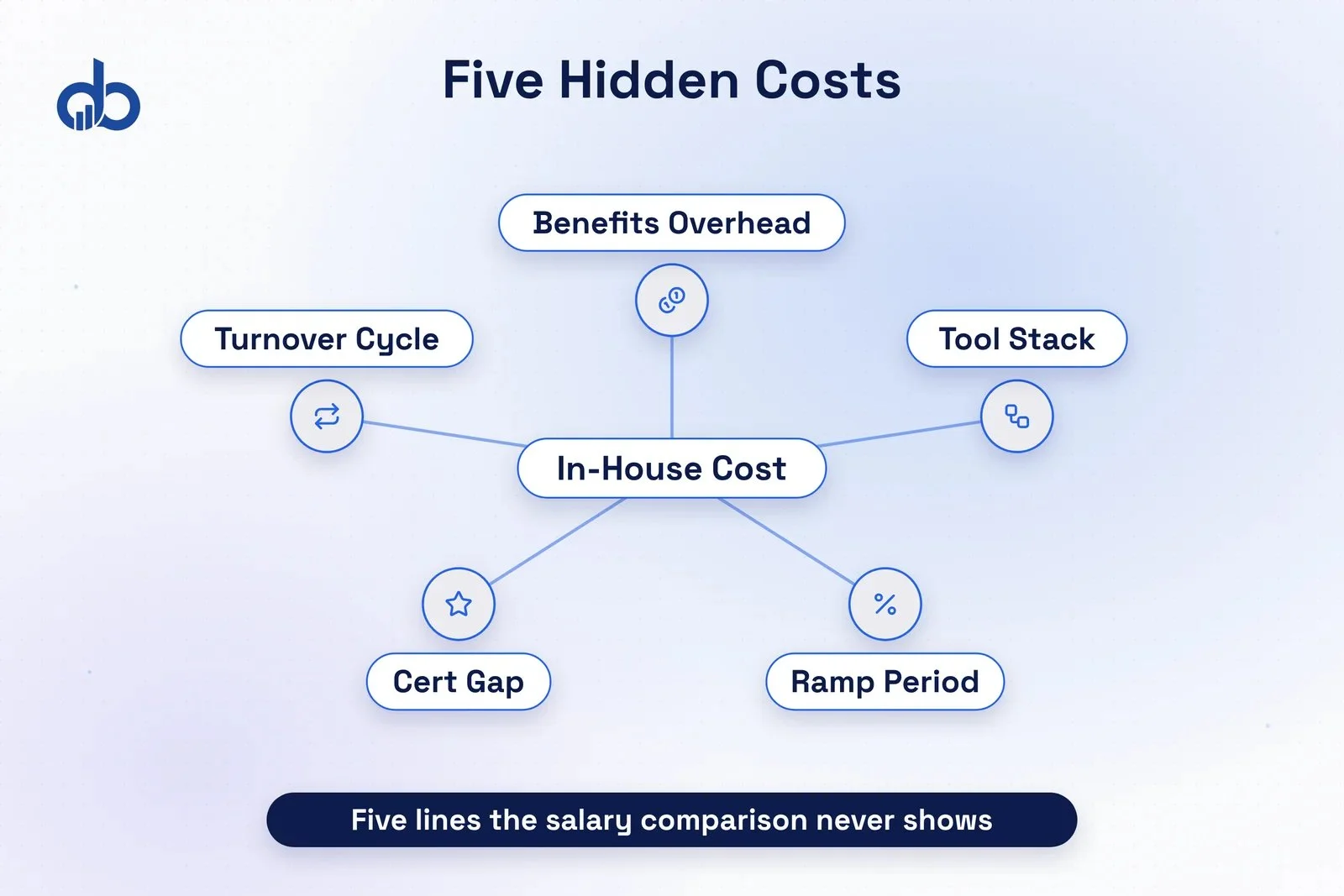
The five cost lines below are not hypothetical. Each is documented, cited, and applies to most businesses running in-house Google Ads management.
1. Benefits and payroll tax overhead
This figure rarely appears in hiring manager budget requests, which focus on headcount cost. The BLS Employer Costs for Employee Compensation report (Q4 2024) puts benefits at 30–33% of base compensation for private-sector employees. A $75,000 specialist costs $97,500–$99,750 in total employer cost before a single ad is optimized.
2. The tool stack
Agencies spread enterprise-grade tools across dozens of client accounts. In-house teams pay full price for one account. A complete in-house PPC tool stack typically covers four categories: keyword research ($1,200–$2,400 per year), bid management or automation ($1,800–$6,000 per year), competitor intelligence ($1,000–$2,400 per year), and landing page testing ($600–$3,600 per year). Total tooling: $4,600–$14,400 per year. That cost almost never surfaces in the initial hire decision.
3. Recruitment and ramp-period cost
SHRM’s 2024 Talent Acquisition Benchmarking Report puts average cost-to-hire at $4,700 per role. That is before the specialist touches an account. During the first three to six months, most in-house hires operate at 50–60% of full optimization capacity. They are learning the account, the business, and the competitive position simultaneously. At $7,500 per month fully-loaded, four months at 50% productive capacity is $15,000 in paid-for-but-not-delivered optimization.
4. Certification gap and time dilution
A 2025 in-house vs agency Google Ads analysis found that in-house teams struggle to stay current with platform changes, while agency teams get continuous training. Certification shows the same gap. Specialist agencies typically keep current Google certifications as part of the job. In-house marketers juggling other channels often let theirs lapse. That gap has a direct operational consequence. Google’s certification program governs access to current platform training, beta documentation, and release notes. Uncertified in-house managers optimize against an older version of the platform’s best practices.
The time dilution compounds this. In-house PPC managers who also cover other channels spend only 50–60% of their time on actual campaign optimization. The rest goes to reporting, meetings, and cross-channel work. The effective cost of their Google Ads management time is 40–50% higher than the salary line implies.
5. Turnover and institutional knowledge loss
Industry talent data puts average digital marketing specialist tenure at approximately 18 months. When they leave, negative keyword lists, audience exclusions, custom bid rules, and conversion tracking configurations are rarely documented. Replacement takes 60–90 days on average. Then the full ramp cycle starts again. Accounts experience significant efficiency declines during these transitions. In audits of accounts post-specialist-departure, negative keyword drift and audience exclusion decay are visible within the first 30–60 days.
Over a four-year window with one turnover cycle, the total cost compounds. Recruitment cost, ramp-period loss, transition efficiency drop, and the replacement hire’s productivity deficit all land together. None of that appears on the salary-versus-fee comparison. These are the hidden costs of in-house Google Ads management that no line item in the comparison spreadsheet will ever capture.
What those five lines do not explain is why the outcomes of the two models differ even at equivalent spend levels. The answer sits in a structural gap that most dashboards are designed to miss.
What the Certification Gap Reveals About Account Performance
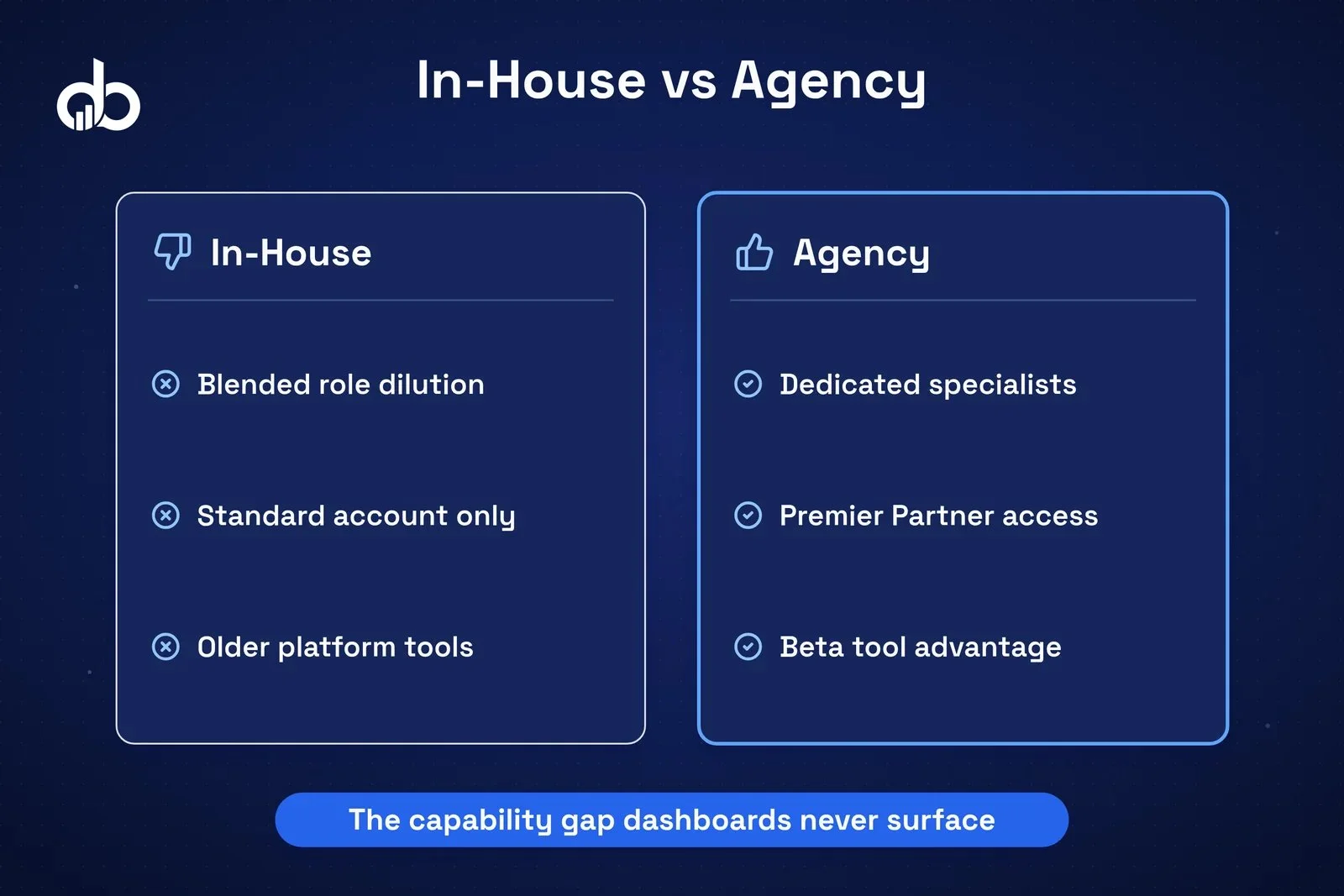
The certification gap is not a credentialing formality. It reflects a structural difference in platform access.
Google grants Premier Partner status to agencies that meet spend thresholds, optimization score requirements, and certification standards. Premier Partners receive early access to new campaign types and bidding tools before public release. Performance Max, now used by 71% of advertisers (up from 60% in 2024), was available to Premier Partners six to twelve months before general release. AI Max for Search Campaigns is in the same selective rollout now.
In-house teams running standard accounts are optimizing against last quarter’s tools. Google Ads agencies with Premier Partner status are piloting next quarter’s.
That creates an efficiency gap that does not appear in monthly dashboards. Performance is measured against last month’s account data, not against what a fully-optimized account in the same category would achieve. A Google Ads account running at 85% of its potential looks healthy on every internal report. On a $50,000 monthly budget, that 15% gap is $90,000 per year in silent waste.
Research on poorly managed accounts puts wasted spend between 20% and 40% of total budget, lost to clicks that will never convert. The 85%-efficiency scenario is conservative by that measure.
The certification and tool access gaps compound the problem. A less-certified, blended-role specialist running last-generation campaign types on a $50,000 monthly budget is not running a $50,000 account. They are running a $40,500–$45,000 account in effective terms, and the difference is absorbed silently as underperformance rather than reported as identifiable waste.
Understanding where the gap comes from narrows the decision to one question: do the conditions exist in your organization to close it?
The Capability Threshold Model: Reframing the Break-Even
Most content on in-house PPC management asks the wrong question. “Is my ad spend high enough to justify an in-house hire?” is a spend threshold question. The performance data suggests a better question: “Do all three capability conditions exist in my organization, or am I paying for expertise I cannot retain?”
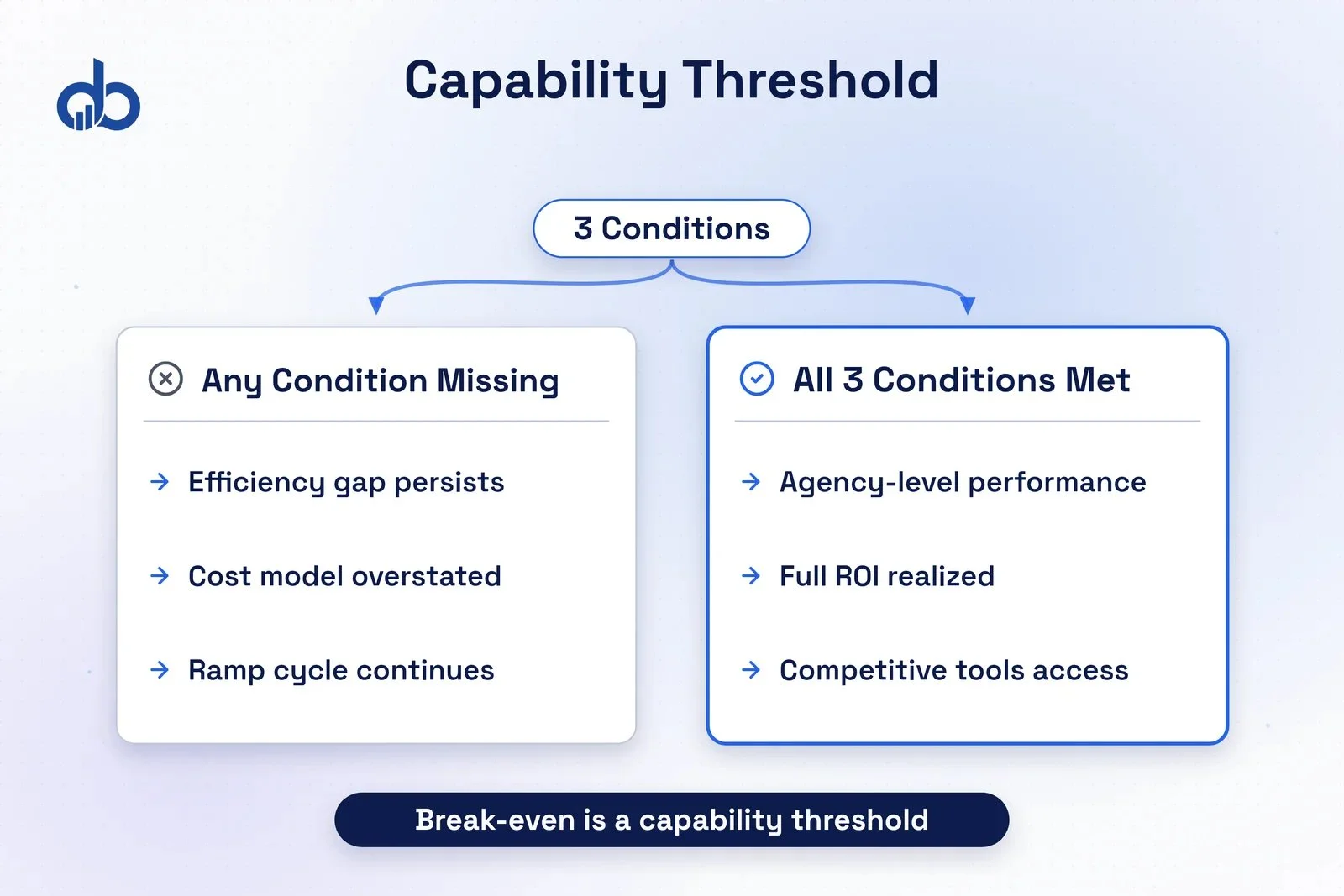
The Capability Threshold Model identifies three conditions that determine whether in-house Google Ads management can match agency-level performance outcomes. The break-even is not a spend number. It is whether all three conditions are genuinely in place.
Condition 1: Specialist Insulation
The hire has a dedicated Google Ads role that is not blended with other channels. In-house PPC managers who also own email, social, or content spend only 50–60% of their time on actual Google Ads optimization. The effective hourly cost of their Google Ads work is 40–50% higher than the salary figure implies. A blended hire at $80,000 is effectively a dedicated hire at $110,000–$120,000 for fewer hours of platform focus.
Condition 2: Certification Depth
The hire holds and actively maintains three or more current Google certifications: Search, Performance Max, and Measurement. The organization also funds annual training to sustain certification currency. A certified hire who doesn’t renew won’t stay certified: Google Ads certifications expire after one year.
Condition 3: Institutional Continuity
The business can retain the specialist for three or more years. In-house Google Ads knowledge compounds with tenure: account history, negative keyword depth, audience segmentation, and conversion configuration improve over time. At an 18-month average tenure, most in-house teams are in a perpetual ramp-and-replace cycle rather than building on institutional knowledge.
When all three conditions are in place and monthly ad spend exceeds $100,000, in-house Google Ads management can realistically compete with agency performance. When any single condition is absent, the spend threshold that makes in-house appear cheaper does not reflect the actual cost of the expertise being purchased.
What This Means for CFOs Making the In-House vs Agency Call
The salary-versus-fee spreadsheet answers one question: which option has a lower visible cost at the current spend level? The Capability Threshold Model answers a different one: which option will actually deliver better performance, fully accounted?
Start with the question no spreadsheet asks: what would a fully-optimized version of this account deliver, compared to what it currently delivers?
That requires an outside benchmark. WordStream publishes click-through rate (CTR), cost-per-click (CPC), conversion rate (CVR), and cost-per-lead (CPL) benchmarks by industry across more than 15,000 accounts. If the account’s conversion rate falls below the industry average for its category, that gap is the real starting cost of the current model. It exists whether you are running in-house Google Ads management or working with a Google Ads agency.
If you’re spending below $50,000 per month: The five hidden cost categories (benefits overhead, tool stack, ramp period, certification gap, turnover cycle) typically exceed the apparent savings from in-house management. The comparison looks right on the spreadsheet and wrong in the actual cost model.
If you’re spending $50,000 to $100,000 per month: Viability depends entirely on whether all three Capability Threshold conditions are in place. A blended-role in-house PPC hire who turns over every 18 months will not outperform a well-chosen PPC agency at this spend level. A dedicated, certified specialist with institutional continuity might.
If you’re spending above $100,000 per month: In-house management makes the strongest financial case. But that requires accounting for all five hidden cost lines. And it requires all three capability conditions to be genuinely in place, not assumed.
The number most businesses should calculate first is the one their current setup is costing them without reporting it.
Conclusion
You now have a TCO framework that goes beyond the salary line. Five cost categories, each specific and verifiable. Three capability conditions that determine whether in-house Google Ads management can match the performance its cost model implies. Knowing the framework and applying it to a specific account are two different tasks. Identifying the actual efficiency gap requires an outside benchmark, not an internal report. Digiblazon’s Performance Marketing team audits your current campaigns, benchmarks your return on ad spend (ROAS) against category averages, and delivers an honest cost-versus-performance assessment.
Ready to see what your account is actually costing you? Start with a Free Marketing Audit.
- On a $50,000 monthly ad spend, a Google Ads account running at 85% efficiency loses $90,000 per year, a gap that never shows up in standard dashboards.
- In-house Google Ads management carries five hidden cost categories beyond salary: benefits overhead, tool stack, recruitment and ramp period, certification and time dilution, and turnover.
- In-house marketers managing Google Ads often hold fewer current certifications than specialist agency staff. That gap directly affects platform access and optimization quality.
- The Capability Threshold Model reframes the buy decision around three conditions (specialist insulation, certification depth, and institutional continuity), not spend volume alone.
- Below $50,000/month in ad spend, the five hidden cost categories typically exceed apparent savings from running Google Ads in-house.
- Above $100,000/month, in-house management has the strongest financial case, but only when all three capability conditions are genuinely met.
Frequently Asked Questions
Is it cheaper to manage Google Ads in-house or use an agency?
The salary-versus-fee comparison looks cheaper for in-house management on paper. Add employer-paid benefits, platform tools, and the productivity loss during the 3–6 month ramp period. The total in-house cost often exceeds agency management fees once those three factors are counted. The right answer depends on ad spend volume, campaign complexity, and whether the business can retain a specialist long enough to recoup the ramp cost.
How much does a Google Ads specialist cost to hire?
Base salary for a Google Ads specialist in the US runs $55,000–$90,000 per year depending on experience and market. Employer-paid benefits and payroll taxes add 30–33% on top of base, putting total compensation at $72,000–$120,000. SHRM puts the average cost to hire at $4,700 per role. That comes before the 3–6 month productivity ramp where the specialist learns the account and the business.
What tools does an in-house Google Ads team need?
Beyond Google Ads itself (free), an in-house Google Ads team needs four additional tool categories. These include a keyword research tool ($1,200–$2,400 per year), bid management or automation software ($1,800–$6,000 per year), a competitor intelligence tool ($1,000–$2,400 per year), and a landing page testing platform ($600–$3,600 per year). Total tooling runs $4,600–$14,400 annually for a fully equipped setup, costs that rarely appear in initial in-house cost estimates.
What happens to Google Ads performance when the in-house specialist leaves?
Campaign performance typically declines during the transition period because institutional account knowledge is not documented or transferable. Negative keyword lists, audience exclusions, custom bid rules, and conversion tracking configurations are often undocumented. Finding and onboarding a replacement takes 60–90 days on average. The new specialist then faces the same 3–6 month ramp period before reaching full optimization capability.
When does in-house Google Ads management make financial sense?
In-house Google Ads management makes the most financial sense at $100,000+ per month in ad spend, with campaigns stable enough to optimize rather than rebuild. The business must also retain the specialist for 3+ years to recover ramp costs. And all three Capability Threshold conditions must be in place: specialist insulation, active certification depth, and institutional continuity.