
Most B2B companies choose a PPC agency the same way they pick a contractor: compare a few options, check the reviews, go with whoever sounds most confident on the sales call. Six months later, they’re sitting across from a new agency trying to figure out what went wrong with the last one.
The challenge isn’t finding a PPC agency or PPC marketing company. There are thousands of them. The challenge is knowing how to choose the right PPC agency for your business when most selection processes are built around the wrong signals. Certifications. Case studies. Pricing decks. Surface indicators that tell you almost nothing about whether the agency’s interests are aligned with yours, who’s actually managing your account, or what you stand to lose if you ever decide to leave.
Switching PPC agencies at the mid-market level can cost $30,000 to $60,000 in lost Smart Bidding machine learning history, audience lists, remarketing pools, and conversion data (Jalapeño Digital). And that’s before you count a single dollar of wasted ad spend on campaigns that were never set up correctly.
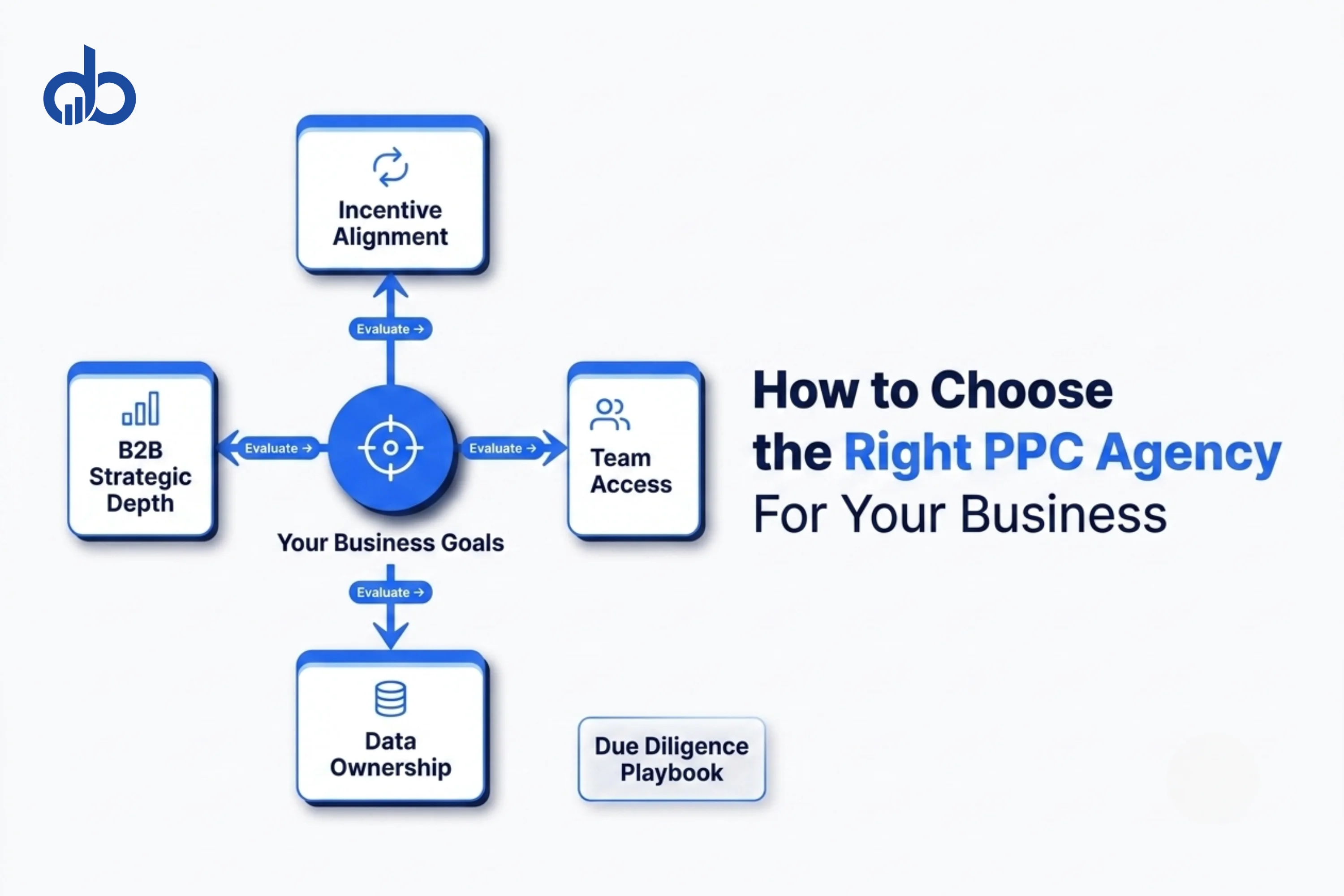
Consider this a due diligence playbook, not a standard checklist article. By the end, you’ll know how to evaluate incentive alignment, data ownership, team structure, and B2B strategic depth. These are the four dimensions that actually predict whether a PPC partnership works or fails.
Before You Choose an Agency: Are You Actually Ready to Hire One?
No “how to choose a PPC agency” article asks this question. That alone should tell you something.
Hiring a great agency into a broken funnel doesn’t fix the funnel. You just burn through budget faster finding out the funnel is broken.
Before you contact a single agency, verify five things:
-
Conversion tracking is live and verified. Your Google Ads account and GA4 should be recording conversions accurately, including form submissions, calls, and any in-platform actions that signal intent. If your conversion data is wrong, every bidding decision the agency makes will be wrong.
-
Your landing pages convert. For B2B lead gen, a 2 to 3% conversion rate is a reasonable baseline. If your pages are converting at 0.3%, an agency can’t compensate for that with better targeting. They’ll just spend more to get the same trickle of leads.
-
Your CRM is set up to close the attribution loop. To know whether paid traffic is generating revenue and not just leads, you need your CRM (HubSpot, Salesforce, or equivalent) connected in a way that lets you trace a closed deal back to its original ad click.
-
Your monthly ad budget is $5,000 or above. Below this threshold, most platforms can’t generate enough statistical volume for meaningful optimization. An agency running a $2,000/month Google Ads campaign is largely guessing.
-
You have internal alignment on what success looks like. Not “more leads.” A specific metric at a specific cost at a specific timeframe. “250 MQLs per month at $150 CPL within 90 days” or “15 qualified opportunities per quarter at under $1,200 CPO.”
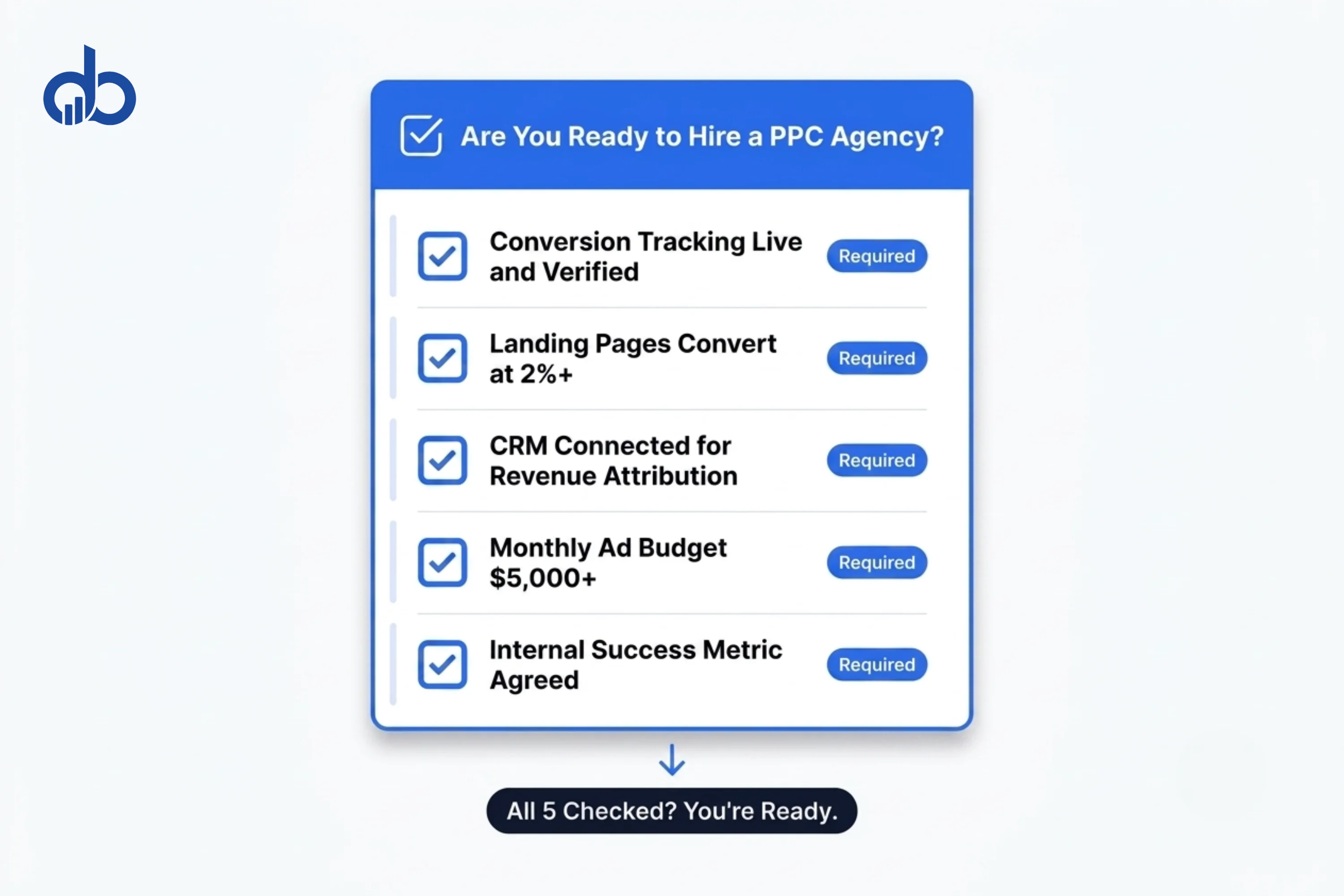
Check all five and you’re ready to evaluate agencies. Miss any of them and fix the foundation first. A capable agency will tell you this themselves in the first conversation. That, by itself, is a signal worth noting.
The Question Every B2B Buyer Skips: Whose Side Is the Agency Actually On?
Before you look at a single case study or certification badge, ask this one.
An agency charging 15% of your monthly ad spend earns $7,500/month when your budget is $50,000. If your campaigns are performing inefficiently and you decide to cut spend to $30,000 to stop the bleeding, the agency earns $4,500/month. Their revenue goes down when your efficiency goes up.
That’s not incompetence. That’s a structural design problem baked into how the agency’s business model works.
Three pricing models. Three different incentive structures:
Percentage of ad spend (10 to 20% of monthly budget): The agency earns more when your budget grows, regardless of whether the growth is justified by performance. This model is common and not inherently dishonest. But it creates a misalignment that compounds over time, especially in B2B where campaigns need extended optimization windows and you may legitimately need to reduce spend while you fix landing pages or tighten the sales process.
Flat monthly retainer ($1,000 to $10,000+/month): The agency earns the same whether your spend is $10,000 or $100,000. Retainer-based models are more incentive-neutral. The agency is motivated to keep you by performing, not by inflating your budget.
Performance-based or hybrid: A base retainer plus a bonus tied to outcome metrics (CPL, CPA, ROAS, revenue). The most aligned structure, but it requires both parties to agree on what “performance” means and how to attribute it. Not every agency offers this. Not every client has the tracking infrastructure to support it.
One structural indicator to add to all of this: does the agency mark up your ad spend? Some charge a management fee and then add a 10 to 15% markup on the media buy itself. At $50,000/month in spend, that’s an additional $5,000 to $7,500 per month going to the agency’s margin, not to your campaigns. Ask directly. The answer is yes or no.
Step 1: Define Your B2B Goals Before You Contact Anyone
For B2B companies, the goal isn’t clicks. It isn’t even leads.
It’s cost-per-closed-deal at a number that keeps your unit economics profitable.
Most agencies will optimize for whatever metric you hand them. Give them a CPL target and they’ll hit it. Your sales team will also be buried in leads that never convert. Give them a ROAS target before you have proper revenue attribution in place and they’ll hit it against the first-touch conversion data they can see, which may have nothing to do with actual closed revenue.
Before your first agency conversation, get clear on:
- Average deal size: What’s the typical contract value of a won opportunity?
- Sales cycle length: How many days from first ad click to closed deal? For B2B mid-market, this is often 4 to 6 months. Enterprise SaaS can exceed 12 months.
- MQL-to-SQL rate: What percentage of marketing-qualified leads become sales-qualified opportunities?
- Close rate: What percentage of SQLs close?
- Maximum allowable CAC: At what customer acquisition cost does a new deal stay profitable?
Bring those numbers to an agency call and you immediately separate strategic partners from campaign operators. A strategic partner uses this information to reverse-engineer the pipeline volume required, the CPL ceiling, the attribution window needed, and the platform mix that makes sense for your funnel stage.
Any agency that doesn’t ask these questions in the first conversation doesn’t have a genuine B2B PPC practice. They have a general ads practice they’re applying to B2B clients.
Step 2: Evaluate Agencies Across These 4 Dimensions (Not Just Certifications)
Google Premier Partner status means an agency is in the top 3% of participating agencies in their country. It reflects a meaningful threshold of spend management and product knowledge. Worth checking.
But certifications aren’t the things to consider for a PPC agency that most B2B companies actually get wrong. These four dimensions are what predict whether a B2B engagement succeeds or fails.
Dimension 1: Incentive Alignment
Covered above. Add one more element to this picture: what happens when you leave?
Specifically: is your Google Ads account created under your Customer ID (your own Google account), or under the agency’s Manager Account?
If it’s the latter, when you switch agencies, you lose everything stored in that account. Every Smart Bidding model trained on your conversions. Every audience list built from your site visitors. Every remarketing pool. Every Quality Score your historical ads built up over time. That data isn’t portable. It doesn’t transfer. It disappears.
Non-negotiable: your account, your data. If an agency won’t agree to this upfront, you now know exactly how they think about your interests.
Dimension 2: Team Access and Transparency
Ask directly: who is managing your account on a Tuesday afternoon?
The right answer is a named individual with a specific title and a manageable client load (10 to 20 accounts for a senior manager, up to 30 for mid-level). The wrong answer is “our team” with no specifics.
Active, well-managed PPC accounts see 20 or more meaningful changes per month (FlyingV Group benchmark): bid adjustments, negative keyword additions, ad copy tests, audience exclusions, budget reallocation across campaigns. An account that hasn’t been touched in two weeks isn’t being managed. It’s being monitored. There’s a difference.
Also ask: is the work done in-house, or is any of it subcontracted to a white-label provider or an overseas team? Some agencies outsource execution while billing at in-house rates. This isn’t inherently unethical, but it’s common and rarely disclosed. Ask the direct question. The answer tells you whether you’re buying a managed service or a middleman.
Dimension 3: Data Ownership
Beyond account ownership, ask about data portability:
- Can you export your full conversion history?
- Do you have access to your audience lists and remarketing pools outside of the agency’s account structure?
- If you pause a campaign, do you retain the performance data for future reference?
The B2B buyer journey averages 272 days (Lever Digital). The data you build over 12 to 24 months of running PPC campaigns (Smart Bidding signals, audience behavioral data, conversion patterns) is a proprietary asset. Treat it like one.
Dimension 4: B2B Strategic Depth
This is where most agencies that say they work with B2B clients will struggle to give you a satisfying answer.
Ask whether they’ve configured offline conversion tracking. This means importing closed-won deal data from your CRM back into Google Ads, so the platform can optimize for revenue, not just form fills. It’s table stakes for serious B2B PPC management services. If the agency doesn’t know what GCLID (Google Click Identifier, the unique tag that links each ad click to a CRM record) is, you have your answer.
Ask how they think about LinkedIn versus Search for B2B. There’s a right answer. Search is demand capture: you’re showing ads to people actively looking for what you sell. LinkedIn is demand generation: you’re running LinkedIn ads to reach people who fit your ICP before they’re even searching. Different funnel stages, different success metrics, different creative requirements entirely. An agency that says “LinkedIn is expensive” and stops there hasn’t thought about where your buyers actually spend their time.
Ask how they optimize when the sales cycle is 4 to 6 months and MQLs take 90 days to validate. The honest answer involves leading indicators (pipeline velocity, lead quality scoring, micro-conversions), patience, and a tracking infrastructure that can connect ad exposure to downstream revenue even when the path takes months.
Step 3: Ask These 8 Questions That Reveal Real B2B Agency Capability
These aren’t “do you have experience in my industry” questions. They have specific right answers you can verify.
- How do you import offline conversions from a CRM into Google Ads?
What to listen for: A specific, technical answer about GCLID (Google Click Identifier) capture at the form level, CSV conversion upload files, the Google Ads API, or a third-party integration like HubSpot Ads or Zapier. Note the distinction: “We use Google Tag Manager” tracks on-site actions, not CRM-confirmed revenue. “We track form submissions” is also the wrong answer. Form submissions are an input. Closed revenue is a business outcome.
- What’s your strategy for LinkedIn versus Search at different stages of a B2B funnel?
What to listen for: Clear awareness that Search and LinkedIn serve different funnel stages with different content types, bidding strategies, and success metrics. Generic statements about LinkedIn being expensive signal they’re not running B2B-specific funnels.
- How do you optimize when the sales cycle is 4 to 6 months and MQLs take 90 days to validate?
What to listen for: A strategy for leading indicators, micro-conversions, pipeline velocity metrics, and patience with attribution windows. “We’ll know in 30 days whether it’s working” is the wrong answer.
- Who specifically manages my account, and what’s their current client load?
What to listen for: A named person, a specific title, and a client count under 25. “Our team” deflects the question and signals they don’t want you to know the answer.
- Is my ad account created under my Google Ads Customer ID or yours?
Right answer: Yours. No exceptions.
- Do you charge a markup on ad spend?
Right answer: No. If the answer is yes, get the exact percentage in writing and factor it into your total cost calculation.
- What does month one look like: an audit and strategy phase, or immediate spend?
What to listen for: Structured onboarding. Account audit, technical setup verification (tracking, conversion actions, negative keyword lists), strategy brief before any campaigns launch or change. “We’ll start running ads immediately” usually means they’re running a template, not your strategy.
- Can you connect me with a B2B client with a comparable deal size and sales cycle?
What to listen for: An easy yes and a willingness to make a direct introduction. Hesitation, confidentiality deflections, or “we can share a case study instead” are all worth noting.
Step 4: Red Flags to Catch Before You Sign Anything
Every red flag article covering PPC agency evaluation tells you what to look for after you’ve already hired the wrong agency. Here are the signals to catch before you sign.
They guarantee specific results. No credible agency guarantees a CPA or ROAS before auditing your account, reviewing your competitive landscape, and evaluating your conversion funnel. When an agency guarantees results, they’re either going to hit an easy metric that doesn’t connect to revenue, or they’re going to say whatever closes the deal.
They own the ad account. Non-negotiable disqualifier. See Dimension 1 above.
They send a proposal without requesting access to your account. A credible agency asks for read-only access to your existing Google Ads account before proposing a fee. An agency that quotes without reviewing your data is selling a package, not a strategy.
The proposal leads with deliverables, not outcomes. “We’ll run 5 ad groups, write 10 ad variations, and provide monthly reports” tells you what they’ll produce. You need to know what they’ll achieve, and by when.
Twelve-month lock-in contracts with no performance exit clause. Confidence in results looks like month-to-month terms or short initial commitments with renewal options based on performance. Long lock-ins protect the agency’s revenue. A performance exit clause (termination rights if agreed KPIs aren’t met within a defined window) protects yours.
Vague answers about who does the work. Agencies that white-label or subcontract PPC work aren’t necessarily bad. But they need to be transparent about it. When direct questions about account management structure get deflected with “our team” or “our proprietary process,” that’s a tell.
Reporting focused on impressions, clicks, and click-through rate. These are inputs. You need outputs: lead volume, CPL, pipeline value, and revenue. An agency that leads with CTR improvements in a B2B PPC reporting deck doesn’t understand what success looks like for your business.
Step 5: Understand What You’re Actually Paying For
PPC agency pricing ranges from $1,000 to $10,000+ per month in flat retainers. Percentage-of-spend models typically fall between 10 and 20% of your monthly ad budget.
Three things to clarify in every pricing conversation:
Management fee and ad spend are separate. Your monthly agency fee doesn’t include your media budget. A $3,000/month retainer plus $20,000 in monthly ad spend is $23,000 per month total. Obvious when stated plainly. Not always stated plainly.
Setup or onboarding fees are normal. An initial campaign build, technical audit, and tracking configuration takes real work. A one-time onboarding fee of $500 to $3,000 is reasonable. Ongoing “setup fees” on recurring campaigns are not.
Ask what’s included and what costs extra. Landing page design, ad creative production, CRM integration work, and additional platform management (LinkedIn, Meta, Bing) are often scoped separately. Know what you’re buying before you sign.
The direct question worth repeating: “Do you charge a markup on ad spend?” Some agencies add a 10 to 15% markup on media buys on top of their management fee. At $50,000/month in spend, that’s $5,000 to $7,500 per month going to the agency’s margin, not to your campaigns.
What the Right B2B PPC Partnership Looks Like in Practice
A concrete model is more useful than an abstract ideal. If you’re looking for the best PPC agency for B2B lead generation, here’s what that partnership should actually look like, using Digiblazon as the benchmark.
Digiblazon manages over $5M in B2B ad spend across 25+ active clients, with a 4.9/5 client satisfaction rating. Here’s the engagement model and what to hold any agency you evaluate against:
In-house team, no subcontracting. The people on your intro call are the people managing your account. You can ask to speak directly to your account manager before signing. After signing, you have direct access.
No markup on ad spend. Every dollar in your budget goes to the platform. The management fee is the management fee.
B2B attribution from day one. Offline conversion tracking, CRM integration, and pipeline-value reporting are standard. You see revenue attributed to campaigns, not just form fills.
Month-to-month terms. No lock-in contracts. Continued engagement is earned on performance, not guaranteed by paperwork.
Transparent reporting. You have direct access to your Google Ads account, your GA4 dashboard, and the spend breakdown. Nothing gets filtered through a proprietary reporting interface designed to make the agency look better than the raw data does.
Still unsure if your current PPC setup is leaving money on the table? See what your campaigns are doing and where the budget goes. No commitment, no agency jargon. Get Free Marketing Audit
The PPC Agency Selection Checklist: 12 Non-Negotiables
Use this before making any final decision on PPC management services.
Before you evaluate (readiness):
- Conversion tracking is live and verified in Google Ads and GA4
- Landing pages convert at 2%+ (confirmed, not estimated)
- CRM is connected to attribute revenue back to ad source
- Monthly ad budget is $5,000+
During evaluation (due diligence):
- Pricing model is flat fee or performance-tied, not uncapped % of spend
- You will own the Google Ads account and all data within it
- Named senior account manager confirmed, with in-house team doing the work
- Agency has configured offline conversion tracking for B2B clients (ask for a specific example)
Before you sign (contract terms):
- No guaranteed ROAS or CPA claims without a prior account audit
- No markup on ad spend (confirmed directly)
- Contract is month-to-month or includes a performance exit clause
- Reference call completed with a B2B client at comparable deal size and sales cycle
If an agency can’t get to 12/12 on this checklist, that doesn’t mean they’re bad. It means you should understand exactly which criteria they miss and why, then decide whether the tradeoff is acceptable for your situation.
- Define clear B2B goals and conversion tracking infrastructure before contacting any PPC agency.
- Evaluate agencies across four dimensions: incentive alignment, team access, data ownership, and B2B strategic depth.
- Ask eight specific due diligence questions, especially about account ownership, offline conversion tracking, and ad spend markups.
- Red flags like guaranteed results, agency-owned accounts, and long lock-in contracts signal misaligned incentives.
- The right PPC agency operates as a strategic partner: transparent, data-driven, and aligned with your revenue outcomes, not just ad spend volume.
Frequently Asked Questions
How much does a PPC agency typically charge?
Most PPC agencies charge either a flat monthly retainer ($1,000 to $10,000+) or a percentage of your ad spend (10 to 20%). Performance-based and hybrid models also exist but are less common. Always clarify whether the fee includes ad spend or is charged on top of it. They're separate. Also ask directly whether the agency charges a markup on the media buy itself, as some add this on top of the stated management fee.
What questions should I ask a PPC agency before hiring?
When evaluating how to choose the right PPC agency for your B2B goals, the most revealing questions aren't about experience. They're about structure and incentives. Ask: Who literally manages my account? Do I own the Google Ads account? Do you charge a markup on ad spend? How do you handle offline conversion tracking for B2B? What does month one look like? Can I speak to a B2B reference with a similar deal size? The quality and specificity of the answers tell you more than any credentials deck.
What is the difference between PPC management services and running ads in-house?
A PPC management service handles strategy, campaign architecture, bid management, ad copy, A/B testing, negative keyword management, audience optimization, and reporting on your behalf. Running ads in-house gives you direct control and eliminates agency fees, but it requires significant internal expertise and time to run campaigns profitably at scale. For B2B companies spending $10,000/month or more on paid search, a specialist agency typically generates better returns than generalist in-house management, provided you choose the right partner.
How long does it take to see results from a PPC agency?
Paid search campaigns can generate traffic the day they launch. Meaningful, optimized performance typically takes 60 to 90 days as the agency builds out campaign structure, refines targeting, tests ad creative, and accumulates enough conversion data for algorithmic bidding to work effectively. For B2B companies with 4 to 6 month sales cycles, revenue attribution takes longer. Build your success metrics around leading indicators (MQL volume, CPL, pipeline value) in the first 90 days. Use revenue-based metrics at 6 to 12 months.
Should I work with a niche PPC agency or a full-service digital marketing company?
A niche PPC specialist often delivers deeper expertise for pure paid search and paid social needs. A full-service agency is worth considering if you want integrated SEO, paid media, analytics, and creative under one team. The more important question for B2B buyers: does the agency have genuine B2B depth, or are they applying e-commerce and SMB frameworks to B2B problems? Ask for B2B-specific case studies, not just general case studies with a paid ads component.