
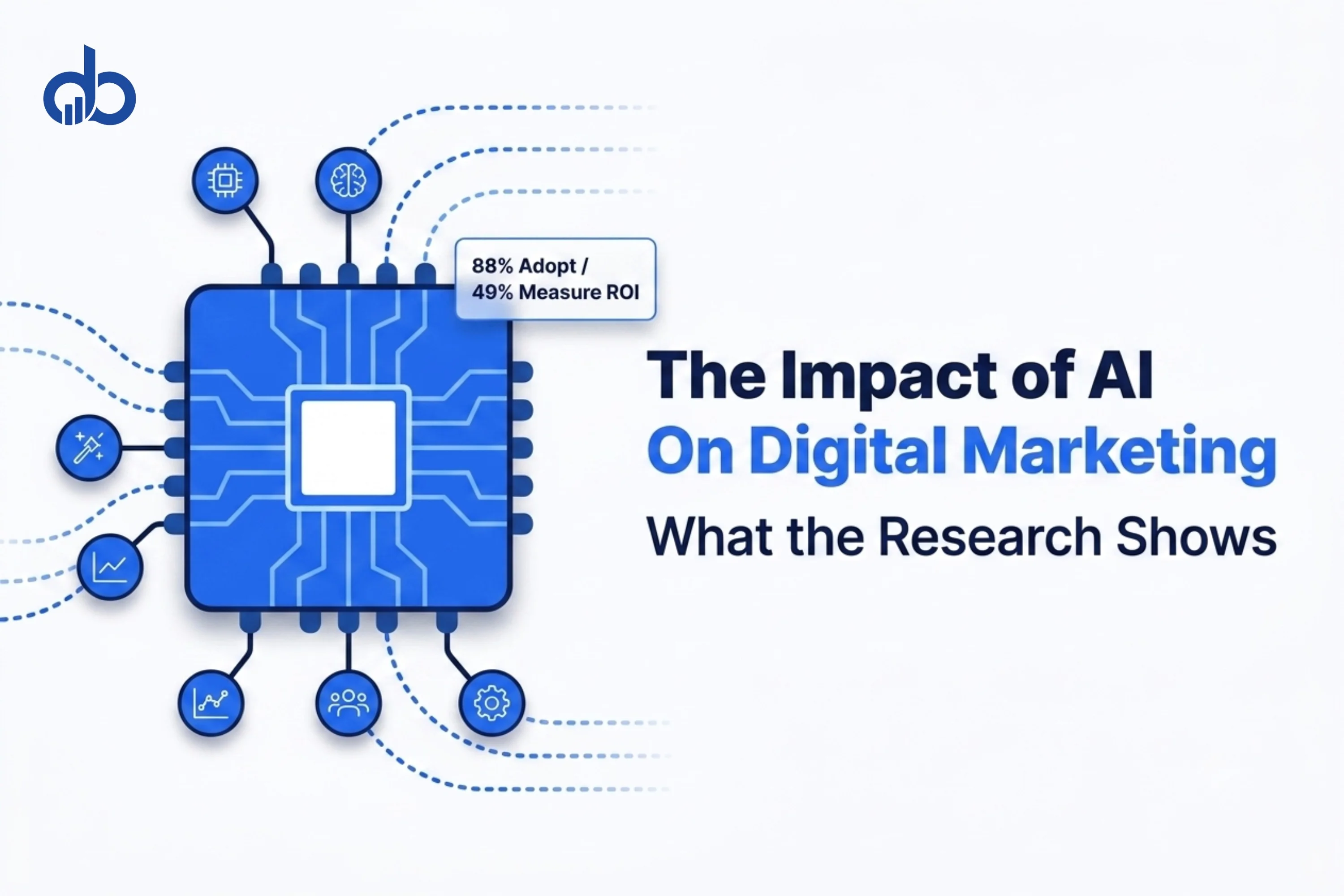
88% of marketers now use AI in their day-to-day roles. The adoption curve is nearly vertical. Yet only 49% of those same marketers formally measure the ROI of their AI investments.
Both things are true at the same time. That gap is where most of the real story lives: not in the tool lists, not in the vendor case studies, not in the “AI will transform marketing” predictions circulating since 2022.
This article draws from primary research: HubSpot’s State of AI Marketing, the CMO Survey from Duke Fuqua School of Business, McKinsey’s AI economic impact analysis, and peer-reviewed work on AI bias in marketing. It gives you an accurate picture of what the research actually shows. What works, what fails, what the failure conditions look like, and what marketing teams do differently when they get it right.
What Is AI in Digital Marketing?
AI in digital marketing is the application of machine learning algorithms, natural language processing, and predictive analytics to automate, personalize, and optimize marketing decisions at scale.
That definition matters because it names three distinct mechanisms, not one. Each underlying mechanism has different data requirements and delivers a different ROI profile.
Machine learning (ML) identifies patterns in historical data and uses those patterns to predict future outcomes. In marketing, it’s what drives audience segmentation, PPC bid optimization, and customer churn prediction. The input is historical behavioral data; the output is a probability estimate or a ranked decision.
Natural language processing (NLP) enables systems to understand, interpret, and generate human language. NLP powers AI-driven chatbots, sentiment analysis tools, and AI content generators. The input is text or audio; the output is a categorized response, a sentiment score, or generated text.
Predictive analytics takes historical performance data and models the probability of future events: which leads will convert, which customers will lapse, which content will outperform. The input is structured event data; the output is a ranked prediction with a confidence level attached.
What artificial intelligence in marketing isn’t: a strategy generator, a replacement for clean data, or a way to extract ROI from a broken campaign structure. Understanding the mechanism level matters because it tells you what each AI marketing tool actually needs to work, and what will make it fail.
Want to know which AI applications are most relevant to your current marketing mix? Get Free Marketing Audit
Why AI Matters for Modern Marketing Teams
Marketing teams are generating more data than humans can meaningfully process. A mid-sized ecommerce brand running Google Ads, email campaigns, and organic social generates tens of thousands of behavioral signals per day. Without automated analysis, most of that data never informs a single decision. And that’s not a small thing.
That’s the practical reason AI adoption in marketing is growing: not hype, not trend-following, but data volume. The CMO Survey, conducted annually by Duke Fuqua School of Business, found that AI now powers 24.2% of all marketing activities, nearly double the 13.1% figure from 2024. That doubling happened in a single year, not because the tools got dramatically better, but because data volume made human-only processing increasingly untenable.
AI digital marketing trends confirm this shift. The question has moved. It’s no longer whether to use AI in marketing. It’s which AI applications actually move business metrics for your specific channel mix and data environment. That’s the question this article is built to answer.
Understanding the future of digital marketing means understanding which AI applications have well-documented ROI profiles and which are still in proof-of-concept territory for most organizations. The answer isn’t the same across channels.
How AI in Digital Marketing Works
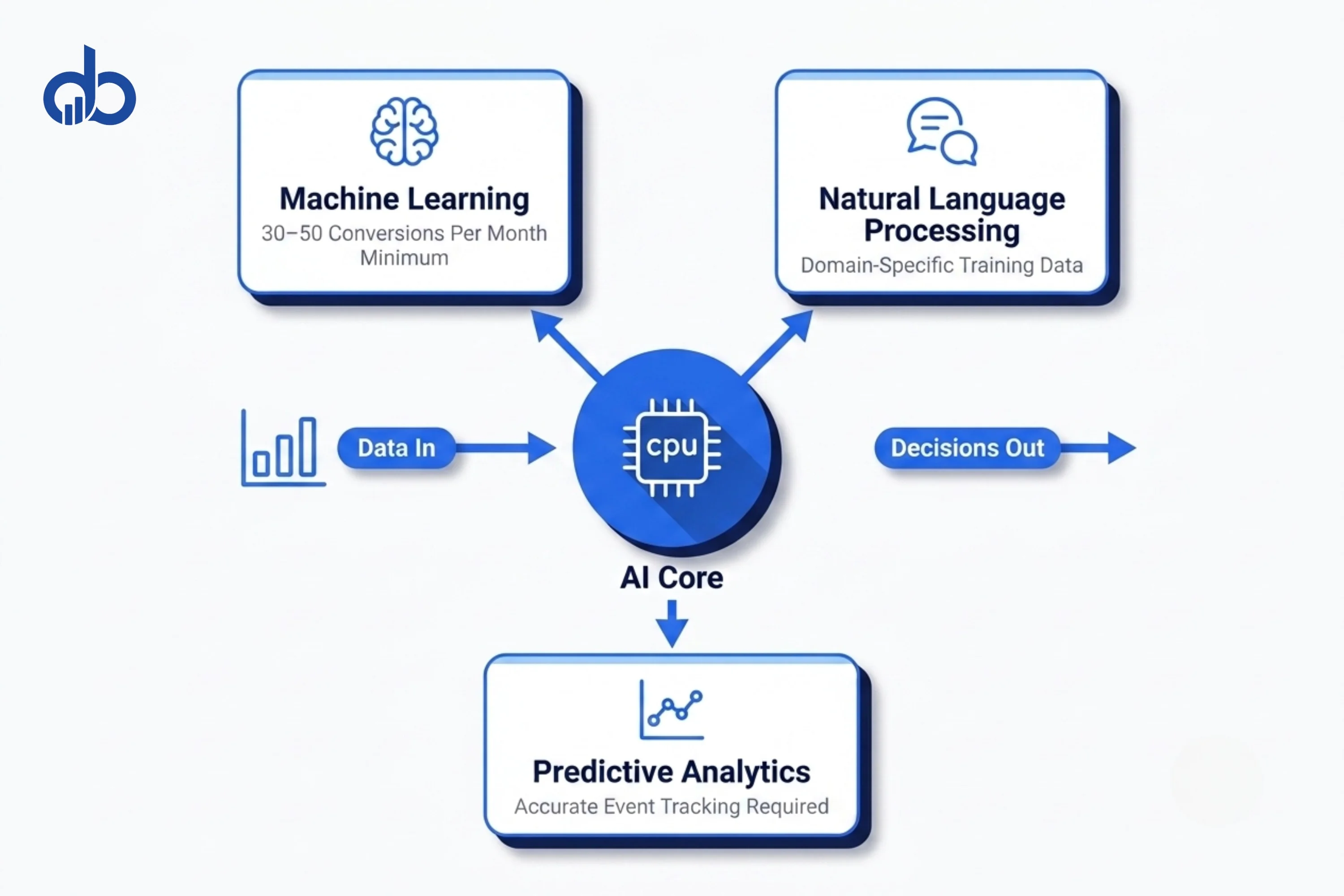
The three core AI mechanisms (machine learning, NLP, and predictive analytics) show up differently across marketing channels. Understanding which mechanism a given tool relies on tells you what it needs and what will break it.
ML-driven applications require a minimum amount of high-quality historical data before they produce reliable outputs. Google’s Smart Bidding is the clearest example. It’s a machine learning bid optimization system. When it has sufficient conversion history (Google recommends at least 30 conversions in the past 30 days before enabling Target CPA), it reduces cost-per-conversion meaningfully. When it doesn’t have that history, it makes decisions with too little signal, and performance becomes unpredictable.
The same principle applies to any ML-based audience segmentation tool. If the historical data reflects a narrow or biased sample of past customers, the algorithm segments and targets the same narrow population with greater precision. Volume isn’t enough. Data quality and breadth matter more.
NLP-driven applications depend on training data quality. An AI chatbot trained on a narrow FAQ dataset handles a narrow range of queries well and fails visibly outside that range. That 80% benchmark assumes those queries fall within the scope of what the model was trained on.
Predictive analytics applications need consistent, accurate event tracking. If your conversion events in GA4 are misconfigured, double-counting, or missing attribution windows, the predictive model builds on flawed data. Digiblazon’s Analytics & Tracking service exists for precisely this reason: getting event tracking right before adding predictive layers isn’t optional. The model can’t self-correct for tracking gaps.
Every AI marketing tool is, at its core, a data transformation layer. The quality of the output is bounded by the quality of the input. Full stop.
Key Applications of AI Across the Digital Marketing Mix
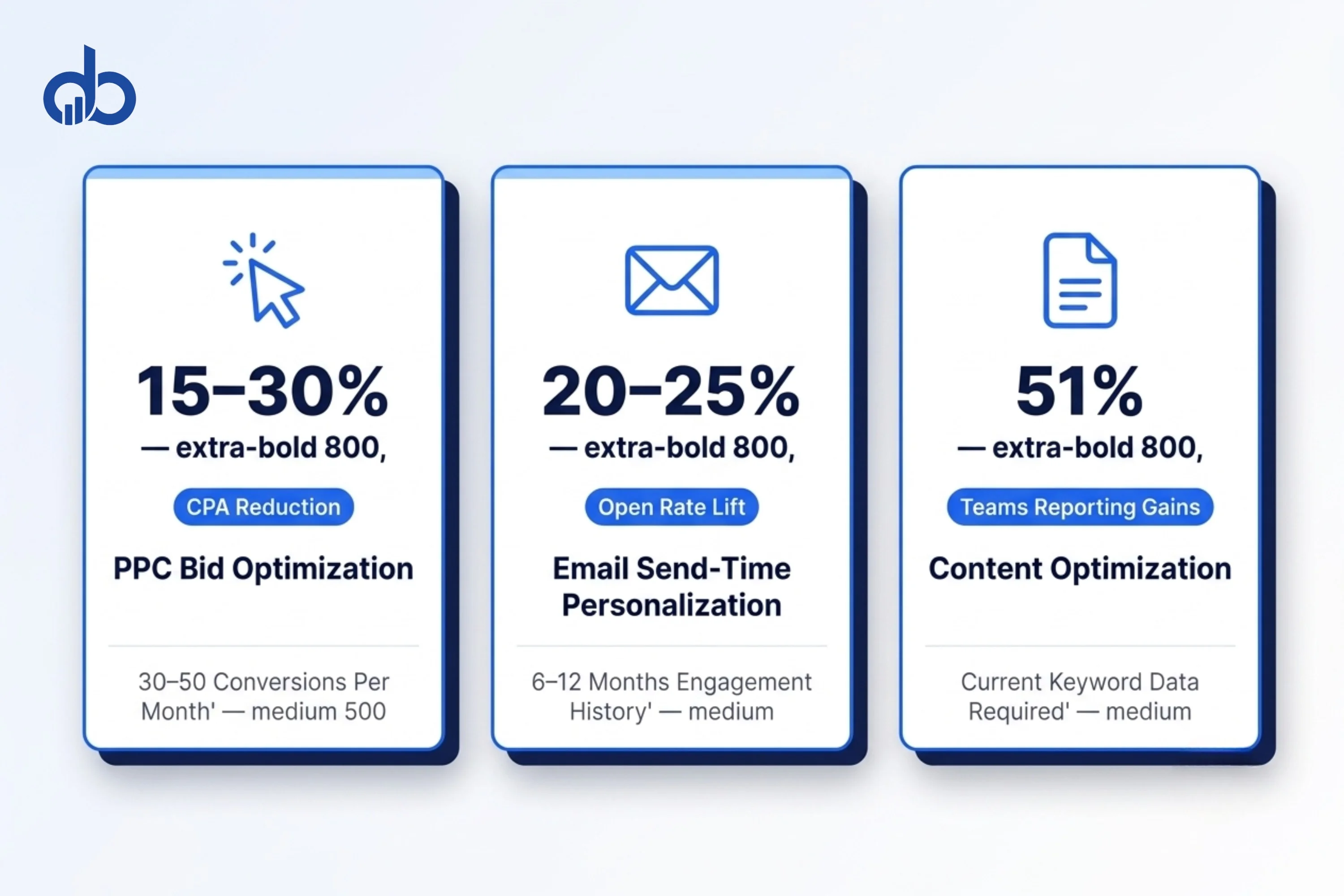
AI touches every channel in the digital marketing mix. But the ROI profile isn’t evenly distributed. Some applications have well-documented outcomes from primary research. Others are still in proof-of-concept territory for most organizations. Choosing the right AI marketing tools starts with knowing which category each application falls into.
Application |
What AI Does |
Documented Outcome |
Data Requirement |
|---|---|---|---|
Adjusts bids in real time based on conversion probability |
15–30% reduction in cost per conversion |
30+ conversions in 30 days (Target CPA) |
|
Email send-time personalization |
Predicts optimal send time per recipient |
6–12 months of engagement history |
|
Audience segmentation |
Clusters users by behavioral patterns |
More precise targeting than demographic segments |
Sufficient conversion history and breadth |
Customer service chatbots (NLP) |
Handles tier-1 queries and lead qualification |
Up to 80% of routine queries resolved automatically |
Domain-specific training data |
Content optimization |
Keyword and readability recommendations |
Current keyword and engagement data |
|
Predictive lead scoring |
Ranks leads by likelihood to convert |
Documented MQL-to-close rate improvements in B2B |
Historical CRM + behavioral data |
The pattern in the table is worth naming directly. Every high-confidence application has a clear data requirement next to it. AI applications fail most often not because the technology is poor, but because the data requirement column is left blank before deployment. This is the distinction that separates AI digital marketing trends that actually move metrics from those that generate activity without ROI.
The Gap Between AI Adoption and AI Impact
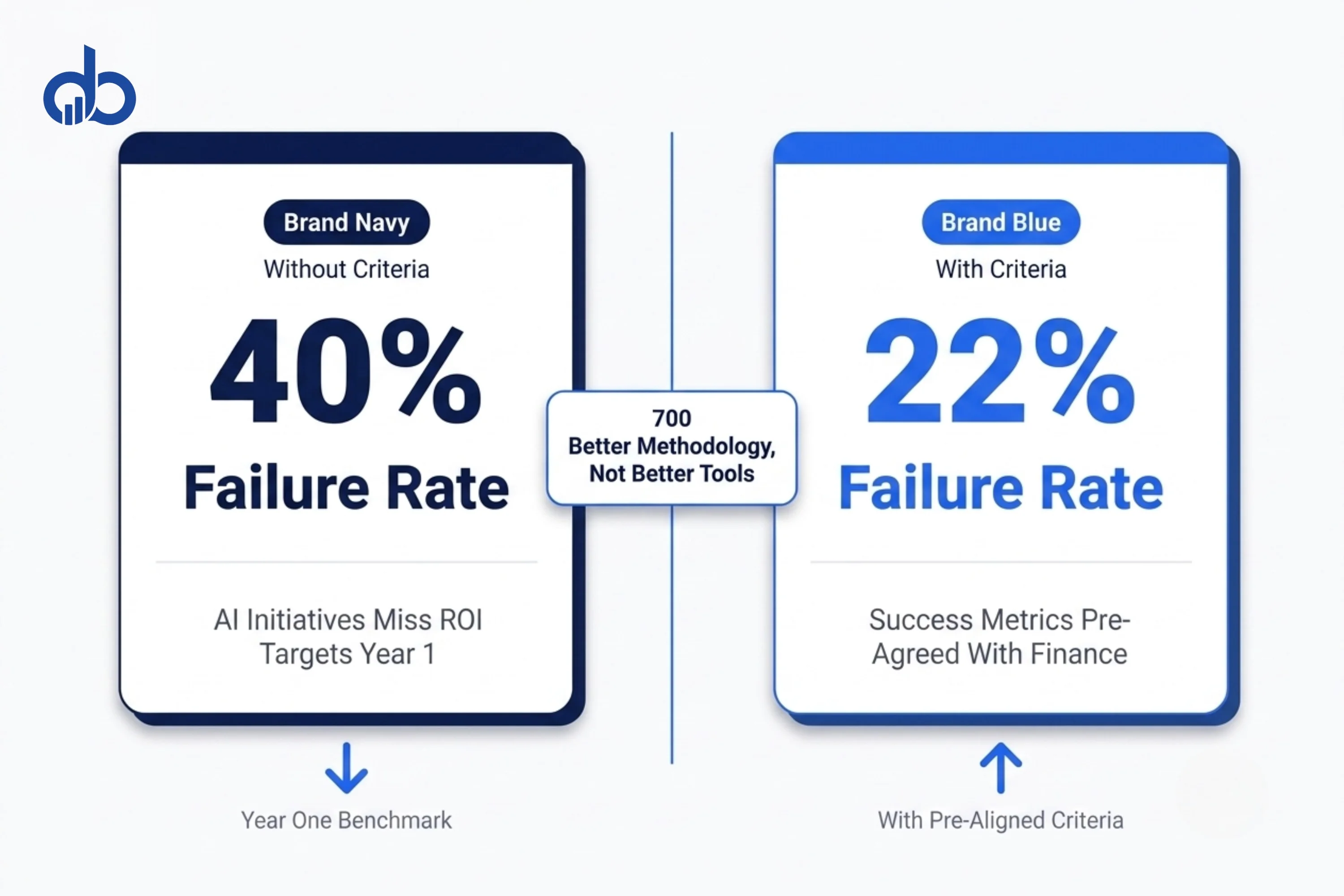
The 88% adoption figure sounds like a success story. But research consistently shows that 40% of AI marketing initiatives fail to meet their stated ROI targets in year one. The same research found that the failure rate drops to 22% when organizations pre-agree on quantitative success criteria with their finance team before deployment begins.
Read that again. The difference between a 40% failure rate and a 22% failure rate isn’t a better AI tool. It’s a better agreement about what success looks like before anyone turns the tool on.
The Three Documented Failure Modes
Three failure modes appear consistently across documented AI marketing implementation failures:
Failure mode 1: Data quality amplification. AI systems make more decisions faster than human marketers. When the data feeding those decisions is incomplete, mislabeled, or biased, the system produces wrong decisions at machine speed and cost. A broken attribution model in GA4 doesn’t become less broken when a predictive analytics layer sits on top of it. It becomes more expensively broken, more quickly, across more decisions.
Failure mode 2: Algorithmic bias. AI learns from historical data. Historical marketing data reflects the targeting decisions made by human marketers over time, including biased ones. An audience segmentation model trained on historical high-converting customer data may systematically exclude demographic groups that were underrepresented in past campaigns. Not because those groups are poor prospects, but because they were never given equal opportunity to appear in the training data.
Failure mode 3: Transparency gaps. A 2025 study published in MDPI’s journal on big data and cognitive computing found that major AI companies averaged only 40 out of 100 on a transparency index measuring how clearly their systems disclose decision-making logic. When you can’t understand why your AI tool made a particular targeting or bidding decision, you can’t diagnose errors, detect bias, or explain performance shifts to stakeholders.
Here’s where it gets interesting: all three failure modes are pre-deployment problems, not technology problems. You can solve for all of them before you turn the AI tool on.
Not sure if your current AI setup is generating actual ROI, or just generating activity? Get Free Marketing Audit
Before deploying any AI marketing tool, run through three questions: Is the data complete (do you track every relevant touchpoint)? Is it accurate (are your conversion events correctly configured)? Is it representative (does your historical data reflect the full range of customers you want to reach)? If any answer is no, fix the data before you add the AI layer. The tool will amplify whatever it finds, including the gaps.
AI Bias in Marketing: What the Research Shows
AI doesn’t generate bias independently. It learns from human-generated data that reflects human decisions: historical hiring patterns, past campaign targeting choices, prior conversion tracking configurations. When that data contains patterns of exclusion or overrepresentation, the AI reproduces and scales them. That’s not a flaw in the algorithm. It’s the algorithm doing exactly what it was built to do.
In marketing, this surfaces most visibly in audience targeting. A look-alike audience model trained on historical purchaser data segments and targets users who closely match past customers. If past customers skewed toward a specific demographic (because of where the brand was distributed, how it was priced, or which neighborhoods its ads appeared in), the model will replicate that skew with increasing precision. Sound familiar? The algorithm finds what worked before, then bets on more of the same.
The research framework published in MDPI in 2025 provides a specific methodology for auditing AI marketing systems for bias: periodic comparison of who the algorithm targets versus who the brand’s potential market actually includes, with structured testing of whether the algorithm’s behavior shifts when historical data is deliberately diversified. This isn’t a theoretical governance exercise. Brands that have identified and corrected algorithmic bias in their targeting consistently find incremental audiences they were systematically missing.
The practical implication: audience composition audits belong in your AI tool management workflow, not just in a governance checklist. If you’re using any ML-driven audience tool, quarterly checks on who is being targeted versus who the potential market includes are now standard practice.
Real-World Applications: What AI Looks Like in Practice
The gap between artificial intelligence in marketing theory and working implementation is wider than most guides acknowledge. Here’s what AI in digital marketing actually looks like in working marketing teams, without the hype layer.
Example 1: Ecommerce brand and Smart Bidding. One ecommerce client we worked alongside switched Google Ads campaigns from manual CPC to Target CPA Smart Bidding. After 90 days, cost per conversion dropped by 18%. What made it work: the account had 60+ conversions per month before switching, conversion tracking was verified accurate, and no significant campaign structure changes were made during the first 60 days of the learning phase. Remove any one of those conditions and the performance story looks different.
Example 2: B2B SaaS and email send-time optimization. A B2B SaaS company applied AI send-time optimization to its nurture sequence, using a platform with sufficient engagement history to model optimal send times per contact. Open rates lifted by approximately 22% over the first quarter. The same company’s experiment with full AI content generation for the nurture emails (without human editorial review) showed engagement rates below its manually written control emails. The lesson: AI performs reliably when it’s optimizing a well-defined, data-rich decision. It performs variably when it’s substituting for editorial judgment.
Example 3: Content team and optimization AI. A content team used AI keyword and readability tools during the outlining and editing process, treating the AI output as a first pass for human refinement. Content performance improved. The same team’s experiment with fully AI-generated first drafts, published without review, showed no improvement, and in some cases, engagement declined. The pattern is consistent: AI as decision support with human oversight outperforms AI as a replacement for human judgment. Every time.
The highest-confidence ROI from AI in digital marketing comes from applications with large datasets and clear optimization targets: PPC bid management, send-time personalization, audience segmentation, and product recommendations. These are your highest-confidence starting points. Anything requiring creative judgment or thin historical data belongs in the "test carefully" category, not the "deploy widely" category.
Digiblazon’s Marketing Consulting service reviews these application decisions: which AI marketing tools fit your data maturity, which require foundational work first, and which are likely to underperform regardless of implementation. The tool selection decision is rarely the hardest part. The data preparation and oversight infrastructure decisions almost always are.
Getting Started with AI in Your Digital Marketing Strategy
Most marketing teams that fail with AI don’t fail because they selected the wrong tool. They fail because they started with the tool rather than the problem.
A more reliable sequence:
Step 1: Identify one high-volume, data-rich decision
Find the marketing decision your team makes most often that’s already driven by data: bid adjustments, send-time selection, audience segment assignment. That’s your first AI deployment candidate. One decision, well-matched to AI, produces more learning than five simultaneous deployments.
Step 2: Audit the data feeding that decision
Check for completeness, consistency, and attribution accuracy. Are all relevant touchpoints tracked? Are conversion events correctly configured and not double-counted? Is the historical data representative of the full customer range? Fix the gaps before you deploy AI on top of them. This is the part most people skip.
Step 3: Define measurable success criteria before deployment
Pre-agree with your team on what “working” looks like in specific numbers: a target CPA reduction, an open rate lift percentage, a conversion rate improvement threshold. Organizations that do this before deployment see the 40% failure rate fall to 22%. The criteria don’t need to be aggressive. They need to be specific and agreed on.
Step 4: Preserve human oversight on AI outputs
Automated doesn’t mean unsupervised. Review AI decisions weekly for the first 90 days. Catch compounding errors before they become expensive. Check audience composition quarterly for signs of algorithmic narrowing.
Step 5: Expand only after one application shows documented ROI
Resist the pressure to deploy AI across every channel simultaneously. The organizations that report positive ROI in the CMO Survey started narrow and expanded systematically. Broad simultaneous deployment produces attribution problems, competing learning phases, and unclear causality when anything changes.
The future of digital marketing belongs to teams that treat AI as a precision tool with specific data requirements, not a universal shortcut. Start narrow, measure everything, and expand from documented results.
Ready to assess which AI applications fit your current marketing stack and data maturity? Get Free Marketing Audit
AI in Digital Marketing Delivers Results, When the Foundation Is Right
You now have a framework for evaluating AI in digital marketing against your actual data maturity and channel readiness, not against vendor benchmarks built from best-case deployments. The conditions that separate 22% failure rates from 40% failure rates are methodological: defining success before deployment, auditing data before adding AI layers, and maintaining human oversight on outputs.
Digiblazon’s Marketing Consulting service reviews both sides: what your AI tools are seeing and what your underlying marketing strategy is actually asking them to do. Start with a Free Marketing Audit to see where the gaps are.
- 88% of marketers now use AI in their day-to-day roles, yet only 49% formally measure its ROI — the gap is where most failures live.
- AI in digital marketing operates through three distinct mechanisms: machine learning, natural language processing, and predictive analytics — each with different data requirements and ROI profiles.
- AI-led campaigns deliver an average 22% better ROI than non-AI campaigns, but only when data quality, attribution, and success metrics are pre-established.
- 40% of AI marketing implementations fail to meet ROI targets in year one — consistently because teams deployed AI before addressing underlying data quality issues.
- The highest-confidence AI applications are PPC bid management, email send-time personalization, audience segmentation, and product recommendations.
- AI bias in marketing is a documented risk: systems trained on historical data can reproduce and scale past targeting biases at machine speed.
- AI as decision support with human oversight consistently outperforms AI as a replacement for human judgment.
Frequently Asked Questions
Will AI replace digital marketers?
AI replaces tasks, not marketers. The roles most at risk are those consisting entirely of high-volume, rule-based work: manual bid adjustments, basic report generation, template-driven email scheduling. Strategic functions (campaign direction, creative judgment, audience insight, stakeholder communication) require human reasoning that current AI systems can't replicate. Marketers who learn to work alongside AI as a decision-support tool consistently outperform peers who treat it as a replacement threat or ignore it entirely.
How much does AI actually improve marketing ROI?
Research across multiple benchmarking sources shows AI-led campaigns deliver an average of 22% better ROI than non-AI campaigns, with documented ranges from 15% to 40% depending on the application and data quality. The caveat: those figures apply to properly implemented artificial intelligence in marketing with clean data, accurate attribution, and pre-agreed success metrics. The 40% of implementations that fail to meet ROI targets in year one consistently share a common factor: they deployed AI before addressing the data quality issues the AI then amplified.
What are the biggest risks of using AI in marketing?
Three documented risks appear in primary research. First, data quality amplification: AI produces more decisions faster, so bad data produces bad outcomes at machine speed and cost. Second, algorithmic bias: AI learns from historical data that may reflect past targeting biases, reproducing and scaling them. Third, transparency gaps: major AI systems average 40/100 on transparency indices, making it hard to diagnose errors or detect bias. The practical mitigation for all three: pre-deployment data audits, quarterly audience composition checks, and preserved human review checkpoints.
How does AI personalization actually work?
AI personalization uses machine learning to group users by behavioral patterns (browse sequences, purchase history, engagement timing, content preferences) and serves content, offers, or messaging predicted to resonate with each group in real time. Documented conversion rate lifts from email send-time optimization average 20–25% across the most common applications, with higher gains in ecommerce product recommendations. The results depend on the quality and breadth of the behavioral data the model trains on.
Is AI-generated content penalized by Google?
Google's published guidance doesn't penalize content based on how it was produced. It penalizes content that's low-quality, unhelpful, or appears designed to manipulate search rankings rather than serve readers. The practical risk with AI-generated content isn't the production method: it's publishing AI output without human editorial review. AI tools produce text that's often accurate in its claims but generic in its framing, thin in its depth, and predictable in its structure. That profile describes exactly the content Google's Helpful Content System was built to demote.