
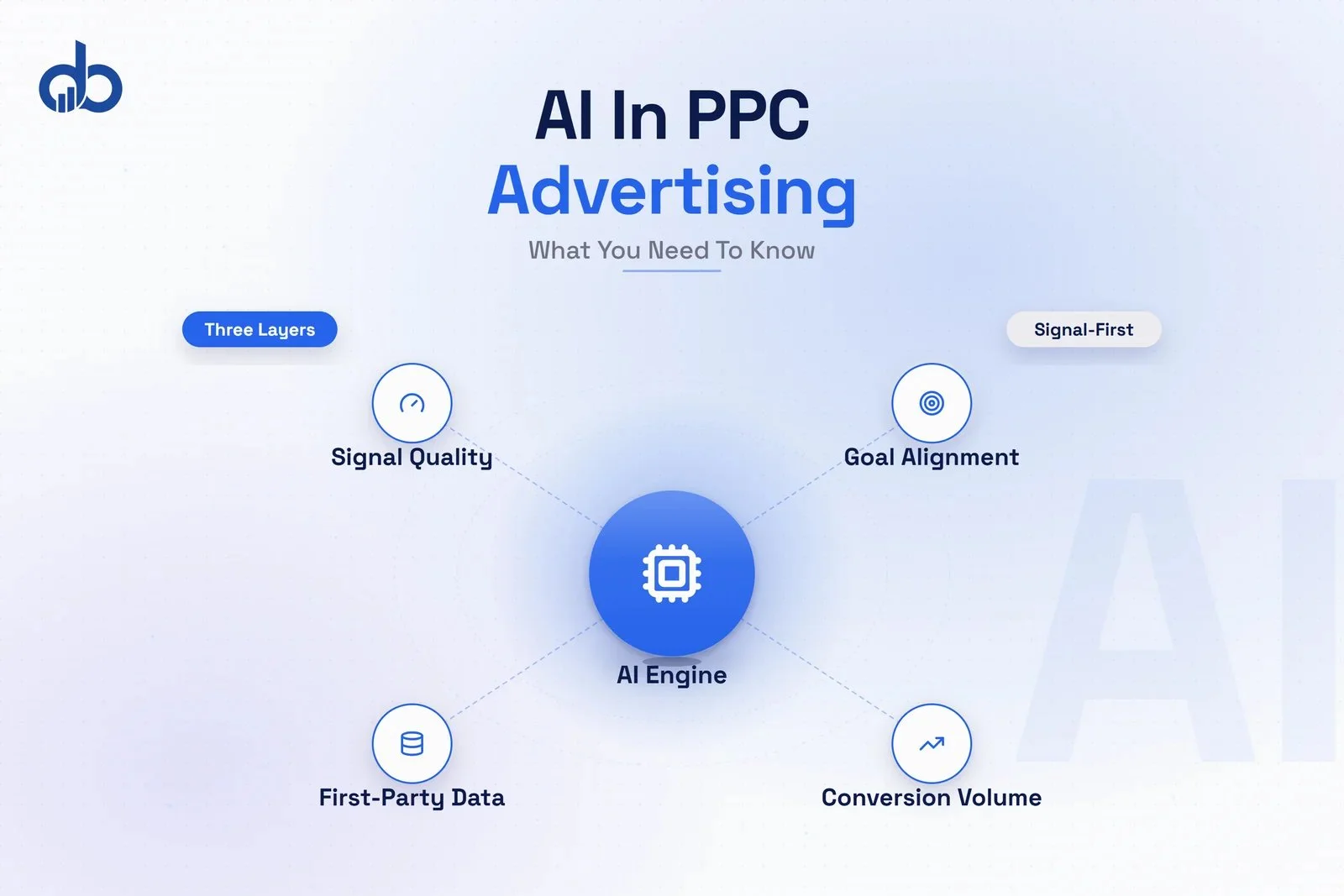
Google launched more than 60 AI features for advertisers in 2025 alone. The platform reports 14% more conversions for advertisers using AI Max, and 27% more for campaigns migrating to Performance Max. Those numbers are real.
So is this one: 53% of PPC professionals say managing paid search is harder than it was two years ago.
That’s not a contradiction. It’s the most important thing to understand about the current state of AI in PPC advertising. The platforms promising efficiency through AI are the same ones that benefit when you spend more. The advertisers seeing the biggest gains aren’t the ones who turned on every AI feature. They’re the ones who built the infrastructure those features require before activating them.
Here’s what this article covers: what AI-powered PPC actually does, where it genuinely delivers, where it breaks down without the right setup, and what you need in place before any AI tool can work in your favor.
What AI in PPC Advertising Actually Does
Most articles about artificial intelligence in digital marketing describe AI as a tool that makes campaigns easier to manage. That’s a reasonable summary. It’s also incomplete.
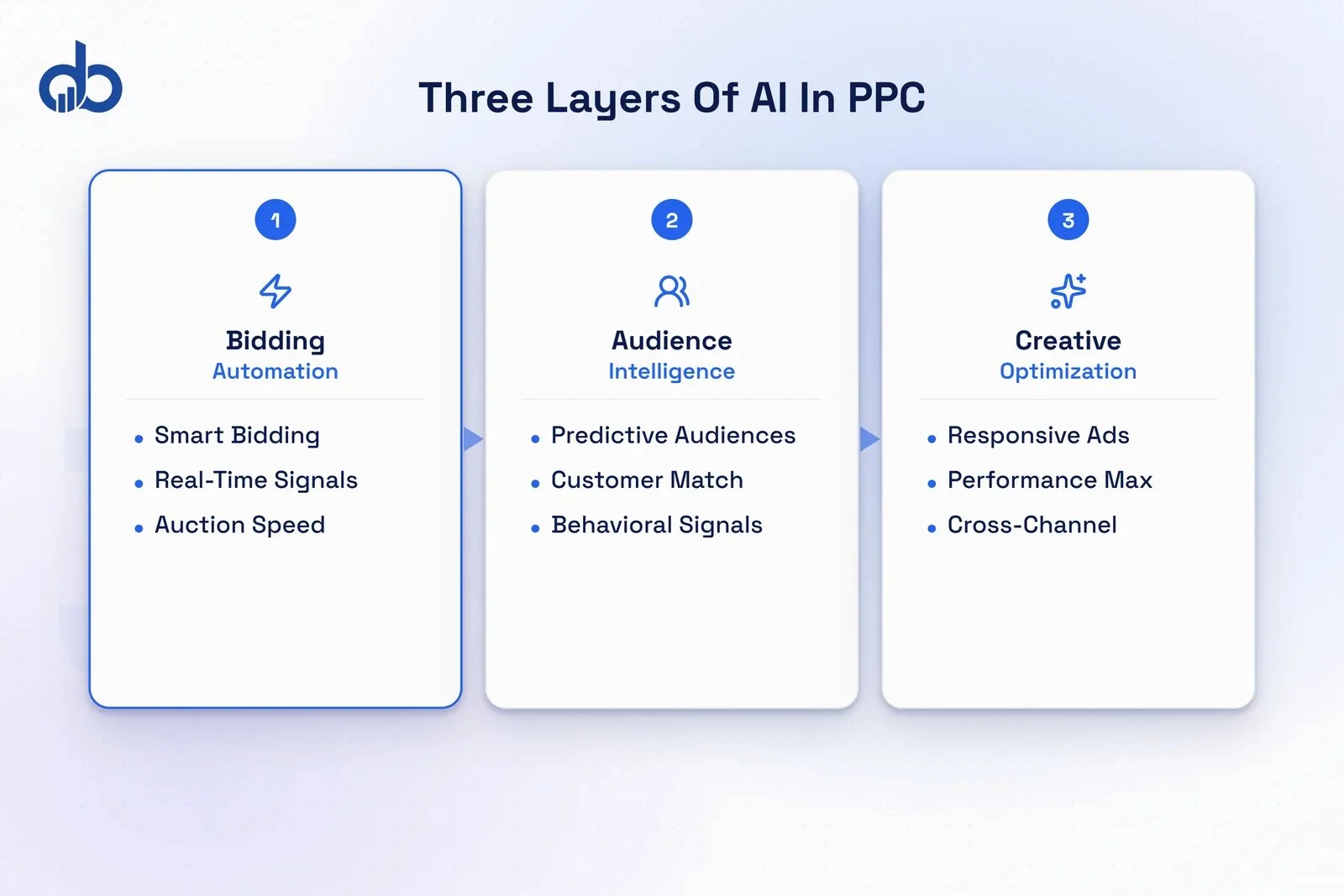
AI in PPC advertising operates across three distinct layers. Each one solves a different problem.
Bidding automation is the most mature layer. Smart Bidding analyzes more than 70 real-time signals per auction: device type, location, time of day, search query context, browser, and audience membership. All in the milliseconds before an ad is served. No human can evaluate those signals at that speed or scale. And that’s not a small difference: we’re talking hundreds of thousands of auctions per day on a mid-sized B2B account.
Audience intelligence is the second layer. Predictive audiences, Customer Match, and similar-segment targeting use AI to find users most likely to convert based on behavioral signals across Google’s properties. It moves targeting beyond the static lists that defined audience management five years ago.
Creative optimization is the third layer. Responsive Search Ads (RSAs) test headline and description combinations against real user data. Performance Max extends this across video, display, and discovery formats. AI assembles creative combinations across channels in real time.
The distinction that matters for decision-makers: AI handles the how at machine speed. Human strategy still owns the what and the why. What you want to achieve, who you want to reach, what your offer is: those inputs belong to your team.
Where AI-Powered PPC Delivers Measurable Results
The performance data from AI-powered PPC is genuinely strong. In the right conditions.
Google’s Smart Bidding Exploration delivers an average 18% increase in unique search query categories with conversions and a 19% lift in conversions overall. These are conversion outcomes, not clicks or impressions. For accounts with the signal volume Smart Bidding needs, the improvement over manual bidding is consistent.
AI Max, Google’s newest Search campaign enhancement, produces an average 14% lift in conversions or conversion value at similar cost-per-acquisition (CPA). For campaigns still relying on exact and phrase match keywords, the lift reaches 27%. Four million advertisers now use Performance Max globally, and that adoption reflects genuine performance rather than platform pressure alone.
PPC automation also changes the time economics of campaign management. PPC professionals using AI tools save an average of five hours per week on tactical tasks: bid management, search term reviews, ad variation setup. That time, reinvested into strategy and creative, compounds into better long-term account performance.
Don't activate Smart Bidding until you've confirmed your conversion tracking is firing on events that actually reflect business outcomes. Most accounts we audit have Smart Bidding running on page views or time-on-site as the primary signal. The AI is working hard to send you traffic that looks engaged, not traffic that converts. Fix the conversion goal first, then turn on the AI.
The honest note: these results are conditional. They apply to accounts with sufficient conversion volume, clean tracking, and aligned goal inputs. The same AI tools produce inconsistent outcomes when those conditions aren’t in place.
The PPC Complexity Paradox: Why More AI Made Things Harder
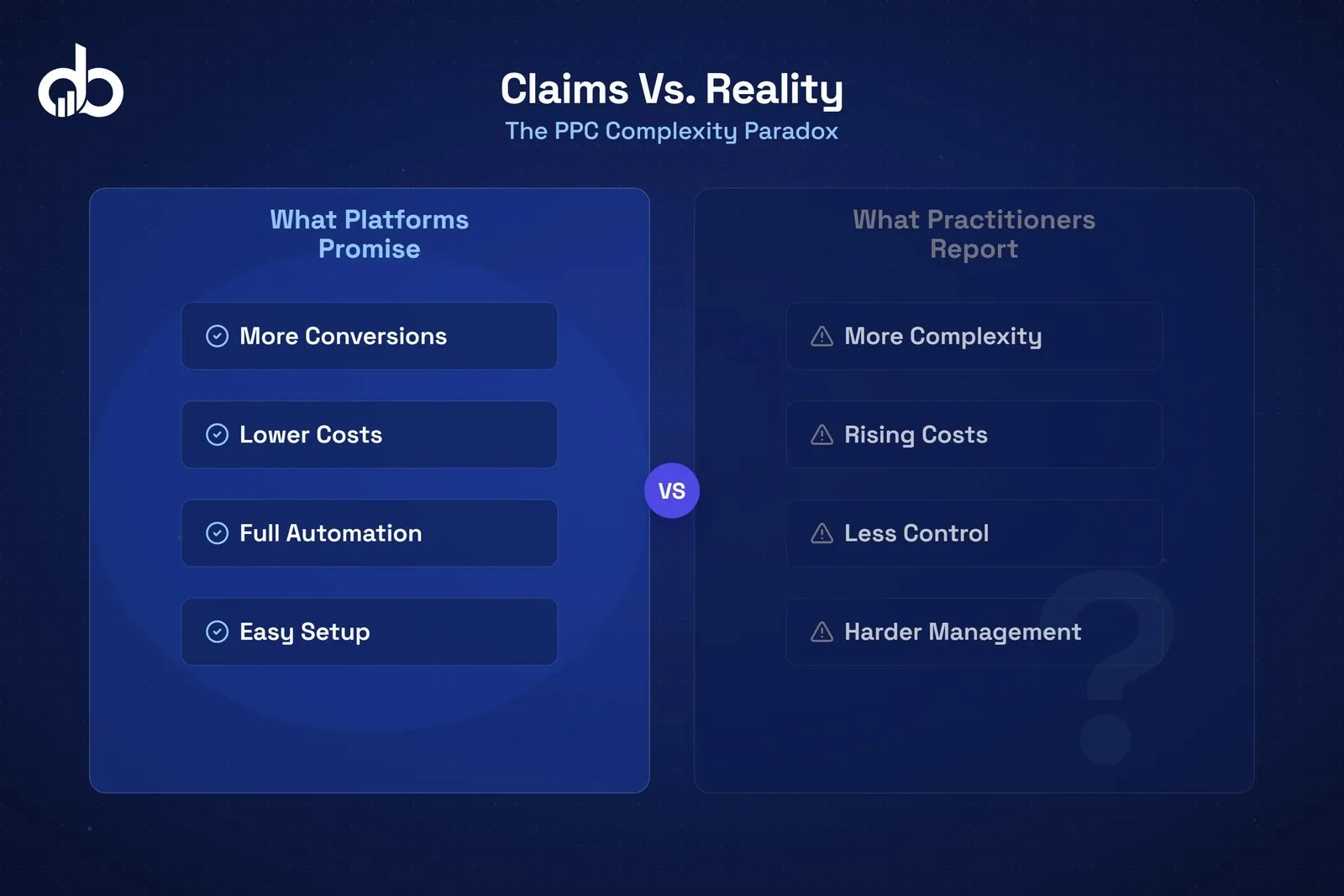
Here’s the gap that every platform announcement ignores.
The State of PPC 2026 survey of 1,306 PPC professionals, fielded in late 2025, found that 53% say managing paid search is harder now than two years ago. Among those who said it was harder, the most commonly cited reason is increasingly opaque, black-box platforms, named by 62%.
Average cost-per-click (CPC) across Google Ads reached $5.26 in 2025, a 12.9% increase year over year across 87% of industries. AI is supposed to optimize spend. Yet advertiser costs keep rising. That’s the complexity paradox. Sound familiar?
AI in PPC advertising doesn’t reduce complexity for every account. It concentrates complexity in a different place. The tactical workload (manual bid adjustments, keyword-level micro-management) gets smaller. The strategic workload (signal quality, goal alignment, attribution setup, learning period management) gets larger and more consequential. Our analysis of current research on AI in PPC traces the same pattern: platform metrics improve while advertiser control shrinks.
There’s a second pressure most articles miss entirely. Google’s own AI Overviews are restructuring the search results page. Research across 25.1 million paid impressions found that paid click-through rates (CTR) fell 68% on queries featuring AI Overviews. The same AI that promises better PPC performance is simultaneously compressing the click inventory that paid ads depend on. That’s not a minor footnote. It’s a structural shift in the PPC market.
The advertisers who benefit from AI in PPC advertising treat it as a system that amplifies quality inputs. The advertisers who struggle treat it as a layer that replaces those inputs.
Common questions we hear on calls:
“Why are our CPCs still rising if we’re using Smart Bidding?”
Smart Bidding optimizes your bid position relative to your conversion goal, but it doesn’t control auction prices; the whole market does. If CPCs are rising across your verticals and your AI Max or Performance Max campaigns are running without tight negative keyword lists, you’re likely buying irrelevant traffic at market rates. Smart Bidding will find conversions, but it’ll find cheap, low-quality ones if that’s what fits your tCPA. The fix is almost never the bidding strategy; it’s the conversion goal alignment and the negative keyword audit.
“We turned on AI Max and performance got worse. What happened?”
AI Max expands match types aggressively. On a B2B account without a solid negative keyword structure, it’ll pull in high-volume consumer queries that fit your keyword themes but don’t fit your buyer. The algorithm sees conversions (form fills) and doubles down. But if those form fills are low-quality leads, you’re funding a volume increase, not a revenue increase. Run a search term report from the first 30 days post-activation. You’ll see exactly where the match expansion went.
What AI in PPC Needs From You to Actually Work
This is the section that changes how you evaluate any AI-driven PPC claim.
Every AI bidding system learns from the conversion data it receives. That learning determines what the algorithm does next. If the input data is thin, inconsistent, or misaligned with actual business outcomes, the AI optimizes efficiently toward the wrong target. And it does that at scale.
Conversion volume floor. Smart Bidding requires approximately 30 conversions in 30 days to begin learning effectively. Performance Max performs best with 50 or more monthly conversions per campaign. Accounts below these thresholds experience 20 to 30% CPA volatility during learning periods. The AI doesn’t have enough signal to stabilize. More than two-thirds of marketers estimate that at least 11% of their media budgets are wasted due to poor optimization signals.
Conversion signal quality. The goal type you assign to the AI controls its behavior. If you use time-on-site or page views as primary conversion goals, the AI will find users who spend time on your site. It won’t find users who buy or qualify as leads. B2B accounts with 90-day sales cycles need offline conversion import, connecting closed revenue from the CRM back to the original ad click, or AI for Google Ads is optimizing against an incomplete picture.
The learning period reset. Any significant change to budget, bid strategy, or creative resets the algorithm’s learning phase. That reset costs 7 to 14 days of stabilization. During that window, performance fluctuates and real budget is consumed. Budget owners who approve mid-campaign changes without understanding this mechanic are funding instability, not iteration.
First-party data. Enhanced Conversions (hashed first-party data sent directly to Google) improve bidding signal quality by connecting ad clicks to real user data. Customer Match audiences give the AI a starting point based on who your actual customers are. These aren’t optional features for accounts with serious performance targets.
Build your Customer Match audience before you activate Performance Max or AI Max. Upload a list of your closed customers (even 500 records makes a difference). The AI uses it to identify lookalike signal patterns. Without it, the algorithm starts from scratch with no prior context about who converts for you. That's a 30 to 60 day head start you're giving away for free.
AI Readiness Checklist:
- Are 30 or more conversions per month tracked accurately?
- Does the primary conversion goal reflect a genuine business outcome?
- Are Enhanced Conversions or offline conversion uploads configured?
- Are first-party audience lists built and connected to campaigns?
- Is there a documented process for campaign changes that protects learning periods?
If any of these answers is no, AI tools will underperform relative to their potential. Not because the technology is wrong, but because the inputs are incomplete.
How AI in PPC Advertising Varies by Platform
AI-powered PPC isn’t a Google-only story. The discipline extends across platforms, and the signal quality problem is universal.
Google Ads has the most developed AI infrastructure. Smart Bidding, Performance Max, AI Max, and VideoGen all run from the same underlying machine learning architecture. The ecosystem is mature and the data pool is vast. That creates both the highest potential and the highest complexity.
Microsoft Advertising has integrated Copilot into its search experience in ways that create new ad placement opportunities. Early data shows 3x higher CTR in Copilot-integrated placements compared to standard search. Because Microsoft Advertising operates in less competitive auction environments, B2B advertisers often find lower CPCs on comparable intent signals. The AI for Google Ads environment is more competitive; Microsoft can offer a meaningful cost advantage for the same buyer intent.
Meta Advantage+ automates audience selection, placement, creative assembly, and bidding in a single AI-controlled campaign. For eCommerce accounts with strong purchase signal volume, Advantage+ has produced consistent efficiency gains. For B2B accounts with long sales cycles, the results are more variable. Meta’s AI optimizes on signals it can see, and purchase-intent signals are harder to isolate in B2B contexts without strong CRM integration.
The takeaway for decision-makers managing multi-channel budgets: the discipline is the same everywhere. Clean conversion signals, aligned goal inputs, a human review layer. Artificial intelligence in digital marketing rewards accounts that build this infrastructure first, regardless of which platform runs the AI.
Want to know if your PPC setup is ready for AI to work in your favor? Digiblazon's Performance Marketing team offers a free audit that shows you exactly where you stand. Get Your Free PPC Audit
What AI Cannot Replace in Paid Search
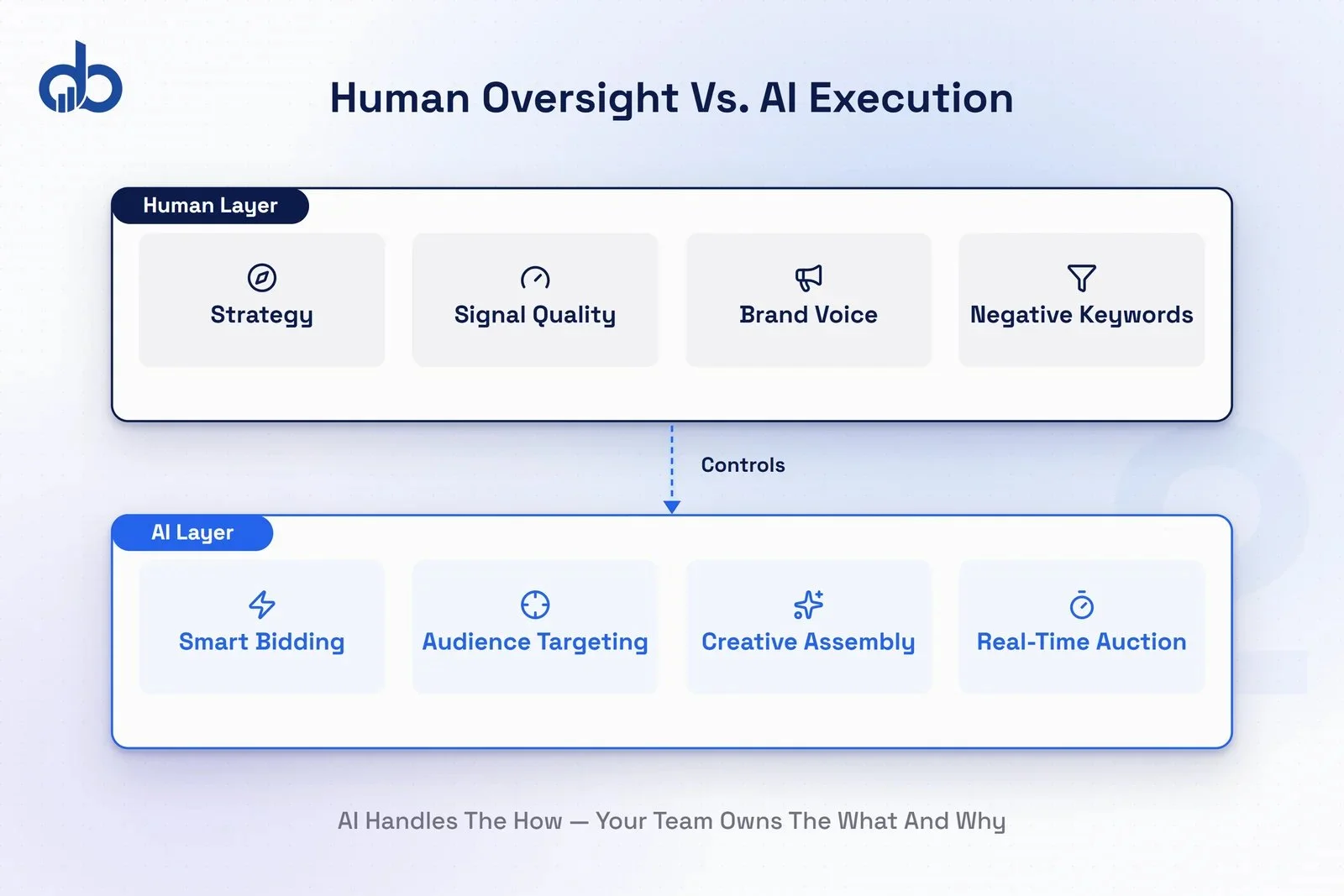
PPC automation handles the mechanical optimization layer. But there’s a meaningful gap between what it does efficiently and what it does completely.
Business context. AI bidding systems know your conversion events. They don’t know your business. A B2B advertiser with a $50,000 average deal size and a 90-day sales cycle needs to tell the AI, through properly configured offline conversion data, which form fills become qualified pipeline. Without that configuration, AI-powered PPC optimizes toward form fills of all quality types with equal enthusiasm. That’s a recipe for volume growth and pipeline disappointment at the same time.
Brand voice and creative direction. RSAs and auto-generated headlines optimize for CTR patterns. They don’t understand what makes your offer different from a competitor’s, what language resonates with a specific buyer persona, or which message fits which funnel stage. The creative inputs you give the AI determine what it can assemble. Better inputs produce better combinations.
Landing page performance. AI drives more traffic to wherever you direct it. It won’t fix a landing page that converts at 1%. AI amplifies what already works. Every account with a rising cost-per-lead has either a signal problem, a creative problem, or a landing page problem. Usually not a bidding problem.
Negative keyword discipline. AI Max and broad match expansion extend reach beyond the queries you originally targeted. For B2B accounts where irrelevant traffic misleads the AI’s learning, a human-reviewed negative keyword list updated monthly is a structural requirement. The AI expands; the human constrains. Both are necessary.
The five hours per week that AI returns to PPC teams should go into these areas. PPC automation frees up tactical time. That time belongs in signal quality, creative direction, and account-level oversight, not in assuming the AI handles everything.
How to Start Using AI in PPC Without Burning Budget
The sequence matters as much as the tools.
Step 1: Audit your signal infrastructure before adding any AI feature. Verify conversion tracking, confirm Enhanced Conversions are active, check that the primary conversion goal reflects a genuine business outcome, and connect offline conversion data if you have a CRM and a meaningful sales cycle. This is a strategy prerequisite, not a configuration check.
Step 2: Align your bidding targets with real business numbers. Set target CPA (tCPA) based on your actual cost-per-qualified-opportunity, not your historical CPA average. Set target return on ad spend (tROAS) from margin data, not from what the platform suggests. AI in PPC advertising optimizes for the target you give it. An accurate target produces an accurate outcome. When using AI for Google Ads, a wrong tCPA target set at launch does more damage than a delayed launch with the right target.
Step 3: Test AI Max on a subset of campaigns, not the full account. Run a 30-day parallel test with enough conversion volume to be statistically meaningful. Review search term reports and placement reports weekly. Assess the quality of conversions generated, not just the volume. Only expand after the test confirms signal alignment.
Digiblazon’s Performance Marketing team works through this sequence across 25+ active B2B clients managing $5M+ in ad spend. The pattern that emerges across accounts is consistent: the AI tools that produce the best results are the ones deployed last, after the tracking, goal alignment, and creative infrastructure are in place.
AI in PPC Rewards the Prepared, Not the Passive
You now know which conditions allow AI-powered PPC to deliver the performance gains platforms report, and which conditions produce the complexity and cost increases that 53% of practitioners are experiencing.
The gap between the two is almost always signal quality and goal alignment. Both are fixable. They require attention before you activate the tools, not after you’ve run the experiment.
- AI in PPC advertising operates across three layers — bidding automation, audience intelligence, and creative optimization — each requiring different levels of human oversight.
- Smart Bidding needs at least 30 conversions per month to learn effectively; below this threshold, manual bidding is often more stable.
- The platforms promising AI efficiency are the same ones that benefit when you spend more — 53% of PPC professionals say paid search is harder now than two years ago.
- AI amplifies quality inputs; fix your conversion tracking, goal alignment, and first-party data before activating any AI feature.
- The five hours per week AI returns to PPC teams should be reinvested in signal quality, creative direction, and account oversight — not in assuming AI handles everything.
Frequently Asked Questions
How does AI work in PPC advertising?
AI in PPC advertising operates through three main functions: Smart Bidding (automated real-time bid adjustments using 70+ signals per auction), audience intelligence (predictive targeting that identifies likely converters), and creative optimization (Responsive Search Ads and Performance Max that test combinations against real performance data). Most Google Ads campaigns now use at least one of these AI layers.
Is AI better than manual bidding in Google Ads?
In the right conditions, yes. Smart Bidding consistently outperforms manual bidding on accounts with 30 or more conversions per month and clean conversion tracking. Below that threshold, manual bidding is often more stable because the AI doesn't have enough signal to learn from. The answer depends on your conversion volume and tracking quality, not the tool itself.
How many conversions do I need for Smart Bidding to work?
Google's guidance, supported by independent performance data, is approximately 30 conversions per month per campaign for Smart Bidding to stabilize. Performance Max performs best with 50 or more monthly conversions. Accounts below these thresholds experience 20 to 30% CPA volatility during learning periods as the algorithm tries to optimize with insufficient data.
Will AI replace PPC managers?
No. AI handles real-time bidding optimization and creative testing at a scale no human can match. But it can't interpret your sales pipeline, validate lead quality, align creative with your brand positioning, or fix a landing page that converts at 1%. PPC managers are now most valuable for signal architecture, strategic goal setting, creative direction, and the oversight that prevents AI from optimizing the wrong outcomes at scale.
Is AI making PPC more expensive?
It hasn't reduced average CPCs. Average CPC across Google Ads reached $5.26 in 2025, up 12.9% year over year. The efficiency gain from AI is in conversion rate and signal precision, not in auction prices. Advertisers who build the right signal infrastructure see better cost-per-qualified-lead, even as raw click costs rise.
What is AI Max for Search campaigns?
AI Max is Google's enhancement for existing Search campaigns that applies AI-driven query expansion and creative optimization beyond traditional keyword match types. Advertisers activating it see an average 14% more conversions at similar CPA. It works best on accounts with strong negative keyword lists and sufficient conversion volume. Without those guardrails, it can expand into irrelevant traffic.