
What Manufacturing Website Design Gets Right, and Where It Stops
The conventional advice on manufacturing website design isn’t wrong. It’s incomplete.
Search for “manufacturing website best practices” and you’ll find consistent guidance. Publish detailed product specs and certifications. Add facility photos and 3D product visuals. Optimize for mobile. Simplify your RFQ form. Guides from agencies and industry consultants identify the same feature gaps. Your site needs more technical content. Your contact form is too long. Your page load speed is hurting conversions.
These recommendations are legitimate. Specs matter. Certifications matter. A fast site with a short RFQ form outperforms a cluttered one. Manufacturers who follow this advice do see improvement.
But the guidance treats manufacturing website design as a feature problem. Add the right content and buyers will find what they need. The underlying assumption is that your site is structured to serve buyers, and that adding better content to that structure will convert them.
That assumption is wrong. It’s why manufacturers can spend significant budget on a new site, check every item on the best-practices list, and see no RFQ increase. Sound familiar?
The feature-list approach produces cosmetically improved sites that still serve the wrong research agenda. It doesn’t produce a site that matches the actual sequence in which buyers evaluate a new supplier.
Is your manufacturing website built for buyers or for your company? Digiblazon audits manufacturer websites for buyer research alignment and builds the content structure that turns qualified traffic into quote requests. Get Free Marketing Audit
The Website Structure That Matches No Real Buyer Journey
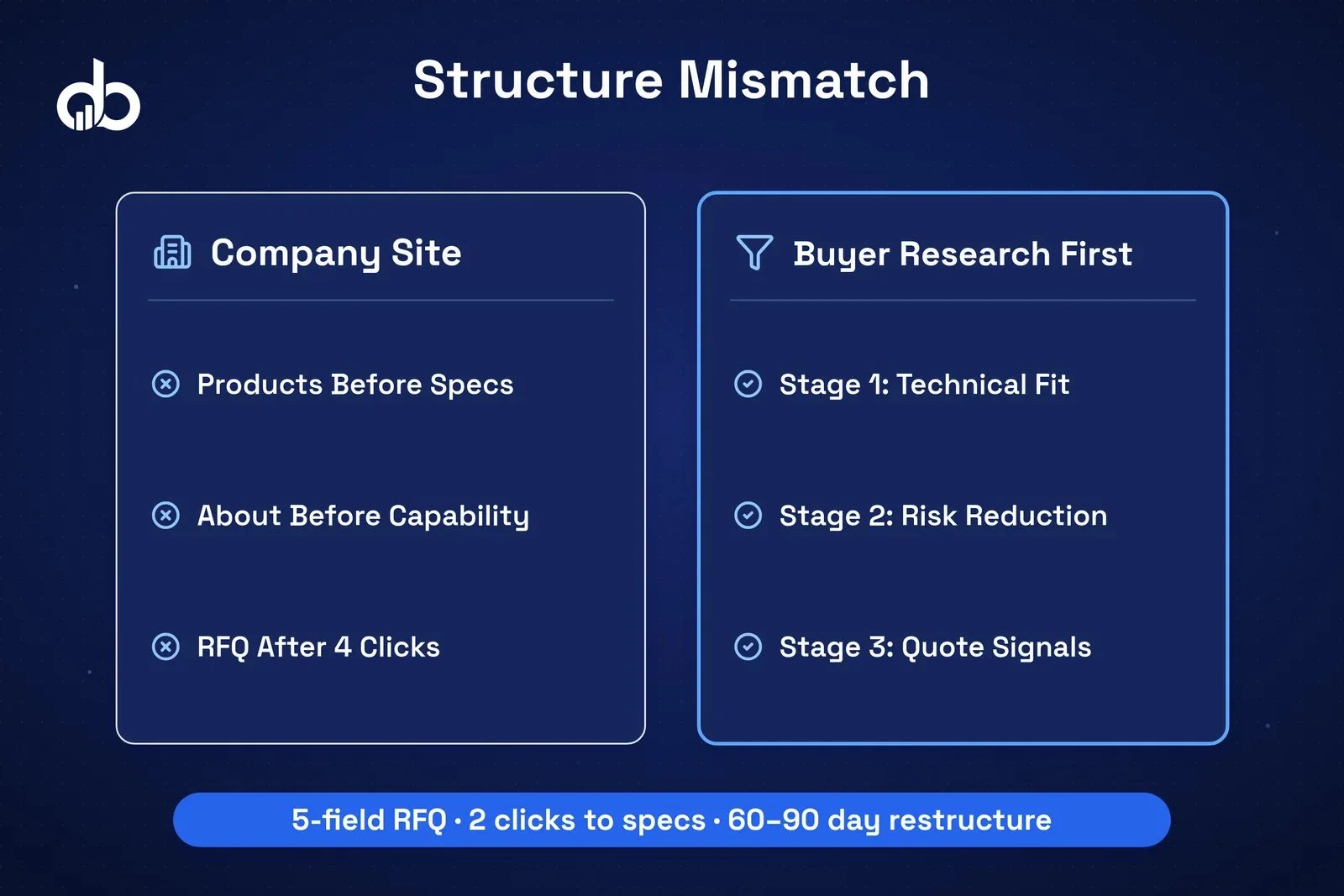
Open any manufacturing company website layout and you’ll find the same navigation structure: Products, Services, About, Industries, Contact. Sometimes the order shifts. Sometimes Industries comes before Products. The labels differ. The logic does not.
This structure is organized around how the company sees itself. It presents what the company makes, how it operates, and who it is. Then it asks buyers to get in touch. That sequence mirrors how a company would present itself in a sales meeting. It doesn’t mirror how a buyer researches a supplier.
Buyers don’t arrive on your site asking “what do you make?” They arrive with a specific drawing requirement or production volume in mind. They’re not at the beginning of their evaluation. Research from 6sense found that 81% of B2B buyers have a preferred vendor selected by the time they make first contact. Your site is not where they start. It’s where they confirm or disqualify.
The stakeholder complexity makes this structural mismatch more costly. Forrester’s 2024 State of Business Buying report found that an average of 13 stakeholders are involved in a complex B2B purchase. Each has different information needs. A design engineer needs tolerances and material data. A procurement manager needs certifications and lead times. A VP of Operations needs capacity, reliability records, and vendor risk signals. A standard manufacturing company website layout puts all of this inside a single “Products” section that serves none of these visitors well.
By the time a buyer reaches your site, they’ve completed 80% of their evaluation. Your website should serve the final 20%, the confirmation phase, not restart the process with a company overview.
Run this test on your own site. Search Google for the type of part or material your best customer buys. If your site doesn't appear, or if the page that appears doesn't answer "can you make this?", your capability confirmation layer is missing.
Are the right buyers finding the right content on your site? Our manufacturing web specialists map your content to buyer research stages and identify exactly what your site is missing before a prospect decides to request a quote. Get Free Marketing Audit
What Buyer Research Actually Looks Like at the Manufacturer Selection Stage
Before redesigning anything, it helps to understand what buyers are actually doing when they evaluate a manufacturer’s website. There are four specific validation criteria they apply, usually in this order.
Technical fit. Does your capability match what the buyer needs to produce? This is the first gate. Seventy percent of engineers say detailed product specs are the most important factor when evaluating a new supplier online. They’re checking tolerances, materials, processing capabilities, and equipment capacity against their drawing requirements. If this information is buried or missing, the evaluation ends before it starts.
Risk reduction. Is this a reliable, quality-certified supplier? After confirming technical fit, buyers assess your credibility. They look for ISO certifications, quality system documentation, customer references, and signals of operational stability. For procurement managers responsible for supply chain decisions, the risk assessment carries as much weight as the capability assessment.
Commercial viability. Can the buyer estimate cost and lead time before committing to an RFQ? Most buyers won’t submit a formal quote request without some signal that your pricing and lead times are in range. Sites that provide no commercial signals force buyers to make contact before they’re ready. Most don’t.
Buying committee support. Can the buyer share this information with the other 12 people involved in the decision? A procurement manager who is convinced you’re the right supplier still needs to bring the rest of the buying committee along. If your site’s content can’t be shared, printed, or forwarded in a useful format, you’re adding friction to the final stage of evaluation.
On a typical manufacturer’s website, this content surfaces after three to four clicks. Technical specifications sit on product sub-pages. Certifications live in a separate Quality section. Case studies, if they exist at all, appear in the Resources tab. A buyer trying to confirm all four criteria has to navigate across your entire site and assemble the picture themselves.
Map the average number of clicks required to find your ISO certification, your lead time range, and your most detailed spec sheet. If any takes more than two clicks from the homepage, a buyer mid-evaluation won't find it. They'll move to the next supplier.
The Buyer-Stage Content Architecture
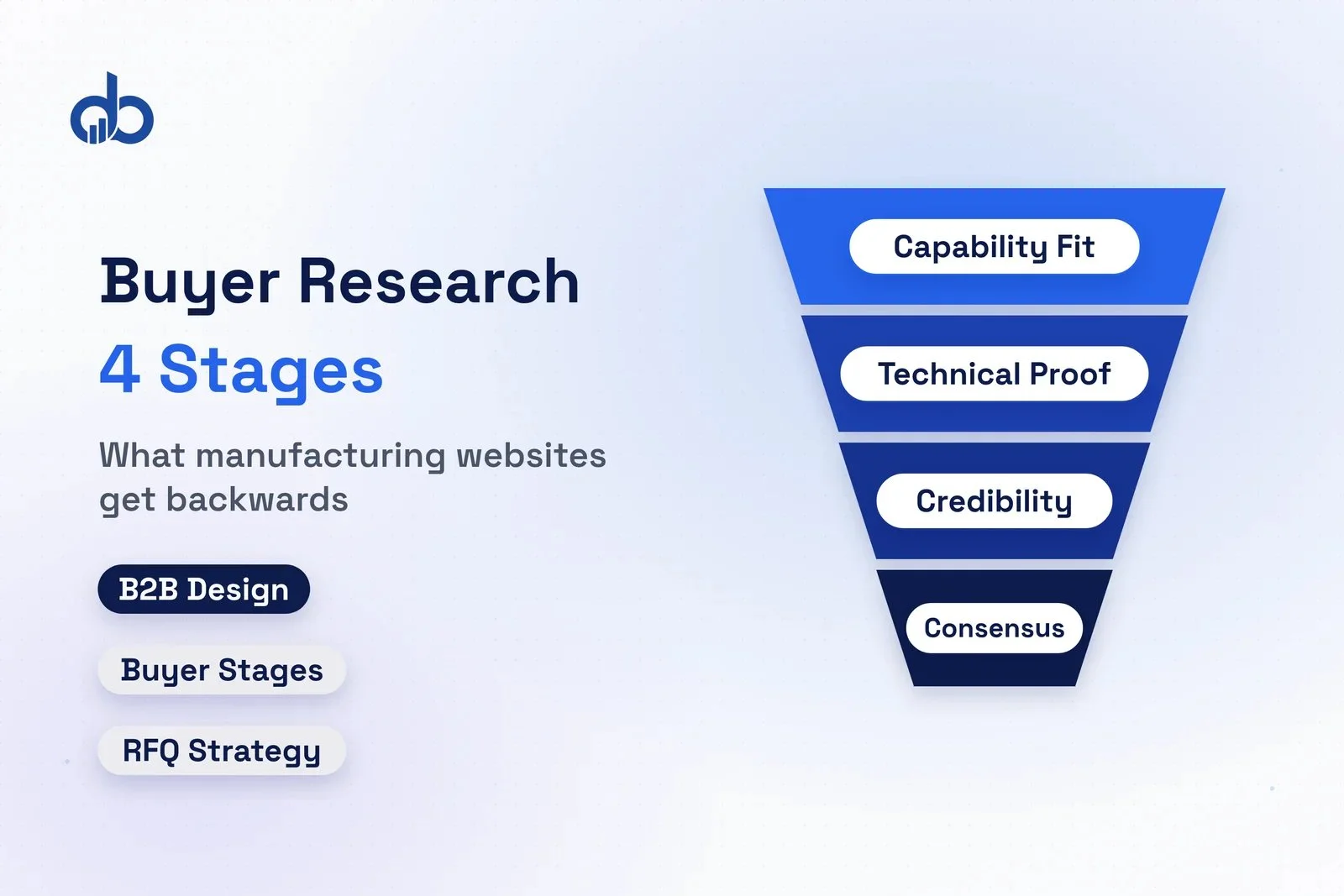
The alternative to organizing your site around company structure is organizing it around buyer research stages. The Buyer-Stage Content Architecture maps your site’s content to the four stages buyers move through when evaluating a new supplier.
Stage 1: Capability confirmation. The first page a buyer lands on should answer one question: “Can you make what I need?” Application-focused landing pages and industry-specific entry points answer it better than generic product pages. A page titled “CNC Machining for Aerospace Components” tells an aerospace buyer immediately that they’re in the right place. A page titled “CNC Machining Services” makes them hunt for that confirmation.
Stage 2: Technical validation. Once buyers confirm capability, they need to verify technical fit. This stage requires searchable spec tables, downloadable datasheets, tolerance ranges, material options, and equipment capacity data. This content should be two clicks from the homepage at most. In most manufacturing web setups, it takes four.
Stage 3: Credibility confirmation. Case studies with specific outcomes, not general descriptions of your quality culture, serve buyers at this stage. A case study that states the part type, production volume, tolerance achieved, and lead time gives buyers the evidence they need for their risk assessment. Quality certifications with scope statements (which standards, which facilities, which product categories) are more useful than a certification logo placed in the footer.
Stage 4: Consensus building. The final stage is about helping the internal champion make the case to the rest of the buying committee. This means content in a format that can be shared: printable capability summaries, email-friendly page layouts, and contact options beyond a form. Many buyers at this stage want to speak to someone, not submit a form and wait for a callback.
Use this as a self-audit for your current site. Take each major page and assign it to one of these four stages. Pages that don’t clearly serve any stage are creating noise rather than advancing the evaluation. Pages that serve Stage 3 content (company history, “About Us”) before Stages 1 and 2 are structured backwards relative to how buyers research.
And here’s the uncomfortable part: most manufacturing web design places Stage 3 content first, because that content is easiest to write. The result is a site that tells a compelling story about the company but fails to answer the questions buyers are actually asking.
What This Means for Manufacturing Marketing This Quarter
Restructuring a website for buyer research alignment doesn’t require a full redesign. Good manufacturing website design starts with three structural decisions and then works through the content implications of each.
Restructure navigation to lead with applications. Move Industries or Applications to the primary navigation position. Buyers search by application, not by your process. A navigation that leads with what you solve for specific industries matches how buyers arrive, not how your sales team has historically organized the pitch.
Run a content gap audit. Map every major page on your site to one of the four buyer research stages. Every page without a clear stage assignment is a candidate for redesign or removal. The goal isn’t more content. It’s content that appears in the right sequence.
Build stakeholder-specific paths. Engineers and procurement managers have different information needs from the same visit to a manufacturing company website layout. Separate entry points, or clearly differentiated page sections, serve both roles without forcing either to search for what they need.
Reduce your RFQ form. Five fields maximum: first name, last name, company, email, and a brief project description. The average manufacturer RFQ form has 12 fields. Buyers mid-evaluation don’t want to answer all of them before they know you can meet their spec.
Shift your measurement. Total website traffic isn’t the right metric for a site built to generate RFQs. Track RFQ conversion rate by traffic source. Which channels send visitors who convert to quote requests? That’s the metric that tells you whether your manufacturing web presence is working.
Common questions we hear on calls: “How long does a content restructure actually take?” Most manufacturers complete the navigation and landing page changes in 60 to 90 days. The variable is usually existing content quality. If your spec sheets and case studies are already strong, the restructure is mostly about organization. If you’re building technical validation content from scratch, add another 30 to 45 days.
“Do we need a full redesign to make these changes?” Not necessarily. The structural changes (navigation order, application-specific entry points, stakeholder paths) can often be implemented without a visual redesign. Start with the content architecture first. Once you can see which pages are converting visitors to RFQs, you have the data to decide where visual investment makes sense.
When Digiblazon’s Marketing Consulting team audits manufacturer websites against the four buyer research stages, the pattern is consistent. Sites that lead with Stage 3 content on their homepage generate fewer RFQ form submissions. The pattern holds whether that content is company history, leadership bios, or “why us” pages. Restructuring takes 60 to 90 days. The RFQ rate impact typically appears within 90 days of the new architecture going live. This is a structural rethink of how your site serves the people evaluating you before they ever make contact.
What You Now Know About Your Buyer Research Gap
You can now identify which buyer research stage your website serves and which ones it ignores. For most manufacturers, the gap is at Stage 1 and Stage 2. The site doesn’t make capability confirmation or technical validation easy, so buyers who could qualify you move on before they ever reach Stage 3.
Identifying the gap is the easy part. Restructuring navigation, building application-specific landing pages, and creating the technical validation content buyers need takes 60 to 90 days of focused work. That timeline gets shorter when you start with a clear audit of what you have and what you’re missing.
Digiblazon’s Marketing Consulting team runs that audit for manufacturers and builds the manufacturing website design that turns the evaluation phase into a conversion.
Ready to see which buyer research stage your website is missing? Get Free Marketing Audit
- 80% of the B2B buying journey is self-directed before buyers contact a vendor, so your website serves the final confirmation phase, not the introduction
- 81% of B2B buyers already have a preferred vendor selected by the time they make first contact, and 13 stakeholders on average are involved in a complex B2B purchase
- Buyers apply four validation criteria in order: technical fit, risk reduction, commercial viability, and buying committee support
- Most manufacturing websites lead with company-story content (Stage 3) instead of the capability confirmation and technical validation buyers need first (Stages 1 and 2)
- The Buyer-Stage Content Architecture maps site content to four stages: capability confirmation, technical validation, credibility confirmation, and consensus building
- Restructuring navigation and landing pages around buyer stages typically takes 60 to 90 days, with RFQ rate impact appearing within 90 days of launch
Frequently Asked Questions
What should a manufacturing company website include to generate RFQs?
Technical specifications, downloadable datasheets, clear capability statements, and a low-friction RFQ form are the baseline. But the bigger issue is organization: those elements need to map to how buyers research, not how your company is structured. A procurement manager and a design engineer arrive with different questions. Your navigation should serve both without making either dig.
Why do manufacturing websites fail to generate leads?
Most manufacturing websites are built to present the company rather than serve the buyer's research process. 80% of B2B buyers complete their evaluation before contacting a vendor. A site focused on company history arrives too late for the conversation. Buyers need to validate technical fit, assess supplier reliability, and understand pricing range before they're ready to request a quote.
How should manufacturing website content be organized for B2B buyers?
Organize around buyer research stages, not your internal structure. Early-stage visitors want problem recognition content: capabilities, industry applications, and proof that you understand their manufacturing context. Mid-stage visitors need technical validation: detailed specs, tolerances, certifications, and capacity. Late-stage buyers want supplier credibility: case studies with specific outcomes, lead times, quality systems, and a clear quote path. Most sites only serve one stage well.
What do engineers and procurement managers look for on a manufacturer's website?
Engineers prioritize technical specifications, materials data, tolerances, CAD files, and the ability to compare your capabilities against their drawing requirements. Procurement managers focus on certifications, quality systems, geographic coverage, capacity, lead times, and pricing signals. These are different information needs from the same visit. A manufacturing company website layout that conflates them into a single "Products" page serves neither group effectively.