
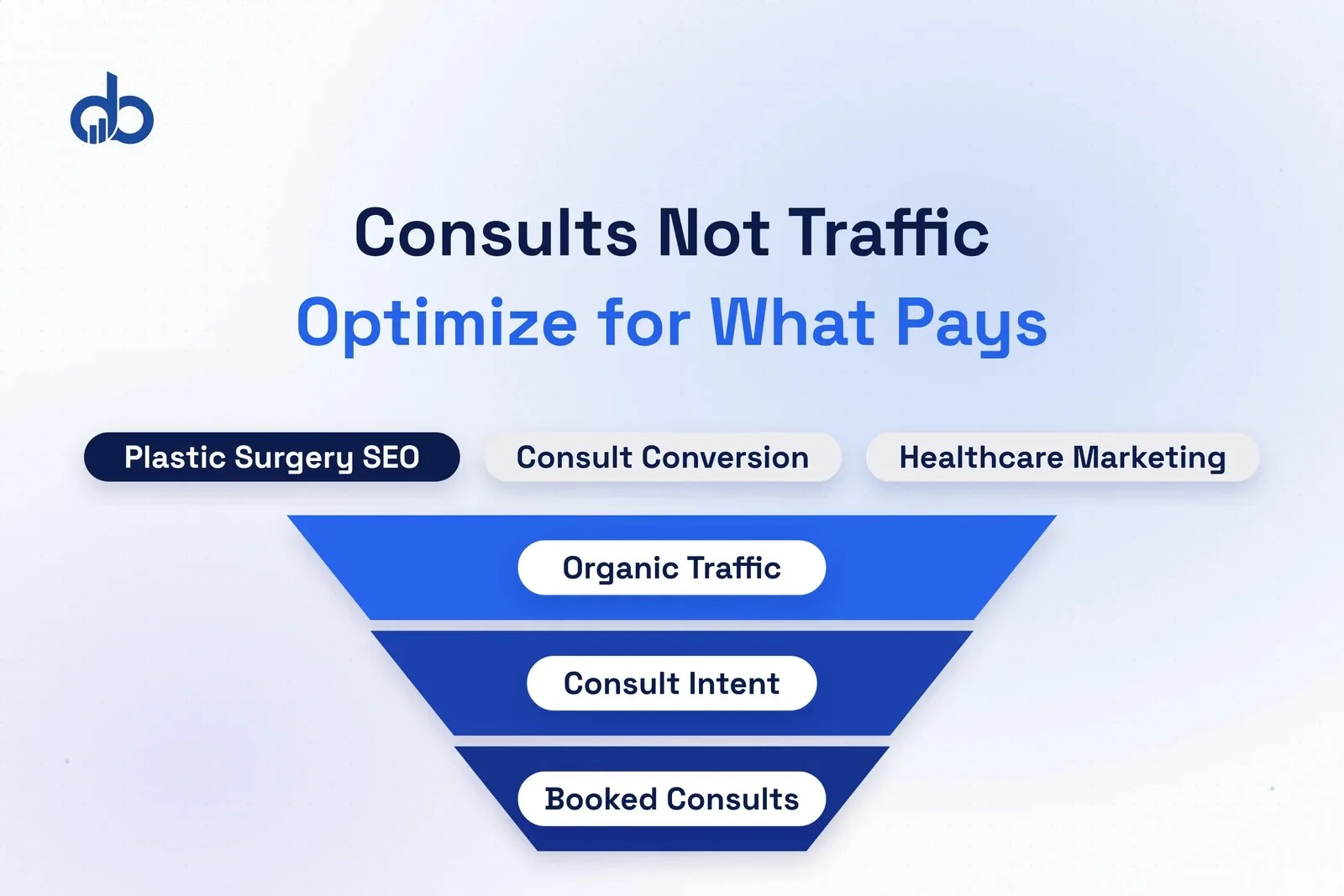
A plastic surgery practice in a mid-sized metro ranks page one for twelve procedure keywords. Monthly organic sessions: 8,000 and climbing. Their Google Business Profile sits at 4.5 stars with 140 reviews. Every month, the SEO agency sends a report full of green arrows.
The consultation calendar is flat.
Two quarters in a row, booked consultations haven’t moved. New patient inquiries trickle in. But the rankings report keeps improving, the traffic graph keeps climbing, and the agency’s retainer gets renewed because everything looks like it’s working.
That’s exactly how plastic surgery SEO fails practices without anyone noticing. Not until the practice owner does the math on what each consultation actually costs do the numbers stop adding up.
The Number That Exposes the Real Problem
Here’s the number that changes everything: the average cosmetic surgery website converts just 2.3% of its visitors into consultation requests.
Take a moment with that. It means 977 of every 1,000 people who arrive on a plastic surgery website through organic search leave without booking, calling, or taking any action that leads to a consultation. More than 97% of the traffic a plastic surgery SEO program works to generate simply disappears before it ever reaches the front desk.
Surgeons get more of their new patients through organic search than from paid ads, social media, or word of mouth combined. So the 2.3% figure isn’t just a conversion benchmark. It’s a description of where most of the investment in SEO for plastic surgeons currently goes.
Practices spend thousands of dollars a month on SEO. That investment generates organic traffic. The traffic converts at 2.3%. And the consultation calendar doesn’t move.
It’s not a traffic problem. Plenty of practices with modest organic volume are booking more consultations than competitors with twice the sessions. It’s a measurement problem. Programs designed to grow a practice are being evaluated on a metric that has almost no relationship to the one that actually determines whether the investment is working.
Why Traffic Metrics Fail Plastic Surgery Practices
Plastic surgery patients don’t book a consultation the week they first search for a procedure. Research consistently shows cosmetic surgery patients spend several months evaluating their options before contacting a single practice. They compare surgeon credentials, study before-and-after galleries, read about recovery timelines, and check pricing across multiple providers. Every step of that process generates organic traffic. Almost none of it represents someone ready to schedule.
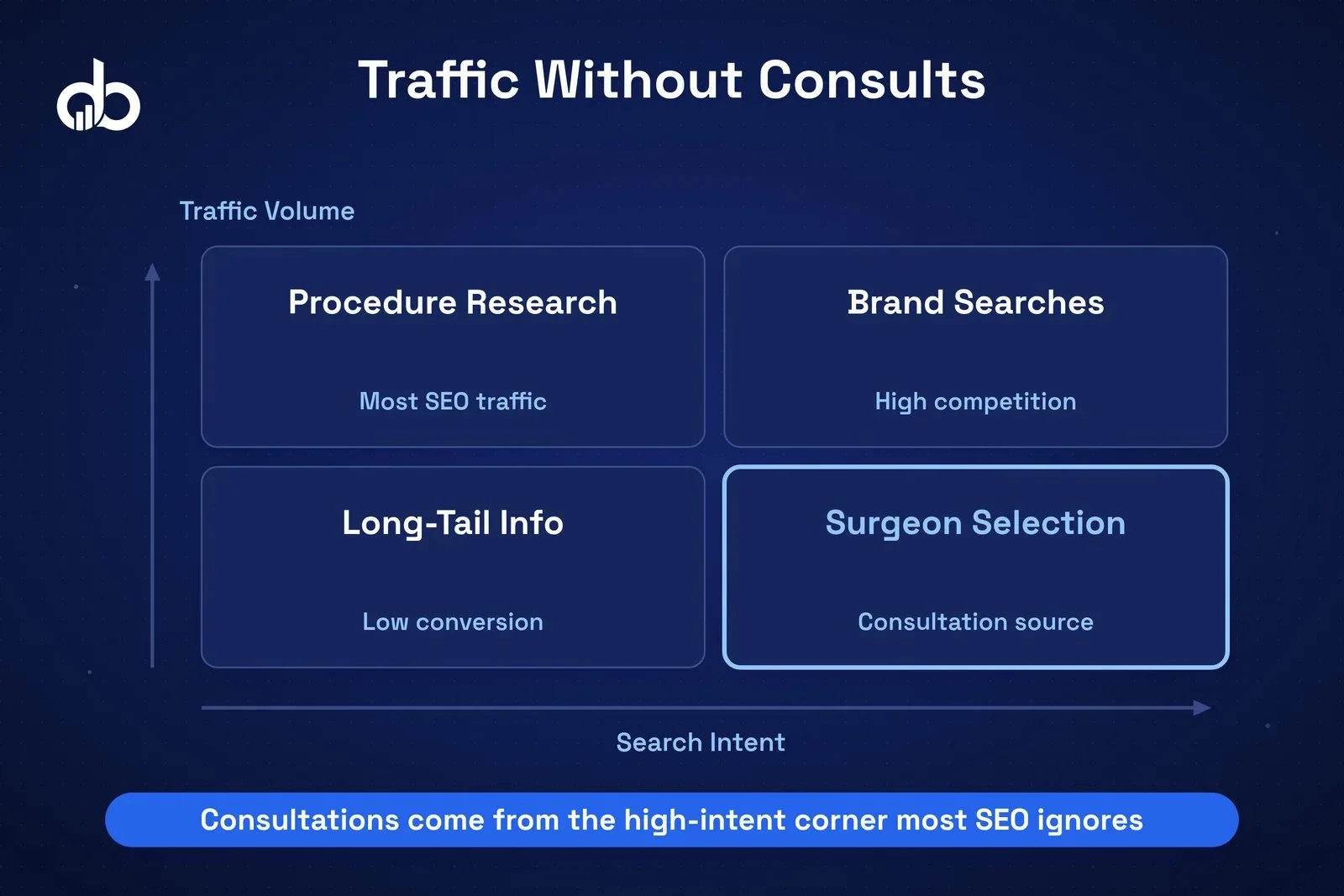
And the problem runs deeper than the research window. Most plastic surgery SEO programs are built around the keywords that carry the most search volume, and high-volume procedure keywords are almost always informational in nature. “What is a rhinoplasty,” “tummy tuck recovery time,” “blepharoplasty before and after.” Patients searching those terms are learning about procedures, not vetting a surgeon for a consultation. That traffic volume looks good in a report. Its value to a consultation calendar is close to zero.
When SEO for plastic surgeons gets evaluated on traffic and keyword rankings, the incentive structure naturally pushes toward keywords that produce the most sessions. Traffic follows informational intent. Consultations don’t. Clicks come in. Bookings don’t follow, and the agency reports that reach the practice owner never explain why.
What makes this failure particularly stubborn is that it’s structural, not tactical. Rankings, organic sessions, impressions, domain authority: these show up in agency reports because they’re easy to track and easy to show improving month over month. Booked consultations from organic search require actual conversion tracking and call attribution. So they don’t make it into most reports. What doesn’t get measured doesn’t get managed.
The Consult Conversion Lens: A Better Framework for Plastic Surgeon SEO
Think of the consult conversion lens as a single filter applied to every decision in a plastic surgeon SEO program: does this produce a visitor with consult-ready intent, and does this page convert that visitor into a booked consultation?
It doesn’t require different tactics. The same keyword research, content production, technical optimization, and link building that any plastic surgery SEO program uses still applies. What changes is the evaluation standard every decision gets measured against before resources get committed.
Run three common SEO decisions through that lens.
Keyword selection. “Rhinoplasty surgeon [city]” and “board-certified plastic surgeon [neighborhood]” signal geographic proximity and decision-stage readiness. Someone searching “rhinoplasty surgeon Chicago” isn’t learning what rhinoplasty is. They’re looking for a specific provider in a specific location. That’s consult-ready intent. “Rhinoplasty cost” or “rhinoplasty recovery time” carries the same procedure topic but a completely different intent stage. Both keywords attract organic traffic. Only one carries a realistic path to a booked consultation. A consult conversion lens picks the first category and treats the second as supplementary.
Content type. A procedure service page built with surgeon credentials, patient testimonials, a before-and-after gallery, and a direct call to request a consultation produces bookings. A 1,500-word educational blog about rhinoplasty recovery produces page views. Both contribute to SEO for plastic surgeons differently: service pages convert, educational content builds awareness. The lens doesn’t eliminate the blog. It ensures service pages get the conversion architecture, schema markup, and investment they need to turn visitors into consultation requests rather than bounce statistics.
Link building. Local citations, medical directory placements, and a fully optimized Google Business Profile drive local pack visibility. Local pack visibility attracts searches with strong geographic intent, and geographic intent is the closest available proxy for consult-ready intent that organic search produces. High-authority domain links help overall rankings broadly. The lens doesn’t ignore domain authority; it prioritizes the local signals that move the consultation needle directly, not just the traffic graph.
None of these are new tactics. The filter changes, not the toolbox.
What Consult-Centric Tracking Actually Looks Like
Most practices genuinely have no idea how many booked consultations came from organic search last month. That tracking gap is exactly what allows a traffic report to substitute for a performance report without anyone questioning it.
Consult-centric tracking for plastic surgery SEO requires two things that most agency setups skip. First: GA4 conversion events mapped to actual consultation form completions, not page views, not session duration, not legacy goal completions carried over from an old analytics property. When a patient submits a consultation request, that event fires in GA4 and gets attributed to the organic traffic source that brought them to the site. Without that configuration, the practice has no record of what drove the conversion.
Call tracking is the second piece. Most cosmetic surgery consultations get booked by phone, not through an online form. Without a tool like CallRail configured with organic source attribution rather than just total call volume, phone-booked consultations are invisible to digital measurement. A patient finds the practice through organic search, calls, and books. Nothing in the reporting captures where that patient came from. Multiply that across twelve months and the practice has spent significantly on SEO with no data to show whether any of it contributed to revenue.
With both tracking layers in place, a practice can calculate cost-per-booked-consultation from organic search and compare it directly against paid media, referral, and every other acquisition channel.
That’s what ROI looks like in plastic surgeon SEO. Not domain authority scores or impression counts or a running tally of page-one rankings. Cost per booked consult. Consultation volume from organic, month over month.
SEO retainers in the cosmetic surgery space run from $3,000 to more than $20,000 per month. At that investment level, a practice deserves to know the cost-per-booked-consultation from organic search. Any reporting structure that can’t produce that number isn’t measuring the right thing.
The Question Your Plastic Surgery SEO Company Should Answer
If your agency sends monthly reports full of ranking positions and traffic trends but can’t tell you how many booked consultations came from organic search in the past ninety days, you’re paying for rankings, not results.
One question is worth asking any plastic surgery SEO company you’re currently working with or evaluating: “How many consultation bookings in the last 90 days came from organic search?”
Can’t answer it? The metric isn’t being tracked. And if it’s not being tracked, the strategy isn’t being optimized for the only outcome that actually pays the practice.
Rankings are an input to the process. Booked consultations are the output. An agency that reports only on inputs has structured its accountability around something the practice doesn’t ultimately bill for.
This isn’t a claim that every agency in the space operates this way. Some programs do connect organic traffic to consultation data and optimize accordingly. But the dominance of traffic-and-rankings reporting in plastic surgery SEO strongly suggests most don’t. Practices that push for consult-level accountability tend to get it once they ask for it specifically. The ones that accept the traffic report never find out what they’re missing.
Unlike SEO for most service industries, SEO for plastic surgeons runs on a longer and more personal timeline. The purchase cycle is extended, the decision is high-consideration and elective, and the consultation is the only gateway to revenue. There’s no digital transaction. No subscription. No immediate purchase path. The booked consultation is the only conversion that matters, and the only number that tells a practice whether its SEO investment is actually generating revenue.
Is your practice measuring the right thing?
Digiblazon builds plastic surgery SEO programs around one metric: the booked consultation. We connect organic traffic to consultation bookings, calculate cost-per-booked-consult by channel, and report on the number that determines whether your SEO investment is generating revenue for your practice. Get a Free Marketing Audit
- The average cosmetic surgery website converts just 2.3% of organic visitors into consultation requests — 97% of traffic disappears without booking.
- High-volume procedure keywords carry informational intent, not consult-ready intent, making traffic volume a poor measure of plastic surgery SEO performance.
- The consult conversion lens filters every SEO decision around one question: does this produce a visitor likely to book a consultation?
- Accurate attribution requires both GA4 conversion events tied to consultation form completions and call tracking (e.g., CallRail) with organic source attribution.
- Cost-per-booked-consultation from organic search is the only ROI metric that tells a plastic surgery practice whether its SEO investment is working.
Frequently Asked Questions
What is the best SEO strategy for plastic surgeons?
The most effective plastic surgery SEO strategy is built around consult-ready intent at every layer: keywords that signal geographic proximity and decision-stage readiness, service pages designed to convert rather than inform, local citation and Google Business Profile optimization for local pack visibility, and conversion tracking that connects organic visitors to booked consultations. Traffic volume is not a useful proxy for strategy quality. Consultation bookings from organic search are the only metric that reflects whether a program is actually working.
How do you measure SEO success for a plastic surgery practice?
The right measure is cost-per-booked-consultation from organic search, alongside total consultation volume attributed to organic per month. Supporting metrics include local pack ranking position for high-intent geographic searches and conversion rate on service pages. Rankings and traffic volume are inputs. They don't tell you whether SEO is producing revenue. Practices that track consultation bookings by acquisition source can evaluate their SEO ROI with the same clarity they apply to paid search.
Why is plastic surgery SEO different from other medical SEO?
Cosmetic surgery is elective, high-consideration, and deeply personal. Patients spend several months researching before they contact a single practice. The consultation is the only gateway to revenue. No digital transaction, no subscription, no automatic purchase path exists. A plastic surgery SEO program that optimizes for traffic and rankings without conversion architecture designed to produce consultation requests will capture patients at the wrong intent stage and fail to convert them when they're finally ready to book. General medical SEO often serves patients making an urgency-driven or diagnosis-driven decision; cosmetic surgery SEO serves patients making an entirely discretionary one on their own timeline.
How long does plastic surgery SEO take to produce consultations?
A well-structured program targeting local, high-intent procedure searches typically produces measurable consultation-level results within four to six months. Programs targeting only high-volume informational keywords may show strong traffic growth within the same window and produce almost no consultation bookings. The determining factor is keyword selection and page conversion architecture, not SEO investment level or timeline alone. Local procedure-specific searches paired with conversion-optimized service pages produce consultation results faster than high-volume content that builds awareness without converting it.
What's a good conversion rate for a plastic surgery website?
The industry average is 2.3%, meaning 977 of every 1,000 organic visitors leave without booking a consultation. A well-optimized cosmetic surgery website with strong service page architecture, clear consultation calls-to-action, patient social proof, and low-friction request forms can realistically reach 4% to 6% conversion on targeted, intent-matched traffic. Closing the gap between 2.3% and a higher number doesn't require more traffic. It requires better conversion architecture and a deliberate focus on bringing in visitors with consult-ready intent rather than informational browsing intent.