
Here’s something the data keeps confirming: businesses with half the budget regularly outperform businesses with ten times the spend on Google Ads. Not because PPC favors small accounts. Because one group runs campaigns based on PPC facts, and the other runs them based on PPC advertising myths.
The myths aren’t obscure. Most business owners running Google Ads have heard them stated as fact: you need a big budget to compete, more keywords mean more reach, the top ad position is always the goal, and a high click-through rate means the campaign is working. These beliefs feel logical. They’re also responsible for more wasted ad spend than poor keyword selection or bad ad copy combined.
What makes PPC misconceptions dangerous isn’t that they’re completely wrong. It’s that they contain enough surface logic to survive scrutiny. You do need to bid to appear. Keywords do determine who sees your ads. Position one does get the most clicks. But each of those statements is missing a mechanism. That mechanism is where the money goes.
This article goes past the surface. It explains why each myth persists, what the PPC facts actually show, and gives you a framework for evaluating any PPC decision before it becomes an expensive assumption.
The Conventional Wisdom
To debunk PPC advertising myths properly, start by acknowledging why people believe them. These aren’t irrational beliefs. They’re the natural conclusions a business owner reaches before seeing campaign-level data.
The budget myth: If a competitor is spending $50,000 a month on Google Ads and you’re spending $3,000, logic says they’ll dominate the results. More spend means more bids. More bids mean more visibility.
The keyword myth: PPC is a keyword-driven channel. More keywords mean more search terms you can appear for. More coverage should produce more customers. The math seems to hold.
The position myth: Position one gets the most impressions and the most clicks. Google reports the click-through rate for position one is significantly higher than positions two through five. If CTR matters, position one should be the target.
The CTR myth: Click-through rate is the most visible performance metric in Google Ads. A campaign with 9% CTR looks healthier than one with 3% CTR. Higher engagement looks like a working campaign.
The set-and-forget myth: You’ve done the hard work: keyword research, ad copy, bid strategy, landing pages. Once the campaign is live and generating clicks, the system should self-optimize. Google’s Smart Bidding learns over time. Frequent intervention might disrupt the learning.
Each of these beliefs has internal logic. That’s what makes them persistent. And that’s what makes them worth examining one at a time.
Where It Breaks Down
The problem with each of these PPC misconceptions is not that they’re entirely false. It’s that they optimize for the wrong variable. Here’s where each one actually breaks down.
The budget myth breaks down at Quality Score.
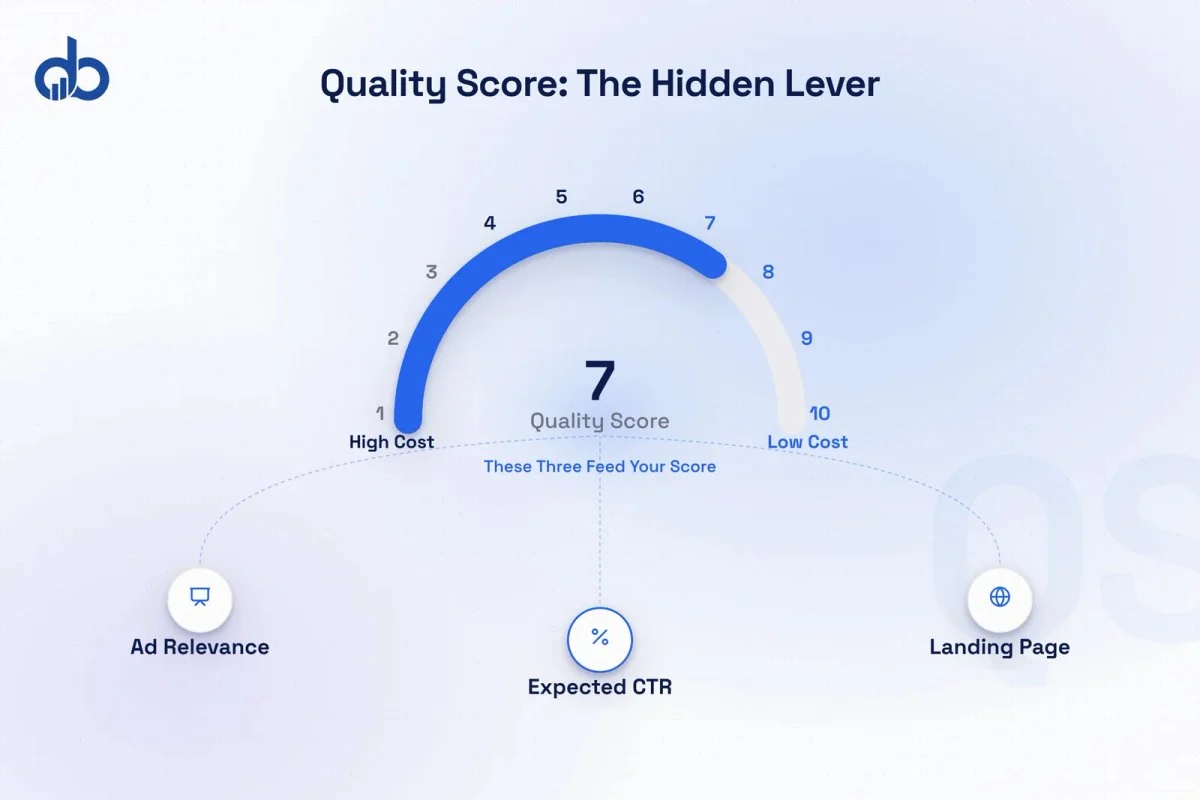
Google doesn’t sell ad positions like auction slots where the highest bid always wins. The system combines your bid with your Quality Score (QS) to produce an Ad Rank. Quality Score rates ad relevance, expected click-through rate, and landing page experience on a scale of 1 to 10.
The cost difference is significant. Adalysis research across 15,000+ accounts found that Quality Score 1-3 costs up to 400% more per click than the QS 5-7 baseline, and Quality Score 10 delivers up to a 50% CPC discount. An SMB running a tight campaign at QS 7-8 can pay less per click than a large competitor at QS 3-4, even if that competitor bids twice as much.
Budget size matters. It’s just not the primary variable.
The keyword myth breaks down at ad group structure.
More keywords in a single ad group means more variations of search intent that the ad copy has to address. Ad copy can’t simultaneously be relevant to someone searching “affordable dental implants,” “emergency dental care,” and “dental insurance options.” The broader the keyword mix, the weaker the relevance signal.
When relevance weakens, Quality Score drops. When Quality Score drops, CPC rises. When CPC rises, the budget runs out faster on lower-intent clicks. The result is a large keyword list that costs more and converts less than a tight, focused one.
High-performing SMB campaigns typically group 5-8 tightly themed keywords per ad group with dedicated ad copy for each theme. Not hundreds of keywords across three ad groups.
The position myth breaks down at intent.
Position one does get the most clicks. But not all clicks carry the same intent. Users who scroll past the first ad often read more carefully before clicking. For many non-branded service searches, positions 2-4 produce higher conversion rates than position 1 because those users have already self-selected past the first option.
Bidding aggressively for position one on competitive terms raises CPCs significantly. A campaign targeting position 2 on a $50 CPC keyword spends less per conversion than one targeting position 1 at $80 CPC, even if the conversion rate dips slightly.
The CTR myth breaks down at conversion intent.
Click-through rate measures whether your ad got clicked. It doesn’t measure whether the click was worth paying for. A CTR of 9% on keywords with low purchase intent means you’re paying for nine unqualified visitors for every 100 impressions. A CTR of 3% on high-intent keywords close to a buying decision is more valuable.
The metric that replaces CTR as a performance signal is cost per acquisition (CPA). A campaign with 3% CTR and 8% conversion rate produces a lower CPA than one with 9% CTR and 1% conversion rate. CPA maps to revenue. CTR doesn’t.
The set-and-forget myth breaks down at match type drift.
Smart Bidding does learn over time. What it learns is shaped by the signals it receives. One of those signals is the search terms triggering your ads. Without regular negative keyword reviews, broad match keywords expand to serve ads for search terms you never intended to target.
Monthly search term audits are how campaigns stay on track. They’re also where you discover that a significant portion of your budget is going to irrelevant queries, the kind that look valid in the keyword list but pull in off-target traffic.
Is your Google Ads campaign optimizing for the wrong metrics? Get a Free Marketing Audit
What the Data Actually Shows
The most persistent PPC advertising myths survive because Google’s reporting interface reinforces them. Impressions, clicks, and CTR are front-and-center. Conversion rate, Quality Score breakdown, and CPA require digging. Most Google Ads myths about budget and position look valid until you see the conversion data sitting behind the click data.
Here are the PPC facts that change the picture.
On conversion rates: The average Google Ads conversion rate across all industries was 6.96% in 2024, according to WordStream’s benchmark research. The 2025 figure is 7.52%. The key word is “average.” Accounts structured around intent-matched ad groups and relevant landing pages consistently sit above this. Accounts built around keyword volume consistently sit below it.
On Quality Score economics: Adalysis 2024 data shows moving a keyword from QS 3 to QS 6 roughly halves its CPC. On a keyword with a $10 CPC at QS 3, that brings the cost down to about $5. On a campaign spending $5,000 a month, the same structural improvement produces the equivalent impact of doubling the budget. No extra spend required.
On position: LocaliQ’s 2026 search advertising benchmark data shows position-one CPCs in competitive industries like legal services and home improvement run $8-10 per click. Positions 2-3 average 25-40% less. For SMB campaigns where every click needs to justify itself, position efficiency matters more than position dominance.
On campaign scale: The relationship between ad spend and results is structural, not linear. A $3,000/month account with clean structure, tight ad groups, and relevant landing pages routinely outperforms a $30,000 account spread across too many campaigns, too many keywords, and too many targets. This doesn’t show up as a published study. It shows up in account audits, and it shows up consistently.
This is what these common Google Ads myths miss: the mechanism. Knowing “high CTR isn’t everything” doesn’t change how you build a campaign. Understanding that CTR without CPA data is an incomplete signal does. These are the PPC facts that most SMBs only discover after wasting three months of budget.
A Better Framework
Most PPC marketing guides offer a list of tactics. A tactic fixes a symptom. A framework fixes the thinking that produces the symptom. And for this topic, the thinking is where the problem lives.
The framework that addresses all five myths above is built around three inputs. Call it the IQS Framework: Intent, Quality, Structure.
Intent (not keyword volume)
The starting question for any PPC campaign isn’t “which keywords should I target?” It’s “what does this person want to do right now, and am I the right answer?” A search for “plumber near me” and a search for “how much does a plumber cost” come from different intent states. One is ready to book. One is researching. Running the same ad to both wastes spend on the researcher and undersells to the buyer.
Intent-first campaign design starts with the customer decision journey and works backward to the keywords that map to each stage. Fewer keywords. Tighter ad groups. Significantly higher relevance at each stage.
Quality (the ROI lever that doesn’t require more budget)
Quality Score is the single most accessible ROI lever in any Google Ads account. It rewards relevance: ad relevance to the keyword, landing page relevance to the ad, expected CTR based on historical performance. All three are controllable.
Every account review that starts with Quality Score rather than click volume finds the same pattern. Low-QS keywords consume disproportionate budget for disproportionately low conversions. Fixing those keywords (whether through tighter ad copy, better landing page alignment, or removing them entirely) improves campaign performance without adding a dollar to the budget.
Structure (what the algorithm actually needs)
Smart Bidding is a powerful tool. It’s also entirely dependent on the structure you build around it. An ad group with mixed intent signals gives the algorithm mixed data. An ad group with 200 keywords spanning three different buying stages gives the algorithm nothing useful to learn from.
Clean structure means: one theme per ad group, ad copy that directly addresses that theme, a landing page that directly addresses that theme, and negative keywords that exclude anything that doesn’t fit. The algorithm then has clean signal to work with. It learns faster, spends more efficiently, and produces better conversion data for future optimization.
The IQS Framework isn’t a startup checklist. It’s the diagnostic every underperforming PPC campaign needs. Most SMB campaigns stall not because PPC doesn’t work for small businesses, but because one or more of these three inputs is broken.
What This Means for Your PPC Campaigns
Correcting PPC misconceptions in theory is straightforward. Applying them to an existing campaign takes a specific sequence.
Audit before you add budget
The most common response to an underperforming PPC campaign is increasing spend. If the underlying structure is weak (low Quality Scores, mixed intent per ad group, mismatch between ad copy and landing pages), more budget accelerates the waste. Every budget increase decision should be preceded by a structural audit.
Restructure before you optimize
Optimization tactics like bid adjustments, A/B testing ad copy, and tweaking target CPA produce marginal gains when the underlying structure is wrong. Ad copy testing on a low-QS ad group doesn’t fix the relevance problem. Restructuring the ad group does. Structure is the prerequisite. Optimization comes after.
Read the right metrics from day one
Build your reporting dashboard around CPA, ROAS, Quality Score, and conversion rate, not CTR and impressions. Google’s default interface surfaces the engagement metrics because they look good. The conversion metrics require a few extra clicks. Make those clicks a weekly habit.
Give campaigns time, but not blind time
The 60-90 day learning phase for Smart Bidding is real. Conversion data accumulates over weeks, not days, and algorithms need that volume to optimize reliably. But “giving a campaign time” is not the same as not reviewing it. Weekly search term reports and negative keyword additions are non-negotiable throughout the learning phase. They don’t disrupt learning. They improve the quality of data the algorithm learns from.
Most campaigns described as “PPC doesn’t work for my business” turn out to be campaigns built on one or more of the five PPC advertising myths above. The platform isn’t the problem. The model is. If your account was built by an agency you’re no longer confident in, it’s also worth reading how to choose the right PPC agency before making the next move.
Ready to find out which PPC misconceptions are affecting your account? Request a Proposal
Stop Managing PPC by Myth
You can now identify the mechanism behind each of the five myths, which means you can catch them before they shape a campaign decision. The practical step is harder: diagnosing which belief is currently driving your own campaigns and restructuring accordingly.
Digiblazon’s Performance Marketing service is built for exactly this. Audits that surface where PPC misconceptions have driven structure and spending decisions, followed by rebuild work grounded in the data. If you want to see what’s actually costing you budget, a free audit is the right starting point.
Stop guessing and start optimizing. Get a Free Marketing Audit
- Budget size alone doesn't determine PPC success: Quality Score controls your cost per click more than bid amount, with QS differences creating up to 400% variance in CPC.
- Broad keyword lists weaken ad relevance; tightly themed ad groups with 5-8 keywords per group convert better and cost less than campaigns with hundreds of mixed-intent keywords.
- Position one is not always the best ROI target: positions 2-4 often deliver higher conversion rates at 25-40% lower cost in competitive industries.
- Click-through rate is a misleading standalone metric; Cost Per Acquisition (CPA) is the true measure of whether a campaign is actually working.
- Smart Bidding requires clean campaign structure and regular negative keyword reviews to learn efficiently. Set-and-forget campaigns drift toward irrelevant traffic over time.
Frequently Asked Questions
Does PPC work for small businesses?
Yes, and often better than larger competitors when campaigns are structured correctly. Quality Score rewards relevance, not budget size. A tight, well-structured campaign with a $1,500/month budget routinely outperforms a $15,000 bloated campaign targeting the wrong keywords.
How long does PPC take to work?
Most campaigns need 60-90 days to exit the learning phase and gather enough conversion data for Smart Bidding to optimize reliably. Immediate clicks happen from day one, but meaningful ROI optimization typically kicks in after the first conversion baseline is established.
Is a high CTR always good in PPC?
No. A high CTR on the wrong keywords or a mismatched landing page means you're paying for unqualified clicks. The metric that matters is conversion rate, not CTR in isolation. Many campaigns with 3-4% CTR outperform those with 8-10% CTR when the intent match is better.
Do more keywords mean better PPC results?
The opposite is often true. Broad, unfocused keyword lists dilute Quality Score, increase average CPC, and send irrelevant traffic to your landing pages. High-performing SMB campaigns typically have 5-8 tightly grouped keywords per ad group, not hundreds.