
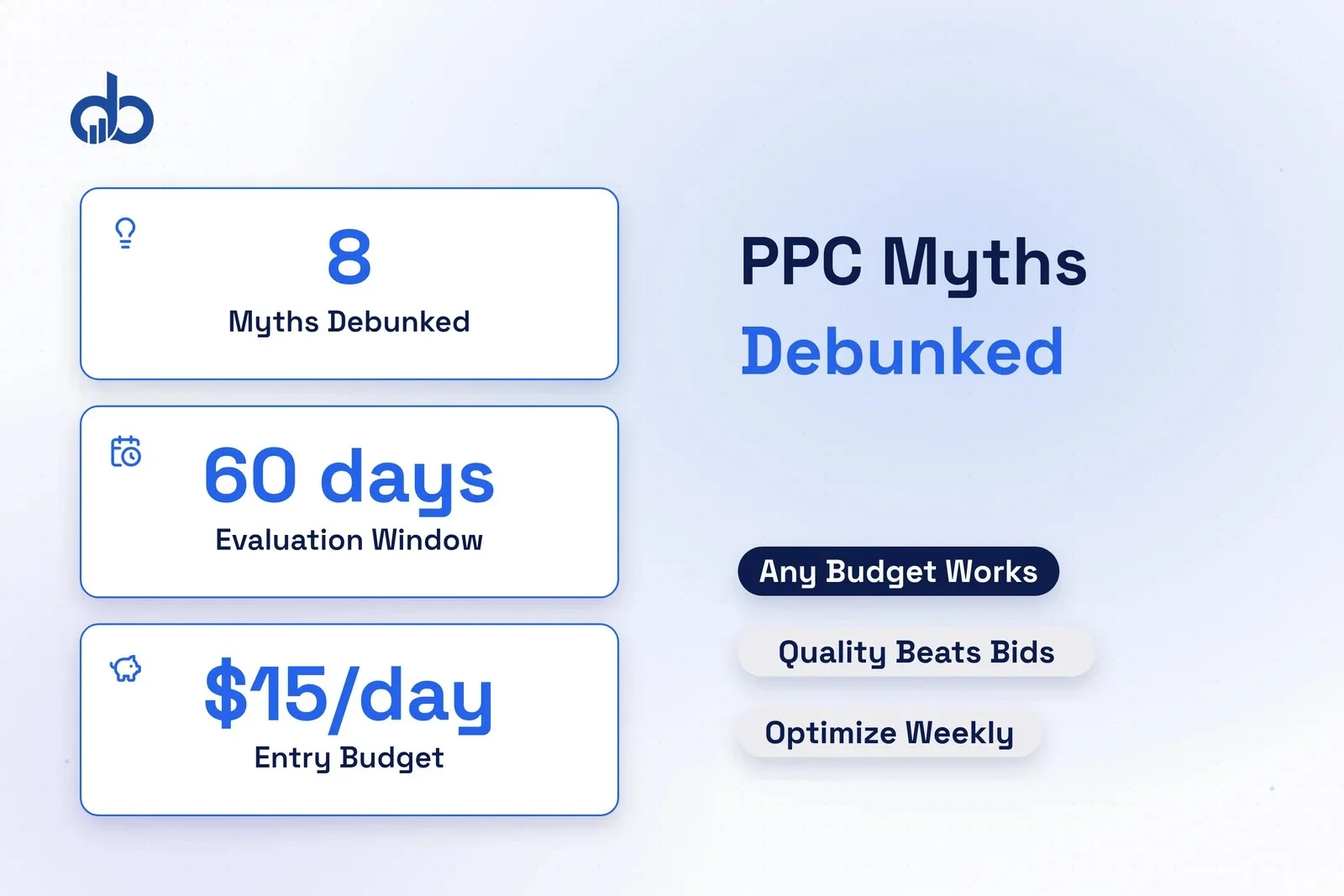
Most businesses that avoid PPC campaigns do so based on myths they’ve heard from someone who heard them from someone else. PPC is too expensive. It only works for big brands. You need to be a Google Ads expert just to get started. These beliefs are common, they’re understandable, and they’re costing businesses real money in missed digital marketing opportunities.
What’s less commonly said: the most damaging PPC campaign myths aren’t the ones that stop businesses from starting. They’re the ones that cause businesses to underperform after they’ve already invested. Set-it-and-forget-it thinking. Click volume as a success metric. The assumption that higher bids always win. These operational myths erode ROI quietly, campaign by campaign.
This guide breaks down eight PPC campaign myths one by one and replaces each with what the data and day-to-day PPC campaign management actually show.
Myth 1: PPC Is Too Expensive for Small Businesses
The Myth: Pay-per-click advertising requires a massive budget. Only large brands with deep pockets can afford to run PPC campaigns.
The Reality: PPC is one of the most budget-flexible advertising channels available to any business. Unlike traditional media where you pay a fixed rate regardless of results, pay-per-click advertising charges only when someone clicks. You control the daily maximum spend. You can pause, adjust, or scale campaigns in real time.
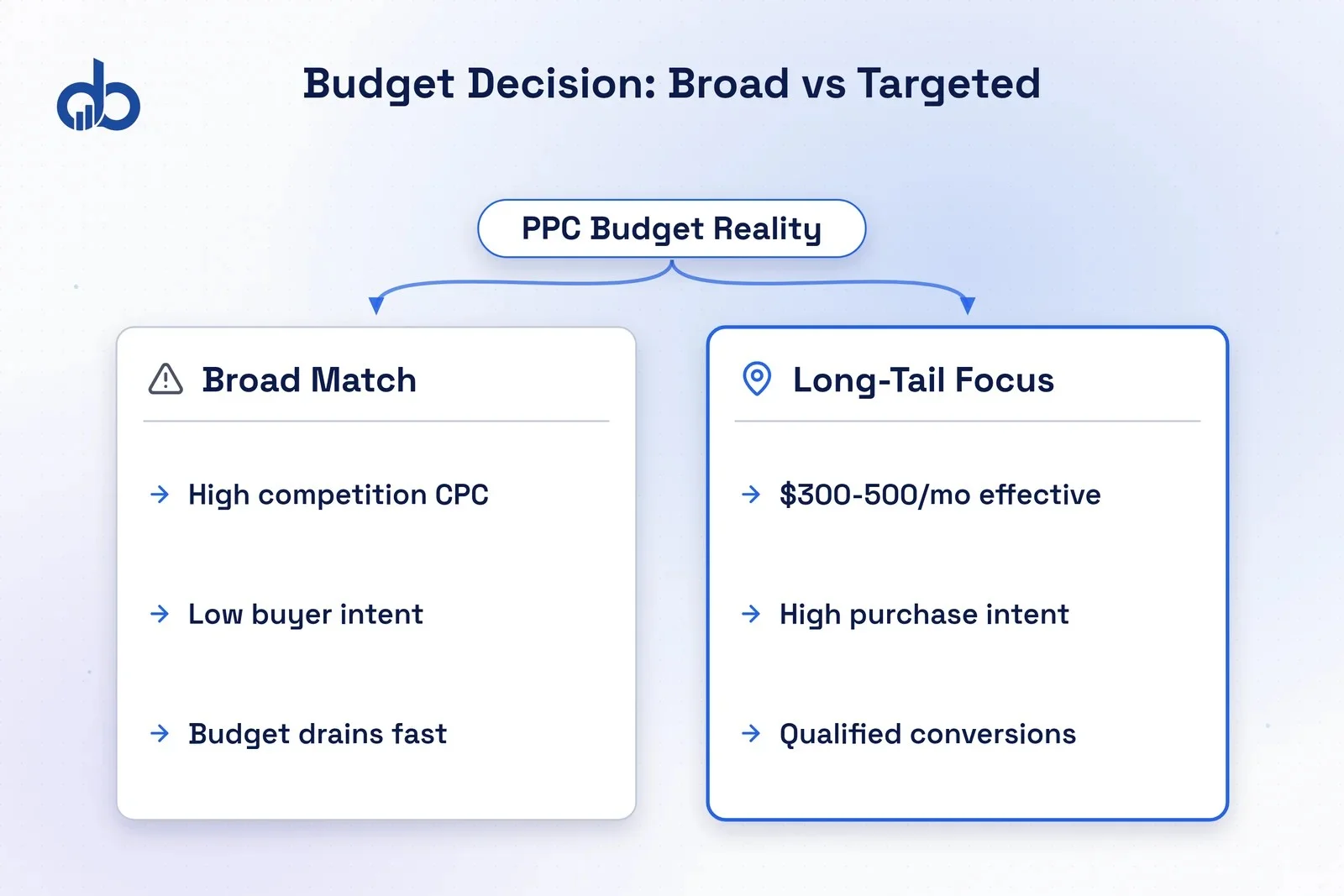
Small businesses run effective Google Ads campaigns with budgets of $300-500 per month by targeting the right keywords. The average cost per click across all industries on Google Ads was $5.26 in 2025. That means even a $15/day budget produces meaningful traffic when it’s qualified.
The real cost driver in PPC isn’t the platform. It’s poor keyword selection. A small business bidding on broad, high-competition terms will burn through budget without converting. The same business targeting 5-10 specific long-tail keywords with clear purchase intent spends less per click and converts at a higher rate.
Start with 3-5 high-intent keywords that match what buyers search for right before making a decision. "Accountant for small business in Denver" costs far less per click than "accountant" and converts at a fraction of the rate. PPC rewards precision, not just spending power.
Myth 2: PPC Only Works for Large Corporations
The Myth: Big brands dominate Google Ads. Small businesses can’t compete against corporations with marketing teams and million-dollar budgets.
The Reality: Google’s ad auction isn’t purely a budget war. Ad Rank, the system that determines which ads appear and in what order, combines bid amount with Quality Score. Quality Score measures how relevant your ad is to the searcher’s intent, based on expected click-through rate, ad relevance, and landing page experience.
A well-structured PPC campaign from a small business with a Quality Score of 9 can outrank a large corporation bidding three times as much but showing a generic, poorly targeted ad. This isn’t a theoretical scenario. It happens in competitive auctions every day.
Small businesses also have a natural advantage that large corporations rarely exploit: geography and specificity. A regional service business targeting city-specific keywords, neighborhood terms, and local purchase intent phrases operates in a part of the search landscape where national brands have minimal ad investment. The competitive pressure is lower. The cost per click is lower. The conversion relevance is higher.
Identify where your target customers search in ways that large brands don't address. Long-tail keywords, local qualifiers, and industry-specific terminology are often underpriced in the auction and directly relevant to your buyers.
Myth 3: More Clicks Mean More Conversions
The Myth: The more clicks your PPC campaigns generate, the better the results. High CTR equals campaign success.
The Reality: Clicks are a cost, not an outcome. A campaign optimized purely for click volume will generate traffic. Whether that traffic converts depends entirely on how well the click intent aligns with what the landing page offers.
Think about it: a PPC campaign showing a broad ad for “marketing software” to anyone who types those words will generate clicks from students researching a class project, job seekers looking for marketing tools, and competitors checking your pricing. None of those clicks will convert. All of them cost money.
Google Ads conversion rates averaged 7.52% across all industries in 2025. The top 10% of campaigns achieved 11.45% or higher. The difference between a 7% conversion rate and an 11% conversion rate isn’t more clicks. It’s better targeting: precise keyword match types, strong negative keyword lists, and ads that speak directly to buyer intent rather than general interest.
Click-through rate is a useful diagnostic metric. It tells you whether your ad copy is resonating with searchers. But CTR by itself says nothing about whether those searchers were the right people to click in the first place.
Review your search terms report weekly. Every search query that triggered your ad but didn't align with buyer intent is a candidate for your negative keyword list. Reducing irrelevant traffic is how PPC optimization actually improves ROI, not by increasing total clicks.
Myth 4: Once You Set Up Your PPC Campaigns, They Run Themselves
The Myth: Launch your campaign, let Google’s algorithm handle the optimization, and check back in a few months to see the results.
The Reality: This is the most expensive PPC campaign myth on this list. And it’s the one most likely to cause businesses to conclude that PPC doesn’t work.
PPC campaigns aren’t static assets. They operate in a dynamic environment where competitor bids shift daily, search trends evolve by season, ad creative fatigue sets in within weeks, and the algorithm’s optimization depends on continuous signal input from your campaign data. A campaign left unattended for 90 days in this environment isn’t holding steady. It’s drifting toward higher spend and lower returns.
Active PPC optimization consistently outperforms passive management. Conversion rates improved for 65% of industries in WordStream’s 2025 benchmarks (15 of the 23 industries it tracked). As LocaliQ’s Cliff Sizemore puts it in the same report, a smart strategy beats cheap clicks.
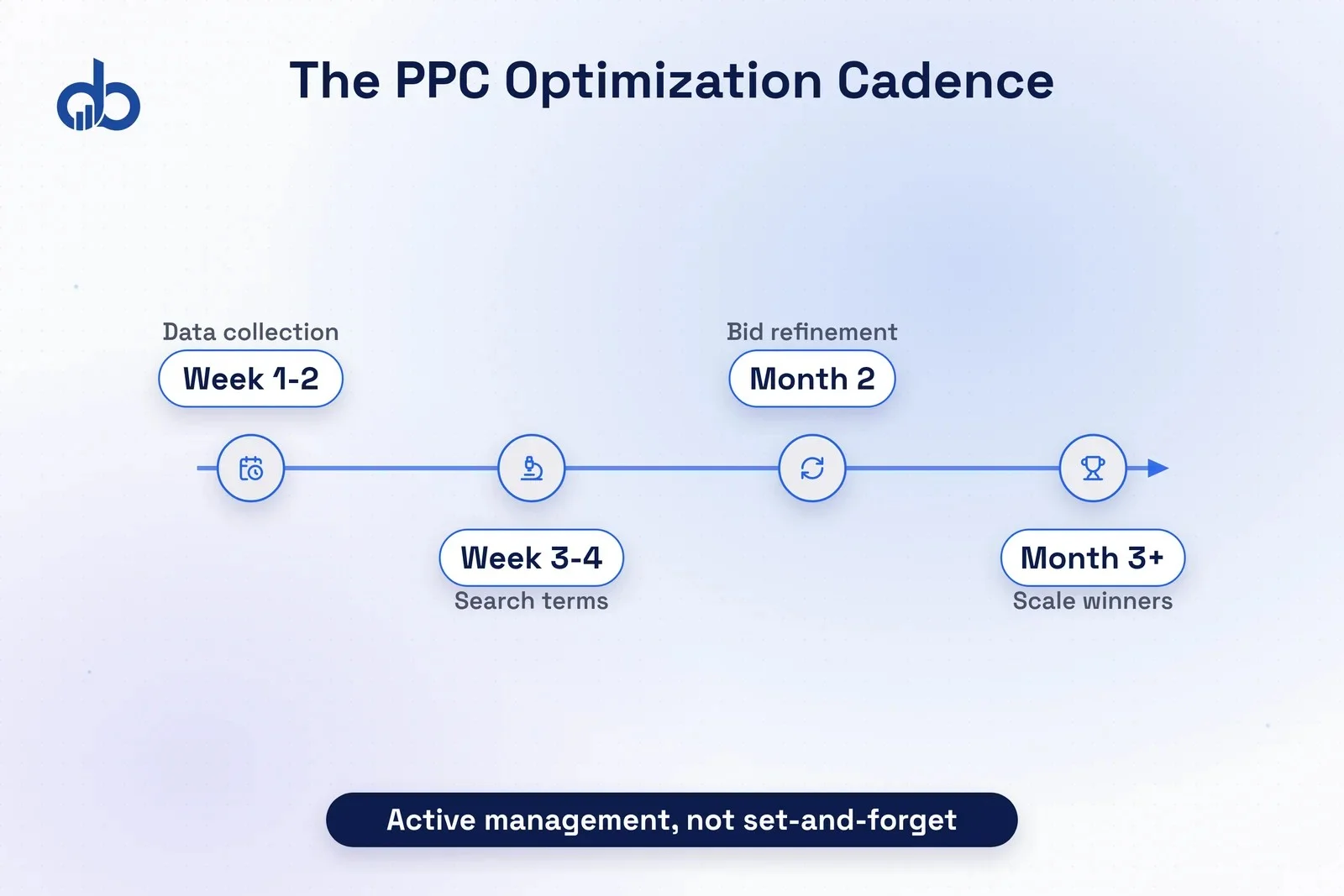
The minimum viable cadence for PPC campaign management: review the search terms report weekly, test one new ad copy variant per month, and audit bid adjustments for underperforming keywords every two to four weeks.
If you can't commit to weekly campaign management, either partner with a PPC specialist or reduce your budget to a level where passive management drift is acceptable while you build operational capacity. Running PPC on autopilot at high spend is exactly the scenario that produces the horror stories people share about wasted ad spend.
Myth 5: PPC Delivers Instant Results
The Myth: Run pay-per-click advertising and see leads or sales within days of launch.
The Reality: PPC does produce results faster than SEO. That’s a genuine advantage. But fast isn’t the same as instant, and confusing the two leads businesses to abandon campaigns before they’ve generated enough data to be properly evaluated.
Google’s Smart Bidding strategies, including Target CPA and Target ROAS, require historical conversion data to optimize delivery. Google recommends at least 30 conversions in the past 30 days before switching to Target CPA, and Target ROAS needs more data still. A new campaign running for two weeks hasn’t hit that threshold. Pausing it for underperformance at that point is one of the most common and most avoidable PPC mistakes.
The first 30 days of a new campaign are a data collection phase. Impressions, click-through rates, and early conversion signals tell you which keywords and ads have potential. That ceiling becomes visible between weeks 6 and 12, when enough optimization cycles have run to refine targeting, improve Quality Scores, and identify the highest-value search intent segments.
Set 60-day evaluation benchmarks for new campaigns, not 14-day ones. Define what "working" means in advance: cost per lead targets, minimum conversion volume, acceptable ROAS range. Measure against those benchmarks, not against an expectation of immediate results.
Myth 6: Higher Bids Always Win Better Ad Placement
The Myth: If you want to appear at the top of Google’s search results, you need to outbid your competitors. More budget equals better placement.
The Reality: Google’s Ad Rank formula combines bid amount with Quality Score. Quality Score is a composite of three factors: expected click-through rate, ad relevance to the search query, and landing page experience. A lower bid paired with a high Quality Score regularly outranks a higher bid with poor ad relevance.
This matters practically because it means businesses can compete for premium placement not by spending more, but by building better campaigns. An ad that matches the searcher’s exact intent, links to a landing page that directly addresses that intent, and earns a high click-through rate can sit above a higher-spending competitor’s ad while paying less per click.
Improving Quality Score is the most cost-efficient form of PPC optimization available. A Quality Score improvement from 5 to 8 on a keyword with a $5 average CPC reduces your effective cost per click while improving your placement. No budget increase required.
Before raising bids on underperforming keywords, check their Quality Scores. A score below 6/10 signals that the problem is relevance, not bid level. Fix the ad copy and landing page alignment first. The bid increase becomes necessary only after Quality Score is optimized.
Myth 7: PPC and SEO Are Competing Channels
The Myth: You allocate your digital marketing budget to either PPC or SEO. Running both splits your focus and duplicates costs.
The Reality: PPC and SEO aren’t competing; they’re complementary. The data PPC campaigns generate directly informs SEO strategy, and organic visibility reduces PPC costs over time.
PPC campaigns generate real-time data on which keywords convert. A keyword driving a 12% conversion rate in paid search is a strong signal it should also be a priority in your SEO content roadmap. Without PPC data, SEO keyword prioritization relies on search volume estimates. With PPC data, it’s informed by actual conversion performance.
The relationship works in reverse, too. A brand with strong organic presence sees higher click-through rates on its paid ads because searchers recognize the brand from organic results. This improves Quality Scores, which reduces cost per click. PPC campaigns for brands with established organic presence consistently cost less per click than identical campaigns for brands with no organic visibility.
Running PPC remarketing also recaptures visitors who arrived through organic search but didn’t convert on the first visit. SEO drives the initial visit. PPC remarketing drives the return visit that converts.
Integrate your PPC and SEO data into a shared digital marketing reporting view. Identify your highest-converting PPC keywords and build content to capture organic traffic for those same terms. Use PPC remarketing to stay visible to organic visitors who didn't convert initially.
Myth 8: PPC Is Only Useful for Driving Immediate Sales
The Myth: Pay-per-click advertising is a direct-response tool. Its only legitimate use is driving purchases or form submissions right now.
The Reality: PPC campaigns cover the full marketing funnel. The search ads most people think of when they hear “PPC” represent just one layer of the channel’s capability. Display campaigns, video campaigns, and remarketing sequences let PPC operate at awareness, consideration, and conversion stages simultaneously.
A complete PPC strategy builds audiences at the top of the funnel through display and video campaigns, then moves them through remarketing as they research and compare. This layered approach outperforms bottom-funnel-only PPC because it pre-qualifies audiences before the conversion moment.
Businesses running consistent display campaigns alongside search campaigns see lower CPCs over time as brand recognition improves click-through rates and Quality Scores on branded keywords.
Audit your PPC campaigns to determine which funnel stages they cover. If every campaign targets purchase-intent keywords only, you're missing the audience-building layer that makes lower-funnel campaigns more efficient. Add one upper-funnel display or video campaign targeting in-market audiences, and measure its influence on search campaign conversion rates over 60-90 days.
The Cost of Believing These Myths
Every PPC campaign myth on this list has a dollar figure attached to it. Businesses that avoid PPC because they believe it costs too much leave growth on the table that their competitors capture. Businesses that run PPC passively burn through ad spend with no optimization to show for it. Businesses that optimize for clicks instead of conversions fund traffic that doesn’t convert.
The average ROI for Google Ads is 200%: businesses earn $2 for every $1 spent on average. That figure represents the aggregate across active campaigns managed with intent. It’s not an automatic outcome. It’s the result of treating PPC optimization as an ongoing discipline rather than a launch-and-leave activity.
The businesses that consistently achieve or exceed that benchmark share one trait: they treat PPC as a channel that rewards continuous learning, not one that rewards initial setup.
- PPC is budget-flexible — small businesses can run effective campaigns with $300–500/month by targeting high-intent keywords.
- Ad Rank combines bid amount with Quality Score, so small businesses with better relevance can outrank larger competitors.
- Clicks are a cost, not an outcome — optimize for conversions and revenue, not click volume or CTR.
- PPC requires ongoing management: weekly search term reviews, bid audits every two to four weeks, and a new ad copy test each month.
- PPC and SEO are complementary channels — shared keyword data and remarketing compound each other's performance.
Frequently Asked Questions
Is PPC worth it for small businesses?
Yes. PPC is one of the most budget-flexible advertising channels available. Small businesses can run effective campaigns with daily budgets as low as $10-15. The key is targeting high purchase-intent keywords rather than competing for broad, high-volume terms. Google Ads conversion rates average 7.52% in 2025, meaning even modest traffic can produce meaningful leads.
How long does it take for PPC to show results?
The Smart Bidding learning phase usually lasts 7-14 days, but most PPC campaigns need 30-60 days to start producing reliable performance data. Expect the first two weeks to focus on data collection. Active PPC optimization (adjusting bids, testing ad copy, refining negative keywords) typically shows meaningful improvements between weeks 6 and 12.
Do I need a big budget to compete on Google Ads?
No. Budget size matters less than keyword selection and Quality Score. A small business targeting specific long-tail keywords with high purchase intent can consistently outperform a large brand bidding broadly. Negative keyword lists, ad schedule adjustments, and geographic targeting all stretch smaller budgets effectively.
What is a realistic ROI for PPC campaigns?
Google estimates an average 200% ROI for Google Ads, meaning $2 in revenue for every $1 spent. Actual returns vary by industry, keyword targeting, landing page quality, and campaign structure. Well-managed campaigns with strong keyword-to-landing-page alignment regularly exceed the 200% benchmark.
Can PPC work alongside SEO and social media?
Absolutely, and it works better when combined. PPC and SEO share keyword intent data. PPC remarketing targets visitors who found you through organic search. Social media campaigns build brand awareness that reduces PPC cost-per-click over time by improving recognition and click-through rates. The channels compound each other.