
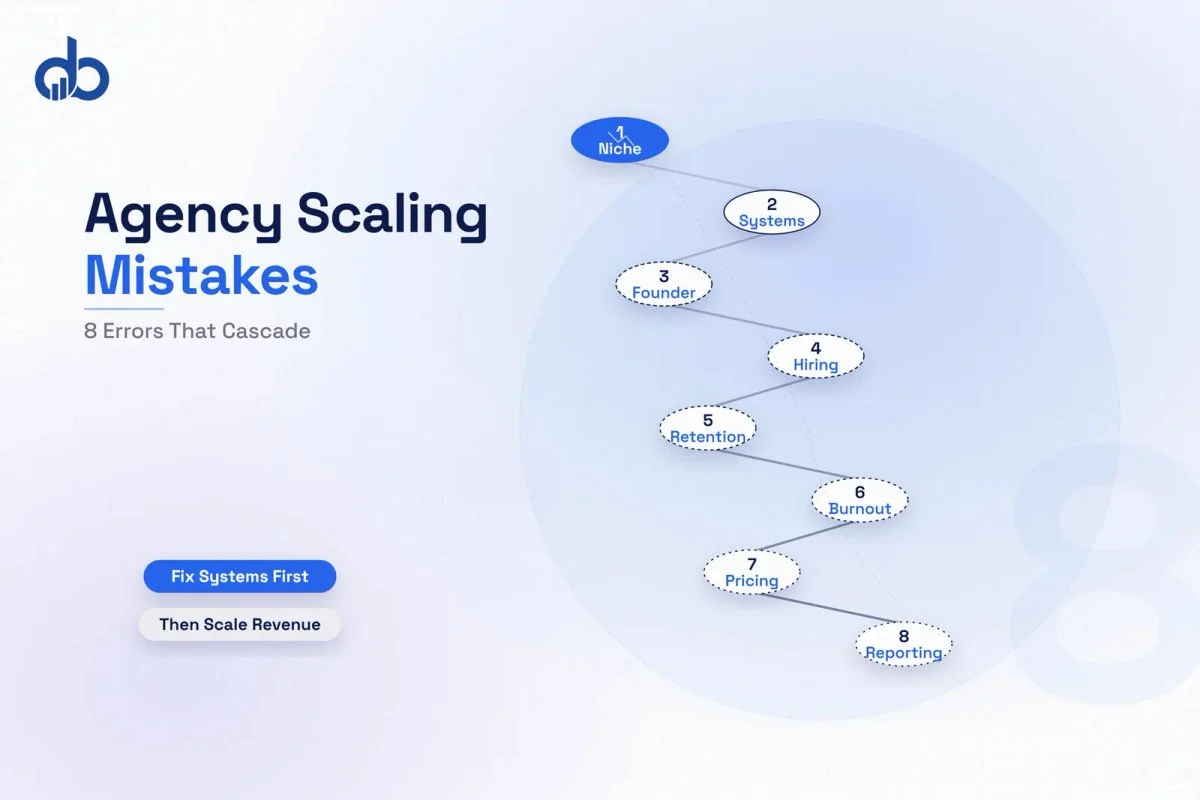
Thirty-four percent of advertising agencies close within their first five years. That number is not driven by weak pitches or poor marketing. It is driven by the same sequence of operational errors appearing in the same order, at roughly the same growth stage, in agency after agency.
The pattern is almost always identical. Growth arrives faster than expected. The founder says yes to every client and every service to capture the revenue. The team scales headcount faster than it scales process. Manual workflows that worked fine at eight clients start collapsing at twenty. Senior people spend their time firefighting instead of delivering. Quality drops on the accounts that don’t complain loudest. Those clients churn quietly. The agency is now overstaffed relative to its revenue base and has a cash problem. The revenue dip that shows up on the dashboard was decided six months earlier by a series of choices that each seemed reasonable at the time.
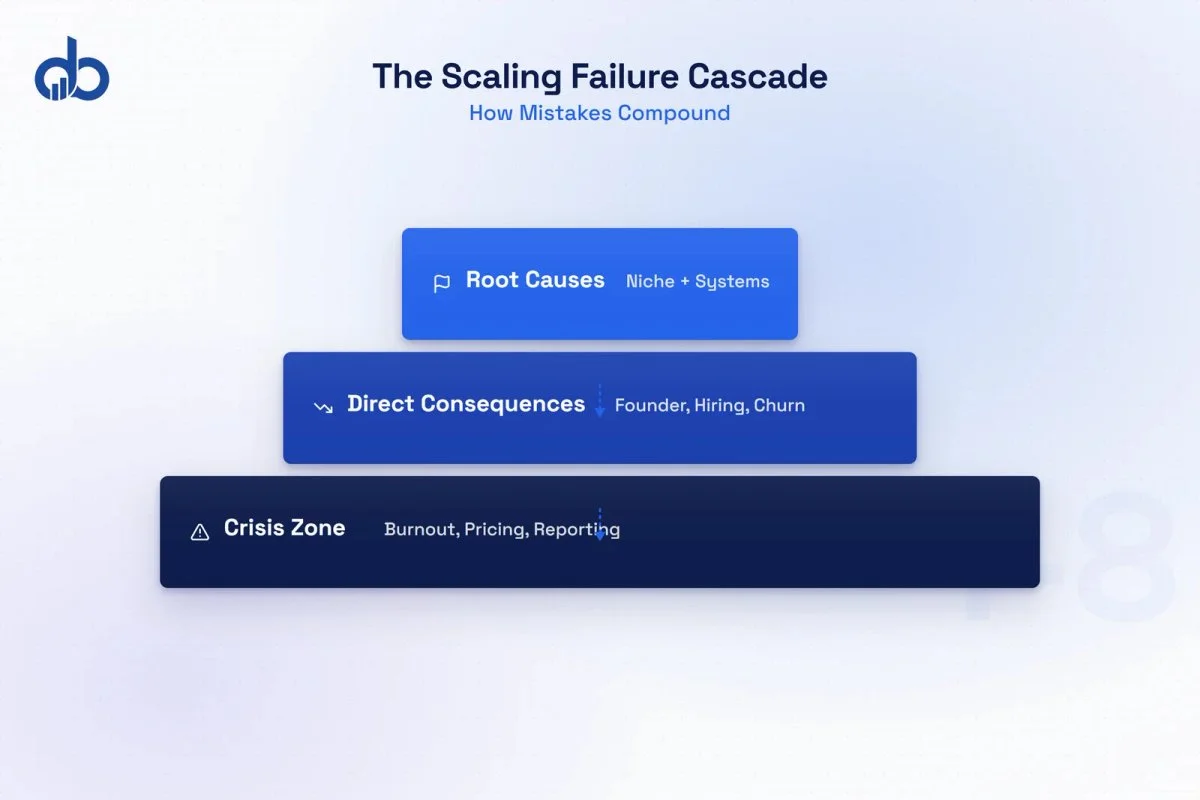
Eight agency growth mistakes drive this sequence. They don’t operate independently. Each one makes the next more likely. The agencies that scale past $1M without breaking understand which mistake unlocks the others. They address that one first.
The Mistakes That Stop Agency Growth Before They Should
Below are the eight mistakes, sequenced in the order they tend to appear:
- Chasing every service instead of owning a niche
- Scaling revenue without scaling your systems first
- Keeping the founder as the delivery bottleneck
- Hiring fast without a structured onboarding process
- Chasing new clients while the existing ones quietly leave
- Missing the burnout signals until your best people leave
- Underpricing retained work when you most need the margin
- Growing without a client reporting infrastructure
The cascade starts at Mistake 1 and is usually triggered by Mistake 2. Everything from Mistake 3 onward is a downstream consequence of not fixing the first two before growth arrives.
Mistake 1 — Chasing Every Service Instead of Owning a Niche
The pattern starts with yes. A new client asks if you do email marketing alongside Google Ads. You say yes. Another asks about website builds. You say yes. A referral comes in wanting PR and LinkedIn content. You say yes to that too.
Within eighteen months, your agency has no clear positioning, your team is stretched across disciplines that require specialist knowledge, and your pitch in a new business meeting sounds like “we do everything digital.” That pitch loses to the agency that says “we are the go-to Google Ads partner for home services companies.”
Trying to serve every vertical with every service creates a fragmented hiring requirement. You can’t hire a specialist when the role spans four disciplines. You end up with generalists who are expensive relative to their output ceiling. Scope creep accelerates because clients know you’ll absorb it rather than push back.
The impact on digital marketing agency growth is direct: agencies that narrowed their service offering averaged 30% net margins in 2025, compared to 10% for those that expanded their services during growth. A specialized team produces better output per hour, commands premium pricing, and loses fewer bids to positioning confusion.
Before your next growth push, identify the one service type generating 60% or more of your gross profit, and the client type that values it most. Make that combination the public-facing positioning of your agency. Everything else becomes an upsell, not the primary offer. If you can't name your niche in one sentence, your clients can't refer you in one sentence either.
Running an agency that does everything for everyone? Get Free Marketing Audit
Mistake 2 — Scaling Revenue Without Scaling Your Systems First
This is the upstream mistake in scaling digital marketing agency revenue. Every other mistake on this list is either caused by it or amplified by it.
“Systems” is not a vague word here. It means documented delivery processes, standardized client onboarding, and project management workflows that don’t depend on one person’s memory. It means quality checkpoints that trigger automatically, and handover protocols a new hire can follow without asking the founder.
At five clients, you don’t need any of that. At fifteen, you need most of it. At thirty, you need all of it. Without it, your team is improvising at scale.
Revenue grows. The team handles more volume manually. Small errors appear more frequently. Senior people spend 30% of their time fixing issues that shouldn’t have happened. Overtime becomes a baseline expectation. Team members stop raising issues because there’s no time to address them. Quality drops on accounts that don’t push back. Those clients churn without explanation.
By the time the revenue dip appears on the dashboard, the operational failure was already three months old.
Agencies with more than fifty employees average around 8% net margins compared to 19% for small studios. That gap isn’t from talent differences. It’s from overhead that grew faster than process efficiency. Scaling headcount before scaling systems turns every new hire into a fixed cost with a shrinking return.
The fix is not complicated. Document every recurring delivery task in your core service before you take on the next five clients. A written process takes four hours to create and saves four hundred hours of rework over the next twelve months.
Mistake 3 — Keeping the Founder as the Delivery Bottleneck
Every client escalation goes to the founder. Every strategy call, every marketing agency operations decision, every creative approval routes through the same calendar. New client kickoffs, campaign reviews, pricing negotiations. It all routes the same way.
That calendar is full at twelve clients. At twenty-five, it’s impossible.
The founder’s bandwidth is the hard ceiling on agency revenue. You cannot compound growth when every decision routes through one person. Hiring more team members does not solve this if those team members can’t make decisions without the founder’s approval, can’t handle a client call without escalating, and can’t onboard a new account without founder-led briefing.
85% of 8-figure agencies document processes for all core services, and 92% use project management and time-tracking tools to simplify operations. The founders of those agencies didn’t get there by working more hours. They built decision-tree playbooks that removed themselves from day-to-day delivery.
Signs you’re the bottleneck:
- Clients email you directly, bypassing your account team
- Your team brings problems to you without a proposed solution
- You're doing work you hired someone else to handle
- A client hasn't met anyone from your team except you
- You couldn't take a two-week vacation without the agency stalling
The fix is not “delegate more.” Write a specific playbook for the three most common client situations your team escalates to you. Give them the authority to use it without checking back in. Measure escalation frequency over 90 days.
Your agency's growth ceiling is your calendar. Request a Proposal
Mistake 4 — Hiring Fast Without a Structured Onboarding Process
Scaling a digital marketing agency requires people. Marketing agency operations can’t grow faster than the team’s ability to deliver consistently. Hiring the right people and then failing to onboard them is one of the most expensive mistakes in the business.
The hiring decision feels like forward momentum. The onboarding failure feels, at first, like a talent problem. “They should have figured it out by now.” “They’re asking questions they should already know the answers to.” After six months, the hire is underperforming. After nine months, they leave.
The real failure is not the hire. It is the absence of any structured onboarding. The knowledge needed to do the job well lives in the founder’s head, not in any document: how your clients prefer to communicate, what the delivery standards are, which tasks require sign-off and which don’t, how to use the project management setup. New hires are expected to absorb it through osmosis during a period when the founder has no time to transfer it.
Junior-level agency staff have a turnover rate of nearly 45% in their first two years, driven primarily by unclear expectations and inadequate onboarding. That turnover costs approximately 1.5x the annual salary per departure in recruiting, training, and productivity loss.
Before your next hire, write a specific list of what they will deliver in their first 30 days. Not general responsibilities. Specific outputs: three client reports completed, one campaign brief written and reviewed, two client calls handled independently. If you can't write that list, you are not ready to hire for that role. Define the job before you recruit for it.
Mistake 5 — Chasing New Clients While the Existing Ones Quietly Leave
37% of agency leaders identify client acquisition as their biggest growth challenge. Most of the energy, budget, and founder time in a growing agency goes toward the next client. Meanwhile, existing clients who feel underserved are evaluating alternatives.
The leaky bucket math is brutal. Your agency signs four new clients at $5,000 per month and loses three existing clients at $4,000 per month. Net revenue growth: $8,000. Gross acquisition cost: far higher. The relationship capital and institutional knowledge from those three lost clients doesn’t show up anywhere in the pipeline report.
Digital marketing agency growth past $1M consistently prioritizes retention before acquisition. 8-figure agencies maintain 92% annual client retention, compared to 78% for 7-figure agencies. The difference between those two numbers is not a sales advantage. It is a stronger client onboarding process and a dedicated client health monitoring system.
The early churn signals are almost never a sudden complaint. They are slow engagement. Shorter meeting requests. Fewer questions in briefs. Slower approvals. A client who used to reply within hours is now taking three days. By the time they give notice, they’ve been mentally checked out for two months.
Not sure which of your clients are at risk of churning? Get Free Marketing Audit
Track three client health signals monthly: engagement frequency, scope expansion or contraction, and response time to your deliverables. A client whose engagement is declining across all three is a retention risk, regardless of what they say on the monthly call.
Mistake 6 — Missing the Burnout Signals Until Your Best People Leave
Agency burnout is a scaling problem dressed as a culture problem.
When scaling digital marketing agency headcount without fixing operational processes, burnout is not a question of if. It is a question of when. At volume, the combination of manual processes, unclear role boundaries, founder unavailability for decisions, and growing client expectations produces chronic stress. Not acute stress from a bad week. Chronic stress from a system that has no slack in it.
70% of media, marketing and creative professionals experienced burnout in the past twelve months. That figure comes from the 2024 Mentally-Healthy Survey, covering 2,000+ professionals across the US, UK, Australia and New Zealand. The agencies contributing to that number are not uniquely bad places to work. They are agencies that grew their client volume without growing their support infrastructure.
The pattern when burnout accelerates: your strongest performer, the one handling the most complex accounts with the most client trust and institutional knowledge, resigns. Suddenly, the agency loses not just a salary, but the client context that lived in that person’s head. The remaining team absorbs the workload. The second wave of resignations follows.
Once per month, ask your full team three questions in a format where they can respond anonymously: What's the one thing you're spending time on that someone else should own? What is blocking you from doing your best work this week? What's your energy level on a scale of 1 to 10? Score anything below 6 as a flag. Two consecutive months below 6 from the same person is an action item, not a conversation to defer.
Mistake 7 — Underpricing Retained Work When You Most Need the Margin
The retainer that made sense at the agency’s early stage almost never makes sense at scale.
When a founder closes a $3,000 per month retainer, the math is based on founder time. The founder can execute efficiently because they carry the context, know the client well, and don’t need to brief anyone. That retainer has a decent margin when the founder is delivering it.
Eighteen months later, that same retainer is being delivered by two account managers, a specialist, and a project coordinator. The effective hourly rate on that account is now less than half what it was when the founder was doing the work. The margin is 8% or less. The account is subsidized by the newer, better-priced retainers.
Agencies averaged a 13% net margin in 2025. Small studios earn around 19%, while agencies above 50 people average roughly 8%. That compression is not inevitable. It is a pricing problem combined with a scope creep problem.
The agencies with the best margins at scale conduct annual retainer reviews. They audit the actual hours delivered against the contracted scope. They identify accounts where the effective rate has dropped below their threshold and present those clients with a repricing or scope reduction. Most clients accept repricing when shown the data. The ones who don’t were unprofitable anyway.
Margin compression at scale is not a market problem. It is a pricing and client management decision that was made, or avoided, twelve months earlier.
Mistake 8 — Growing Without a Client Reporting Infrastructure
When clients can’t see what they’re getting, they don’t value what they’re paying for.
A growing agency with twenty-plus clients and no reporting infrastructure is delivering results that are invisible to the clients receiving them. A strong ROAS improvement, a keyword ranking leap, a CPL reduction: all of it sits in platform dashboards that clients don’t check and reports that take three hours to build manually every month.
At eight clients, that manual report takes twenty-four hours of total team time per month. At twenty clients, it takes sixty. That is one and a half full-time weeks of senior team capacity spent on formatting, not analysis.
The second failure is strategic. Clients who can’t see the trend of their results don’t feel the compounding value of a long-term relationship. They evaluate the agency at each renewal as if it’s a new engagement. That makes every renewal a new sales conversation.
Before scaling past fifteen clients, invest in a dedicated reporting platform. The monthly cost of a good reporting tool typically runs less than two hours of account management time per client. Automate the data connection, customize the template once per client type, and replace manual report-building with a review and insight layer. The reporting becomes a retention asset, not an overhead line.
Your clients see your results every month. Do they understand what they mean? Get Free Marketing Audit
How to Scale Without Breaking: The Fix Priority Order
Knowing the eight mistakes is not enough. The sequence you fix them in matters as much as fixing them at all.
The order below reflects tested agency scaling strategies, sequenced by which fixes create the most downstream improvement:
Step 1 — Document and standardize core delivery processes.
This is the foundation for scaling digital marketing agency operations. You cannot remove the founder from delivery (Mistake 3), onboard new hires properly (Mistake 4), or maintain quality at volume (Mistake 2) without documented processes. Start here, before you do anything else.
Step 2 — Reprice at least two existing retainers.
Identify your two most underpriced accounts and present a repricing within 60 days. This funds the investment in systems and people that the rest of the fix requires.
Step 3 — Narrow to your two core service types.
Cut or subcontract everything outside your two highest-margin service lines. This immediately reduces operational complexity and allows specialist hiring.
Step 4 — Build client onboarding and retention monitoring protocols.
Create a standard onboarding sequence for new clients and a monthly health-check dashboard for existing ones. These two things address Mistakes 4 and 5 simultaneously.
Step 5 — Define the founder’s 90-day handover plan.
Pick one client relationship the founder is currently the primary contact for and hand it to a senior account lead over 90 days. Measure client satisfaction at 30, 60, and 90 days. Use this as the template for every future handover.
Step 6 — Write 30-day deliverables for the next planned hire.
Before posting the job description, write the specific outputs expected in the first month. If you can’t write them, defer the hire and document the role requirements first.
Step 7 — Implement a reporting platform for your top ten clients.
Set up automated reporting for your ten highest-value clients this month. The infrastructure will pay for itself within two billing cycles through reduced manual work and improved retention.
Is Your Agency Scaling Sustainably? Score Yourself
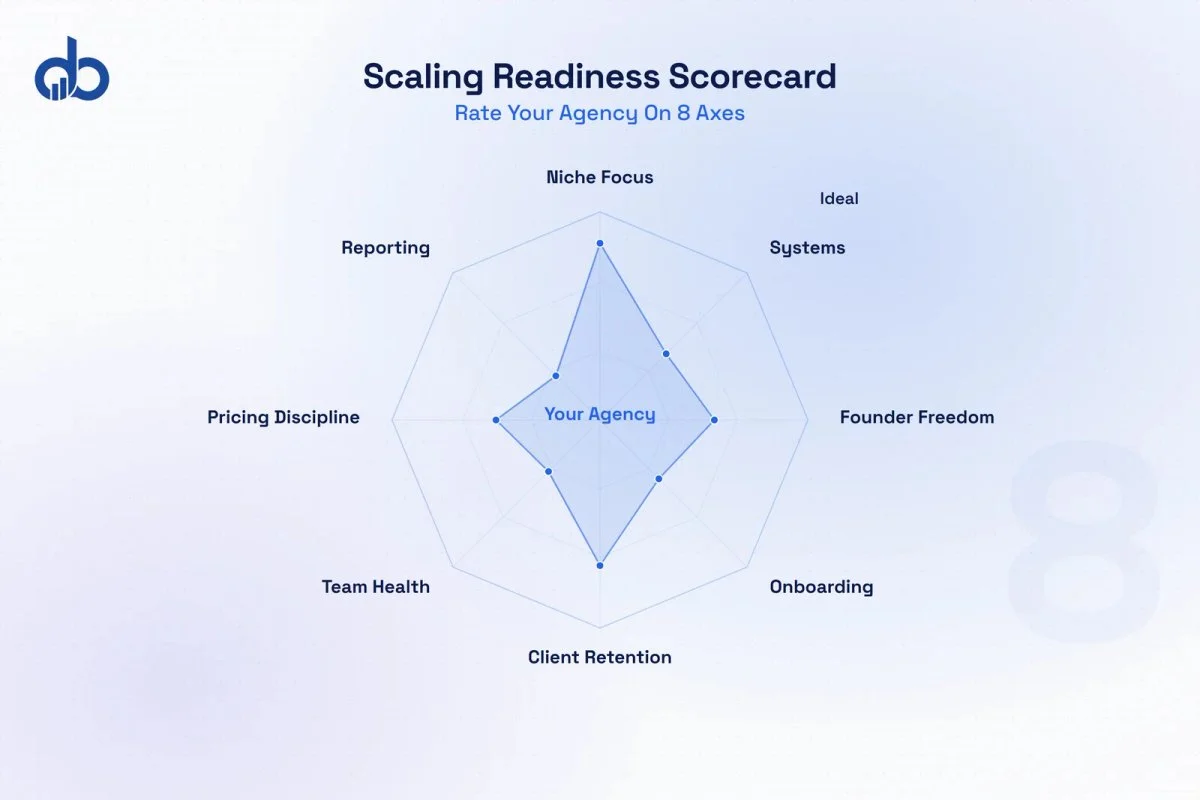
Use this checklist to score your digital marketing agency growth readiness and pinpoint your scaling digital marketing agency weak spots. Answer yes or no to each question and count your total.
8 Scaling Readiness Questions:
- Do you have a defined niche service and client type that you lead all new business pitches with?
- Are all core delivery processes documented so a new hire could follow them without asking you?
- Can your senior team handle a new client onboarding from start to finish without founder involvement?
- Does every new hire have a written 30-day deliverable plan before their start date?
- Do you track client health signals (engagement frequency, scope changes, response time) monthly?
- Does your team have a recurring anonymous pulse check mechanism separate from project status meetings?
- Are all active retainers priced based on team delivery cost, not founder delivery cost?
- Do all active clients have automated reporting that updates without manual effort each month?
Scoring:
| Score | What It Means |
|---|---|
| 7–8 Yes | Scaling-ready: your foundation is built. Focus on acquisition and client success now. |
| 4–6 Yes | Foundation building: fix the gaps identified above before adding more than 3 new clients. |
| 0–3 Yes | Systems first: adding clients now accelerates the cascade, not the revenue. Fix the infrastructure this quarter. |
Build the Infrastructure First, Then Scale the Revenue
You now have the causal map: eight agency growth mistakes, a single upstream cause, and a prioritized sequence of agency scaling strategies that interrupts the cascade before it reaches cash crisis. The gap between knowing this and building it is where most agencies stall. Operational discipline is straightforward when growth is steady. It becomes hardest exactly when you need it most: when new clients are arriving faster than your systems can absorb them.
That operational gap is exactly what our Performance Marketing and Agency Operations services are built to close. If you want to see where your current growth plan will break before it does, start with a Free Marketing Audit.
Ready to scale your agency without breaking what makes it work? Get Free Marketing Audit
- Scaling revenue before building operational systems is the single biggest upstream mistake—it triggers a cascade of founder bottleneck, team burnout, churn, and margin compression.
- Agencies that narrowed their service offering averaged 30% net margins vs. 10% for those that expanded services during growth—niche positioning directly impacts profitability.
- The founder as delivery bottleneck creates a hard revenue ceiling; documenting decision playbooks and delegating client relationships is the primary fix.
- Junior-level agency staff have a 45% turnover rate in their first two years—structured 30-day onboarding deliverables are the most effective prevention tool.
- Digital marketing agency growth past $1M consistently prioritizes retention before acquisition; tracking three client health signals monthly reduces churn risk.
- Fix mistakes in sequence: document core processes first, then reprice retainers, narrow services, build onboarding, delegate founder tasks, define next hire outputs, then implement reporting infrastructure.
Frequently Asked Questions
What is the biggest mistake when scaling a digital marketing agency?
Scaling revenue before scaling systems is the most common upstream error. When client count grows faster than your operational infrastructure, manual processes collapse, team burnout accelerates, and quality drops, triggering a client churn spike that erases the revenue gains. Fix the systems first, then scale acquisition.
How do you reduce founder dependency when scaling an agency?
Start by documenting every recurring client-facing decision as a playbook, then delegate those decisions to a senior account lead with a 30-day handover period. The founder should be removed from day-to-day delivery entirely within 90 days of the handover. If clients escalate to the founder directly, the playbook needs more specificity.
Why do digital marketing agencies struggle with client retention when they scale?
Most agencies focus on new client acquisition while ignoring retention signals in existing accounts. When headcount grows and the founder's attention splits, delivery quality drops first for accounts that don't complain, not the loudest ones. By the time churn shows up in the numbers, the retention problem has been building for months.
What profit margin should a digital marketing agency target at scale?
Agencies that narrowed their service offering averaged 30% net margins compared to 10% for those that expanded services during growth. The target for a sustainably scaled agency is 20 to 25% net margin. If margins compress as you grow, you are either underpricing retained work, overstaffing relative to revenue, or absorbing too much scope creep.