
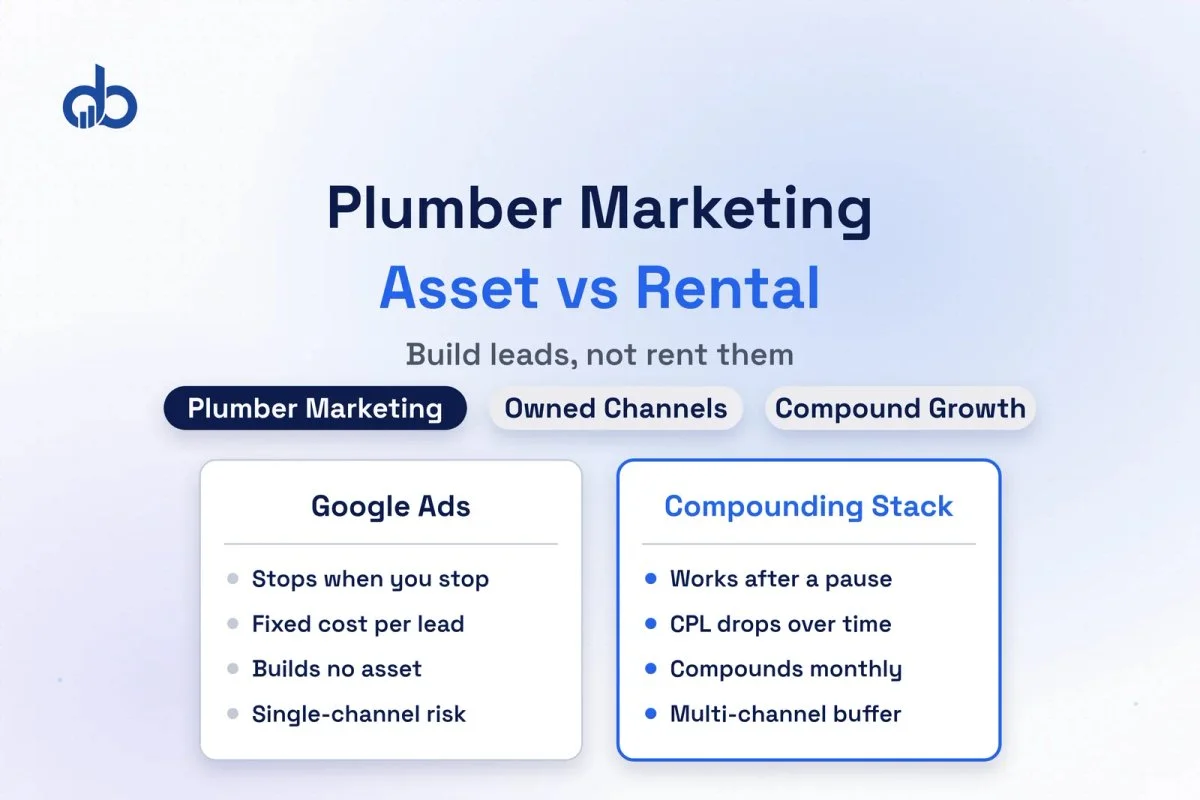
Every plumber running Google Ads has had the same conversation with their bookkeeper. The leads are coming in. The phone rings. But look at what it actually costs to keep it ringing: $70, $100, sometimes $183 per lead for a non-branded search.
And every month, that number goes up.
Then someone says, “What happens if we pause the ads?” The answer is immediate: the phone stops. No ads, no leads. Nothing from the previous six months of spend carries over.
That’s the dependency problem sitting at the center of most plumber marketing today. Agencies selling Google Ads rarely bring it up, because their fee depends on your ad spend continuing. The math is uncomfortable. And there’s a different model that most guides to digital marketing for plumbers don’t bother to quantify. One where the cost per lead drops as the system matures. One where pausing one channel doesn’t collapse everything else.
Why Google Ads Became the Default for Plumber Marketing
Before challenging the convention, it’s worth understanding why Google Ads became the standard recommendation in the first place. The case is real. It’s not wrong. It’s just incomplete.
Search ads for plumbers target people who’ve already decided they need a plumber. A homeowner searching “emergency plumber near me” at 11pm isn’t browsing options. They’re calling whoever appears first. That intent shows in the numbers: plumbing search ads convert at 7.63% on average in LocaliQ’s 2025 benchmarks, so about one click in 13 becomes a lead.
Google Ads also delivers results fast, at least compared with the early months of SEO. A new plumbing business with no reviews, no rankings, and no local reputation can generate leads on day one. That matters when cash flow is the immediate constraint.
The measurement case is strong too. Every click, call, and cost-per-conversion is visible in the platform. Business owners can see exactly what a lead cost. That transparency is genuinely useful for early-stage decisions.
And there’s a legitimate seasonal argument. Emergency call volumes spike in winter. A business that needs to staff up can use ads to accelerate demand without waiting for organic rankings to move.
When Google Ads makes sense for plumbers:
| Situation | Google Ads role |
|---|---|
| New business (0 to 6 months in) | Primary lead source while organic builds |
| Seasonal demand spike | Volume accelerant, short-term |
| New service area expansion | Immediate visibility in a new geography |
| Specific emergency keyword push | Highly targeted, defined campaign objective |
The problem isn’t that Google Ads doesn’t work. It works well in these situations. The problem is what happens when it becomes the primary lead source for a plumbing business that’s been operating for two or three years, and nobody’s built anything else.
The Math Nobody Runs Before Launching Plumbing Ads
Agencies quote the easy numbers: click-through rate, impressions, cost per click. The number that actually matters for a small plumbing business is simpler and harder to look at.
The average non-branded plumbing cost per lead on Google Ads was $183 in Q1 2026, according to SearchLight Digital’s benchmark of 524 US plumbing contractors. That’s for searches where the user is looking for a category, not a specific brand name. “Plumber near me.” “Drain cleaning service.” Those are the searches most plumbing businesses need to win.
At $183 per lead, a business closing 30 percent of its leads needs to generate about 33 leads to close 10 jobs. That’s $6,039 in ad spend for 10 closed jobs, before agency fees.
Add the agency fee. Most agencies charge 15 to 20 percent of ad spend as a management fee, which is another $1,000 to $1,200 per month on top.
Now do this math for a plumbing business with 3 technicians. They can close 40 to 50 jobs per month at full capacity. If ads account for 60 percent of those, they need 24 to 30 jobs from ads. At $183 CPL and 30 percent close rate: $14,500 to $18,300 in ad spend per month. Plus the fee.
That’s a real number. Plenty of plumbing businesses are spending it. The question is whether any of it is building anything.
When you pause that spend, the answer is no. No search rankings. No review volume increase. No email list. No content that keeps ranking. Nothing has compounded. The previous 12 months of ad spend produced 12 months of leads, then stopped the day the campaign paused.
This isn’t an argument against ads. It’s an argument for knowing what they are: a lead rental, not a lead asset.
Rent has its place. The problem is when rent is all you’re paying.
What the Data Shows About Plumbing Leads That Don’t Come from Ads
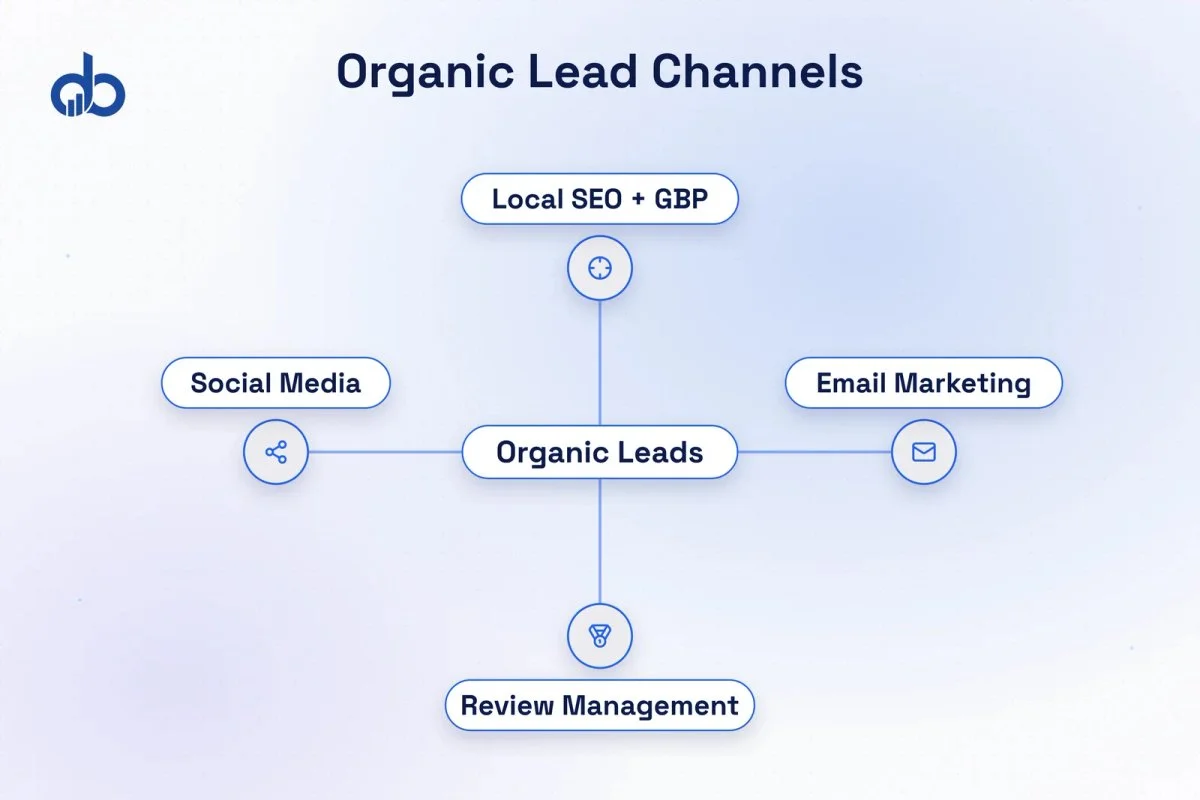
The channels that don’t feel like “marketing” are often the ones producing the most plumbing leads.
55% of plumbing leads come from Google Maps and GBP listings, not from paid search ads. That’s the largest single lead source in plumbing, and it’s organic. It depends on review count, GBP completeness, photo recency, and keyword relevance in the business description. None of those factors cost money per lead. They cost time and consistency.
The median SEO return on investment for home services businesses is 27 times the spend. At maturity, organic SEO produces leads at $10 to $30 per lead, versus $183 non-branded from paid search.
Email keeps the economics from resetting. Sixty percent of plumbing business revenue comes from repeat customers. A customer who had their water heater replaced becomes a repeat customer for a drain cleaning, a faucet repair, a maintenance visit. Without an email list, that customer is functionally invisible until they search again, and they might call a competitor this time.
The math on email is pretty clear: plumbing email marketing returns $42 for every $1 spent. A list of 500 contacts with a 25 percent open rate and a maintenance sequence converts repeat bookings at two to three times the rate of a cold search click. Those 500 contacts don’t cost per lead when they convert. They’re already in the system.
Reviews drive 70 percent of customer choice among plumbing providers. A Map Pack listing with 14 reviews loses the call to a competitor with 97 reviews, every time, regardless of ranking position. Each review added strengthens the GBP ranking signal, which increases organic impressions, which generates more calls without increased spend.
Channel comparison for plumbing businesses (2026 data):
| Channel | CPL at maturity | Time to results | Stops when you stop? | Compounds? |
|---|---|---|---|---|
| Google Ads (non-branded) | $183 | Immediate | Yes | No |
| Local SEO + GBP | $10 to $30 | 6 to 12 months | No | Yes |
| Email marketing | Under $5 (to existing list) | 30 to 60 days | No | Yes |
| Review management | $0 per lead | 3 to 6 months | No | Yes |
| Social media (organic) | $15 to $40 | 3 to 6 months | Mostly no | Yes |
The data isn’t arguing that Google Ads should be shut off. It’s showing that four channels, each costing less per lead than paid search, produce results that persist after the spend stops. That’s a fundamentally different risk profile for a business owner.
The Plumber’s Compounding Stack
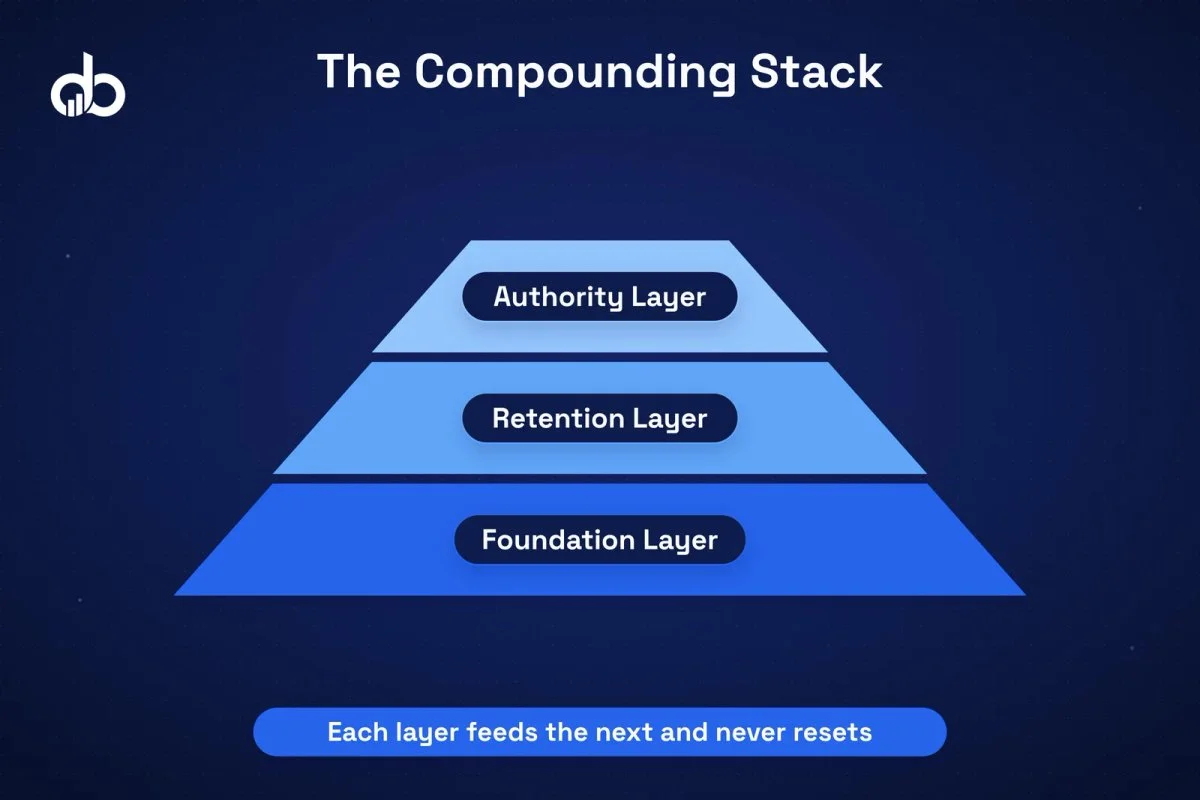
Name matters in frameworks. It’s easier to act on a named system than a loose list of tactics. Here’s the framework that pulls the organic channels together into a single, compounding model for plumber marketing.
The Plumber’s Compounding Stack has three layers. Each layer feeds the next. None of them reset to zero when a budget is paused.
Foundation Layer: GBP and Local SEO
This is where 55% of plumbing leads start. GBP optimization isn’t a one-time task: it requires monthly photo uploads, service updates, Q&A responses, and consistent review acquisition. Local SEO builds the organic rankings for “emergency plumber [city]”, “drain cleaning [neighborhood]”, and service-specific terms.
Expect 6 to 9 months before organic rankings stabilize. The GBP review count needs to reach 40 to 50 before Map Pack conversion rates materially improve. Both take consistent effort, not activity bursts.
What compounds: every optimized service page, every citation built, and every review added makes the next month’s performance better. A plumbing business with 200 reviews and a fully optimized GBP is almost impossible for a competitor to displace quickly.
Retention Layer: Email and Review Automation
Most plumber marketing stops at acquisition. That’s where most of the revenue gets left on the table.
The Retention Layer captures the 60% of revenue that comes from repeat customers. After each job, three things happen automatically: a review request goes to the customer, a follow-up email goes into a maintenance sequence, and the customer’s job type is tagged for future segmented campaigns. Water heater customers get a maintenance reminder at 18 months. Drain cleaning customers get a pre-winter camera inspection offer.
Review requests sent within 2 hours of job completion convert at significantly higher rates than delayed ones. Review count growth strengthens GBP authority. That feeds the Foundation Layer. The two layers reinforce each other.
Authority Layer: Content and Service-Area Pages
This layer builds organic coverage for every high-value term in a plumbing business’s service area. A “water heater replacement [city]” page ranks for that specific search. A “24-hour emergency plumber [neighborhood]” page captures after-hours searches that ads miss when budget caps out.
Each page added is a permanent lead entry point. A page that ranks for “sump pump installation [city]” generates calls for as long as it ranks, not only as long as the ad budget lasts.
Google Ads’ role in the Compounding Stack: Optional accelerant. Run ads during the first 6 to 12 months while the Foundation Layer builds. Reduce ad dependency as organic lead share grows. At 12 to 18 months, ads should represent less than 40% of total leads. At 24 months, less than 25%.
The stack by business stage:
| Stage | Compounding Stack priority | Google Ads role |
|---|---|---|
| 0 to 6 months | Foundation Layer setup | Primary lead source |
| 6 to 12 months | Retention Layer launch | Supporting (30 to 40% of leads) |
| 12 to 24 months | Authority Layer build | Seasonal and overflow only |
| 24+ months | All three layers active | Optional accelerant (under 20% of leads) |
What This Means for Your Plumbing Business Right Now
Plumber marketing decisions are usually made reactively. The phone slows down. Someone suggests running ads. Ads run. Leads come in. The reactive loop repeats.
The Compounding Stack requires a different kind of decision: a six-month commitment to building channels that don’t pay off immediately. That’s a harder sell to a business owner managing technician scheduling, job costing, and fleet maintenance.
It’s also the only way out of the dependency trap.
Here are three questions to run before the next monthly ad payment goes out.
- What percentage of your leads came from channels you don’t pay per click for last month?
If that number’s under 30%, you’re in ad dependency territory. The Compounding Stack gives a clear target: get that number above 60% within 18 months.
- How many new reviews did you get last month?
A healthy review velocity for a plumbing business doing 40 to 50 jobs per month is 8 to 12 new reviews. Below 4 per month means the GBP authority isn’t growing fast enough to compound.
- What is your current email list size, and when did you last send to it?
A list under 200 contacts means the Retention Layer hasn’t started yet. A list that hasn’t been emailed in 90 days isn’t a retention asset. It’s a missed opportunity.
Effective plumber marketing agency work looks like this: an agency that’s doing its job won’t optimize just one channel. It’ll build the stack. It’ll reduce your Google Ads dependency quarter over quarter, not maintain it. When a plumber marketing agency pitches you, ask what the projected organic lead percentage is at 12 months. If they don’t have an answer, they’re selling you a rental.
Plumber marketing that lasts is built on owned channels. Digital marketing for plumbers that compounds means the next job doesn’t always cost the same as the last one. That’s the difference.
Conclusion
You can now calculate whether your current spend is buying leads or building them. The difference isn’t semantic. It’s whether your phone still rings the month after you pause a budget line. Knowing the framework is step one. Building the Foundation, Retention, and Authority layers in sequence, without losing patience at month three when organic results haven’t come through yet, is where most plumbing businesses need real help. That’s what our digital marketing for plumbers program is built around. Start with a Free Marketing Audit to see where your stack stands.
- Google Ads delivers instant leads but creates an ad-dependency trap — no spend means no leads, with zero compounding value.
- Non-branded plumbing Google Ads average $183 per lead in Q1 2026; organic SEO delivers leads at $10–$30 per lead at maturity.
- 55% of plumbing leads come from Google Maps and GBP listings, not from paid search.
- The Plumber's Compounding Stack (GBP + Local SEO → Email + Reviews → Content + Service Pages) builds owned lead channels that keep working when ads pause.
- Email marketing returns $42 for every $1 spent in the plumbing industry — the highest-ROI retention channel most plumbers ignore.
- Reviews drive 70% of customer choice; a Map Pack listing with 50+ reviews outperforms a top-3 organic result for emergency searches.
Frequently Asked Questions
Is Google Ads worth it for plumbers?
It depends on your stage and your alternatives. For a new plumbing business with no organic presence, Google Ads delivers leads immediately while SEO builds. For a business 18 months in with a growing GBP and review base, the ad spend should be reducing as organic leads increase. At $183 average CPL for non-branded searches in 2026, it's not a long-term primary channel for small-to-mid-size plumbing operations.
How much should a plumber spend on digital marketing?
A useful benchmark is 5 to 10 percent of gross revenue. A plumbing business doing $600,000 annually should budget $30,000 to $60,000 for marketing across all channels, not exclusively ads. At the lower end, most of that should fund the Compounding Stack: SEO, GBP management, email automation, and review systems. A good plumbing marketing agency shifts that ratio toward owned channels over time.
Does SEO work for plumbers?
Yes, and the economics are clear. Organic SEO produces leads at $10 to $30 per lead at maturity, compared to $70 to $183 for paid search. It takes 6 to 12 months to build ranking stability, but every ranking earned keeps producing leads without additional cost per click. For most established plumbing businesses, SEO is the highest long-term ROI channel in any complete digital marketing for plumbers strategy.
What is the best marketing strategy for a plumbing business?
The Plumber's Compounding Stack: GBP and local SEO as the foundation, email and review automation for retention, and content plus service-area pages for authority. Google Ads can accelerate early growth but should decrease as a percentage of total leads over time. A qualified plumbing marketing agency can model that transition for your specific market. The target is 70%+ of leads from owned organic channels within 24 months.
How long does it take for SEO to work for a plumber?
Expect 4 to 6 months before rankings start appearing for less competitive service-area terms. 9 to 12 months for stronger Map Pack positioning in competitive metros. The GBP review count is often the real limiting factor. Businesses with fewer than 30 reviews rarely hold top-3 Map Pack positions in markets with active competitors.