
Everyone says to avoid expensive PPC keywords. Find the gaps. Target long-tail phrases where big spenders aren’t competing. Let someone else waste money on $50 clicks.
That advice is wrong.
The most expensive PPC keywords in Google Ads aren’t priced by corporate recklessness or inflated budgets. They’re priced by a market that has run the conversion math thousands of times over. Insurance keywords average $58.64 per click. Personal injury attorney terms hit $300 per click in competitive US cities. These prices didn’t appear because companies have unlimited budgets. They appeared because the underlying economics justify them.
Once you understand why expensive ppc keywords cost what they do, it changes how you evaluate every single keyword in your account.
The Belief That High CPCs Signal High Risk
Here’s the conventional mental model: a high CPC means high spend. High spend means high risk. High risk means SMBs and growing brands should stay away.
This belief gets reinforced every time a trade publication runs a “most expensive keywords” list. WordStream, SEMrush, HubSpot all publish versions of the same content. The format presents a CPC number next to a keyword category, and the implied message is a warning. These are the dangerous waters. Stay close to shore.
It’s not entirely wrong. A $100 CPC will drain a thin-margin business fast. But the model is incomplete, and that incompleteness pushes advertisers toward bad decisions.
Most expensive keywords lists treat price as the primary variable. They don’t treat price as a signal. And that’s exactly what a CPC is: a signal about the market’s collective assessment of what a click in that category is worth.
When you see expensive ppc keywords in insurance, legal, or financial services, you’re looking at the output of an auction system that reflects decades of bidding behavior from sophisticated advertisers with real conversion data. The price tells you about the demand. It doesn’t tell you whether you can afford it.
Where This Belief Breaks Down
If $55 CPCs for insurance keywords were systematically unprofitable, the advertisers paying them would have quit years ago. They haven’t. Insurance advertisers have held the top Google Ads positions for more than 15 years. That persistence is the first crack in the “expensive equals risky” model.
The second crack is the conversion rate data. Legal keywords average a 6.4% conversion rate on Google Search, well above the 3.75% all-industry average. The most expensive adword keywords aren’t just expensive. They convert at higher-than-average rates because the searchers behind them have genuine purchase intent. Someone searching “personal injury attorney near me” isn’t browsing. They have a case and they need a lawyer.
Third: what economists call the Goodhart problem. Once a “most expensive ppc keywords” list becomes widely circulated, advertisers start using it as a blacklist. They avoid expensive categories not because the economics are bad for them specifically, but because the word “expensive” triggers avoidance. It’s a category error. Price tells you what others are willing to pay. Cost tells you what a click does to your margin. Those aren’t the same thing.
The fourth crack involves long-tail logic. Cheap keywords are cheap for a reason. They attract searchers earlier in the decision cycle, with lower purchase intent. You trade a lower CPC for a much lower conversion rate. In many accounts, a broader long-tail campaign costs more per acquisition than the expensive head-term campaign would have, because the volume of unconverted clicks adds up fast.
What Google’s Auction Mechanism Actually Reveals
Google’s ad auction is a second-price system. You bid your maximum. You pay one cent more than the next highest bidder. This structure means the market price for any keyword converges on what the marginal advertiser is willing to pay.
Who’s the marginal advertiser in insurance? A mid-size agency with real LTV data. They know that an average auto insurance customer generates $1,200 per year in premiums and stays for 7-10 years. At a 10-year LTV of $12,000 and a 10% target margin, the maximum allowable CPA is $1,200. If their landing page converts at 3%, the maximum CPC they can sustain is $36. If it converts at 5%, that ceiling rises to $60. That’s why you see $58 average CPCs in the insurance category. The auction priced the keyword at what efficient operators can support.
Legal keywords follow the same logic, just with bigger numbers. Personal injury attorneys work on contingency, typically keeping 33% of settlements. A single converted client on a $50,000 case is worth $16,500 in revenue. That makes a $300 CPC defensible if the firm closes one case per 55 clicks. The most expensive ppc keywords in the legal space are expensive because the revenue per converted client is extraordinary.
Here’s the stat that shifts how you should think about this: 72% of advertisers in high-CPC industries report positive ROAS despite above-average CPCs. Expensive ppc keywords aren’t a budget black hole for advertisers who understand their own conversion economics. They’re a reliable acquisition channel, because the market has already priced in the expected return.
The Intent Premium Framework: Three Components of Keyword Cost
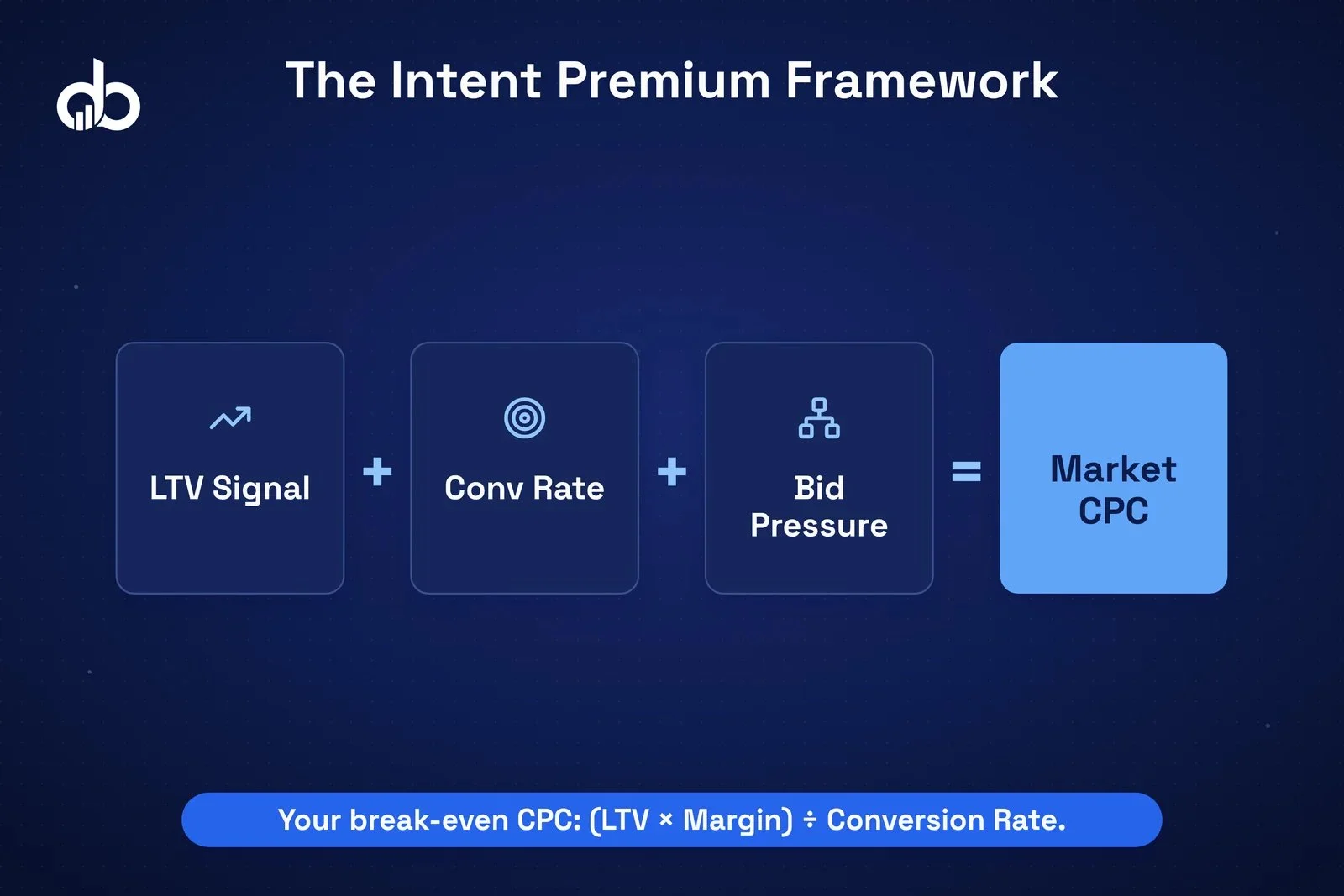
Skipping the most expensive keywords without doing the math isn’t conservatism. It’s guesswork. A better approach: evaluate every keyword through what I call the Intent Premium Framework. It has three components.
Component 1: The LTV Signal
Every CPC reflects the customer lifetime value the market has assigned to that search intent. It’s not a perfect signal, since your LTV may differ from the average competitor’s. But it’s a useful benchmark. If the market CPC for a keyword is $80 and your customer LTV is $200, that keyword probably isn’t for you. If your LTV is $8,000, the math looks completely different.
Map your own LTV before you evaluate any keyword’s cost. Most businesses that avoid most expensive keywords have never done this calculation.
Component 2: The Conversion Rate Anchor
The CPC isn’t the number that matters. The cost per acquisition is what matters. A $100 CPC with a 10% landing page conversion rate produces a $1,000 CPA. A $10 CPC with a 1% conversion rate also produces a $1,000 CPA. On an acquisition cost basis, they’re identical. The decision comes down to volume and LTV, not the CPC itself.
Your break-even CPC formula: (Customer LTV x Acceptable Margin) x Conversion Rate. Run this before you pause any keyword for being expensive. The calculation takes five minutes. The savings from pausing the wrong keywords can be significant.
Component 3: Competition Depth Diagnosis
Not all expensive keywords are expensive for the same reason. Some are expensive because one or two dominant advertisers have set a high price floor and others follow. Some are expensive because 50+ advertisers are competing for limited impression inventory.
These situations need different responses. A keyword priced by a single dominant competitor may have pricing power you can exploit by improving Quality Score, which lowers your effective CPC without changing bid competition. A keyword priced by genuine market saturation may need differentiated ad copy or a landing page positioned specifically to outconvert competitors.
Diagnosing competition depth means looking at auction insights data in Google Ads, not just the keyword CPC in a planning tool.
What This Means for Performance Marketing Managers and eCommerce Brand Owners
If you manage PPC budgets, the most common mistake I see is reporting CPCs to leadership without including CPA and LTV context. A slide showing “our average CPC rose 15% this quarter” tells an incomplete story if conversion rate trends and CPA movement aren’t alongside it. Leadership sees cost going up and pushes for cuts. You cut the expensive keywords. Acquisition volume drops. The issue was never the CPC.
For eCommerce brand owners, the framework applies differently. High-AOV, high-repeat-purchase categories can often support expensive ppc keywords in ways that low-margin, one-time-purchase categories can’t. A brand selling $800 espresso machines with 40% repurchase rates has very different CPC tolerance than a brand selling $25 phone cases.
The question isn’t “is this CPC too high?” It’s “does my post-click funnel justify this CPC?” That funnel includes landing page conversion rate, average order value, and repeat purchase probability. Digiblazon’s PPC management team builds this calculation into every account before setting bid strategies.
For SMB founders new to Google Ads: define your target CPA before you run a single keyword. Most accounts are built backward. Keywords first, budget second, CPA target never. Running your CPA math upfront tells you immediately which keywords are viable and which sit outside your funnel’s ability to convert.
The Industries Where the Most Expensive Keywords Concentrate
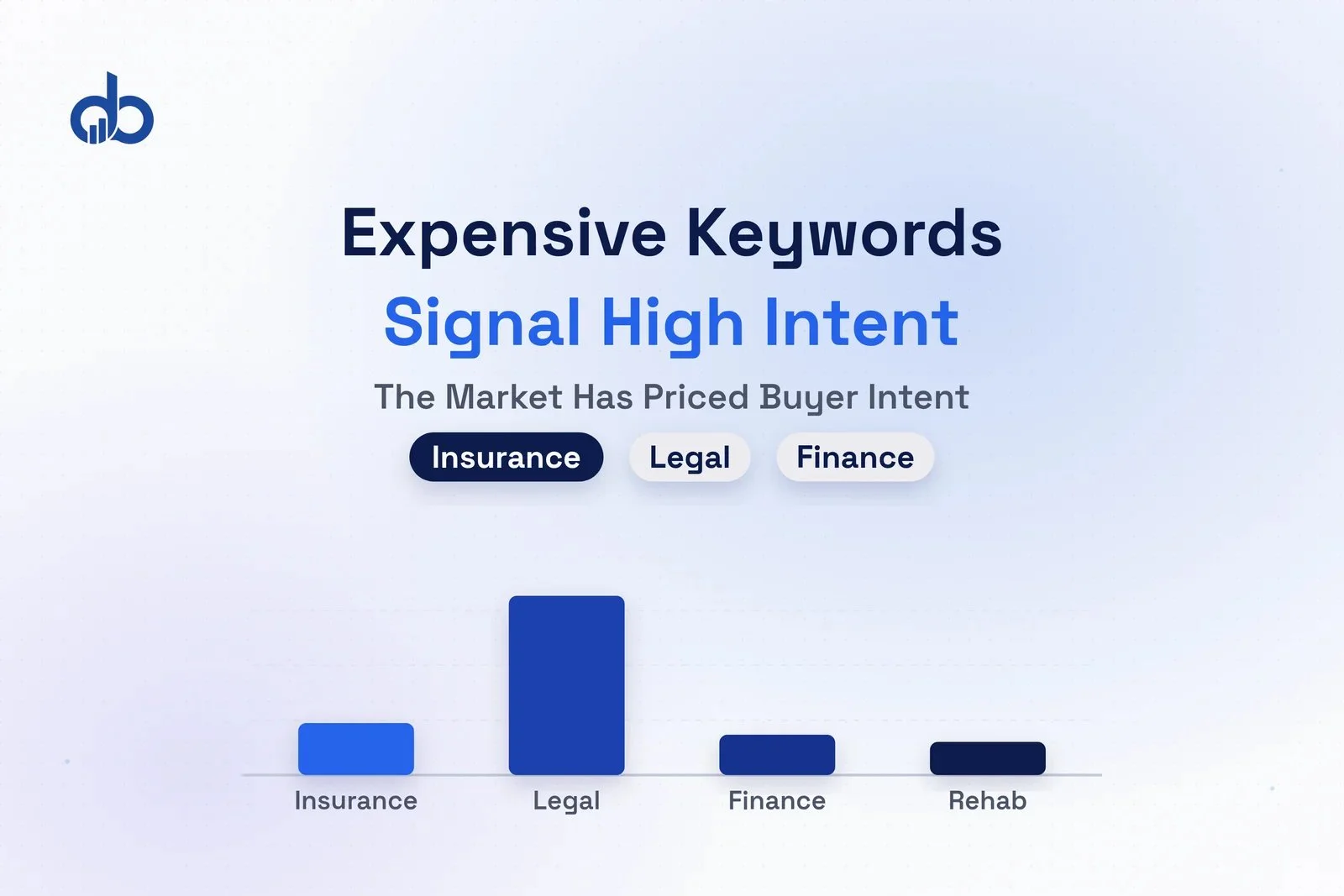
The most expensive adword keywords cluster in four industry groups. Each has a clear economic explanation.
Insurance ($50-$60 average CPC): Multi-year policy retention means each converted customer is worth $10,000-$25,000 in LTV. Dozens of national and regional carriers compete for the same search intent, pushing CPCs toward that LTV ceiling.
Legal ($40-$300 CPC): Contingency fee structures mean a single case can return 50-100x the ad spend on the converting click. Personal injury, DUI, and medical malpractice terms hit the highest CPCs because case values in those categories are highest.
Financial services ($30-$50 CPC): Mortgage origination generates $3,000-$10,000 per funded loan. Credit card products generate $200-$500 per approved account. Investment accounts generate long-running advisory fee streams. The most expensive ppc keywords in finance reflect these per-customer revenue realities.
Addiction treatment and rehabilitation ($25-$50 CPC): Inpatient treatment runs $10,000-$30,000 per admission. Searchers have real urgency. High intent drives high bids.
You’ll notice the same pattern across all four: high LTV, regulated competition, and limited alternatives to paid search as a customer acquisition channel. When Google Search is the primary demand-generation channel for an industry, CPCs reflect that intensity.
The Real Cost Is What Happens After the Click
The most important shift you can make in how you think about expensive ppc keywords: the CPC is not the cost. What happens after the click is the cost.
A business with a 2% landing page conversion rate pays five times more per lead than a competitor with a 10% conversion rate, on the same keyword at the same CPC. The competitor’s “expensive” keyword is effectively five times cheaper. This is why post-click optimization isn’t a secondary concern in high-CPC campaigns. It’s the primary variable.
A $58 insurance keyword on a landing page converting at 6% costs $967 per lead. The same keyword on a page converting at 2% costs $2,900 per lead. The keyword didn’t change. The funnel changed.
Improving the post-click experience is the single most effective action available to any advertiser competing on most expensive keywords. The performance marketing team at Digiblazon runs a post-click audit as the first step in any high-CPC account engagement. Landing page speed, offer alignment, form friction, and trust signals all get evaluated before bid strategy is touched. Because the math only works when the funnel supports it.
Conclusion
The most expensive PPC keywords are not a warning sign. They’re a map.
They show you where buyer intent is highest, where LTV is strongest, and where the market has spent years confirming that paid search works as an acquisition channel. Treating them as a blacklist means surrendering that map to competitors who’ve done the math.
Don’t pause a keyword because it’s expensive. Calculate your break-even CPC first. You may find that the keyword you’ve been avoiding is the one most worth keeping.
Paying high CPCs but not seeing the returns? Get a free PPC audit and find out whether your post-click funnel is keeping pace with your bids.
- A high CPC is a market signal of buyer intent and customer LTV, not a reason to avoid a keyword.
- Google's second-price auction sets keyword prices at what the most efficient advertisers can profitably pay.
- Use the Intent Premium Framework — LTV Signal, Conversion Rate Anchor, Competition Depth — to evaluate any keyword's real cost.
- Post-click conversion rate affects your cost per acquisition more than the CPC itself.
- Calculate your break-even CPC before pausing an expensive keyword.
Frequently Asked Questions
What are the most expensive PPC keywords in 2025?
Insurance keywords top the list, averaging $54-$60 per click. Legal and attorney terms follow at $40-$100+, with personal injury keywords reaching $300 per click in competitive US markets. Financial services, mortgage, and loan keywords typically run $30-$50 CPC. These costs reflect high customer lifetime value in each industry, not arbitrary pricing.
Why do insurance keywords cost so much per click?
An insurance customer who converts can generate $1,200-$6,000 or more per year in premium revenue. Over a 7-10 year retention period, LTV easily exceeds $10,000. At that LTV, a $55 CPC is rational if your landing page converts at 2% or better. Insurance companies bid aggressively because the math supports it, and that competition sets the market price.
Should small businesses avoid expensive PPC keywords?
Not automatically. Calculate your break-even CPC first. If your customer LTV and target margin support the market price, competing on expensive keywords may be more efficient than chasing cheap long-tail traffic with low purchase intent. Some SMBs find that a small set of high-intent, high-CPC keywords outperforms a broad campaign built on cheaper clicks that convert poorly.
What are most expensive adword keywords outside the US?
Globally, the most expensive adword keywords follow similar industry patterns: insurance, legal, finance, and healthcare. But CPCs vary by market. UK legal keywords can hit £80-£150. Australian financial terms frequently exceed AU$30. The mechanism is identical: high LTV industries drive high bids wherever Google Ads operates.