
Every small business owner we talk to describes the same situation. They built a website, published some content, and waited for the search traffic to show up. It didn’t. Paid ads kept running because there was no organic alternative, and every month that passed without SEO traction felt like money burned.
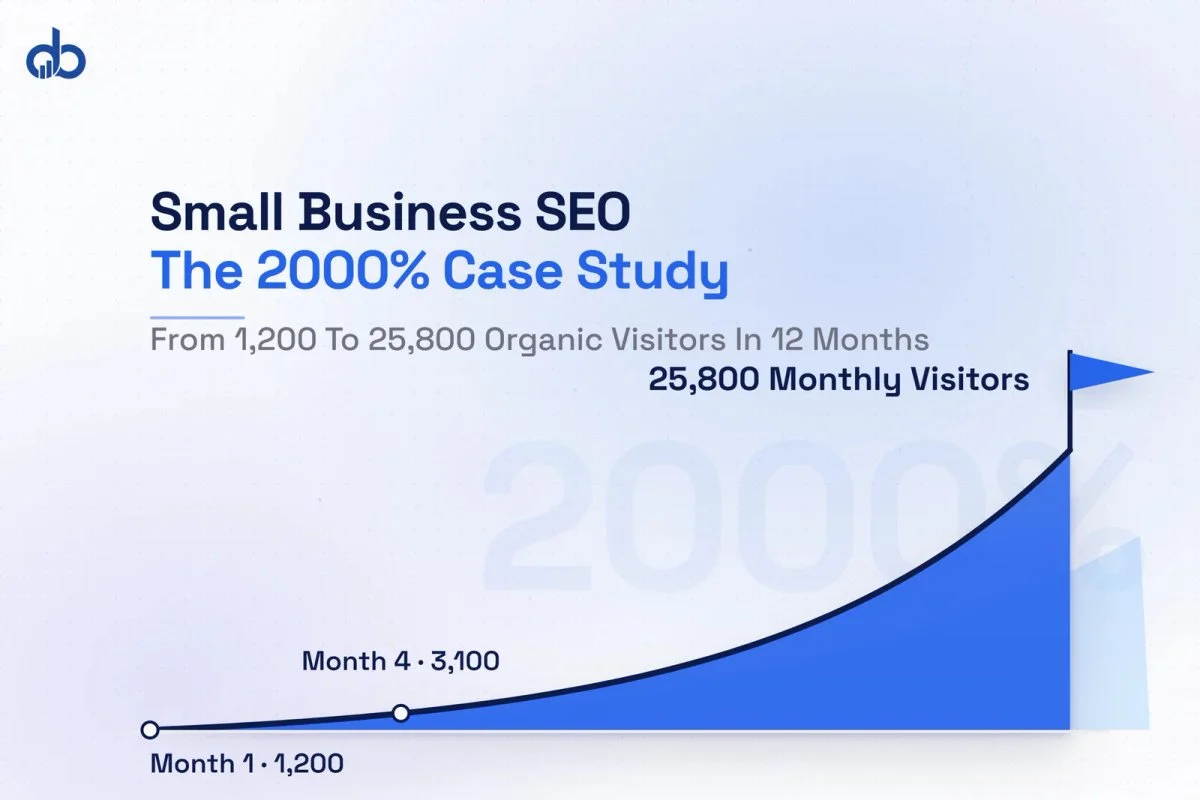
Then there’s the other side of that story. One small e-commerce brand with eight employees was spending $3,500 per month on paid ads while getting fewer than 1,200 monthly visitors from organic traffic. Twelve months later, that number crossed 25,000. No viral moment. No press coverage. Just a structured four-part SEO strategy that compounded over time.
That’s what we’re sharing here. It’s an SEO case study built for small business owners who want to know exactly what was done: not in abstract terms, but tactic by tactic, in the order it was executed. Because the sequence mattered as much as the tactics themselves.
Why This Small Business Was Getting Zero Organic Traffic (Despite Having a Website)
The client was a home décor e-commerce brand selling mid-range decorative items online. They had a four-year-old website, a Shopify storefront, and a product catalog with 300+ SKUs. On paper, they had everything in place. In reality, organic traffic accounted for fewer than 12% of total visits.
The rest came from paid Google Shopping ads at a monthly spend of $3,500. The campaigns were breaking even (some months slightly profitable, others not), but scaling spend didn’t scale revenue in proportion. Every new customer cost more to acquire than the last.
The organic problem came down to three things. First, they didn’t have a keyword strategy. Product pages used manufacturer-copy descriptions with no search intent alignment whatsoever. Second, the technical foundation was weak: duplicate title tags across product category pages, missing H1s on 40% of product pages, and page speed scores below 45 on mobile. Third, they’d published twelve blog posts over four years, none targeting a specific keyword, none earning a single backlink.
Organic search drives 53% of all website traffic globally. For this brand, it was delivering under 150 visitors per month. That gap is not a content problem. It’s a strategy problem.
Is your website traffic almost entirely paid? Get Free Marketing Audit
What Standard SEO Advice Failed to Fix
Before working with our team, the brand had made two previous attempts at SEO. The first was a six-month engagement with a freelancer who focused exclusively on link building. They picked up 18 backlinks from generic directories and saw no meaningful ranking improvements. The second was a content agency that produced two blog posts per week for three months. Organic traffic didn’t move.
Neither attempt failed because the tactics were wrong. They failed because both were deployed without a working foundation. You don’t build links to pages that aren’t indexed properly. You don’t publish content targeting keywords your site has no authority to rank for yet.
This is the mistake most digital marketing guides for small businesses don’t acknowledge. They treat each tactic as independent when organic growth is a compounding system. Keyword research informs on-page optimization. On-page optimization creates the structure that link building amplifies. Content marketing builds topical authority that makes the links land harder. Break any part of that chain and the whole system underperforms.
Sound familiar? If you’ve tried SEO before and gotten nothing out of it, the tactics probably weren’t the problem.
Before running any link building or content campaign, run a technical SEO audit first. Crawl errors, duplicate content, and slow page speed are silent traffic killers. Fix the foundation or every other investment gets discounted.
The Four-Part SEO Strategy That Changed Everything
The strategy ran in four phases, each building on the last. Nothing was launched in parallel. Every phase had to be functional before the next one started.
Phase 1: Keyword Research and the 47 Untapped Clusters
The first month was spent entirely on keyword research. Not broad terms like “home décor” or “decorative pillows”: those SERPs were dominated by Pinterest, Wayfair, and Amazon, all with domain authorities in the 80–90 range. A small business has no realistic path to ranking for those in year one.
Instead, we focused on commercial-intent long-tail keywords: “modern ceramic vase set for living room,” “minimalist wall art under $100,” and “boho throw pillow sets for bedroom.” These terms were specific, transactional, and achievable. Approximately 70% of all Google searches are long-tail queries. For small businesses, that’s where the match between search intent and attainable ranking actually exists.
The audit uncovered 47 keyword clusters the brand could realistically target within 6–12 months. Each cluster had a primary keyword with at least 200 monthly searches and fewer than five direct competitors with domain authority above 40.
These clusters became the roadmap for every other phase.
Phase 2: On-Page Optimization Across 300+ Product Pages
With keyword clusters defined, Month 2 focused on on-page optimization across the full product catalog. Every product page received:
- Title tags with the target keyword and a purchase modifier (“buy,” “shop,” “set,” “under $X”)
- Meta descriptions rewritten with a benefit statement and soft CTA
- H1 tags using the exact product name plus primary keyword variant
- Unique product descriptions replacing manufacturer copy, each 150–200 words with the primary keyword in the first sentence
- Internal links to related product categories using descriptive anchor text
This phase also fixed the technical SEO issues flagged in the audit: canonicalization on category pages, image compression across 1,400 product images, and a switch to HTTPS across all internal links. Page speed scores improved from 41 to 78 on mobile.
Here’s why this matters: Google’s crawlers can now understand what each page is about and which queries it should answer. Before, most of those 300+ pages were invisible to search.
When rewriting product descriptions for SEO, write for the buyer first, not the algorithm. The keyword should appear naturally in the first sentence. If it sounds forced, restructure the sentence instead. The keyword should fit, not appear forced.
Phase 3: Link Building and the Three Partnerships That Counted
With a solid on-page foundation in place, link building began in Month 3. The goal wasn’t volume; it was relevance. Generic directory links (the previous agency’s approach) pass minimal equity. Contextual links from topically relevant sites pass both equity and relevance signals.
The strategy focused on three tactics:
Guest post partnerships: The brand identified five lifestyle and interior design blogs with domain authorities between 35–55, high enough to pass value, low enough to be accessible. They pitched guest articles on topics adjacent to their products: “How to Layer Textures in a Minimalist Living Room,” “5 Ways to Style a Bookshelf Without Clutter.” Three partnerships converted, each resulting in one published guest post with a contextual link to a relevant product category page.
HARO responses: HARO (Help a Reporter Out) sends daily queries from journalists looking for expert input. The brand’s founder responded to relevant home décor and interior design queries weekly. Over four months, they secured placements in two regional lifestyle publications and one national home decor media outlet.
Supplier link reclamation: The brand discovered that three of their wholesale suppliers listed retail partners on their websites without linking to them. A simple outreach email converted all three into followed links pointing to the homepage and two category pages.
Combined, Phase 3 built 12 new backlinks from relevant, editorially placed sources. Twelve well-placed links outperformed the previous agency’s 18 directory submissions. Quality over quantity isn’t a slogan here. It’s measurable.
Ready to build a link profile that actually moves rankings? Request a Proposal
Phase 4: Content Marketing and Building Topical Authority
Content launched in Month 4, after keyword research, on-page foundation, and link building infrastructure were in place. This was deliberate. Publishing content before a site has technical credibility and keyword direction produces content that can’t rank and won’t earn links. (That’s exactly what happened with the previous content agency’s two-posts-per-week push.)
The content strategy targeted two audience layers:
Top-of-funnel educational content: Blog posts answering questions buyers ask before they’re ready to purchase, such as “How to Choose the Right Size Rug for Your Living Room” and “What’s the Difference Between Boho and Scandinavian Décor?” These posts targeted informational long-tail keywords with 300–800 monthly searches. They build awareness and create entry points for new audiences.
Buyer’s guide series: Six long-form guides targeting commercial-intent keywords, including “Best Ceramic Vases Under $50” and “Top 10 Minimalist Wall Art Pieces for Modern Homes.” Each guide linked internally to product pages using relevant anchor text, creating a topical content cluster that reinforced the product pages’ keyword relevance.
Publishing cadence was two posts per month, not two per week. Companies that blog consistently see 55% more website visitors than those that don’t, but cadence matters less than targeting. Two well-researched, keyword-targeted posts per month outperform eight generic ones every time.
Build your content around keyword clusters, not individual posts. Each cluster should have one pillar page (the broad topic) and 3–5 supporting posts (the specific subtopics). This architecture tells Google you have depth and authority on a topic, not just one article about it.
From Near-Zero to 2000% Traffic Growth: The Numbers
Results didn’t arrive uniformly. The first three months produced minimal visible traffic change. That’s normal. SEO is a compounding investment, not a linear one. What was happening beneath the surface was indexing: Google re-crawling updated pages, processing new content, and reassigning keyword relevance scores.
Month 4 was when movement started. Twenty-two product pages entered the top 20 positions for their target keywords. Organic traffic climbed from 1,200 to 3,100 monthly visitors.
By Month 7, the buyer’s guides began ranking. The “Best Ceramic Vases Under $50” guide entered position 6 for its target keyword and drove 820 monthly visits on its own. Topical authority was compounding. New content ranked faster because the site’s credibility had been established.
| Metric | Starting Point | Month 12 | Change |
|---|---|---|---|
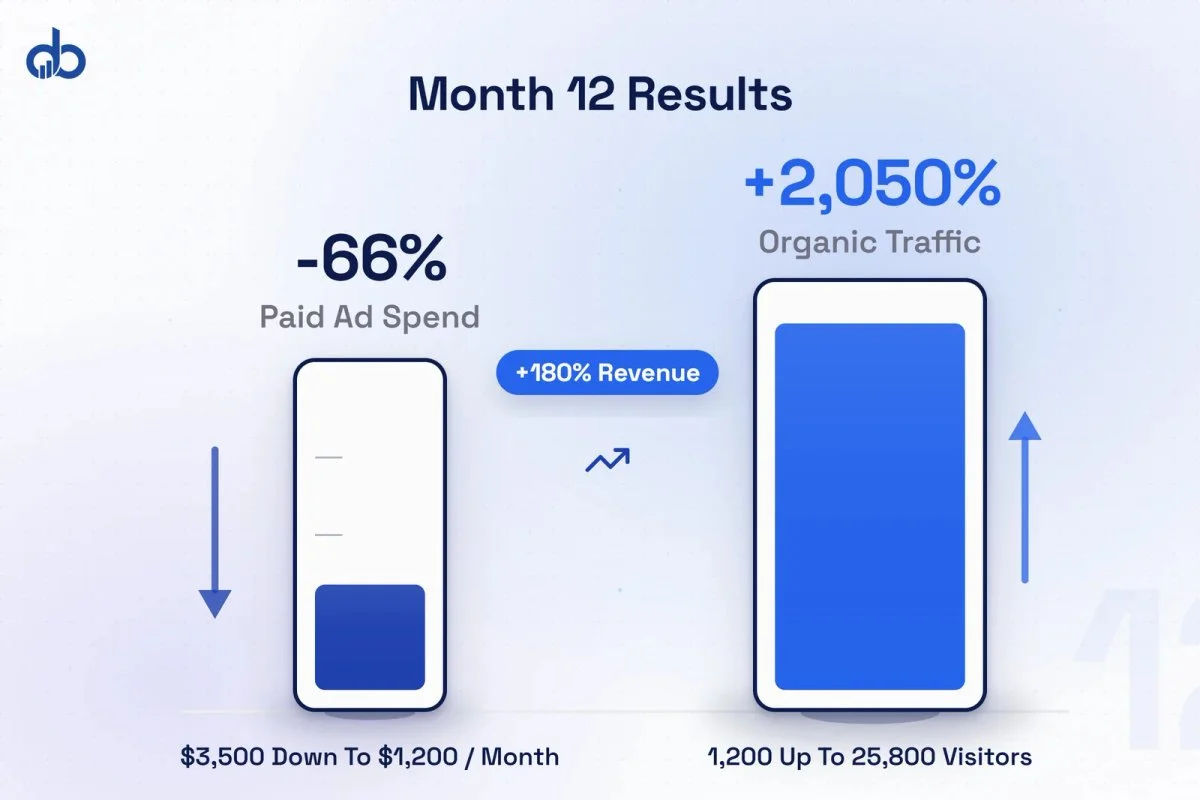
| Monthly organic visitors | 1,200 | 25,800 | +2,050% |
| Organic revenue share | 12% | 68% | +56 pts |
| Ranking keywords (top 20) | 14 | 312 | +2,129% |
| Domain rating | 18 | 31 | +13 pts |
| Monthly ad spend | $3,500 | $1,200 | −66% |
The reduction in ad spend was the outcome that surprised the client most. As organic traffic scaled, they gradually reduced paid search investment in the keyword clusters where organic rankings took over. By Month 12, ad spend was down 66% and total revenue was up 180%.
That’s the compounding effect of SEO done right. It doesn’t replace paid search; it eventually subsidizes it.
Want numbers like this for your business? Get Free Marketing Audit
The Decisive Factor: Why Content and Technical SEO Together Won
This is where most SEO case study writeups stop. Right at the results table. But the number that explains the 2000% outcome isn’t traffic. It’s the sequence.
The prevailing advice is to start with content. “Just publish consistently and the rankings will come.” It’s the dominant SEO guidance, and it misses what this case study demonstrated: content marketing only compounds when it’s published onto a technically sound, keyword-mapped foundation.
When the previous agency published two posts per week without addressing technical issues, none of it ranked. When we ran the same content strategy (after the technical foundation was fixed, keyword clusters were mapped, and link acquisition had begun), the content ranked within weeks of publication.
The insight here isn’t that content marketing doesn’t work. It’s that it only works after the other pieces are in place. Technical SEO without content gives you a fast, well-structured site that has nothing to say. Content without technical SEO gives you articles that are hard to find. Link building without both gives you authority pointing to pages that don’t earn the click.
Every phase of this digital marketing strategy amplified the phases before it. That’s why the result was 2000% and not 20%.
Think of your SEO investment as a production line, not a menu. You can't skip steps or run them out of order. Every phase creates the conditions the next phase needs to work.
What Small Business Owners Can Apply Right Now
This SEO case study isn’t a one-off. The same four-phase approach works across industries because it follows the same logic: foundation first, amplification second.
Here’s what you can start this week:
- Run a technical SEO audit (Google Search Console, Screaming Frog free tier, or GTmetrix for page speed)
- Identify 10–20 long-tail keyword clusters with clear commercial intent and achievable competition levels
- Update your top 10 most-visited pages with keyword-targeted title tags, H1s, and rewritten meta descriptions
- Identify 3–5 topically relevant sites for potential link partnerships (not directories; editorial sites only)
- Plan a content calendar targeting keyword clusters you’ve already identified, not generic topics
The temptation is to start with content because it feels productive. Resist it. Every hour spent publishing content onto a weak technical foundation is time that organic traffic can’t compound.
This is exactly why the small business in this case study was stuck for four years. They weren’t lazy. They weren’t uninformed. They were running the right tactics in the wrong order.
The SEO & Organic Growth methodology we use at Digiblazon runs this four-phase sequence for every client, because it’s the only order in which organic growth compounds reliably.
Lessons from This Small Business SEO Case Study
You now have the exact four-part sequence that took a small home décor brand from 1,200 to 25,800 monthly organic visitors. This SEO case study proves that the sequence matters as much as the tactics themselves. The tactics aren’t secret. The sequence is what most small businesses and agencies skip.
The gap between knowing a strategy and executing it correctly is where results are made or lost. These are the most common digital marketing mistakes small businesses make: running keyword research without fixing technical issues first, or publishing content before on-page foundations are set.
Digiblazon’s SEO & Organic Growth service is built around this exact four-phase methodology. If you want to see where your current setup stands and what the path to organic traffic looks like for your specific business, start with a Free Marketing Audit.
- SEO is a compounding system — the sequence (keyword research → on-page → link building → content) matters as much as the individual tactics.
- Long-tail commercial-intent keywords are the most achievable entry point for small businesses competing against high-authority domains.
- Technical SEO must be fixed before link building or content marketing — both tactics underperform on a weak foundation.
- This home décor brand grew monthly organic visitors from 1,200 to 25,800 in 12 months while cutting paid ad spend by 66%.
- Quality contextual backlinks (12 editorial placements) outperformed volume-based directory links (18 submissions) in rankings impact.
Frequently Asked Questions
How long before SEO starts working for a small business?
Expect three months before meaningful ranking movement, six months before rankings stabilize, and twelve months before the compounding effect fully kicks in. The case study showed traffic first moved in Month 4, accelerated in Month 7, and peaked at 25,800 monthly visitors by Month 12.
What if I don't have budget for all four SEO phases at once?
Do them in order and stretch the timeline if needed. Phase 1 (keyword research) costs the least and sets up every phase that follows. Skipping straight to content or link building — without a keyword map or technical foundation — is exactly what produced zero results for this client in their previous two SEO attempts.
Why did this brand's previous SEO attempts fail?
Both previous attempts — one focused solely on link building, one on content publishing — failed because they skipped the foundation. You cannot build effective links to pages that are not indexed properly, and you cannot rank content on a site that has no technical credibility or keyword direction established first.
What was the most impactful phase in this SEO case study?
All four phases were interdependent, but Phase 1 (keyword research) was the enabler. The 47 keyword clusters mapped in Month 1 guided every subsequent decision — which pages to optimize, which links to pursue, and which content to create. Without that roadmap, the other phases would have produced the same results as the previous two failed attempts.
Can a small business realistically rank on Google without a large SEO budget?
Yes, by targeting long-tail commercial-intent keywords with achievable competition levels rather than competing against high-authority domains on broad terms. The brand in this case study avoided terms dominated by Wayfair and Amazon and instead ranked for specific queries like "modern ceramic vase set for living room" — terms with real purchase intent and attainable competition.