
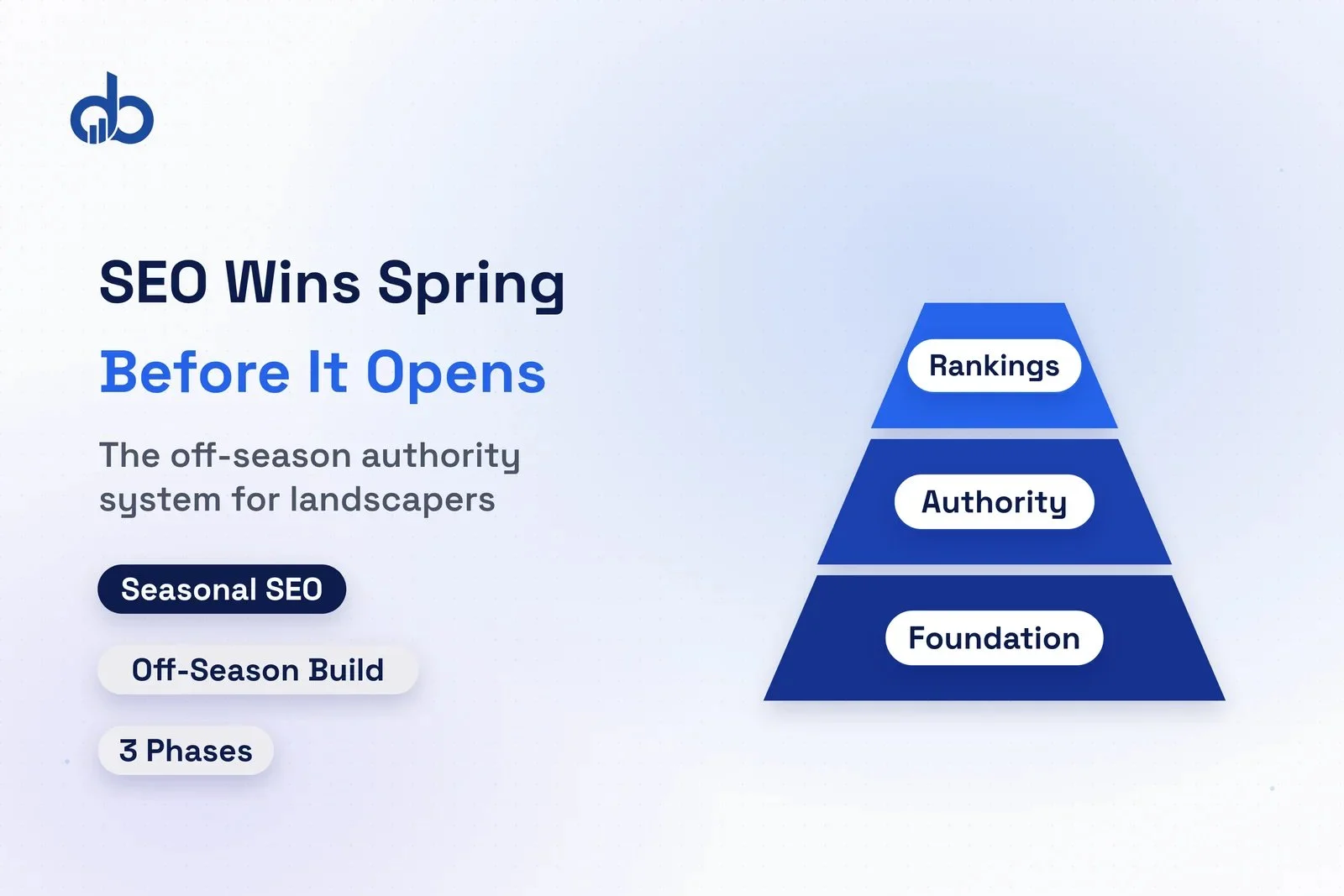
The landscaping businesses that fill their spring calendar before March do not stumble into that position. They started building for it in October.
Most landscaping business owners think about digital marketing when they need calls. When spring volume drops, they call an agency. When March arrives and the phones are quiet, they wonder if running ads will help. The instinct to match marketing effort to demand is completely logical. The problem is that organic search does not work on demand. The rankings that drive spring inquiries were earned months before the first homeowner typed “landscaper near me.”
There is a specific window in the calendar year when landscaping SEO can be built with enough lead time to matter. Most business owners never know when that window opens. They definitely do not know when it closes. By the time spring arrives and search volume spikes, the positions are already taken. Understanding this single dynamic changes how landscaping businesses should think about every dollar they invest in digital marketing.
The Case Every Agency Makes for Spring Landscaping Marketing
The conventional argument is reasonable. Spring is when homeowners search for landscaping services. Search volumes spike in April and May. Demand is real, concentrated, and ready to convert. The logical response is to make your business visible precisely when potential customers are looking.
Google Ads is built for this. Pay for placement, appear immediately, match your spend to the season. When spring searches start, your ad runs. When the season ends, you pause the campaign. The budget follows the demand, which feels efficient.
Most digital marketing agencies recommend some version of this approach for seasonal businesses. The seasonal spend model is not wrong on its face. Homeowners are searching in spring, and a landscaping business that is not visible during that window loses real revenue to competitors who are.
The issue surfaces when you look at what spring visibility actually costs in paid search versus organic. Landscaping Google Ads cost per lead averages $90.92 at peak season. That figure is not an anomaly. It reflects the economics of a high-demand auction where every landscaping business in your market is bidding simultaneously. The spring window that concentrates demand also concentrates competition, and that competition inflates the price of every click.
The demand is real. The paid approach works. But it has a specific cost structure that changes the calculation when you compare it to seo for landscapers.
Why Starting SEO in Spring Is Already Too Late
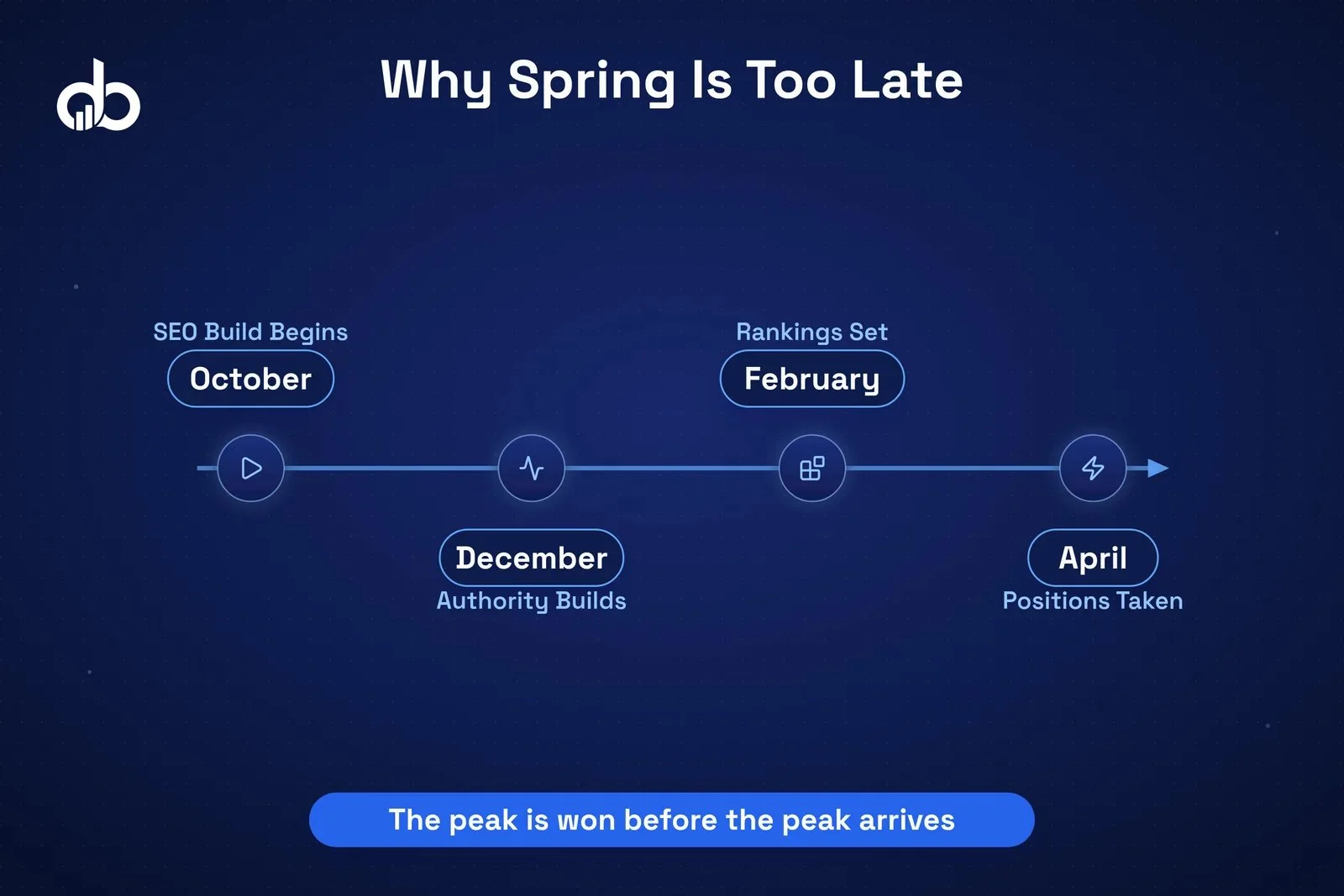
Organic rankings do not switch on when you publish a page. They accumulate.
For competitive local keywords like “landscaper [city]” or “spring cleanup [city]”, Google’s algorithm relies on a set of signals that build over months: crawl frequency, click-through rate, dwell time, citation consistency, review volume and recency, and the authority of pages that link to yours. These signals do not resolve in days or weeks. The 3-to-6-month timeline documented by seasonal SEO practitioners in competitive local verticals is not a rough estimate. It is what the signal accumulation actually takes for a new or underdeveloped page to register meaningful ranking movement.
This creates a structural problem for landscaping businesses that approach SEO as a seasonal tactic. A spring cleanup service page published in March is competing against a page that a competitor published last October. That competitor’s page has been indexed and crawled through winter. It has accumulated seven months of Google signals. The algorithm treats click history as a quality indicator. A page that users have clicked on and spent time reading is a page that users find useful. A page published in March has no click history and no authority. It enters a competitive spring SERP as the weakest contestant.
The same applies to Google Business Profile authority. A profile that has been consistently updated, actively reviewed, and receiving regular customer actions (direction requests, calls, website visits) through the winter carries a stronger prominence signal than one that went quiet in November and reappeared in March. Prominence is one of the three factors (alongside relevance and proximity) that determine local Map Pack rankings, per Searchlab’s 2026 Google Business Profile data. It compounds slowly, and it decays if neglected.
Starting seo for landscapers in spring means entering the most competitive window with the weakest signal history. The organic approach only changes the cost structure compared to Google Ads if the rankings are actually there when demand peaks. And rankings require a lead time that spring marketing budgets cannot manufacture.
What Call Volumes and Ad Costs Reveal About Off-Season SEO Timing
The economic case for seo for landscapers as an off-season investment rests on two data points that most landscaping business owners have never seen side by side.
First, the concentration of spring demand. The 10-week window from April through May accounts for 60-70% of annual new maintenance client acquisitions for landscaping businesses. When spring arrives, call volumes increase by 200-300% virtually overnight. This is not a gradual uptick. It is a demand spike that catches businesses with thin digital visibility at the worst possible moment, when competition for every available customer is at its peak.
Second, the cost divergence at that peak. The average Google Ads cost per lead for landscapers runs $90.92 during that high-demand window. After six months of active landscaping seo investment, organic cost per lead drops to the $10-30 range. Those figures are not measuring two different types of customers. They are measuring the same homeowner, searching for the same service, in the same spring window. One landscaping business pays $90 per lead. The other pays nothing per click because their organic ranking earned visibility before the auction started.
Local search behavior amplifies this. 78% of local mobile searches result in an offline purchase within 24 hours. When a homeowner searches for a landscaper in April, they are typically booking, not researching. The conversion from search to customer is fast. Businesses that rank organically for those searches capture that intent without a per-click cost during the exact window when click costs are highest.
The businesses paying $90 per lead in April are not just paying more. They are subsidizing the competitive position of the landscapers who invested in SEO in November and now convert the same searches for near-zero marginal cost.
The Off-Season Authority Window: A 3-Phase Landscaping SEO System
The timing argument only has value if it translates to a specific system. Here is how seo for landscaping businesses is structured when it is built to win spring demand, not respond to it.
Phase 1 (September to November): Foundation Building
This phase builds the assets that Google needs to assess before ranking anything. Start with the Google Business Profile. Set the primary category correctly: Landscaping Service or Lawn Care Service, not the generic Landscaping option that some directories default to. Add all service areas and fill every section: services list with individual offerings, a business description that incorporates the target keywords, and a complete photo set including recent job photos, before-and-after images, and equipment photos.
On the website, audit every core service offering. Each major service (spring cleanup, lawn maintenance, hardscaping, fall leaf cleanup, irrigation) should have a dedicated page optimized for local search. Not a single catch-all services page. Separate pages, each targeting specific keyword intent, each with a service area reference in the page title and first paragraph. This is the foundation that landscaping SEO is built on, and it is far easier to build in fall when the season has just ended and the team has capacity.
Run a citation audit. Your NAP (name, address, phone number) should be identical across every directory where your business appears. That includes Google Business Profile, Apple Maps, Yelp, Bing Places, Angi, and HomeAdvisor, plus the 40-50 industry-specific and local directories that reference local service businesses. Inconsistent NAP data undermines the prominence signals that local rankings depend on.
Phase 2 (December to January): Authority Building
This phase builds the social proof and backlink signals that tell Google your business is legitimate and trusted. The most direct lever is reviews.
December and January are the best months to request reviews from customers who completed projects in the fall. Those customers are not yet thinking about spring. They are evaluating their landscaping relationship while the fall work is fresh in their minds. A systematic review request process (text message or email within 48 hours of job completion, with a direct link to your Google review page) run consistently through Q4 can add 15-30 reviews before spring, exactly when review volume becomes a visible trust signal to searchers comparing Map Pack listings.
In parallel, add 5-10 targeted local citations in directories you are not yet listed in. Chamber of commerce websites, local business association directories, and neighborhood-specific platforms like Nextdoor all carry citation value. This is also the phase to publish 1-2 seasonal content pieces targeting the long-tail seasonal terms that homeowners search in late winter, such as “Spring Lawn Care in [City]: What to Do Before April” or “How to Prep Your Lawn Before the First Mow.”
Phase 3 (February to March): Signal Reinforcement
By February, the foundation and authority work from Phases 1 and 2 should be generating indexing signals. This phase keeps those signals fresh as spring search volume begins to ramp.
Update existing service pages with new content: current-year seasonal references, recent project photos, and any pricing or service area updates. Google treats content freshness as a quality signal, and a page updated in February reads as more current than one untouched since October. Continue the review request process from Phase 2. Check Google Search Console in February for any keyword positions ranking between positions 4 and 10. These are pages one targeted push away from page 1 visibility and can be prioritized for quick wins.
Run a technical SEO check: load speed on mobile (landscaping customers book from their phones), mobile rendering, and LocalBusiness structured data markup. These technical signals do not win rankings alone, but they remove barriers that prevent good content from ranking. For landscaper seo, a February technical pass is the last preparation step before the peak season window opens.
The biggest mistake landscaping businesses make is treating February as preparation time. In organic search terms, February is already spring. The window for meaningful ranking movement before the April demand peak is nearly closed. Real preparation runs September through January.
What This Means for Your Landscaping Business Right Now
The timing of this article in your calendar determines what the actionable takeaway looks like.
If you are reading this in spring or early summer (March through June): the current season is largely set. The positions ranking for spring cleanup and lawn maintenance in your market were earned before April. The practical response is to start the Phase 1 foundation audit now, even though spring has passed. Every week of work completed before September compounds the head start you carry into the next off-season window. Landscaper seo is not a “set it and forget it” system: the businesses ranking consistently through multiple spring seasons are the ones maintaining their signals year-round, not running campaigns only when demand peaks.
If you are reading this in summer (July or August): the off-season window opens in September. Use this period to audit your current Google Business Profile setup, inventory your service pages, and check your citation profile. A local SEO foundation review completed now means walking into September knowing exactly what to build, rather than spending the first month of the off-season on assessment.
If you are reading this in fall or winter (September through February): this is the window. The businesses that will dominate next spring’s search results are building authority right now. For seo for landscaping to change your business trajectory by next April, the work needs to start this week, not next month.
In all cases, the core insight is the same: off-season is not a quiet period in landscaping SEO. It is the only period when meaningful ranking advantage can be built.
The landscapers who win spring demand are not the ones who turn on marketing when calls start arriving. They are the ones who understood, months earlier, that the season was going to belong to whoever showed up first in organic search. SEO for landscapers does not generate demand. It positions a business to capture demand that was always going to be there. The only question is who captures it, and that answer is decided before the season opens.
Most landscaping businesses start thinking about SEO when the phones slow down. By then, the window to influence spring rankings has already closed. A Digiblazon SEO audit shows exactly where your organic visibility stands and what needs to happen before peak season opens. Get Free Marketing Audit
- Landscaping businesses that dominate spring search traffic start building SEO in fall — rankings for April–May demand must be earned months before the season opens.
- Google Ads cost per lead for landscapers averages $90.92 at peak season; organic SEO cost per lead drops to the $10–30 range after six months of consistent investment.
- A three-phase off-season system — Foundation (Sep–Nov), Authority Building (Dec–Jan), Signal Reinforcement (Feb–Mar) — is the framework that converts off-season effort into spring rankings.
- Google Business Profile completeness, citation consistency, and a steady review flow are the three signals that most directly determine local Map Pack visibility.
- 78% of local mobile searches result in a purchase within 24 hours, so organic spring rankings convert at near-zero cost during the window when paid search CPCs are highest.
Frequently Asked Questions
How long does SEO take to work for a landscaping business?
For competitive local keywords, most landscaping businesses that invest in seo for landscapers see meaningful ranking movement within 3-6 months of consistent activity. For brand-new domains, the timeline can stretch to 6-12 months. This is why the off-season is the correct window to start: a landscaping business that begins SEO in October is positioned to see results by the following spring. Starting in March means you are unlikely to see meaningful organic traffic before the spring season has already peaked.
Is SEO worth it for landscapers compared to Google Ads?
For landscaping businesses with a 2-3 year planning horizon, SEO consistently outperforms Google Ads on cost per lead. Average CPL on landscaping Google Ads runs around $90.92. After 6 months of active SEO investment, organic cost per lead drops to the $10-30 range. The bigger advantage is timing: organic rankings compound while Google Ads CPCs inflate precisely when demand peaks in spring. The two channels are not mutually exclusive, but businesses that treat SEO as the foundation and paid ads as a supplement typically achieve lower blended CPL than businesses running paid ads exclusively.
How do I get my landscaping business to show up on Google?
Start with your Google Business Profile. Complete it fully: set the primary category to Landscaping Service or Lawn Care Service, define your service area accurately, add photos of recent jobs, and list every service you offer. Then build a consistent flow of genuine customer reviews requested within 48 hours of job completion. On your website, create separate pages for each major service with local keyword targeting. These three systems work together to determine where your business appears in local search results. Google Business Profile and reviews carry more weight in local rankings than most business owners realize.
What keywords should a landscaping business target for SEO?
Target high-intent local keywords: "landscaper near me," "landscaping company [city]," "lawn care [city]," and service-specific terms like "spring cleanup [city]" or "lawn maintenance [city]." Long-tail seasonal terms like "spring lawn care," "fall cleanup," and "landscaping services near me" have lower competition and clearer purchase intent. Build dedicated service pages for each main keyword cluster rather than trying to rank a single page for all services. During the off-season, publish content targeting seasonal terms that homeowners search in late winter and early spring. Those pages build authority during the months when no one else is publishing seasonal landscaping content.