
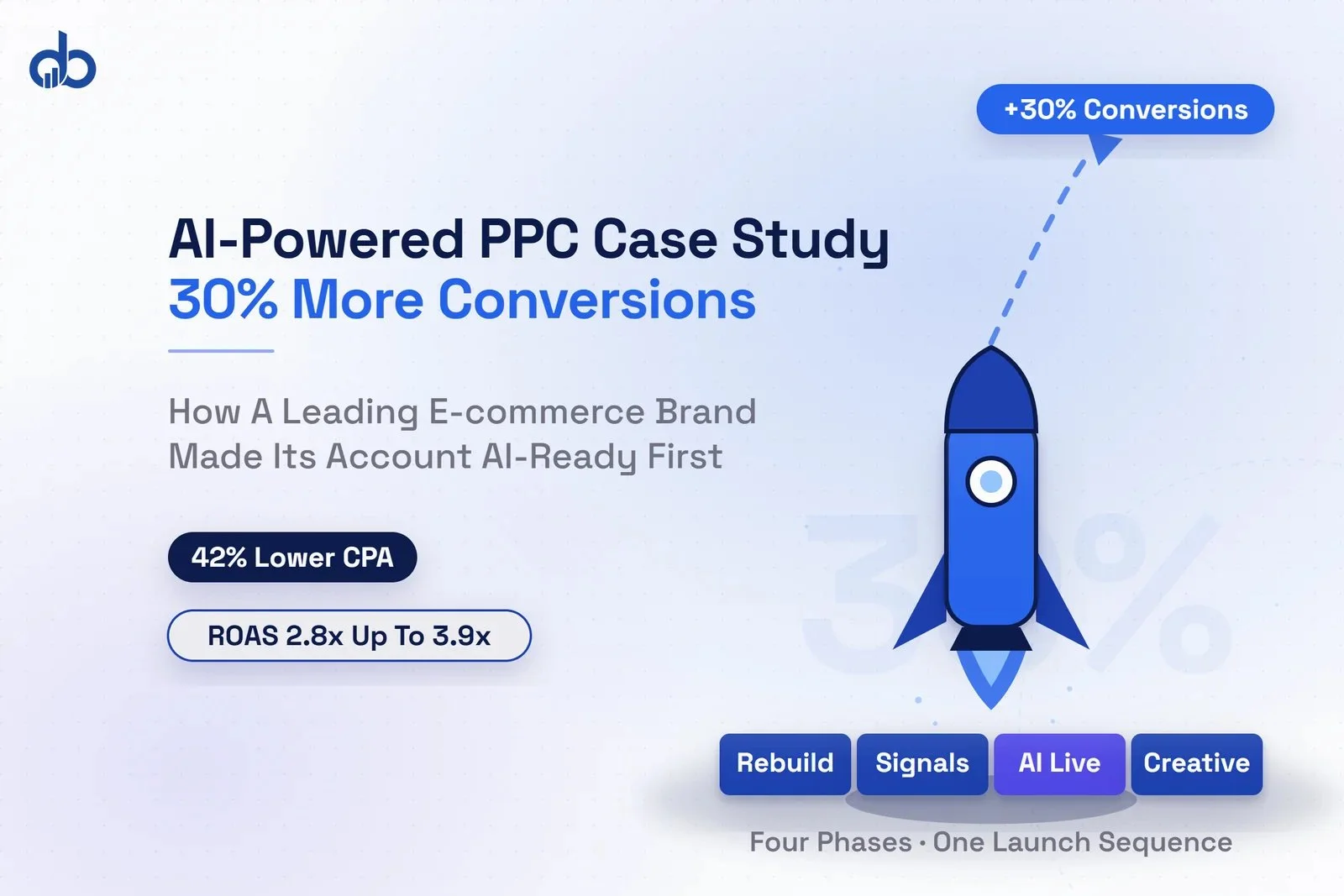
When a mid-size e-commerce brand came to Digiblazon with flat PPC performance, the initial plan was to switch to AI-powered PPC optimization and let the platform handle the rest. Static conversion rates, a rising CPA, and three years of manual account management had created a ceiling the team couldn’t break through. Research shows that e-commerce brands using AI bidding tools achieve an average 75% more conversions after 90 days{rel=“nofollow”}. The technology works. What most case studies skip is what happens before you turn it on.
This brand had activated Smart Bidding once before on their own. Results were modest for six weeks and then flatlined. They added Performance Max to their account. Performance improved briefly and then reverted. The pattern is familiar. And the cause is always the same: AI-powered optimization learns from the signals the account feeds it. A structurally broken account feeds the wrong signals. The AI optimizes confidently in the wrong direction.
The brand in this e-commerce case study achieved a 30% increase in PPC conversions and a 42% reduction in cost per acquisition within 90 days. The path required four structured phases, and the first two had nothing to do with AI bidding.
The Starting Point: Three Years of Manual PPC Management
The client ran an online retail brand with a mid-six-figure annual Google Ads budget. Their team had managed campaigns in-house with support from a generalist marketing team. The account had grown organically. Campaigns were added as products launched, keywords accumulated over time, and bidding strategies were never formally reviewed.
When Digiblazon’s Performance Marketing team audited the account, three problems appeared immediately.
Tracking fragmentation. The account ran two separate conversion tracking setups: Google Ads native conversion tags and a legacy Google Analytics goal import. Both fired on the same conversions. Reported conversion volume was approximately 40% higher than actual revenue-generating events. The AI bidding signals previously activated had been learning from inflated data. Every optimization decision was built on numbers that didn’t reflect what was actually happening.
Campaign structure mismatch. Thirty-four active campaigns overlapped on keyword targets. Products from the same category appeared in four different campaigns with different match types, different bidding strategies, and different daily budgets. No cohesive architecture existed.
Audience signal gaps. Customer match lists hadn’t been updated in 14 months. Remarketing lists excluded mobile traffic due to an old tag configuration. The first-party data in the account was effectively invisible to Smart Bidding’s optimization layer.
These three problems aren’t unusual. They’re the standard condition of a manually managed Google Ads account that has grown faster than the team behind it. The unusual part is what happens when AI-powered PPC optimization runs on top of this setup: the system learns from noise and optimizes toward it.
Why Manual PPC Management Creates a Performance Ceiling
Manual PPC management has a specific ceiling. A skilled operator adjusts bids by time of day, excludes underperforming placements, and tests ad copy variants. But no human operator can simultaneously process 400 signals per auction across hundreds of thousands of daily impressions. That’s what Google’s bidding AI does.
The ceiling shows up predictably. Conversion rates plateau despite increasing spend. CPA trends upward as keyword competition intensifies. The account runs well enough, but it never moves past a certain performance threshold.
For this brand, the ceiling had been in place for approximately 18 months. Monthly spend increased. PPC conversions held flat. The team attributed the plateau to market saturation and keyword competition. That was partially accurate. The deeper problem was structural: the account wasn’t giving AI bidding the signal quality it required.
AI-powered optimization works through signal density. The more conversion events the system references, the more accurately it learns which auction contexts produce revenue. Thin signals, broken signals, or duplicate signals teach the AI the wrong patterns. That’s what was happening here, and it’s what happens in most AI PPC campaigns that underperform relative to expectations.
Phase 1: Rebuilding the Campaign Architecture Before Touching Bidding
Phase 1 lasted four weeks and didn’t touch bidding strategies at all. The focus was campaign architecture.
The 34 active campaigns consolidated into 11. Product categories moved into individual campaigns with clearly defined budget allocation. Shopping campaigns split into separate structures for high-margin and low-margin product lines. This let budget flow toward the product groups with the highest revenue impact.
The conversion tracking cleanup was the most critical action in this phase. Both conversion tracking setups received a full audit. The legacy Analytics goal import was removed. A single Google Ads conversion tag replaced it, with enhanced conversions enabled. This added first-party signal matching to improve attribution accuracy.
After the cleanup, reported conversion volume dropped 38%. That wasn’t a performance decline. It was an accurate picture of actual revenue-generating events for the first time in years. (The account had been optimizing toward inflated conversions all along. Worth pausing on that.)
Before activating Smart Bidding or Performance Max on any account, run a conversion tracking audit first. Open Google Ads Tag Diagnostics and check for duplicate conversion actions. If any conversion fires on the same event from two sources, remove one source entirely. Clean data is the prerequisite for effective AI-powered PPC optimization. Everything downstream depends on it.
The structure rebuild and tracking cleanup took four weeks. No significant performance gains appeared during this phase. That’s expected. Phase 1 work doesn’t produce results directly. It builds the foundation that Phase 2 requires.
Phase 2 Signal Enrichment: Why Most AI PPC Campaigns Stall Here
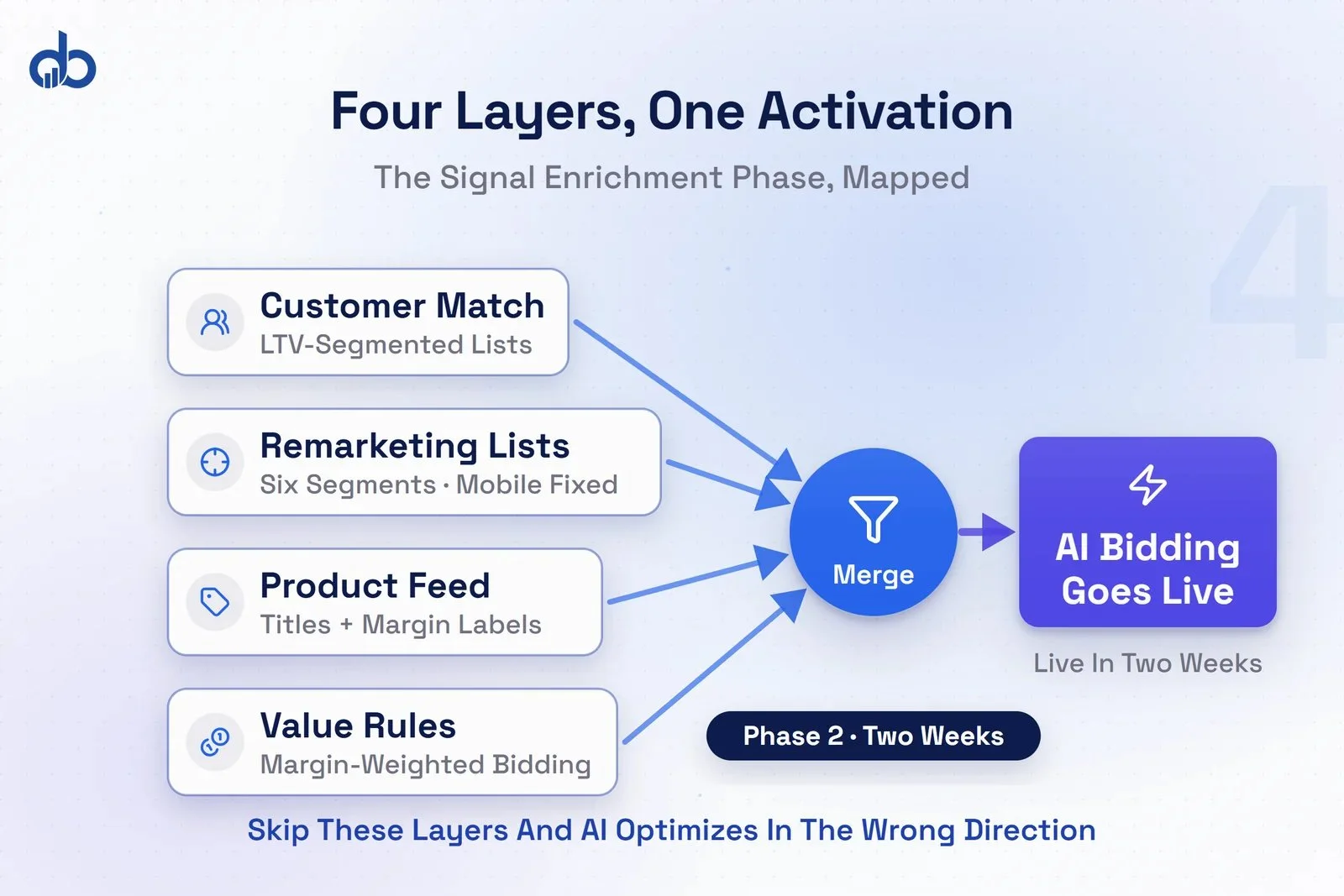
Signal enrichment is the phase where most AI PPC campaigns fail before they start. AI bidding systems learn from conversion signals. If those signals are thin, inconsistent, or misconfigured, the AI learns the wrong patterns and optimizes confidently toward them. The platform reporting will look encouraging. The actual revenue impact won’t be.
After tracking cleanup, Phase 2 added four signal layers to the account.
Layer 1: Customer match rebuild. The existing customer match lists were exported, cleaned, and re-uploaded with current customer data. First-purchase customers were segmented from repeat purchasers. High-LTV customer segments went into separate lists to give Smart Bidding purchase history as a direct signal.
Layer 2: Remarketing list expansion. The team corrected the mobile exclusion in the remarketing tag. Audience lists expanded to cover 30-day, 60-day, and 90-day visitors. Cart abandoners and product page visitors were segmented. This gave the bidding system access to six distinct remarketing segments it had previously ignored.
Layer 3: Product feed optimization. The Google Merchant Center feed hadn’t been updated in eight months. Product titles were missing category and specification data that Shopping algorithms use for query matching. Titles were restructured to front-load key attributes. Custom labels were added to segment products by margin tier and seasonal relevance.
Layer 4: Conversion value rules. After discussion with the client’s finance team, products were tiered by gross margin. Conversion value rules were applied in Google Ads to weight high-margin product conversions above standard conversions. This told Smart Bidding to bid more aggressively for the revenue events that mattered most to profitability.
Phase 2 took two weeks. Two failure points came up during this phase. The customer match rebuild initially contained email format inconsistencies that reduced match rate until the team corrected them. The product feed restructure triggered a Merchant Center review that delayed Shopping ad serving by five days. Both resolved before Phase 3 started.
Phases 1 and 2 together represent the six weeks of groundwork required before AI-powered PPC optimization could function at its intended level. Every result that followed was built on what this phase established.
Not sure whether your account has the signal quality to support AI bidding? Digiblazon's Performance Marketing audit includes a signal readiness check as its first step.
Phase 3: AI-Powered PPC Optimization Goes Live
With clean tracking, enriched audience signals, and a restructured campaign architecture in place, Phase 3 activated AI-powered bidding across the account. This is when results began to move.
Smart Bidding activated on Search campaigns using a Target Return on Ad Spend (ROAS) strategy. The team set the initial target conservatively: 10% above the current blended ROAS. This gave the bidding system time to learn without aggressive constraint. Over four weeks, the target stepped up in increments as the system demonstrated consistent performance above target.
A Performance Max campaign launched alongside the restructured Search campaigns. The PMax campaign received a separate budget initially, covering the brand’s three highest-revenue product categories. Asset groups were built with distinct creative sets for each category, using existing product imagery and tested ad copy variants.
Results in Phase 3 became visible within two weeks. Conversion volume increased 14% in the first two weeks after Smart Bidding activation, which lines up with Google’s benchmark data: Smart Bidding delivers an average 14% higher conversion value{rel=“nofollow”} versus manual CPC bidding.
Performance Max campaigns need a 4-to-6-week learning period before optimization patterns stabilize. Don’t evaluate PMax performance before that window closes. During the first three weeks, review asset-level signals weekly but don’t adjust budgets or asset groups. Changes during the learning period reset the optimization clock and extend the wait. It’s a frustrating constraint, but ignoring it costs more time than respecting it.
Performance Max took longer than Search to stabilize. During the first three weeks, PMax performed well on branded terms but weakly on prospecting. By week five, prospecting performance improved materially as the system refined its audience signals. That’s a predictable pattern, not a failure signal.
Phase 4: Creative Iteration with AI Signals
Smart Bidding optimization addresses when and to whom to show ads. It doesn’t determine what those ads say. Creative performance determines the quality of traffic the AI attracts, and underperforming creative caps the gains that better bidding can produce.
Phase 4 used AI performance signals from Performance Max to run a structured creative testing cycle. Google Ads’ asset group reporting identifies which headline, description, and image combinations drive the highest conversion rates. This data drove the process of removing underperforming creative assets and replacing them with variants built from the patterns of the highest performers.
Three creative iterations ran over 30 days. After each iteration, the team reviewed asset-level performance data, removed the bottom 20% of assets by conversion rate, and added replacement assets. By iteration three, the average asset group conversion rate had improved 22% above the baseline set at Performance Max launch.
The creative iteration cycle is where most brands stop too early. A single round of testing and a new batch of assets isn’t iteration. It’s a refresh. Sustained creative iteration, driven by AI asset signals, compounds over time. The brands that see the largest long-term gains from Performance Max run continuous creative cycles, not one-time setups.
The Results: 30% More E-commerce PPC Conversions, 42% Lower CPA in 90 Days
Ninety days after Phase 1 started, and approximately 60 days after Smart Bidding activated, the account metrics had shifted across every key measure.
PPC conversions increased 30%. Total conversion volume was 30% higher than the 90-day baseline from the prior period, measured against actual revenue-generating events, not the inflated pre-cleanup numbers. This figure accounts for the 38% drop in reported conversions after tracking cleanup. The 30% gain is genuine incremental volume.
Cost per acquisition dropped 42%. CPA declined because the same budget now generated more revenue-qualifying conversions. Smart Bidding routed spend away from low-conversion auction contexts and toward the audience segments, devices, and time patterns that customer match and remarketing data identified as high-value.
Return on ad spend improved from 2.8x to 3.9x. The client’s ROAS target was 3.5x. The account exceeded that target in month two and maintained it in month three.
Wasted spend identified and redirected. The account restructure and audience data improvements identified approximately $8,400 per month in spend previously going to low-converting keyword variants, low-intent mobile placements, and audience segments outside the brand’s actual customer base. That spend was reallocated to the highest-performing campaign and product segments.
Adspert’s 2026 benchmark report found that e-commerce brands using AI bidding achieve an average 75% more conversions after 90 days. The result here was 30% growth in e-commerce PPC conversions, more conservative than that benchmark, because the account had a significant noise problem requiring cleanup before AI could function effectively. But the gains are built on accurate signals. That makes them sustainable.
Want to know your account's current AI readiness level? Get Free Marketing Audit from Digiblazon's Performance Marketing team.
The Decisive Factor: Six Weeks Before AI-Powered PPC Optimization Activated
The single decision that made the most difference in this campaign wasn’t which bidding strategy to use. It was the decision to delay AI activation until the signal foundation was ready.
Most brands activate Smart Bidding or Performance Max immediately. The platform makes this easy. Bidding strategy changes take two clicks. The results from skipping the setup phase are predictable: an initial period of encouraging performance, followed by a plateau or regression as the AI overfits to noisy signals. The brands that report disappointing AI PPC results have almost always skipped signal cleanup and jumped straight to bidding strategy changes. That shortcut costs more than the time it saves.
Digiblazon’s Performance Marketing team recommended six weeks of auditing, consolidation, and signal enrichment before activating any AI bidding. That wasn’t the expected starting point. But the audit data made the rationale clear: the account wasn’t AI-ready. Running AI-powered PPC optimization on a structurally broken account wouldn’t produce better results. It would entrench existing problems faster.
The delay paid off. E-commerce PPC conversions improved within two weeks of AI activation because the system learned from accurate, enriched signals from day one.
What E-commerce Brands Can Take From This
The 30% increase in PPC conversions in this e-commerce case study didn’t come from switching to AI. It came from making the account AI-ready first, then letting the bidding system do what it’s designed to do.
That distinction matters because most e-commerce brands approach AI-powered PPC optimization as a product decision: which tool to activate, which bidding strategy to select, which campaign type to use. Those are Phase 3 decisions. Phases 1 and 2, signal integrity and architecture, determine whether the AI has anything useful to learn from.
The four conditions required before AI bidding produces reliable e-commerce PPC conversions:
- Conversion tracking is clean: one source of truth, no duplicate firing, enhanced conversions enabled
- Customer match lists are current (updated within 60 days) and segmented by LTV tier
- Campaign structure matches product economics: high-margin and low-margin products in separate campaigns
- Sufficient conversion volume: at least 30 revenue-qualifying conversions per month per bidding strategy
If any of these conditions aren’t in place, AI bidding will optimize confidently toward the wrong outcome. The platform reporting will look promising. The actual revenue impact will be muted.
The brand in this case study had a budget and a product line strong enough to compete in their market. What they needed was an account structure that let the AI see what was actually working. That’s what the four-phase process delivered.
AI-Powered PPC Optimization Works When the Signal Foundation Is Ready
You now have a clear picture of the specific conditions that allow AI-powered PPC optimization to produce material conversion gains. The technology is effective. The process isn’t automatic.
The gap between reading this and executing it is usually in the audit: identifying exactly where your own account’s signal problems are, how severe they are, and what sequence of fixes will have the most impact before AI bidding activates.
Digiblazon's Performance Marketing service runs that audit as the first step of every engagement. If you want to know whether your Google Ads account is AI-ready and what it would take to get there, Get Free Marketing Audit to see where your account stands.
- AI-powered PPC optimization delivered 30% more conversions and 42% lower CPA — but only after a complete account signal audit and restructure.
- Manual PPC management creates a performance ceiling that AI bidding cannot break through until tracking errors, campaign sprawl, and audience gaps are resolved.
- The four-phase process — campaign architecture rebuild, signal enrichment, AI bidding activation, and creative iteration — must run in sequence; skipping phases 1–2 causes AI campaigns to plateau.
- Smart Bidding requires at least 30 revenue-qualifying conversions per month per bidding strategy; below that threshold, manual bidding outperforms full AI automation.
- Signal enrichment — enhanced conversions, Customer Match updates, product feed optimization, and conversion value rules — is the most commonly skipped step and the most common reason AI PPC campaigns underdeliver.
Frequently Asked Questions
How long does it take to see results from AI-powered PPC optimization?
Most brands see meaningful results within 60 to 90 days, but the timeline depends on how much groundwork is required before AI bidding activates. If your tracking is clean and your audience data is rich, results can appear in 4 to 6 weeks. If the account needs a full signal enrichment phase first, expect 10 to 12 weeks before AI bidding makes consistent gains. The Smart Bidding and Performance Max learning period alone requires 4 to 6 weeks of data accumulation.
Does AI-powered PPC optimization work for small e-commerce budgets?
Smart Bidding requires a minimum of 30 conversions per month to function effectively. This typically corresponds to a monthly Google Ads budget of $1,000 to $3,000 depending on your industry CPA. Below that threshold, AI bidding systems don't have enough signal to make reliable optimization decisions. For smaller budgets, a hybrid approach combining manual bidding with AI-assisted audience targeting often outperforms full AI automation.
What is the difference between Performance Max and Smart Bidding?
Smart Bidding is a bidding strategy that uses machine learning to set bids on individual auctions. Target CPA, Target ROAS, and Maximize Conversions are all Smart Bidding strategies. Performance Max is a campaign type that runs across all Google inventory, including Search, Display, YouTube, Gmail, and Maps, and uses Smart Bidding as its default bidding method. Smart Bidding applies to standard campaign types. Performance Max is the campaign format Google now recommends as the default for e-commerce.
Can AI optimization reduce wasted PPC spend?
Yes, and this is often the fastest visible gain from AI-powered optimization. AI bidding systems reduce wasted spend by adjusting bids down on low-conversion auction contexts in real time. In the case study above, CPA dropped 42% within 90 days. That came directly from a reduction in wasted spend on non-converting traffic segments that manual bid management had been overpaying for.